Fuckass Bio.
 Call Kai
 Learn
Learn Practice Test
 Spaced Repetition
 Match
Match Flashcards
 Knowt Play
1/41

Earn XP
Description and Tags
Vocabulary flashcards covering the key terms, building blocks, linkage types, structural levels, and functional concepts associated with biological macromolecules (carbohydrates, lipids, proteins, and nucleic acids).
Name | Mastery | Learn | Test | Matching | Spaced | Call with Kai | Chat |
|---|
No analytics yet
Send a link to your students to track their progress
42 Terms
Macromolecules
Large molecules composed of thousands of covalently connected atoms.
Polymer
A long molecule consisting of many similar building blocks called monomers.
Monomers
Smaller building-block molecules that covalently bond together to form polymers.
Dehydration reaction
A condensation reaction in which two monomers covalently bond to each other through the loss of a water molecule.
Hydrolysis
A chemical reaction that disassembles polymers into monomers by the addition of water, functioning as the reverse of a dehydration reaction.
Monosaccharides
The simplest carbohydrates or single sugars, having molecular formulas that are usually multiples of CH2O.
Disaccharide
A double sugar formed when a dehydration reaction joins two monosaccharides together.
Glycosidic linkage
A covalent bond formed between two monosaccharides by a dehydration reaction.
Polysaccharides
Polymers composed of many sugar building blocks linked by glycosidic bonds, serving storage and structural roles.
Starch
A storage polysaccharide in plants consisting entirely of glucose monomers joined by alpha glycosidic linkages.
Glycogen
An extensively branched storage polysaccharide found in animals, stored mainly in liver and muscle cells.
Cellulose
An unbranched structural polysaccharide composed of glucose monomers with beta glycosidic linkages that forms the tough walls of plant cells.
Chitin
A structural polysaccharide found in the exoskeleton of arthropods and in the cell walls of many fungi.
Lipids
A diverse class of hydrophobic biological molecules consisting mostly of hydrocarbon regions that do not form polymers.
Fat (Triacylglycerol)
A lipid constructed from one glycerol molecule joined to three fatty acids by ester linkages; also known as a triglyceride.
Glycerol
A three-carbon alcohol with a hydroxyl group attached to each carbon.
Fatty acid
A molecule consisting of a carboxyl group attached to a long carbon skeleton.
Saturated fatty acid
A fatty acid in which all carbons in the hydrocarbon tail are connected by single bonds, maximizing the number of hydrogen atoms attached.
Unsaturated fatty acid
A fatty acid that possesses one or more double bonds between carbons in the hydrocarbon tail.
Phospholipid
A lipid made up of glycerol joined to two fatty acids and a phosphate group, forming a molecule with hydrophobic tails and a hydrophilic head.
Steroids
Lipids characterized by a carbon skeleton consisting of four fused rings.
Cholesterol
An essential steroid component of animal cell membranes that can also contribute to cardiovascular disease at high blood levels.
Enzymes
Proteins that act as biological catalysts, speeding up chemical reactions repeatedly without being consumed.
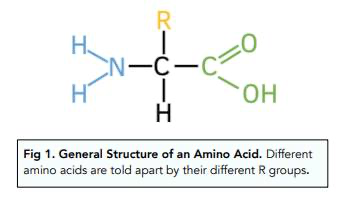
Amino acids
Organic molecules possessing both carboxyl and amino groups that serve as the monomer building blocks of polypeptides.
Basic Anino acid structure
picture
Peptide bond
The covalent bond formed between the carboxyl group of one amino acid and the amino group of another via a dehydration reaction.
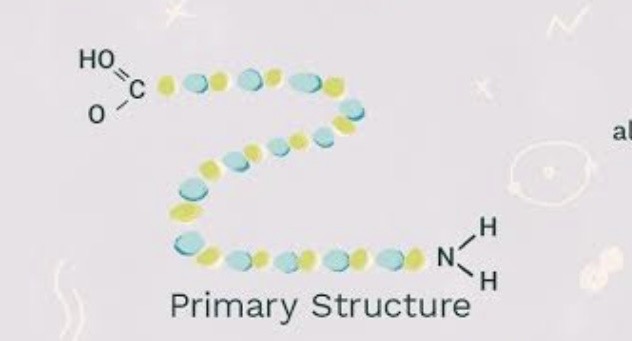
Primary structure
The unique, linear sequence of amino acids in a protein, determined by inherited genetic information.
Secondary structure
The localized coils and folds in a polypeptide chain (such as alpha helices and beta pleated sheets) resulting from hydrogen bonds between repeating backbone constituents.

Tertiary structure
The overall three-dimensional shape of a polypeptide, determined by interactions among various side chains (R groups).

Quaternary structure
The overall protein structure that results when two or more polypeptide chains aggregate to form one functional macromolecule.

Disulfide bridges
Strong covalent bonds between the sulfur-containing side chains of cysteine amino acids that reinforce a protein's tertiary conformation.
Sickle cell disease
disease with a change in primary structure of protein, affects conformation and ability to function, inherited, causes single amino acid substitution in the protein hemoglobin
Denaturation
A process in which a protein loses its native shape and becomes biologically inactive due to environmental disruptions such as alterations in pH, salt concentration, or temperature.
Chaperonins
Protein complexes that assist in the proper folding of other protein molecules.
Gene
A discrete unit of inheritance composed of DNA that programs the amino acid sequence of a polypeptide.
Nucleic acids
Biological macromolecules (DNA and RNA) made of nucleotide polymers that store, transmit, and express hereditary information.
Nucleotide
The monomer building block of a nucleic acid, consisting of a pentose sugar, a nitrogenous base, and a phosphate group.
Nucleoside
The portion of a nucleotide that consists only of a nitrogenous base bound to a pentose sugar, lacking a phosphate group.
Pyrimidines
A family of nitrogenous bases characterized by a single six-membered ring structure.
Purines
A family of nitrogenous bases characterized by a six-membered ring fused to a five-membered ring.
Phosphodiester bond
A covalent linkage formed between the hydroxyl group on the 3' carbon of one nucleotide and the phosphate group on the 5' carbon of the adjacent nucleotide.
Antiparallel
Refers to the arrangement of the sugar-phosphate backbones in a DNA double helix, which run in opposite 5' to 3' directions relative to one another.