Thermodynamics Test 2
 Call Kai
 Learn
Learn Practice Test
 Spaced Repetition
 Match
Match Flashcards
 Knowt Play
1/151

Earn XP
Description and Tags
Chapter 2 and 4
Name | Mastery | Learn | Test | Matching | Spaced | Call with Kai |
|---|
No analytics yet
Send a link to your students to track their progress
152 Terms
What is the total energy of a system?
The sum of all energy forms in the system:
E=U+KE+PE
What is the difference between macroscopic and microscopic energy?
Macroscopic energy depends on motion and position (KE, PE). Microscopic energy is internal energy (U).
What is internal energy (U)?
The sum of all microscopic forms of energy stored within a substance.
For most stationary closed systems, what energy change is usually considered?
Only internal energy:
ΔE=ΔU
What is mechanical energy?
Energy that can be completely converted into mechanical work.
Why is pressure associated with mechanical energy?
Because pressure forces can perform work on a flowing fluid.
What are the two ways energy can cross a system boundary?
Heat and work.
What causes heat transfer?
A temperature difference.
Does a system contain heat?
No. Heat only exists while crossing a system boundary.
What is an adiabatic process?
A process with no heat transfer: Q=0
What is work?
Energy transfer associated with a force acting through a distance.
What two conditions are required for mechanical work?
Force and boundary movement.
If a force exists but nothing moves, is work done?
No.
What is power?
The rate of doing work or transferring energy.
What is the difference between a property and a path function?
Properties depend only on state; path functions depend on the process path.
Are heat and work state properties?
No. They are path functions.
Why are heat and work called boundary phenomena?
They are only recognized as they cross the system boundary.
In a well-insulated room with a burning candle, what is the heat transfer?
Q=0
In the candle example, why is ΔU=0?
Chemical energy converts into sensible energy, but total internal energy remains constant.
Kinetic Energy (KE)
Energy due to motion.
Potential Energy (PE)
Energy due to elevation in a gravitational field.
Internal Energy (U)
Microscopic energy stored within a system.
Mass Flow Rate (ṁ)
Mass passing through a cross-section per unit time.
Volume Flow Rate (V̇)
Volume passing through a cross-section per unit time.
Flow Work
Work required to push fluid into or out of a control volume.
Flow Energy
Energy associated with pressure forces in flowing fluids.
Heat Transfer Rate (Q̇)
Heat transferred per unit time.
Work Rate (Ẇ)
Work done per unit time (power).
Shaft Work
Work transferred by a rotating shaft.
Torque (T)
Twisting force causing rotation.
Spring Constant (k)
Measure of spring stiffness.
Surface Tension (σs)
Force per unit length acting on a liquid surface.
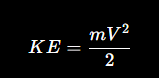
Kinetic Energy formula
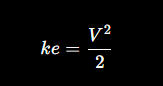
Kinetic Energy per unit mass
Potential Energy formula

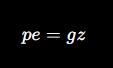
Potential Energy per unit mass
Total Energy of a system
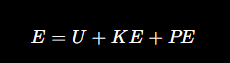
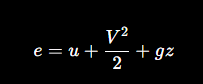
Total Energy per unit mass
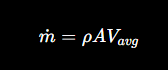
Mass Flow Rate
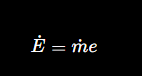
Energy Flow Rate
Mechanical Energy per unit mass
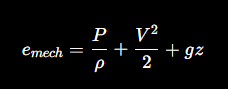
Mechanical Energy Change

Heat transfer per unit mass
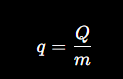
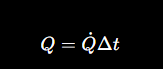
Heat transfer (constant rate)
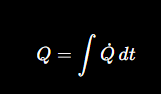
Heat transfer (variable rate)
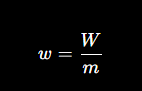
Work per unit mass
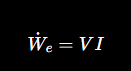
Electrical Power
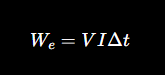
Electrical Work (constant V and I)
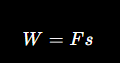
Mechanical Work (constant force)
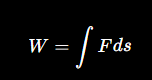
Mechanical Work (variable force)
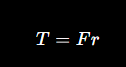
Torque equation
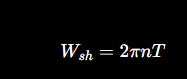
Shaft Work
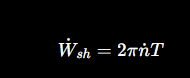
Shaft Power
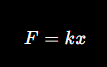
Hooke's Law
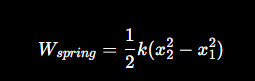
Spring Work
What is the First Law of Thermodynamics?
Energy cannot be created or destroyed; it can only change forms.
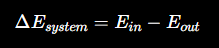
What is the most important energy balance equation?
Energy In − Energy Out = Change in System Energy.
What does the First Law represent physically?
Conservation of energy.
What are the three ways energy can cross a system boundary?
Heat transfer, work transfer, and mass flow.
What two energy interactions exist in a closed system?
Heat and work.
What is the total energy change of a system composed of?
Internal, kinetic, and potential energy changes.

For most thermodynamics problems, why is ΔE often equal to ΔU?
Because ΔKE and ΔPE are negligible.
What is an adiabatic process?
A process with no heat transfer Q=0
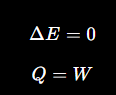
What happens during a thermodynamic cycle?
The system returns to its initial state ΔE=0
For a complete cycle, what relationship exists between heat and work?
Q = W
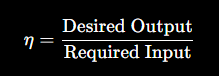
What is efficiency?
How effectively energy is converted into a desired form.
Why is efficiency always less than 100%?
Some energy is always lost or wasted.
What does a pump do?
Adds mechanical energy to a fluid.
What does a turbine do?
Extracts mechanical energy from a fluid.
What does a motor do?
Converts electrical energy into mechanical energy.
What does a generator do?
Converts mechanical energy into electrical energy.
What is the difference between HHV and LHV?
HHV includes recovered vaporization energy; LHV does not.
First Law of Thermodynamics
Conservation of energy.
Energy Balance
Accounting of all energy entering and leaving a system.
Internal Energy (U)
Microscopic energy stored in a substance.
Adiabatic Process
Process with no heat transfer.
Cycle
Process that returns a system to its original state.
Heating Value (HV)
Heat released by complete combustion of a fuel.
Lower Heating Value (LHV)
Heating value when water leaves as vapor.
Higher Heating Value (HHV)
Heating value when water is condensed and latent heat is recovered.
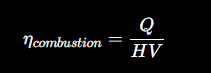
Combustion Efficiency
Measure of how effectively fuel energy becomes useful heat.
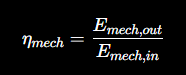
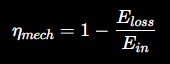
Mechanical Efficiency
Ratio of useful mechanical output to mechanical input.
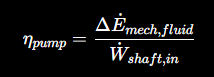
Pump Efficiency
Effectiveness of converting shaft work into fluid mechanical energy.
Turbine Efficiency
Effectiveness of converting fluid mechanical energy into shaft work.
Motor Efficiency
Effectiveness of converting electrical power into shaft power.
Generator Efficiency
Effectiveness of converting shaft power into electrical power.
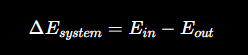
General Energy Balance
Total Energy Change

Internal Energy Change
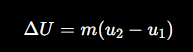
Kinetic Energy Change
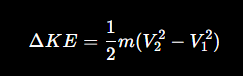
Potential Energy Change
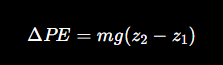
Heat Transfer at Constant Rate
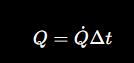
Work Transfer at Constant Rate
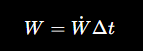
Cycle Relationship
General Efficiency Formula
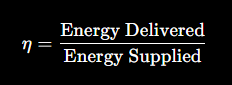
Water Heater Efficiency
Combustion Efficiency
Mechanical Efficiency
Alternate Mechanical Efficiency Formula
Pump Efficiency