Block 3 master set
 Studied by 0 people
 Call Kai
 Learn
Learn Practice Test
 Spaced Repetition
 Match
Match Flashcards
 Knowt Play
1/256

There's no tags or description
Looks like no tags are added yet.
Name | Mastery | Learn | Test | Matching | Spaced |
|---|
No study sessions yet.
257 Terms
What is a NOTAM?
A notice distributed by telecommunication containing information on the establishment, condition, or change in any aeronautical facility, service, procedure, or hazard, essential for flight operations personnel.
What does the 'Aeronautical facility' category in a NOTAM refer to?
Navigational aids, communication systems, aerodrome facilities, and aerodrome lighting.
What types of hazards can be subjects of a NOTAM?
Airshows, balloon launches, volcanic eruptions, unlighted towers, debris, cable crossings, bird migrations, or restricted areas.
How many NOTAMs can be in effect for a single facility at one time?
Only one NOTAM can be in effect for a single facility.
Under what circumstances is a NOTAM originated and issued promptly?
When the information is of a temporary nature and short duration, or for operationally-significant permanent changes made at short notice.
What is the recommended maximum lead time (how much time in advance) for routine NOTAMs to reduce pre-flight review burden?
The lead time should not exceed 48 hours.
For planned events or outages, what is the minimum lead time for a NOTAM?
No less than 6 hours lead time must be provided.
What is the minimum advance notice required for the activation of established danger, restricted, or prohibited areas?
At least seven days' advance notice shall be given.
What is the maximum advance notice that can be given by a NOTAM without contacting the NOF Manager?
The maximum advance notice is set at 14 days.
What organization is responsible for analyzing, disseminating, and storing Canadian NOTAMs in a timely manner?
The International NOTAM Office (NOF).
For how long are NOTAMs retained in the unit operational records at FSS sites?
NOTAMs are retained for a thirty-day period.
The NOTAM office retains electronic records of NOTAMs for how many years?
For seven years.
What are the two primary methods of distributing NOTAM information?
By Aeronautical Fixed Telecommunication Network (AFTN) and by Voice.
Which type of NOTAMs are handled by the FSS site, as opposed to the FIC?
Voice NOTAMs.
What does the acronym AFTN stand for?
Aeronautical Fixed Telecommunication Network.
Voice NOTAMs are used to notify of unplanned situations that are dynamic, of short duration, and confined to a _ area.
localized
What are the 3 criteria that must be met before a Voice NOTAM can be disseminated?
The duration of the Voice NOTAM is anticipated to be less than one hour.
An extension to the original Voice NOTAM’s duration must not exceed one hour.
The total duration (including any revisions) of the Voice NOTAM must not exceed two hours.
If a situation exceeds the time criteria for a Voice NOTAM, how must the information be disseminated?
It must be disseminated via AFTN using a normal NOTAM.
At the March site, who is responsible for all non-voice NOTAMs?
The Edmonton FIC.
What NAV CANADA center is responsible for originating NOTAMs pertaining to all electronic systems maintained by Technical Service?
The Technology Operations Coordination Centre (TOCC).
Under MATS, NOTAM information may be omitted for domestic traffic if it has been issued and disseminated on AFTN for how long?
12 hours or more.
Under MATS, NOTAM information may be omitted for international traffic if it has been issued and disseminated on AFTN for how long?
24 hours or more.
If a stakeholder calls an FSS with information for a regular NOTAM, what action should the FSS take?
Redirect them to the appropriate FIC.
For a departing IFR aircraft from March, what type of NAVAID NOTAMs must be provided in the advisory?
NOTAMs regarding only March en route NAVAIDs (e.g., YMR VOR/DME or MR NDB).
For an arriving IFR aircraft at March, what NAVAID NOTAMs must be provided?
NOTAMs for all March NAVAIDs used for the approach and potential missed approach procedure.
When should an FSS provide a NAVAID NOTAM to an aircraft operating in the local circuit?
Only if the pilot indicated they wanted to practice IFR approaches or receive DF service.
For a departing VFR aircraft, what NOTAMs (other than NAVAIDs) must be provided?
All NOTAMs impacting the taxi route, intended runway, departure path, and direction of flight while departing the MF.
For an arriving VFR aircraft, what NOTAMs (other than NAVAIDs) must be provided?
All NOTAMs impacting the route entering the MF, the intended runway, and potential taxiways to the intended apron or helipad.
What does NOTAMN signify?
A new NOTAM.
What does NOTAMR signify?
A NOTAM that replaces a previous NOTAM.
What does NOTAMC signify?
A NOTAM that cancels a previous NOTAM.
What is the FSS's four actions after receiving Verbal Cancellation of NOTAMs?
Confirm which NOTAM is being cancelled.
Ensure that the individual cancelling the NOTAM represents the appropriate authority associated with the NOTAM.
Confirm that the cancellation has been reported to the appropriate FIC or IFSS or will be reported in the near future.
Resume operations previously restricted by the cancelled NOTAM.
When relaying a NOTAM for pre-flight information, which line of the operational message is typically omitted?
The top line containing the NOTAM series number and type (e.g., H0241-17 NOTAMN).
When relaying a NOTAM in an advisory, which part of the NOTAM text is typically the only part that needs to be read?
Line E), which contains the condition text. (i.e. NOTAM MARCH N-D-B FREQUENCY THREE-FIVE-SIX KILOHERTZ UNSERVICEABLE)
What does the abbreviation 'EST' signify when it follows the date-time group in Item C) of a NOTAM?
The end time is an estimate, and the NOTAM is not self-cancelling.
What is the responsibility of the NOTAM originator for a NOTAM with an 'EST' end time?
To replace or cancel it before the estimated expiration time is reached.
What is the difference between a facility being 'unserviceable' versus 'unmonitored'?
Unserviceable means it is not working; unmonitored means its operational status is unknown because it is not being watched.
What is the definition of Atmospheric Pressure?
The force per unit area exerted by the atmosphere due to the weight of the overlying air.
Where is atmospheric pressure the greatest?
Atmospheric pressure is greatest at the Earth's surface.
What is Station Pressure?
The actual atmospheric pressure computed at an observing station.
Why would the station pressure in Calgary be lower than in Vancouver?
Because Calgary is at a higher altitude, there is less overlying air, resulting in less weight and lower pressure.
Generally speaking, the higher the station elevation, the _____ the station pressure will be.
lower
What common reference level is used to compare pressures from stations at different elevations?
Mean sea level (MSL) is used as the standard reference datum.
How is mean sea level pressure calculated from station pressure?
The weight of an imaginary column of air extending from the station down to MSL is added to the station pressure.
Besides the weight of an imaginary air column, what other factor must be considered when calculating MSL pressure from station pressure?
The temperature of the air, as it directly impacts the air's weight and density.
What specific temperature value is used for the calculation when reducing station pressure to sea level?
A mean temperature from the previous 12-hour period is used.
In Canada, what are the primary SI units used to measure atmospheric pressure?
Pascals (Pa), Hectopascals (hPa), and Kilopascals (kPa).
What other unit of pressure measurement, besides SI units, is commonly used in Canadian aviation?
Inches of Mercury (Hg).
In the International Standard Atmosphere (ISA), what is the average MSL pressure in inches of mercury?
29.92 inches of mercury.
In the International Standard Atmosphere (ISA), what is the average MSL pressure in hectopascals?
1013.2 hPa.
When a parcel of air rises in the atmosphere, does it expand or compress?
It expands.
What happens to the temperature of a parcel of air as it rises and expands?
It cools.
When a parcel of air descends in the atmosphere, does it expand or compress?
It is compressed.
What happens to the temperature of a parcel of air as it sinks and is compressed?
It heats up.
What is the downward motion of air, such as on the leeward side of a mountain, called?
Subsidence.
What meteorological phenomenon is defined as a layer of air where temperature increases with height?
An inversion.
What are the two primary types of low-level inversions?
Nocturnal inversions and frontal inversions.
How does a nocturnal inversion form?
The Earth's surface cools rapidly at night through radiation, cooling the air in contact with it by conduction, making it colder than the air above.
How does a frontal inversion form?
It forms when warmer, less dense air is forced to rise over a cooler, denser air mass. (warm front moved over cold front)
What is the collective term for the five processes that initiate vertical motion in the atmosphere?
Lifting processes.
List the five lifting processes.
Convection,
Mechanical Turbulence,
Orographic lift,
Frontal lift,
and Convergence.
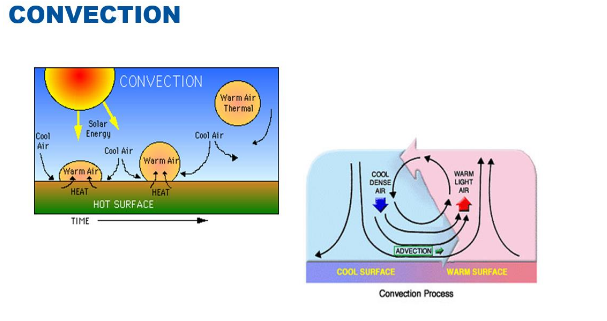
Which lifting process results from the uneven heating of the Earth's surface?
Convection.
Which lifting process is caused by friction between the air and the Earth's surface, creating eddies?
Mechanical turbulence.
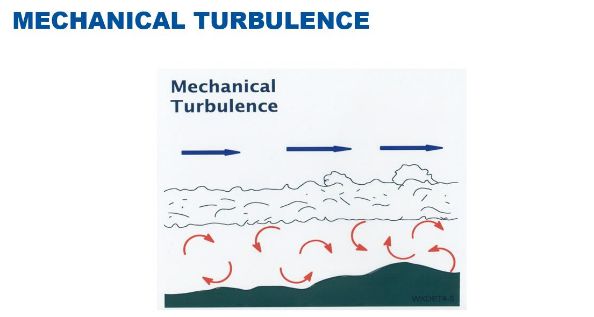
What are the three factors that influence the intensity of mechanical turbulence?
Unevenness of the ground,
speed of the wind,
and stability of the air.
The effects of mechanical turbulence are usually limited to what part of the atmosphere?
The lowest 3000 feet, also known as the boundary layer.
What is the term for the lift that occurs when an air mass is forced to move over rising terrain like mountains?
Orographic lift.

The lifting process that occurs when advancing cold air undermines warmer air is known as _.
Frontal lift
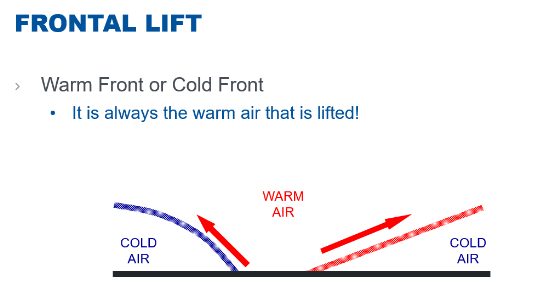
During any form of frontal lift, which air mass is always lifted?
It is always the warm air that is lifted.
What lifting process occurs when air accumulates near the surface and is forced to rise, often in low-pressure areas?
Convergence.
Which lifting process, convection or mechanical turbulence, can provide lift to much higher altitudes?
Convection (as long as the parcel of air is warmer than the
surrounding air.)
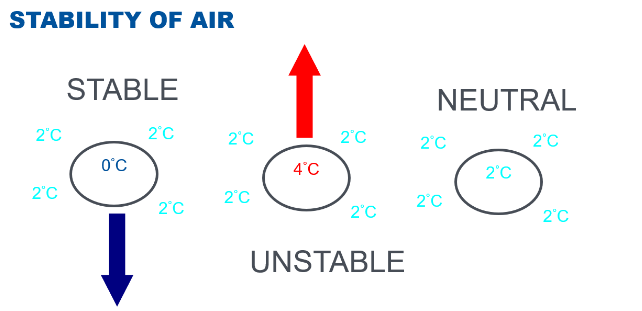
What is Atmospheric Stability
The atmospheric resistance to vertical motion.
In a stable air mass, what will a lifted parcel of air do after the lifting process is removed?
It will return to its original position.
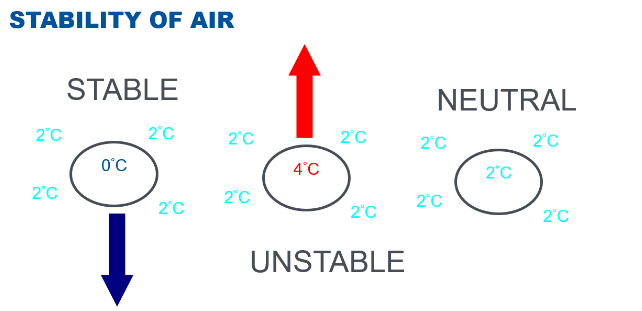
In a neutrally stable air mass, what will a lifted parcel of air do after the lifting process is removed?
It will stay in its new position.
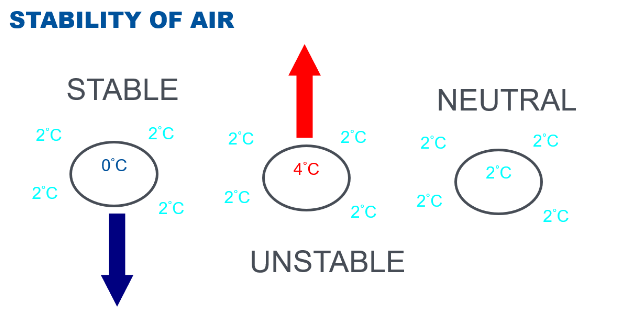
In an unstable air mass, what will a lifted parcel of air do after the lifting process is removed?
It will continue moving in the direction of the initial force (continue to rise).
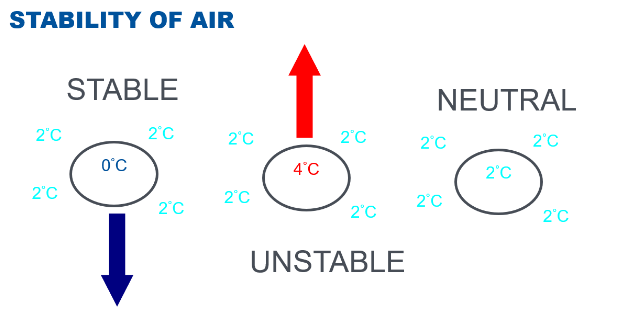
In stable air, is a lifted parcel of air colder or warmer than the surrounding air?
It becomes colder and denser than the surrounding air, causing it to sink.
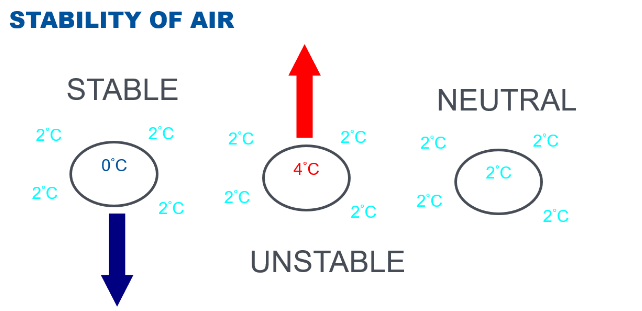
In unstable air, is a lifted parcel of air colder or warmer than the surrounding air?
It remains warmer and lighter than the surrounding air, causing it to continue rising.
What type of clouds are characteristic of unstable air?
Cumuliform clouds.
What type of clouds are characteristic of stable air?
Stratiform clouds.
What type of precipitation is associated with unstable air?
Showery precipitation.
What type of precipitation is associated with stable air?
Continuous or intermittent precipitation.
How is visibility generally affected in unstable air (outside of precipitation)?
Visibility is generally good.
How is visibility generally affected in stable air?
Visibility is often reduced due to haze, smog, or fog.
What is a steep lapse rate?
A large decrease of temperature with height.
What is a shallow lapse rate?
A small decrease of temperature with height.
What is the term for a situation where there is no change in temperature with altitude?
Isothermal.
What is the term for a situation where there is an increase in temperature with altitude?
Inversion.
A steeper atmospheric lapse rate indicates that the air is more _.
unstable
A more shallow atmospheric lapse rate indicates that the air is more _.
stable
How does an inversion layer affect upward vertical motion?
It blocks vertical motion because a rising parcel of air becomes colder than the warmer inversion layer above it.
What is the term for the thin sheet of air extending from the Earth's surface to the edge of space?
The atmosphere.
What is the most abundant gas in the Earth's atmosphere, and what is its approximate percentage?
Nitrogen, at 78%.
What is the second most abundant gas in the Earth's atmosphere, and what is its approximate percentage?
Oxygen, at 21%.
In which layer of the atmosphere does most weather occur?
The Troposphere.
What is the name of the dividing line between the Troposphere and the Stratosphere?
The Tropopause.
What is the approximate atmospheric pressure at sea level in millibars?
Around 1,013.25 millibars.
How do atmospheric pressure and the density of air change with an increase in altitude?
Both atmospheric pressure and air density decrease with altitude.
The constant changes in the atmosphere's gaseous properties over time and location are referred to as _.
weather
Approximately what percentage of the atmosphere by weight is below 5.5 km (18,000 feet)?
About 50%.
Approximately what percentage of the atmosphere by weight is below 11 km (36,000 feet)?
About 75%.
How does the thickness of the troposphere vary between the poles and the equator?
It is thinnest at the poles (7-8 km) and thickest at the Equator (16-18 km).