ID 2242 Exam 3 - Post Impressionism
 Call Kai
 Learn
Learn Practice Test
 Spaced Repetition
 Match
Match Flashcards
 Knowt Play
1/29

There's no tags or description
Looks like no tags are added yet.
Name | Mastery | Learn | Test | Matching | Spaced | Call with Kai | Chat |
|---|
No analytics yet
Send a link to your students to track their progress
30 Terms
Adjacent colors
colors located next to one another on the color wheel & light spectrum
Can be blended
Represent solid surfaces
complementary contrasts
colors opposite to each other on color wheel & light spectrum
Cannot be blended
Represent boundaries and shadows
homogeneous brushstrokes
technique to use the same size and shape brushstroke in painting- mainly impressionists used
Represent that everything is light/light texture
contiguous color
technique where paint is applied adjacent and next to each other
laws of shadows
shadows are not colorless and grey- they are refracted color of light gathering in the boundaries
The complementary colors (Red and green shadow)
glazing
technique where paint is applied in layers on top of each other
Gives 3D effect
Opposite of contiguous color technique
Society of Irregularists
Renoir started group that believed light reflects in different/irregular patterns in static and moving objects
Use of different brushstrokes to show motion or stillness
divided brushstrokes
Seurat painting technique
dotted paint strokes separated by intervals (empty space around dots)
optical mixture
Color mixture created by the eye as small bits of color are perceived to blend and form a mixture- Seurat used this method
Eye sees orange when red and yellow dots are placed next to each other
Opposite of mechanical mixing
Expressive theory
Charles Henry theory involving use of lines and color to express a mood
(Dynamogeny- ascending lines/warm colors)
(Equilibrium- Neutral lines/both warm and cool)
(Inhibition- descending lines/cool colors)
Seurat influenced by this theory
Post Impressionism
"paint not the thing itself, but the effect it produces" - Stephane Mallarme
(Quote to describe the movement)
moving away from painting things, but not light, but mood

Self Portrait, 1879
- Post-impressionism
-Cezanne
-"realization of the motif (pattern)"
to realize - to achieve in colors, textures
to paint the wallpaper in the face and the face in the wallpaper
all the diagonals intersect to a body part
-Had earlier version that was a "failure"
Really descriptive of what he looked like, which he didn’t like
-equivalence: comparison, substitution
-cut this brush to create a diamond-shaped brushstroke to continue the motif
Equivalence
comparison/substitution used in art movements Post impressionism
Mme. Cezanne with a Coffeepot, 1898
- Post-impressionism
-Cezanne
-"realization of the motif (pattern)"
-Equivalence: wife=coffeepot
stiff and upright like coffeepot
-Equivalence: wife=teacup with spoon
stiff, upright qualities
-colors in face resemble the same in the paintings in the backgruond
the mountains in the paintings are in her face
-colors in hands are the same as the tablecloth
as she spreads out tablecloth, she has patterns within the tablecloth and the tablecloth leaves texture in her hands


Mme Cezanne in a Red Armchair, 1893
- Post-impressionism
-Cezanne
-rounded shoulder of her arm compared to the rounded shoulder in the chair
-Equivalence: wife=armchair
-face in the upholstery
-she is soft and fluffy like the armchair
-curled up hands resemble the swirls in the chair
-diamond wallpaper finds its way in her scarf
same colors/textures
-skirt includes Mt Ste Victoire

Still Life with Compotier, 1882
- Post-impressionism
-Cezanne
-"the folded napkins looked like snowy mountains"
-shifts into landscape
-knife=road
-fruit=shrubs
-homongenous burstroke = square
-multiple viewpoints
parallel viewpoint and high viewpoint
-Time as subject matter in art

Mt Ste Victoire, 1872
- Post-impressionism
-Cezanne
-Had over 80 paintings of the mountain
clouds take form of the moutains
"Found the mountain in the sky and the sky in the mountain"
-Equivalence; moutain (square) brushstroke

The Large Bathers, 1906
- Post-impressionism
-Cezanne
-"The landscape thinks itself through me and I am its consciousness"
-another portrait of wife in landscape
-arbitrary colors
-not descriptive
arbitrary colors
color chosen by an artist to express his or her feelings
Non-descriptive and non-imitative of the objects painted

The Tub, 1886
- Post-impressionism
-Degas
Multiple view points
look down at the bather
looking parallel to items of the desk
idea of the duration of time
quivalence
hair = color of copper
body = same curves and colors in pitcher

The Bath, 1892
- Post-impressionism
-Mary Cassatt
-equivalence = embracing line (maternal embrace)
-kid and mother embracing eachother
-bath embracing the foot
-dress is striped, bowl is strikped
-kid is compared to color of the picher
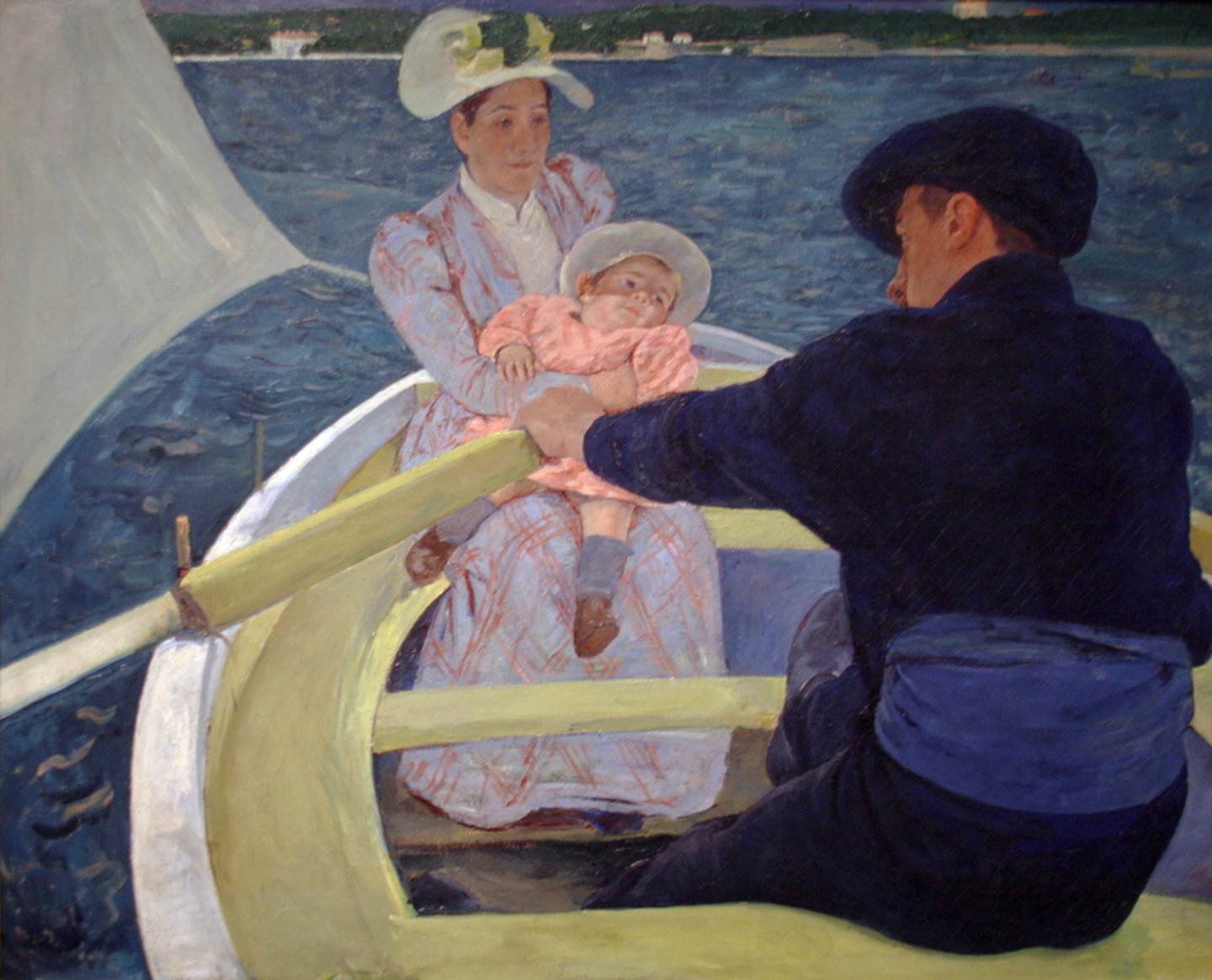
Boating Party, 1894
- Post-impressionism
-Mary Cassatt
-equivalence = embracing line (maternal embrace)
-father is embracing ship
-mother holds shild
-saild encloses/embraces
Embracing line
term used by Cassatt to describe maternal and protection; shown by hugging arms EX

The Night Cafe, 1888
- Post-impressionism
-van Gogh
-"express the terrible passion of humanity of blood red and green"
"-cafe is a place of nausea"
-glazing
-contemporary contrasts
-table is distorted
-proprietor is not completed, maybe a ghost
-multiple view poitns

Bedroom in Arles, 1888
- Post-impressionism
-van Gogh
-room at mental health faculity
-“this could be my self portrait"
-not mainting about the thing itself
"I use color arbitrarily to express myself forcibly"
-next window is landscpae painting
-mirror not reflecting anything
-reflecting van Gogh’s moocd
-Looung parallel at window and the down on the chairs
-glaxing on floors
-red bedding may imply discomfort
-patterns on pillow inidcate where his head rests

Starry Night, 1889
- Post-impressionism
-van Gogh
"everything is in motion"
"the tree...like flames"
-equaivalence: swirling brushstroke
-wind miving across landscape
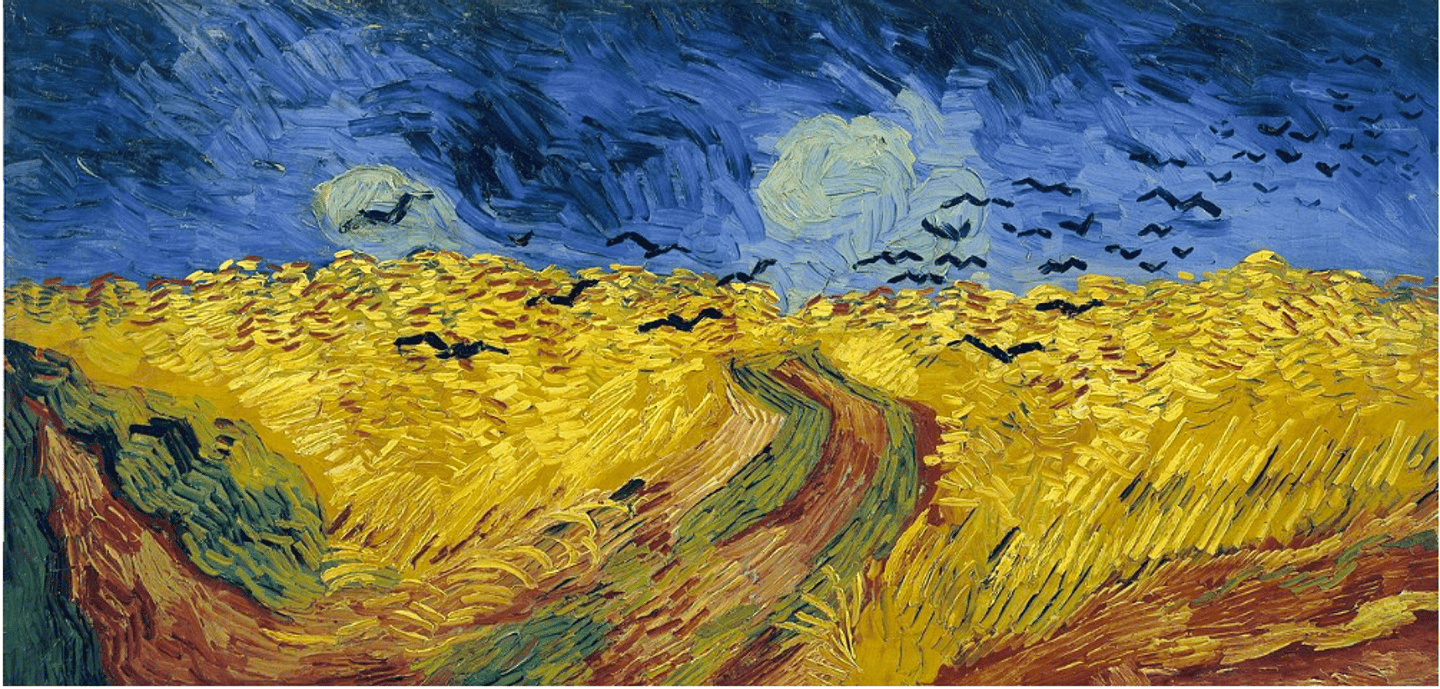
Crows Over the Wheat Field, 1890
- Post-impressionism
-van Gogh
-movment through weat field
-marks left wagon in feild

Self Portrait with a Skeleton Arm, 1895
- Post-impressionism
-Munch
"my art...study of soul, that is the study of my own self"

The Scream/Cry, 1893,
- Post-impressionism
-Munch
"I was walking down the road at sunset...suddenly the sky turned red as blood...then I heard the infinite scream of nature"
equivalence: blood red for sky
-equivalence: scream that starts at person and into nature in a soundwave pattern
skull: death’s head, effect of screaming
planimetric separation
foreground, engaged eye
middle ground (protagonist)
background: soundwave
-blue/orange
-yellow/purple
-glazing

The Dance of life, 1899,
- Post-impressionism
-Munch
-a part of a series of Frieze of Life
3 major themes: love, anxiety, death
-3 figures
woman in white = the virgin, black glazed with white, vibrating brushstrokes
woman in red = sexually mature woman dancing with a male, black glazed with red, puddling brushstrokes
woman in black = the widow, closed body language, red glazed in black, rigid/sharp brushstrokes
essentially all the same woman
-equivalence: colors for ages
-brushstrokes for moods