gaseous state
 Call Kai
 Learn
Learn Practice Test
 Spaced Repetition
 Match
Match Flashcards
 Knowt Play
1/24

There's no tags or description
Looks like no tags are added yet.
Name | Mastery | Learn | Test | Matching | Spaced | Call with Kai | Chat |
|---|
No analytics yet
Send a link to your students to track their progress
25 Terms
basic assumptions of the kinetic theory
the gas consists of particles of negligible volume compared to the volume of the container it occupies
the gas particles exert no attractive forces on each other
the collisions between gas particles are perfectly elastic and no kinetic energy is lost on collision
the gas particles are in continuous random motion
the average kinetic energy of the gas particles is directly proportional to the absolute temperature (in Kelvin, K)
measuring standards of gas samples
physical properties of gases vary depending on several factors ⇒ physical conditions have to be specified when measurements are made
molar volume is the volume occupied by 1 mol of an ideal gas
s.t.p. at 105 Pa [1 bar] and 273 K [0 ℃] → 22.7 dm3mol-1
r.t.p. at 101325 Pa [1 atm] and 293 K [20 ℃] → 24 dm3mol-1
gases are usually described through the use of the four properties
pressure
volume
temperature
number of moles of gas, n
the gas laws describe the relationships between pairs of the properties when the other two properties are kept constant
gas laws
describe the behaviour of any gaseous substance, regardless of its identity
combining the three gas laws ⇒ V is directly proportional to nT/p [V ∝ nT/p]
boyle’s law
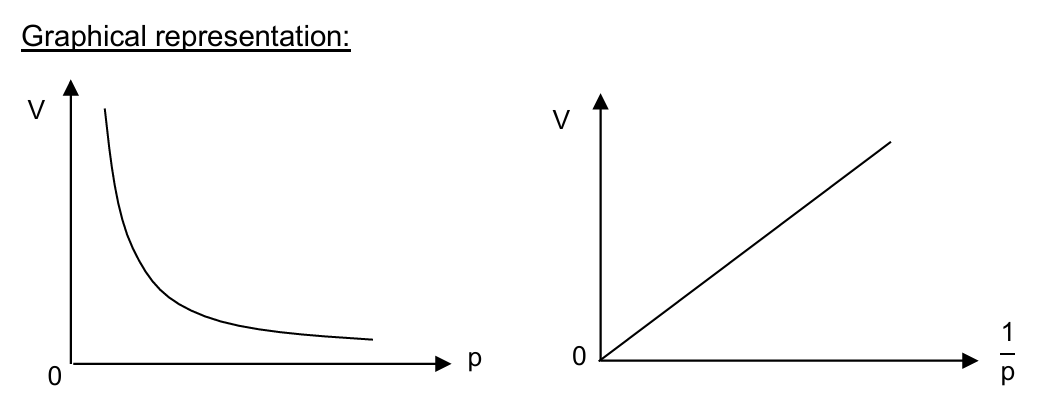
states that at constant temperature, the volume of a fixed mass of gas is inversely proportional to its pressure
V ∝ 1/p ⇒ pV = constant
an increase in pressure will decrease its volume
fixed mass ⇒ gas has a fixed amount ⇒ n is constant
charles’ law
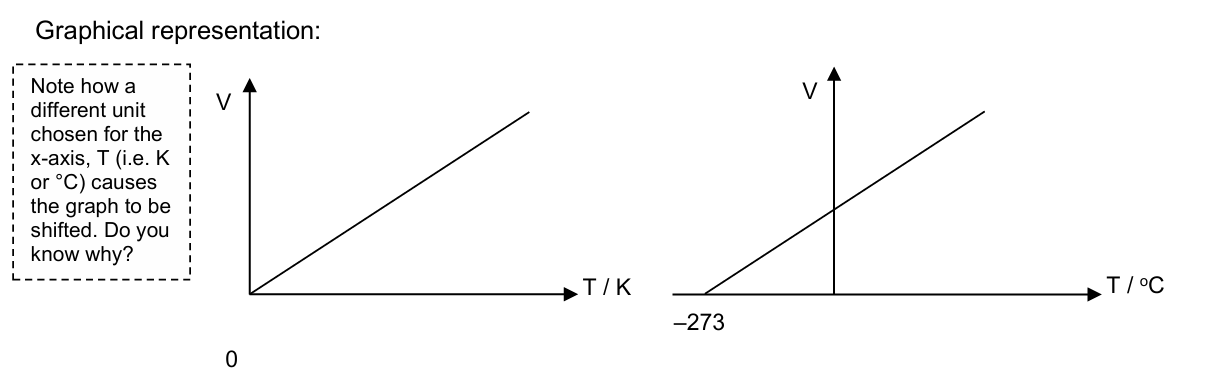
states that at constant pressure, the volume of a fixed mass of gas is directly proportional to its absolute temperature (in Kelvin, K)
V ∝ T ⇒ V/T = constant
an increase in the temperature of the gas will increase its volume
avogadro’s law
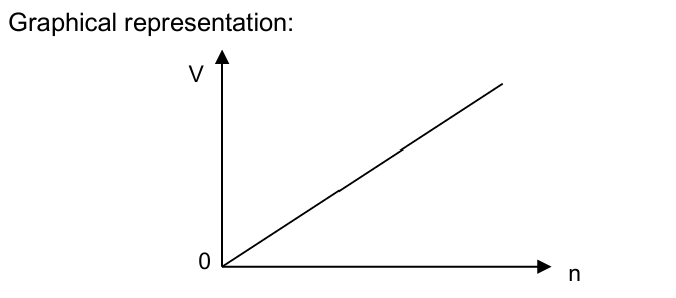
states that at constant temperature and pressure, equal volumes of gases contain equal number of gas particles
V ∝ n
an increase in the amount of gas will increase its volume
ideal gas equation
ideal gas equation: pV = nRT
p: pressure of gas in Pa or N m-2
v: volume of gas in m3
T: temperature in K
n: amount of gas in mol
R: molar gas constant 8.31 J K-1 mol-1 [found in data booklet]
conversion of units [gas equation]
make sure all quantities are in their correct units before substitution
pressure: 1 atm = 101325 Pa, 1 bar = 105 Pa
volume: 1 m3 = 103 dm3 = 106 cm3
temperature: absolute temp (K) = temp (℃) + 273
to determine relative molecular mass using ideal gas equation → application of ideal gas equation
since n = amount of gas = mass/molar mass, and the numerical values of molar mass and Mr are the same ⇒ pV = mass x RT/Mr
Mr = (mass x RT)/pV [mass is in g]
since density of gas, ρ = mass/V
Mr = (ρRT)/p [density is in g m-3)
to convert g cm-3 to g m-3, multiply by 106
calculating gas variables under different physical conditions
to perform calculations involving gases under two different sets of physical conditions, the strategy is to rearrange the ideal gas equation into a form that can be equated with another rearranged ideal gas equation
make R the subject of the ideal gas equation: R = pV/nT
since R is a constant, for a gas that is first subjected to an initial set of physical conditions before a final set of physical conditions, the two sets of pV/nT can be equated: p_1V_1/n_1T_1 = p_2V_2/n_2T_2
when any of the four variables (p, V, n and T) is kept constant, the combined equation above can be further simplified
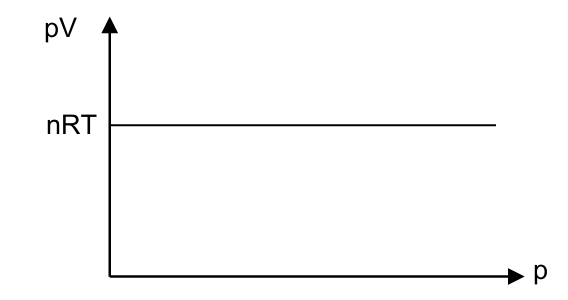
plot pV vs p at constant temperature (T) for a fixed amount (n) of gas
y-axis: pV, x-axis: p
constants: T, n and R
pV = nRT (no further manipulation required)
from above, pV = constant, which is in the form of y = c
the plot is a horizontal line that cuts the y-axis at y = nRT
as the pressure, p, of a gas increases, its volume decreases, such that the product, pV remains constant since the pressure, p, is inversely proportional to the volume, V
the plot of pV vs p (at constant T) is the same as the plot of pV vs V (at constant T)
graphical plots for a fixed amount of ideal gas → n is constant
sketch V vs p (at constant T)
equation: pV = nRT ⇒ V = nRT(1/p)
sketch V vs 1/p (at constant T)
equation: pV = nRT ⇒ V = nRT(1/p)
sketch V vs T (K) (at constant p)
equation: pV = nRT ⇒ V = (nR/p) T
sketch V vs T (°C) (at constant p)
equation: pV = nRT ⇒ V = (nR/p)(T(°C)+273) ⇒ V = nR/p(T(°C)) + nR/p(273)
plot pV vs V (at constant T)
equation: pV = nRT
since pV = constant, p and V will vary such that pV remains constant
general shapes of graphs
use the mathematical equation for straight line: y = mx + c
y and x are values on the axes, m is the gradient and c is the y-intercept
horizontal straight line cutting the y axis at k
straight line with positive gradient cutting y axis at c
straight line with positive gradient passing through origin ⇒ directly proportional
hyperbola
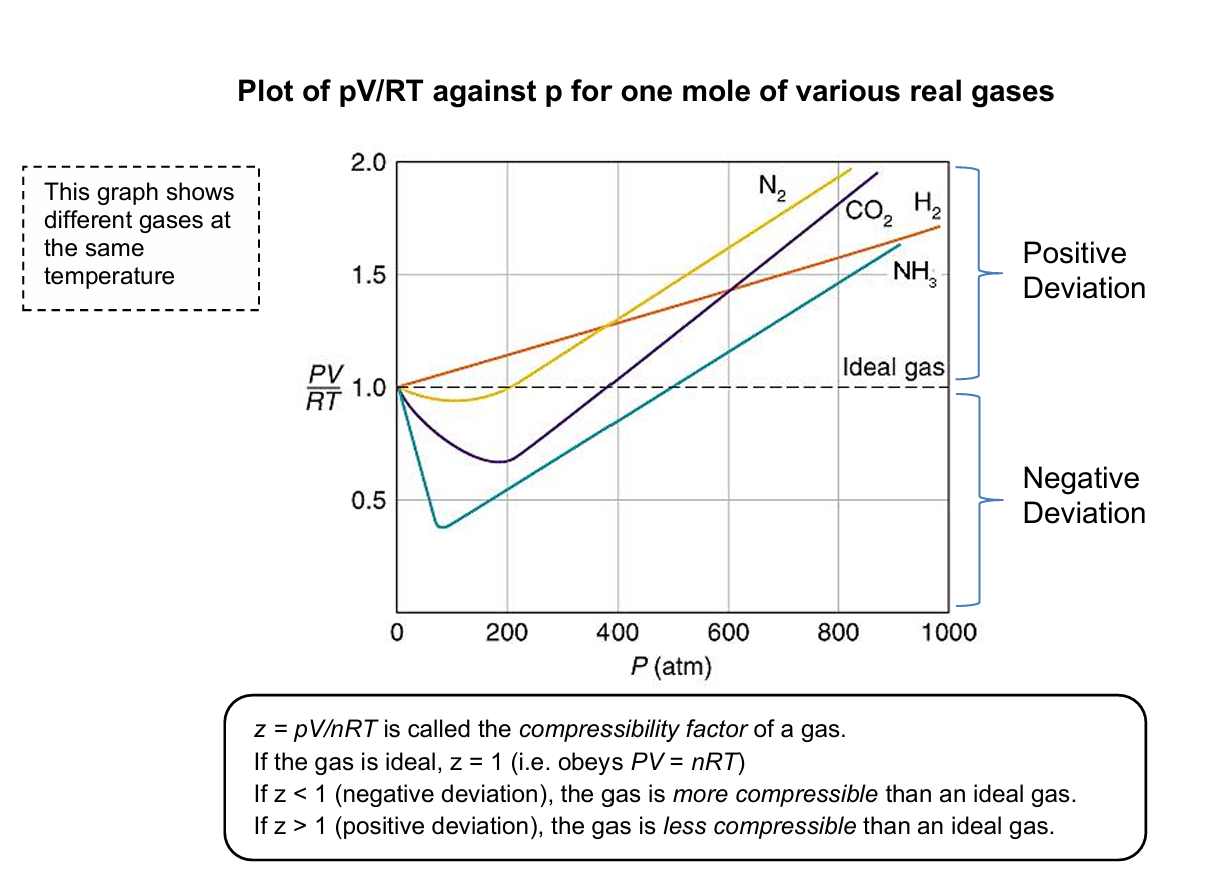
deviation from ideal gas behaviour
for an ideal gas under all conditions, pV = nRT ⇒ pV/nRT = 1
a plot of pV/nRT against p should be a horizontal line → constant value of 1
however, an ideal gas (which obeys the ideal gas equation) does not exist in reality
the ideal gas model was constructed so that the physical quantities that describe a real gas can be approximated to a good enough degree of accuracy without having to involve mathematics in a rigorous manner
while pV = nRT strictly applies to only ideal gases, when applied to a real gas, the values calculated are generally good enough estimates
real gases
real gases do not obey the ideal gas equation
deviations (positive or negative) from ideal gas behaviour can be attributed to these properties of real gases
significant attractive forces between the gas particles
significant volume of gas particles
the extent and nature of deviation depends on
temperature
pressure
nature of the gas → strength of intermolecular forces and molecular size
negative deviation
real gases tend to exhibit negative deviation when the temperature is low [temperature: experimental temperature in Kelvin]
the kinetic theory assumes that an ideal gas is made up of particles (atoms or molecules) with negligible intermolecular forces of attraction
however, at low temperatures, gas particles move slowly and have low kinetic energy
they have more time for interaction with each other and hence intermolecular forces of attraction between the particles are significant
as particles collide with the walls of the container with lower frequency and with lesser force than at high temperatures
the pressure exerted by a real gas is lower than that by an
ideal gassince p(real) < p(ideal) ⇒ p(real)V/RT < p(ideal)V/RT ⇒ p(real)V/RT < 1
negative deviation becomes greater when temperature lowers
always specify the type of intermolecular forces of attraction between the gas
![<p><strong>real gases tend to exhibit negative deviation when the temperature is low [temperature: experimental temperature in Kelvin]</strong></p><ul><li><p>the kinetic theory assumes that an ideal gas is made up of particles (atoms or molecules) with negligible intermolecular forces of attraction</p></li><li><p>however, at low temperatures, gas particles move slowly and have low kinetic energy</p></li><li><p>they have more time for interaction with each other and hence intermolecular forces of attraction between the particles are significant</p></li><li><p>as particles collide with the walls of the container with lower frequency and with lesser force than at high temperatures</p></li><li><p>the pressure exerted by a real gas is lower than that by an<br>ideal gas</p><ul><li><p>since p(real) < p(ideal) ⇒ p(real)V/RT < p(ideal)V/RT ⇒ p(real)V/RT < 1</p></li></ul></li></ul><p><strong>negative deviation becomes greater when temperature lowers</strong></p><p><strong>always specify the type of intermolecular forces of attraction between the gas</strong></p>](https://assets.knowt.com/user-attachments/67203459-4d0b-49e9-a618-59363f3a1098.png)
when is the temperature considered low
the experimental temperature is considered low when it is near the boiling point of the gas → depends on the identity of the gas
summary for negative deviation
negative deviation occurs at low temperature → relative to boiling point of gas
extent of negative deviation depends on
experimental temperature ⇒ the lower the temperature, the greater the negative deviation
strength of intermolecular forces of attraction ⇒ the stronger the intermolecular forces of attraction, the greater the extent of negative deviation
positive deviation
real gases tend to exhibit positive deviation when the pressure is high
the kinetic theory assumes that an ideal gas is made up of particles (atoms or molecules) with negligible volume compared to the volume of the container
at high pressures, the gas is compressed, and the total volume occupied by the gas is reduced
gas particles become closer together, and the molecular size (volume) of the gas particles becomes significant when compared to the total volume of the gas (i.e. the volume of the container the gas is in)
since V(real) > V(ideal) ⇒ pV(real)/RT > pV(ideal)/RT ⇒ pV(real)/RT > 1
the volume of a gas particle is determined by its electron cloud size and estimated by its Mr ⇒ a gas particle with a bigger Mr has a larger electron cloud size
summary of positive deviation
positive deviation occurs at high pressure
extent of positive deviation depends on the size of gas particles → indicated by the Ar or Mr
the greater the molecular size, the greater the extent of the positive deviation
if a gas has larger sized particles, at high pressures, the volume occupied by the gas particles is even more significant compared to the volume of the container the gas is in (in comparison to a gas with smaller sized particles)
this results in the volume of the real gas being much greater than the volume of an ideal gas ⇒ V(real) >>> V(ideal)
this would result in the pV/nRT being much larger than 1 [more positive deviation]
conditions necessary for gas to approach ideal gas behaviour
real gases only tend towards ideal gas behaviour when
pressure is very low
temperature is very high
low pressure
at very low pressures, gas molecules are further apart (intermolecular forces of attraction are also negligible)
the volume of the gas molecules is insignificant compared to the volume of the container
high temperature
at high temperatures, gas molecules have sufficient kinetic energy to overcome intermolecular forces of attraction which can be considered insignificant
dalton’s law of partial pressure → definition
the total pressure exerted by a mixture of gases which do not react is equal to the sum of the partial pressures of the constituent gases at the same temperature
only applies when the volume of the vessel of individual gases is the same as the volume of the gas mixture
dalton’s law of partial pressure
mathematically expressed as: total pressure of the gas mixture, Ptotal = P1 + P2 + P3 + … + Pi
Pi = partial pressure of gas i in the mixture = the pressure which gas i exerts if it alone occupies the container at the same temperature
the total pressure of air is the sum of partial pressures of O2(g), N2(g), CO2(g) and other gases present
Ptotal = PO2 + PN2 + PCO2 + …
PO2 is the pressure exerted by O2 in the air mixture; it is also the pressure exerted by the same amount of O2 if it were to exist alone without the other gases
relating partial pressure to total pressure:
PA/PT = (nART/VT) / (nTRT/VT) ⇒ PA = (nA/nT) x PT [nA/nT is the mole fraction of gas A in the gaseous mixture]