NE203 Lecture 4 REAL
 Call Kai
 Learn
Learn Practice Test
 Spaced Repetition
 Match
Match Flashcards
 Knowt Play
1/42

There's no tags or description
Looks like no tags are added yet.
Name | Mastery | Learn | Test | Matching | Spaced | Call with Kai | Chat |
|---|
No analytics yet
Send a link to your students to track their progress
43 Terms
Patch Clamp Method
Measures current flowing through a single ion channel using a highly sensitive amplifier connected to a recording pipette
4 Patch Clamp Configurations
Cell-attached recording, whole-cell recording, inside-out recording, outside-out recording

Cell-attached recording
Pipette forms tight seal with membrane using mild suction; channel stays intact in cell, tight contact between pipette + membrane

Whole-cell recording
Strong suction pulse ruptures membrane patch so cytoplasm is continuous with pipette interior

Inside-out recording
Pipette pulled away and patch exposed to air; cytoplasmic domain becomes accessible and allows manipulation inside + out
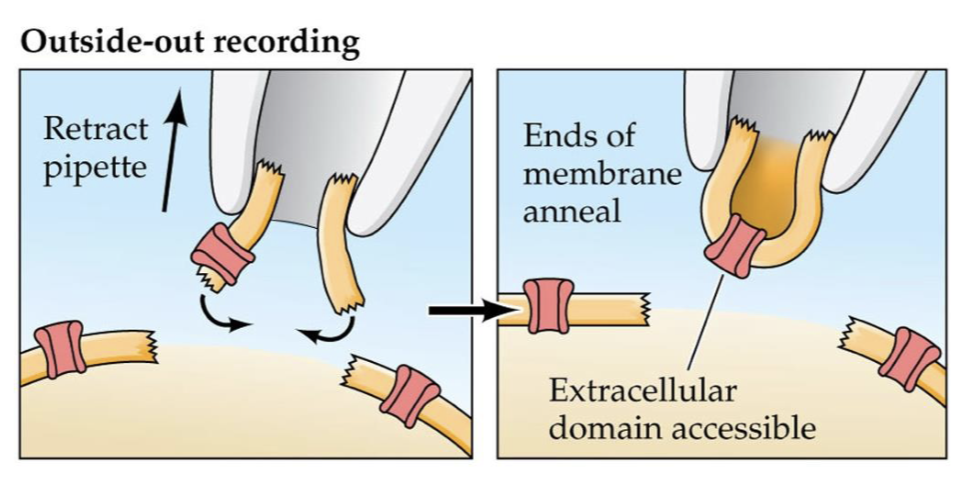
Outside-out recording
Pipette retracted so membrane ends anneal into a vesicle; extracellular domain becomes accessible
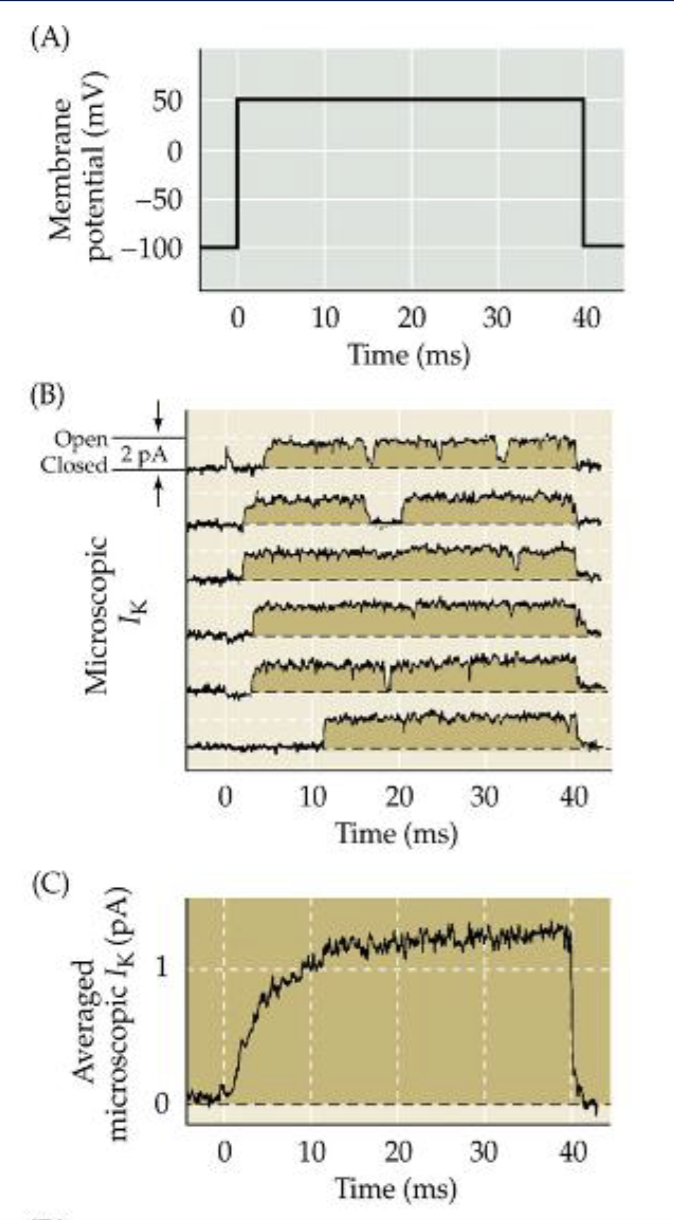
Microscopic currents
Currents flowing through individual/single ion channels
Macroscopic currents
Currents through many channels, representing a large surface of membrane

Na+ channel behavior
Most Na+ channels open within the initial 1-2 ms after depolarization, then probability of opening diminishes due to channel inactivation → closes after
K+ channel behavior
K+ channels open with a delay but remain open for the duration of the depolarization
Tetrodotoxin, saxitoxin, mu-Conotoxin
Toxins (pufferfish, dinoflagellates/cyanobacteria, cone snail venom) that block Na+ channels and inhibit depolarization
alpha-Toxins
Poisonous chemicals from Aspergillus molds (corn, peanuts, tree nuts) that prolong action potentials, scrambling information flow
beta-Toxins
From scorpion venom and staph; cause Na+ channels to open at lower-than-normal potentials, causing uncontrolled AP firing
Batrachotoxin
Potent cardiotoxic/neurotoxic alkaloid from frogs, birds, beetles; removes and shifts activation of Na+ channels
Dendrotoxin, apamin, charybdotoxin
Toxins from mamba snake, honeybee venom, and deathstalker scorpion venom that block K+ channels
SCN genes
Encode voltage-gated Na+ channels
KCN genes
Encode voltage-gated K+ channels
CACNA genes
Encode voltage-gated Ca2+ channels
CLCN genes
Encode voltage-gated Cl- channels
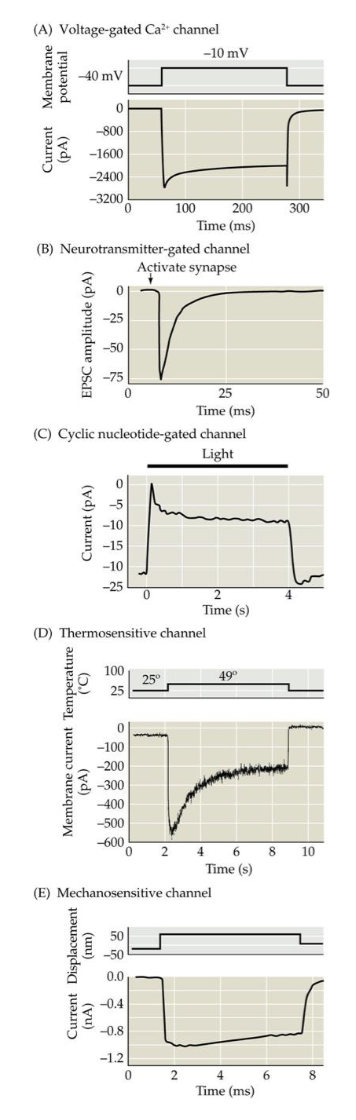
5 types of channel gating stimuli
Voltage-gated, neurotransmitter-gated, cyclic nucleotide-gated, thermosensitive, mechanosensitive

Selectivity filter criteria in ion channel pores
Mouth of the pore is made of amino acids that are opposite charge to that of the ion being taken in.
Pore diameter, atomic radius of ion (naked), atomic radius of ion (hydrated), and electronegativity of the ion
Voltage sensor gating (V-gated)
Positively charged amino acids in voltage sensors are pushed outward by depolarization and pulled inward by hyperpolarization, pulling helical linkers to open/close the pore

Ligand gating (AMPA receptor)
Extracellular ligand (e.g., glutamate) binding shuts the clam-shell shaped ligand-binding domain (LBD), moving gate helices of the transmembrane domain to open the pore
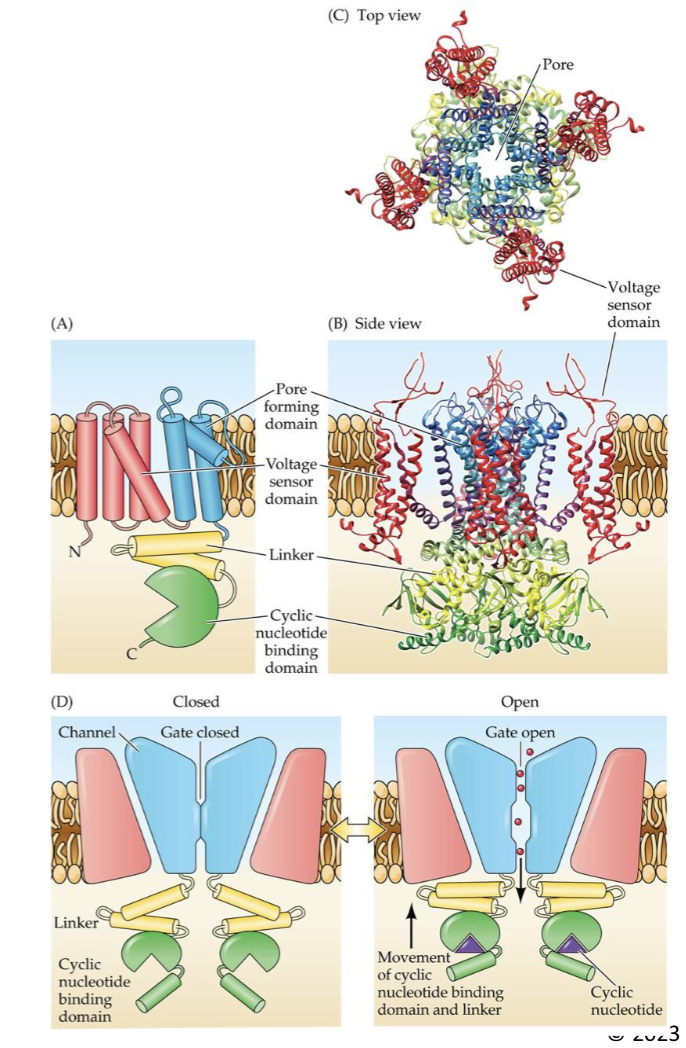
Intracellular ligands
Cyclic nucleotide-gated channel is structurally similar to voltage-gated K+ channel; example operates in response to light
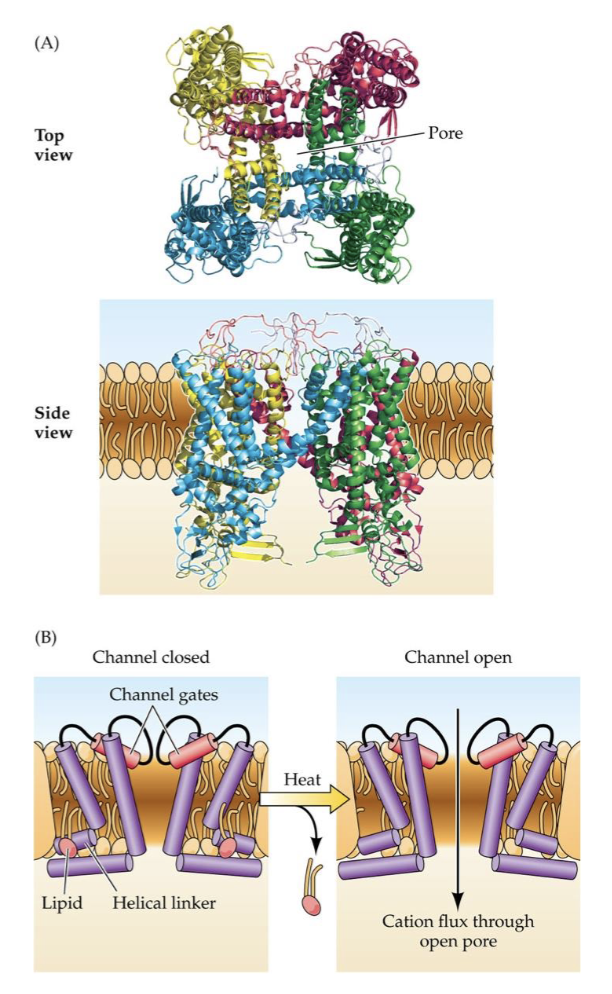
TRPV1 channel gating via heat
Heat or capsaicin displaces membrane lipids near the helical linker connecting sensor domains to the pore, causing a conformational change that opens the channel gates
gating of channels via mechanical displacement
Sensitive to light touch and allodynia; extremely large protein (38 transmembrane helices) with 3 'blades' that act as levers sensing membrane curvature; mechanical flattening builds tension and opens the channel

Na+/K+ ATPase pump
Uses ATP hydrolysis to remove 3 Na+ (rate ~1/3 faster, efflux depends on extracellular K+) and take in 2 K+ per cycle; maintains Na+/K+ gradients
PMCA pump
Plasma membrane Ca2+ ATPase; extrudes Ca2+ from the cell
SERCA pump
ER membrane Ca2+ ATPase; extrudes Ca2+ from the cytoplasm into the ER
Ion exchangers
Use electrochemical gradient of other ions as energy source; carry one ion up its gradient while taking another down its gradient

Antiporters
Exchange intracellular and extracellular ions in opposite directions (e.g., Na+/Ca2+ exchanger, Na+/H+ exchanger to maintain pH)

Co-transporters
Carry multiple ions in the same direction (e.g., Na+/K+/Cl- co-transporter, which regulates intracellular Cl-)
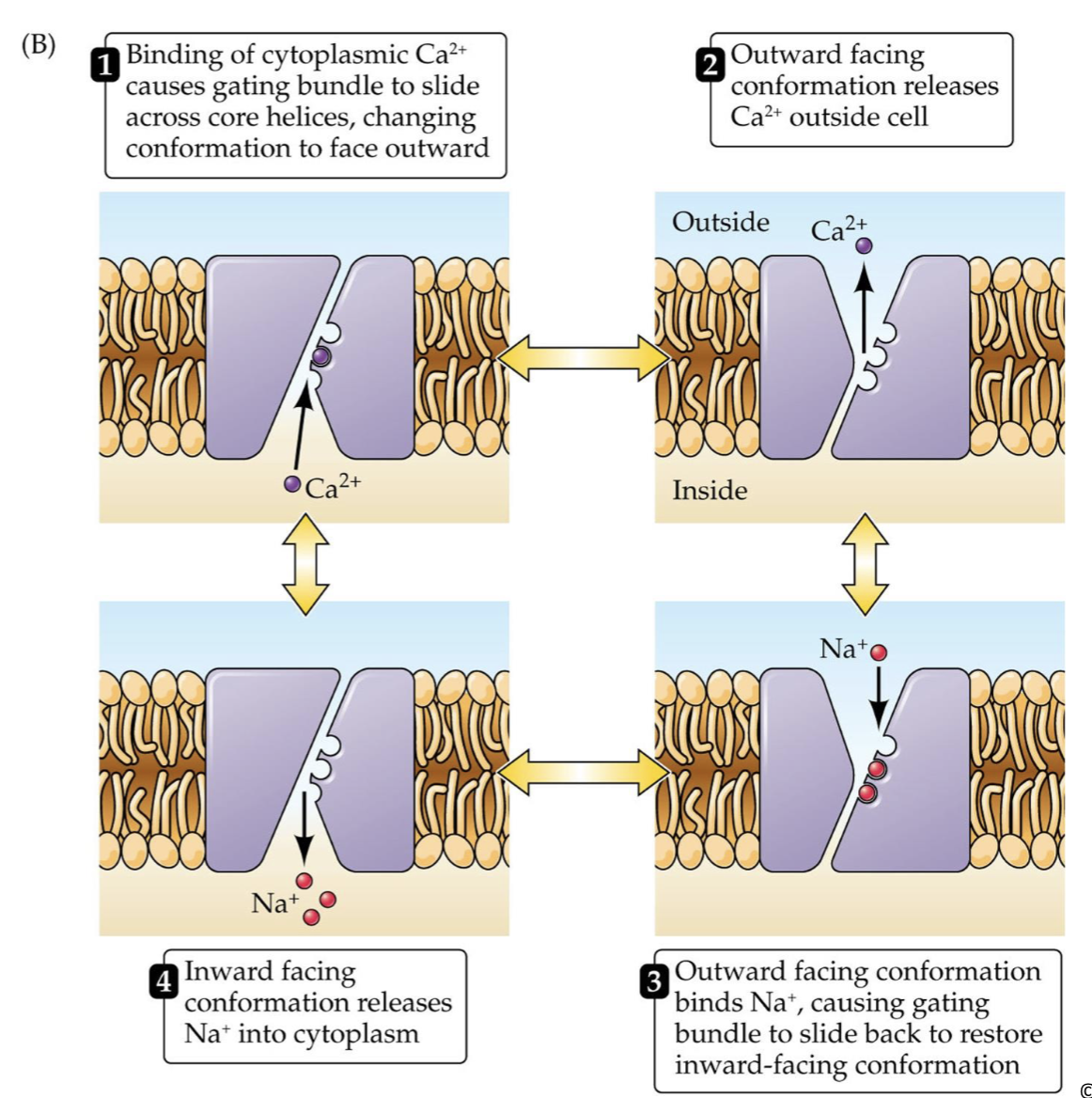
Na+/Ca2+ exchanger structure
10 transmembrane helices: 8 form the core domain (ion binding/translocation, 3 negatively charged binding sites), 2 form the gating bundle that slides to switch conformation

Electrical synapses
Use gap junctions as ion channels; bidirectional; faster; synaptic delay less than 0.1 ms
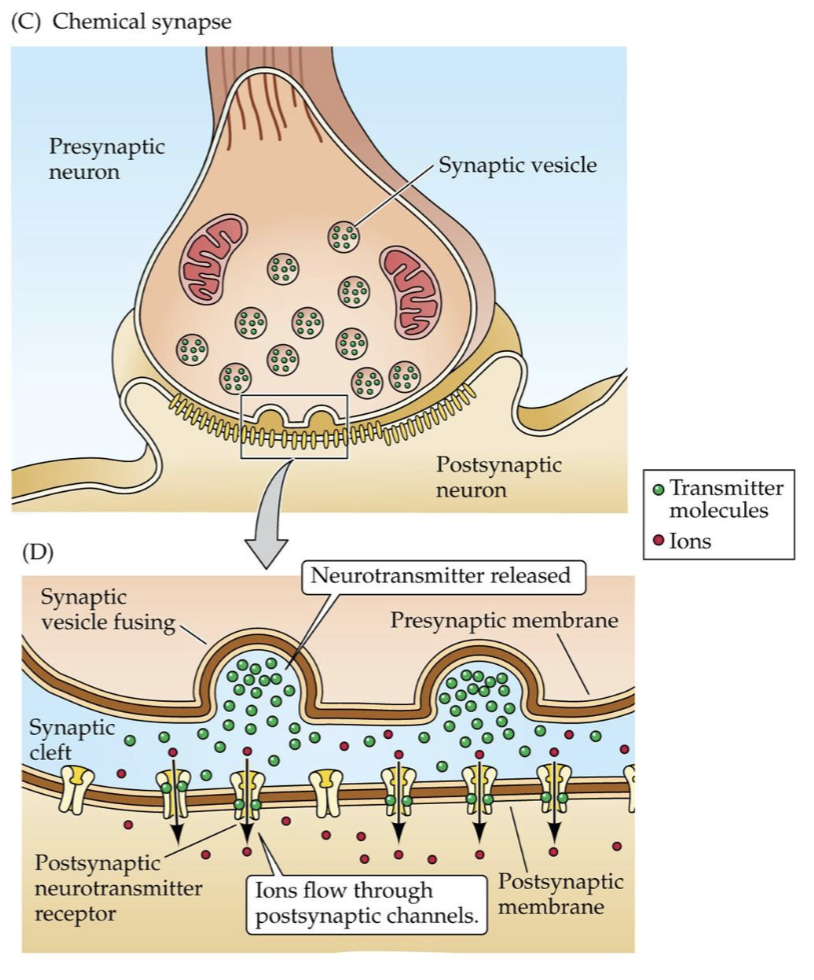
Chemical synapses
Use neurotransmitters and receptors; Ca2+-dependent release; unidirectional; slower
Connexon
Hexamer of 6 connexin subunits; each cell contributes one connexon (half the gap junction channel) providing electrical and cytoplasmic continuity

Hippocampal interneurons
One of the few CNS locations that use electrical synapses; allow synchronized firing across adjacent neurons
Ionotropic vs metabotropic receptors
Two mechanisms by which chemical synapse signaling ultimately opens ion channels to change postsynaptic membrane potential
Presynaptic active zone
Site where vesicle pools are ready for exocytosis; filamentous structures guide vesicles here
Postsynaptic Density (PSD)
Anchors postsynaptic receptors, prevents their lateral diffusion; contains proteins involved in plasticity, learning, memory, health and disease
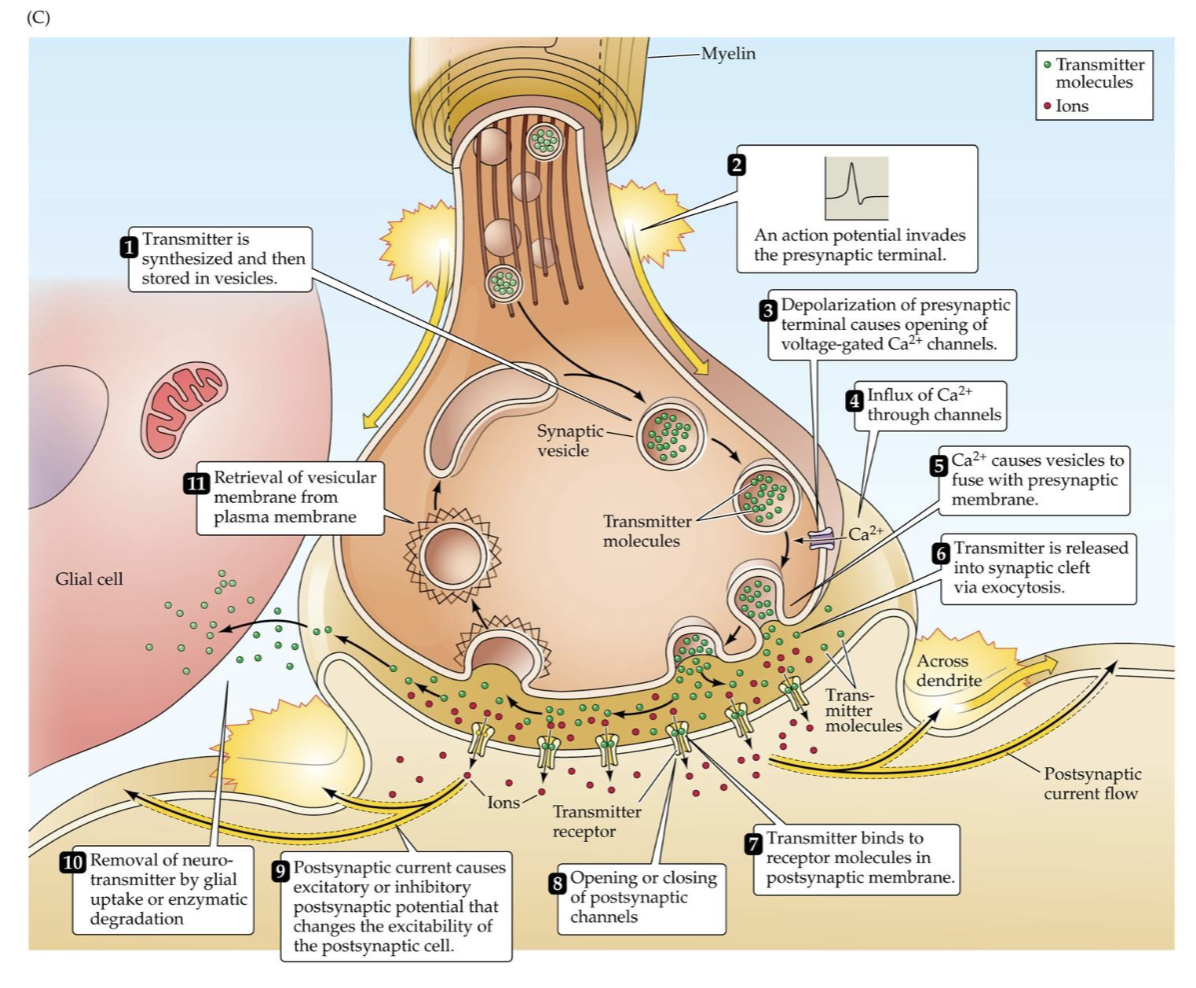
Chemical synapse signaling steps
AP invades presynaptic terminal -> depolarization opens voltage-gated Ca2+ channels -> Ca2+ influx -> vesicles fuse with membrane -> neurotransmitter released via exocytosis -> ntm binds to postsynaptic receptors -> opens/closes postsynaptic channels -> generates postsynaptic potential -> neurotransmitter removed by glial uptake or enzymatic degradation -> vesicular membrane retrieved
Ion channel pores
composed from arrangement of loops + helices of subunits; large enough for only the ion for which it’s meant to pass through → membrane is permeable to that ion
Active transport
essential to maintain a conc gradient for all physiologically relevant ions