Week 9 - Animal Physiology
 Studied by 0 people
 Call Kai
 Learn
Learn Practice Test
 Spaced Repetition
 Match
Match Flashcards
 Knowt Play
1/103

There's no tags or description
Looks like no tags are added yet.
Name | Mastery | Learn | Test | Matching | Spaced |
|---|
No study sessions yet.
104 Terms
How does respiration/the movement of gases always occur by?
Diffusion (movement down the concentration gradient - a passive process).
Name and describe the 3 distinct phases of respiration.
External respiration (ventilation): when the environmental medium carrying the oxygen e.g., water is brought to the respiratory membrane for gas exchange to occur. This causes gas exchange between the animal and the environment.
Internal respiration: once the oxygen has passed that membrane, internal respiration occurs, where the gases are transferred from the respiratory organs to the rest of the body. This is the transport of oxygen and carbon dioxide in the blood.
Cellular respiration: This is the production of ATP in cells?
What is external respiration?
External respiration (ventilation): when the environmental medium carrying the oxygen e.g., water is brought to the respiratory membrane for gas exchange to occur. This causes gas exchange between the animal and the environment.
What is internal respiration?
Internal respiration: once the oxygen has passed that membrane, internal respiration occurs, where the gases are transferred from the respiratory organs to the rest of the body. This is the transport of oxygen and carbon dioxide in the blood.
What is the rate of division between 2 regions governed by?
Ficks law of diffusion
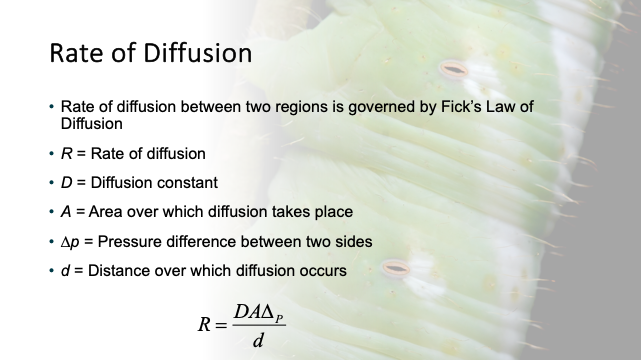
What is Ficks law of diffusion?
States that for a dissolved gas, the rate of diffusion is proportional to the pressure difference between the 2 sides of the membrane and the area of which the diffusion takes place
Describe some types of evolution, which act to maximise the rate of diffusion
Increasing the surface are
Decrease the distance for diffusion
Increase the concentration difference
How does gas exchange occur in single celled organisms? How can this happen?
In single celled organisms, distance for diffusion is already very short, hence gas exchange via diffusion can take place across the membrane.
How are amphibians adapted for gas exchange?
Amphibians= adapted for blood supply to be in very close contact with the skin (short diffusion distance) also have a counter current system (to ensure steep conc gradient).
How are echinoderms adapted for gas exchange?
Echinoderms= have papula to increase the surface area.
How are insects adapted for gas exchange?
Insects= have complex tracheole system, closely associated with cells, delivering oxygen directly to every single cell in the body.
What are invaginations and evaginations of gas exchange membranes, what is their role in maximising gas exchange?
Invaginations or evaginations of gas-exchange membranes act to increase the surface area.
For example gils are evaginated from the body (they stick outwards)
And lungs are invaginated into the body (they fold inwards).
What structures act as gills in polychaete annelids?
Polychaete annelids have tentacle-like projections that function as gills, allowing gas exchange with the surrounding water.
How are polychaete gills ventilated? How is oxygen distributed through the body after entering the gills?
They use passive ventilation, relying on natural water currents to bring oxygenated water into contact with the gills.
Oxygen diffuses from the water into the polychaete’s body, and the circulatory system then transports it throughout the organism.
What is an example of passive ventilation?
Ventilation by water currents.
What are 2 examples of active ventilation? Where is this seen
Cilia beating which requires energy (seen in gastropods).
Muscular contractions of the mantle (seen in cephalopods)= water is sucked in, then squished out again.
What is the musclular contraction of the mantle important for in cephalopods
For movement of the body.
In ventilation.
How is air drawn into land gastropods
The mantle cavity has evolved into a lung.
By raising and lowering the mantle cavity, air is drawn into the mantle cavity.
What do most terrestrial anthropods have? How is this adapted for rapid gas exchange? Why is this important?
Have a tracheole system.
Tracheoles penetrate directly into the cells to provide a high, fast oxygen supply for cells (for aerobic respiration), to produce energy in cells for the insect (insects generally have a high energy requirement).
What does the circulatory system of animals act to do?
The circulatory system moves the chemicals/exchange gases over long distances at a high speed in order to meet the demands of respiring cells.
Which 3 types of organism have no circulatory system, how do they instead act for gas exchange or for diffusion?
The sponges, the hydra, the nematode.
Sponges use environmental water, which passes through channels in their body, to supply their body tissues with oxygen.
The hydra uses the gastrovascular cavity that acts as the digestive, and the circulatory system to digest tissues to the cavity. Hydra have thin walls (only 2 cell thick), so each cell in the Hydra is either in contact with the external oxygen carrying medium, or the gastrovascular cavity.
The nematode is so thin, the distance of diffusion is so short.
What is the difference between open and closed circulatory systems? Where are each of these forms found?
Closed= blood and circulatory fluid is always contained within discrete vessels (e.g., the vein or arteries)
Only occur in a few group of invertebrates, these include annelid worms and the cephalopod molluscs
Open= blood and circulatory fluid is not always contained within discrete vessels, because of this there is little differentiation.
Found in all athropods (including insects), and some molluscs
What are systemic hearts? Where are they found?
Systemic hearts are hearts (or heart chambers) that pump oxygenated blood to the body’s tissues, rather than to the lungs or gills.
They are found in closed circulatory systems.
What are branchial hearts? Where are they found?
Branchial hearts are specialized hearts that boost blood flow to the gills to enhance oxygen uptake before it is sent to the rest of the body.
They act in the closed circulatory system to split the circulatory system into 2 channels.
Why do open circulatory systems typically have low blood pressure?
Open systems usually lack discrete blood vessels, leading to low pressure circulation.
Why is it incorrect to assume that open circulatory systems are inferior?
Low pressure does not mean slow or inefficient flow.
The rate of blood flow is not directly determined by pressure.
How can blood flow be fast in an open circulatory system despite low pressure?
These systems have very low resistance to blood flow, allowing blood to circulate rapidly even at low pressures.
How do animals with open circulatory systems control the direction of blood flow?
They use cardio-arterial valves, which allow them to regulate and direct blood flow within the system.
Why is maintaining osmotic balance important?
Osmotic pressure must be maintained to prevent cells shrinking or swelling.
What 2 things do most vertebrates maintain homeostasis for?
Most vertebrates maintain homeostasis for:
Total solute concentration of their extracellular fluids.
Concentration of specific inorganic ions.
What 2 things is water in a multicellular body distrusted between?
Intracellular compartment
Extracellular compartment
Why is the maintenance of osmotic pressure particularly important in animal cells?
Animal cells lack the cell wall. Because of this, energy change in the osmosis pressure of the extracellular fluid will cause the cell to either shrink or swell as water moves across the membrane. It will effect its cell structure and shape.
What are the important ions for cells?
Sodium (Na⁺) is the major positive ion (cation) found in extracellular fluid.
Chloride (Cl⁻) is the major negative ion (anion) in extracellular fluid.
Calcium (Ca²⁺) and Magnesium (Mg²⁺) are important divalent cations involved in processes such as muscle contraction, nerve function, and enzyme activity.
Potassium (K⁺), a major monovalent cation inside cells, along with other ions, also performs essential roles and is carefully regulated to maintain proper cellular and physiological function.
In what direction does the osmotic movement of water occur?
Down the water potential gradient (from a more dilute to a less dilute solution)
What is osmotic pressure?
The measure of a solutions tendency to take in water by osmosis (that is a measure of concentration difference).
Hence a a solution with a higher solute concentration will have a higher osmotic pressure.
What is osmolarity?
The number of osmotically active moles of solute per litre of solution.
A solution with a higher osmolarity exerts more osmotic pressure than one with a lower osmolarity.
What is tonicity?
The measure of a solutions ability to change the volume of a cell by osmosis.
What does it mean when the intracellular fluid is hypertonic?
Inside has a higher osmotic pressure.
What does it mean when the intracellular fluid is hypotonic?
Inside has a lower osmotic pressure.
What does it mean to be isotonic?
Where there is equitable osmotic pressure.
What is an osmoregulator?
An osmoregulator is an organism that actively controls the concentration of water and solutes (like salts) in its body, maintaining a stable internal environment even when external conditions change.
They maintain a relatively constant blood osmolarity, despite different concentrations in their environment.
What is an osmoconformer?
An osmoconformer is an organism that does not actively regulate its internal salt and water balance, but instead allows its internal osmotic conditions to match the surrounding environment. (Organism that are in osmotic equilibrium with their environment)
What is osmotic regulation?
The maintenance of a steady osmotic pressure.
What is ionic regulation?
The maintenance of a constant concentration of an inorganic ion.
What is volume regulation?
The maintenance of a constant total amount of water in the body fluid.
What are marine invertebrates, why is this important?
Marine invertebrates are isosmotic and therefore have the same osmotic pressure as seawater.
They do not gain or lose water by osmosis.
What type of osmotic regulators are freshwater invertebrates?
They are hyperosmotic regulators.
This means they regulate their blood osmotic pressure levels hyperosmotic to freshwater (they are more concentrated than freshwater).
How does the concentration in body parts of freshwater animals compare to the concentration in body parts of marine animals?
Most freshwater animals have less concentrated body fluids than their marine counterparts.
This reduces the energy cost of living in freshwater (Because the difference between their internal fluid concentration and the surrounding freshwater is smaller, they use less energy to regulate water and ion balance.
This makes osmoregulation in freshwater comparatively less costly).
What are stenohaline and euryhaline species?
Stenohaline species can only survive within a narrow range of salinities.
Euryhaline species can survive within a broad range of salinities.
Name 2 examples of euryhaline animals?
Oysters and muscles
What are the pros and cons of osmoregulation?
+ Cells experience a constant osmotic environment
- But energy costly
What are the pros and cons of osmotic conformity?
+ Avoid energy costs
- But cells must cope with changing osmotic conditions
How is water lost in terrestrial invertebrates?
Body fluids generally have a higher concentration of water than the surrounding air.
Hence terrestrial invertebrates tend to lose water by evaporation from skin and respiratory structures.
Which systems have evolved in terrestrial invertebrates to help terrestrial invertebrates retain water?
Urinary/osmoregulatory systems have evolved that help terrestrial invertebrates retain water.
Which environments do humidic terrestrial invertebrates tend to adopt to prevent water loss?
The way they can prevent water loss, is to reduce the gradient of water between their internal body fluids and their surroundings, they do this by only living in very humid and water rich environments.
How do xeric terrestrial invertebrates act to prevent water loss?
Being xeric, means they are capable of living in dry, water-poor environments e.g., insects and arachnids.
These types of organisms use a layer of lipid which acts as barrier for water loss via evaporation.
How is water loss in the urine of terrestrial invertebrates reduced by?
Producing a concentrated urine.
Producing a poorly soluble nitrogenous waste products.
What are the osmoregulatory organs of most organs like?
There is lots of variation between organisms and organs, but they are generally built on a complex network of tubules that provide a large surface area for the exchange of water and solutes, include nitrogenous wastes
Describe the osmoregulatory organs of flatworms
Flatworms use protonephridia which branch into bulb like flame cells opened to the outside of the body. They have cilia (hair like projections) within these flame cells, draws in fluid into the body, so water and metabolites are reabsorbed into the body.
Describe the osmoregulatory organs of earthworms
They use nephridia, open to both the inside and the outside of the body.
Describe the osmoregulatory organs of insects
Waste molecules and K+ is secreted into the maloighian tubules by active transport.
Water followed the osmotic gradient.
Most of the water and solutes are reabsorbed into the hind gut.
Describe the osmoregulatory organs of crustaceans
Have ‘Green glands’ located in the head that open near the antennae.
They consist of a sac, an excretory tubule and a bladder.
The urine is formed by filtration and reabsorption.
What is a hormone?
A regulatory chemical made by glands in the endocrine system, secrete into extracellullar fluid, and is carried by the blood.
What does it mean when we say a hormone can act at a distance from its source?
When we say a hormone can act at a distance from its source, we mean:
The gland that produces the hormone is often far away from the organ or tissue that the hormone affects.
After being released into the bloodstream, the hormone travels through the body until it reaches its target cells or organs.
Why are hormones seen as specific?
Hormones can only affect cells that have the correct receptors for that hormone.
What 2 types of transformations do insects undergo during post-embryonic development?
Molting
Metamorphosis
What is molting?
The shedding if an old exoskeleton, causing the secretion of a new larger one.
What is metamorphosis?
A radical transformation from the larval to the adult form.
What are the 3 hormones involved in metamorphosis?
Prothoracicotrophic hormone (PTTH)
Ecdysone “moulting hormone”
Juvenile hormone (JH)
How do the 3 hormones involved in metamorphosis act together?
The brain releases PTTH, which stimulates the release of ecdysone.
Ecdysone (from prothoracic glands) triggers moulting.
Juvenile Hormone (JH) (from corpora allata) controls what the insect becomes after moulting:
High JH → next stage is another larva
Low JH → moults into a pupa
No JH → moults into adult
Together, these hormones ensure growth and development happen in the correct sequence.
What is the difference between hemimetabolous and holometabolous insects?
Hemimetabolous insects go through gradual metamorphosis.
Holometabolous insects go through complete metamorphosis.
What is Adipokinetic hormone (AKH) involved in in insects?
Lipid recruitment (the process by which stored lipids (fats) are mobilized from the insect’s fat body into the hemolymph (blood) to be used as fuel).
What is Corazonin (Crz) hormone involved in in insects?
A stress hormone (helping insects cope with: Starvation, Heat stress, Desiccation and Metabolic imbalance).
What is the hormone diuretic neuropeptides involved in in insects?
Involved in water balance (helps the insect rapidly get rid of excess water or salts).
What is the hormone Leucokins involved in in insects?
Leucokinins = Myotropic Peptides
Leucokinins belong to a group of neuropeptides that affect muscle activity, especially in:
The gut
Malpighian tubules
Other visceral muscles
This makes them myotropic, meaning they change muscle tone or contraction.
What is the hormone pheromone biosynthesis activating neuropeptides (PBANs) involved in in insects?
Pheromone biosynthesis (its main and defining function is activating sex pheromone biosynthesis).
What hormone do neuroendocrine brain cells release to start molting?
Prothoracicotropic hormone (PTTH).
From where is PTTH released into the hemolymph?
The corpora cardiaca or corpora allata, depending on species.
What gland does PTTH stimulate, and what does it secrete?
PTTH stimulates the prothoracic gland, which secretes ecdysone (a prohormone).
Where is ecdysone activated and what is it converted into?
Activated in target tissues, especially the epidermis, and converted into 20-hydroxyecdysone (20E).
What does 20-hydroxyecdysone (20E) do?
Stimulates secretion of enzymes that digest the old cuticle.
Triggers synthesis of a new cuticle.
Which hormone maintains juvenile characteristics in developing insects?
Juvenile hormone (JH).
Where is Juvenile Hormone (JH) produced?
By non-neural endocrine cells in the corpora allata.
What happens when 20E acts while JH levels are high?
The insect molts into a larger larva or nymph (remains juvenile).
What happens when 20E acts while JH levels are low?
The insect molts into a pupa or adult.
Which brain hormones are released before each molt to trigger the behavioral process of shedding the cuticle?
Eclosion hormone (EH) and corazonin.
EH and corazonin signal which cells, and what do these cells release?
They signal Inka cells, which release:
Pre-ecdysis triggering hormone (PETH)
Ecdysis-triggering hormone (ETH)
What do PETH and ETH do?
Stimulate muscle contractions that help the insect shed the old cuticle.
Which hormone hardens and darkens the new cuticle after molting?
Bursicon.
What must the corpora allata do once the insect becomes an adult?
Resume producing Juvenile Hormone (JH).
What role does JH play in adults?
Acts as a gonadotropin.
Supports egg production in females and sperm production in males.
Stimulates pheromone production.
Where is ecdysone produced in adult insects?
In the ovaries.
What does 20-hydroxyecdysone (20E) do in adult females?
Stimulates production of yolk proteins (vitellogenins) that are incorporated into developing eggs.
Summarize the hormonal control of molting, metamorphosis, and reproduction in insects.
Neuroendocrine brain cells release PTTH, which is secreted from the corpora cardiaca/allata into the hemolymph and stimulates the prothoracic gland to produce ecdysone.
Ecdysone is converted in the epidermis to 20-hydroxyecdysone (20E), which digests the old cuticle and stimulates formation of a new one.
Juvenile Hormone (JH) from the corpora allata determines the molt outcome:
High JH + 20E → new larval/nymph stage
Low JH + 20E → pupa or adult
Before shedding, the brain releases eclosion hormone (EH) and corazonin, which trigger Inka cells to secrete PETHand ETH, stimulating contractions that shed the old cuticle.
Bursicon hardens and darkens the new cuticle.
In adults, the corpora allata resume JH production, which acts as a gonadotropin, supporting sperm and egg production and pheromone synthesis, while ovaries produce ecdysone and 20E stimulates yolk protein production for egg development.
What is a physiological modulator (ligand)? LABS
Ligands that bind to specific receptors in the cell membrane.
Provide 4 examples of physiological modulators. LABS
Neurotransmitters, hormones, Ingested substances, Medicines.
In the Daphnia experiment, why should you turn the light off when you are not investigating them? LABS
To avoid overheating them, or drying up their environment, which would cause distress.
What does noradrenaline do? Does it increase intracellular calcium? LABS
Increase heart rate (showing a positive chronotropy).
Noradrenaline increases intracellular calcium and thus contraction
What does acetylcholine do? Does it increase intracellular calcium? LABS
Decrease heart rate (showing a negative chronotropy).
Acetylcholine does not increase intracellular calcium levels
What does the autonomic nervous system regulate? LABS
Regulates ‘non-voluntary’ body functions such as breathing, digestion and heart rate.