Eosinophilic Skin Disease Flashcards
 Call Kai
 Learn
Learn Practice Test
 Spaced Repetition
 Match
Match Flashcards
 Knowt Play
1/7

Earn XP
Description and Tags
Vocabulary flashcards covering the types, clinical signs, diagnosis, treatments, and associations of eosinophilic skin disease in cats based on the lecture transcript.
Name | Mastery | Learn | Test | Matching | Spaced | Call with Kai | Chat |
|---|
No analytics yet
Send a link to your students to track their progress
8 Terms

Eosinophilic skin disease
A condition in mature cats classically characterized by
raised, reddened, or yellow linear
Or circular plaques on the lips, footpads, ventral abdomen, and thighs.

Eosinophilic ulcer
Also known as a rodent ulcer, an erythematous, nonpainful, and nonpruritic ulcer usually located on the upper lip.
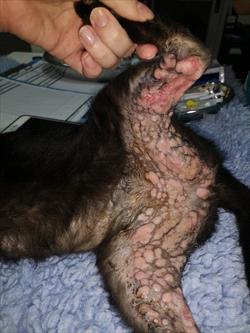
Eosinophilic plaque
Raised erythematous lesions typically found on the medial thigh and abdomen
accompanied by peripheral eosinophilia and pruritus.
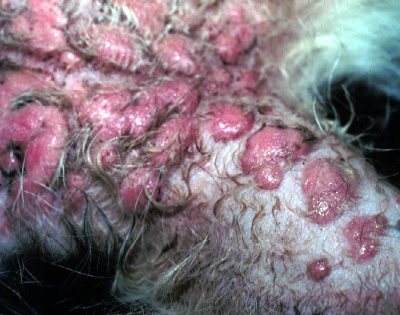
Eosinophilic granuloma
Yellow, orange, or pink lesions found anywhere but mostly on the caudal thighs (linear) and in the oral cavity; occurs more frequently in females and displays peripheral eosinophilia when oral cavity lesions are present.
Eosinophilic skin disease diagnosis
Performed using incisional or excisional biopsy.
Eosinophilic skin disease treatment
Includes anti-inflammatory therapy with prednisolone or cyclosporine, radiotherapy, laser therapy, surgical excision, and treating underlying causes like atopy or allergies.
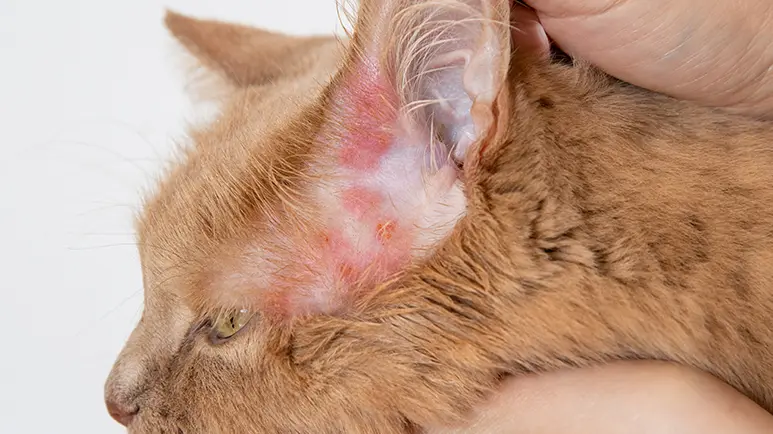
Eosinophilic ulcers and plaques associations
Conditions commonly associated with flea or food allergies and atopy.
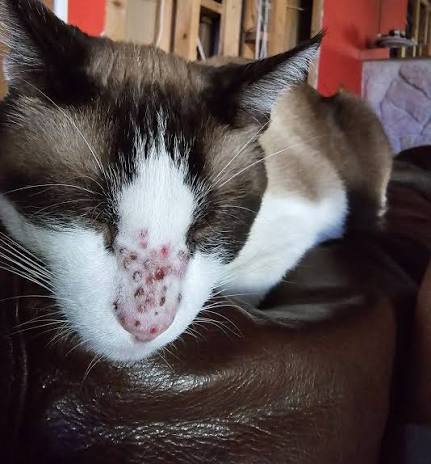
Eosinophilic granulomas association
Condition commonly associated with mosquito bites.