9.9 Enzyme Mechanism and Catalysis II
 Call Kai
 Learn
Learn Practice Test
 Spaced Repetition
 Match
Match Flashcards
 Knowt Play
1/23

There's no tags or description
Looks like no tags are added yet.
Name | Mastery | Learn | Test | Matching | Spaced | Call with Kai | Chat |
|---|
No analytics yet
Send a link to your students to track their progress
24 Terms
Substrates can be aligned by binding to an enzyme so that
nucleophiles are position for reaction
An AA residue can function both as a
general acid and general base
Transition-State Analogs
Stable molecules designed to resemble transition states; type of irreversible inhibitors; binds more tightly than substrate
Protease catalyzes _______ _______ of ______ ____ at ___-terminal side
hydrolytic cleavage of peptide bonds; C-terminal
Chymotrypsin
bovine pancreatic protease that catalyzes the hydrolytic cleavage of aromatic AA peptide bond
Chymotrypsin cleaves polypeptide chains at _-terminal side of the aromatic amino acid residues:
C terminal; Phe, Trp, and Tyr
Chymotrypsin enhances rate by
109
Phase 1 of hydrolysis reaction
Acylation of N-terminal with Phe
Phase 2 of hydrolysis reaction
Deacylation of N-terminal fragment (releasing Phe)
Hexokinase catalyzes the phosphorylation of
glucose in a reversible reaction, involving Mg ion, ADP and ATP
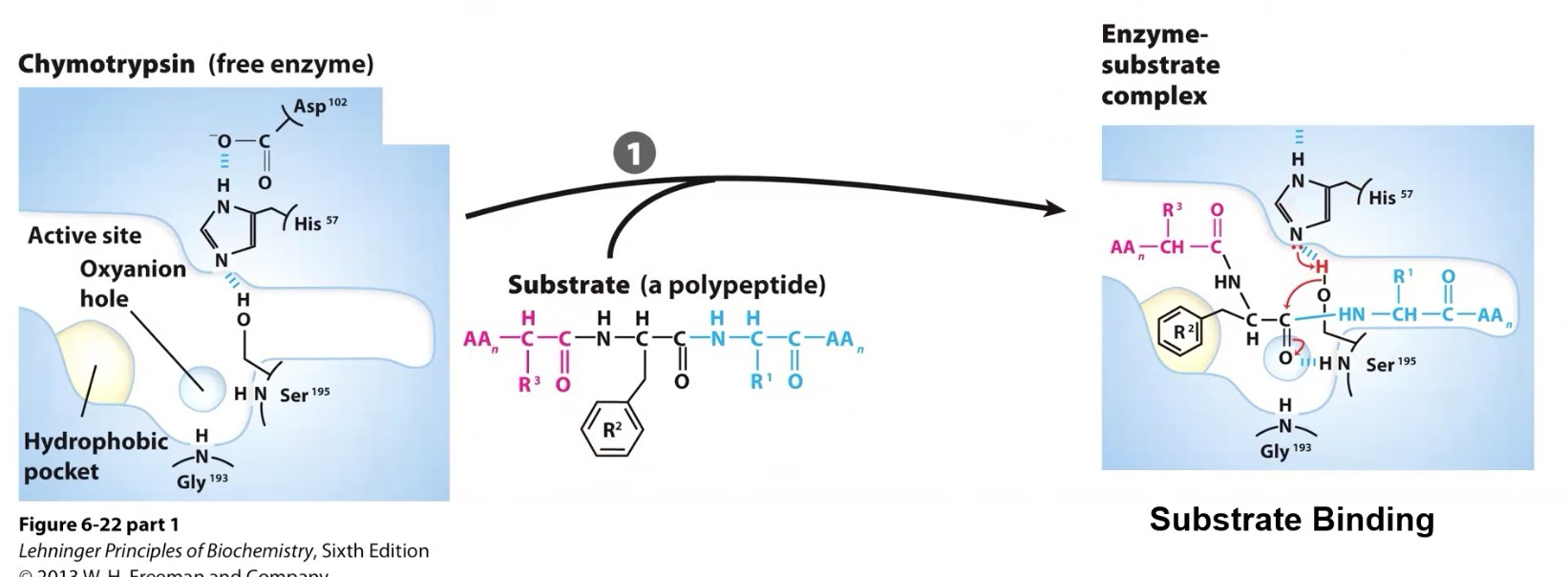
Phase 1 - Step 1, Chymotrypsin Reaction
Substrate binds to active site at Asp-102, His-57, and Ser-195, forming catalytic triad, Asp -102 makes His-57 a better general base in the first step
This step creates the ES complex
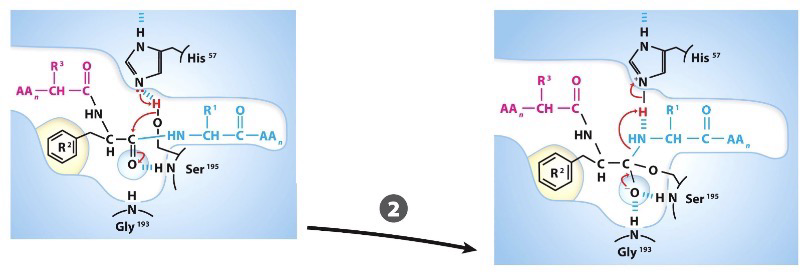
Phase 1 - Step 2, Chymotrypsin Reaction
His-57 acts as general base and deprotonates hydroxyl group on Ser-195 to make it a nucleophile.
Ser-195 then acts as a nuc to attack carbonyl group on substrate (Covalent catalysis)
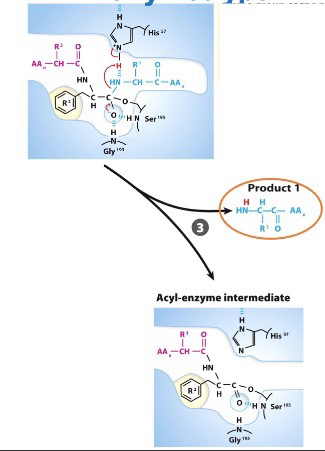
Phase 1 - Step 3, Chymotrypsin Reaction
Short-lived protonated His-57 from step two acts as an acid and protonates the amine leaving group, causing the peptide bond to break and product 1 (Group on peptide bond) to leave
This step creates the acyl-enzyme intermediate
Phase 2 - Step 4, Chymotrypsin Reaction
Water enters site where product exited
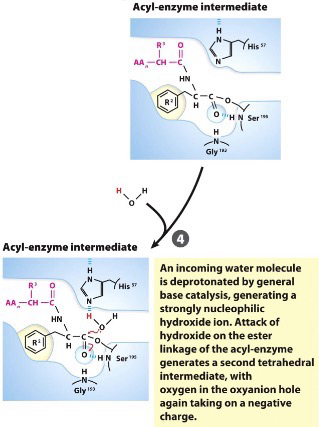
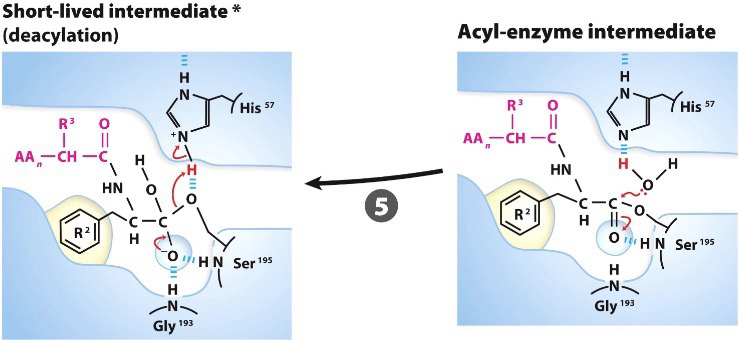
Phase 2 - Step 5, Chymotrypsin Reaction
His-57 acts as a general acid to deprotonate water, making it more nucleophilic, the OH- then attacks the carbonyl carbon
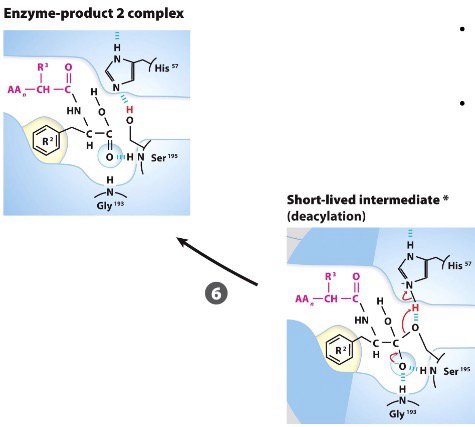
Phase 2 - Step 6, Chymotrypsin Reaction
Protonated His-57 acts as a general acid to protonate Ser-195 leaving group
Ser-195 cleaves from the N-term end of polypeptide (This regenerates the enzyme)
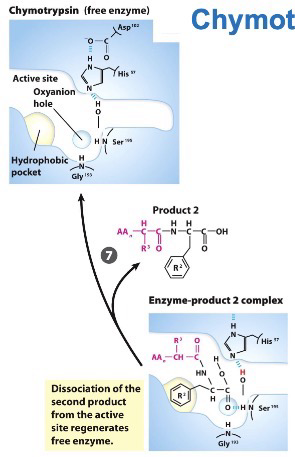
Phase 2 - Step 7, Chymotrypsin Reaction
The final product (N-term end of original substrate) leaves
Enzyme can restart reaction again
Explain pH dependence of chymotrypsin reactions; pH 7, 8, and 8.5
pH7: protonation of His57 stops enzyme function; pH8: optimal, His57 is unprotonated and Ile16 is protonated; pH8.5: Ile16 is deprotonated, stops enzyme function
Retrovirus
possesses an RNA genome and enzyme; a reverse transcriptase that uses RNA to direct synthesis of a complementary DNA; ex. HIV
HIV protease mechanism
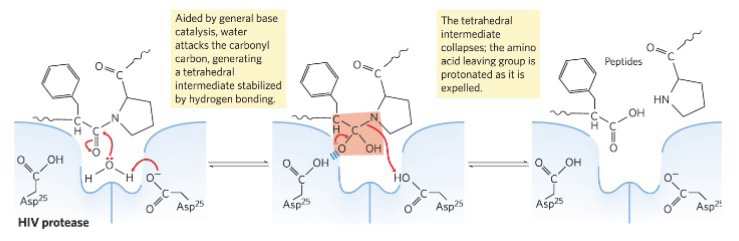
Aspartyl protease: Utilizes water to cut amino acid leaving group; Water attacks carbonyl carbon to generate tetrahedral intermediate with Asp25, when it collapses, the amino group is expelled and protonated by another Asp as it leaves
HIV protease inhibitors
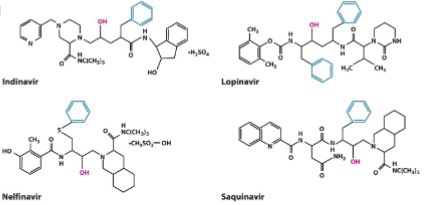
Irreversible inhibitors; forms a noncovalent complex with the enzyme; red hydroxyl groups acts as a transition-state analogs and blue benzyl groups targets binding site
Transition-state analogs
Inhibitors meant to mimic the high-energy, short-term intermediates of enzymes
Hexokinase induced fit; what causes hexokinase autophosphorylation?
Hexokinase phosphorylates glucose molecule; when Mg*ATP binds, the energy created results in a conformational change that makes hexokinase active and facilitate the phosphorylation; very specific to glucose. In presence of xylose, hexokinase is tricked to induce autophosphorylation.
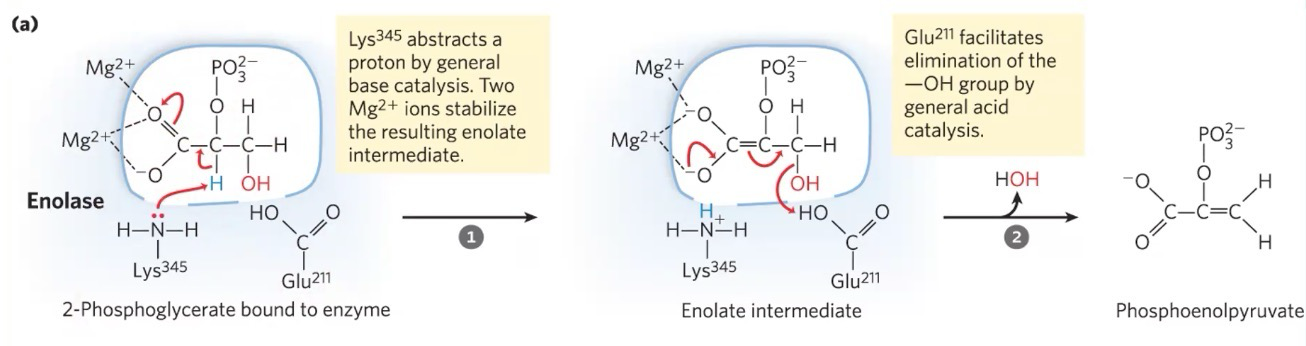
Enolase; Enzyme requires what?; Provide mechanism
Catalyzes dehydration of 2-phosphoglycerate to phosphoenolpyruvate; Requires metal ions (Mg+2) which acts as a cofactor
Lys345 attracts a proton via base catalysis. 2 Mg+2 stabilizes structure. Glu211 eliminates OH group by acid catalysis