Lab Quiz #3
 Call Kai
 Learn
Learn Practice Test
 Spaced Repetition
 Match
Match Flashcards
 Knowt Play
1/27

There's no tags or description
Looks like no tags are added yet.
Name | Mastery | Learn | Test | Matching | Spaced | Call with Kai | Chat |
|---|
No analytics yet
Send a link to your students to track their progress
28 Terms
Diffusion
“To spread out”. It is the net movement of a substance down a concentration gradient—from a region of high concentration to a region of low concentration.
Rate of diffusion
How fast molecules move down a concentration gradient
Kinetic energy
Energy due to motion. Increasing temperature of a molecule will increase the speed of its random movements.
Copper vessel
Coldest object on earth, cooled down to -459.659 F
Concentration
Amount of solute particles dissolved in a given amount of solution
Solute
The minor component of the solution that is dissolved by the solvent
Solvent
The major component of the solution that dissolves the solute
Sugar
Solute
Water
Solvent
Kool Aid
Solution
Concentration of solution
Amount of solute(sugar) / amount of solvent(water)
Molar (M)
Moles / liter
The larger the difference in concentration
The faster molecules will diffuse
Molecular weight
The weight of a molecule. Think of yourself swimming in water or jello. Agar is a jello-like subastance obtained in algae sugars. Dye will diffuse slower in agar compared to water.
Osmosis
Diffusion of water of a water molecule in a solution across a semipermeable membrane
Semipermeable membrane
Barrier that allows some molecules to pass through, and prevents other molecules from passing through
Lower M (2)
Higher concentration than (5)
Semipermeable membrane
H2O passes, charged ions can not (Na+, CL-)
Osmotic force
Pushing the water from left compartment to the right compartment.
Tonicity
Relative solute concentrations inside and outside of a cell. Determine if water will tend to diffuse into a cell, out of a cell, or have no net movement in either direction

Hypertonic solution
Concentration of solutes in the extracellular solution is higher than the solute concentration inside of the cell. Water would move out of your blood cells. The cells would shrivel up and get smaller.

Hypotonic solution
Concentration of solutes in the extracellular solution is lower than the solute concentration inside of the cell. Water moves into blood cells in this situation. The cells will swell with water and may burst like an over-inflated water balloon.
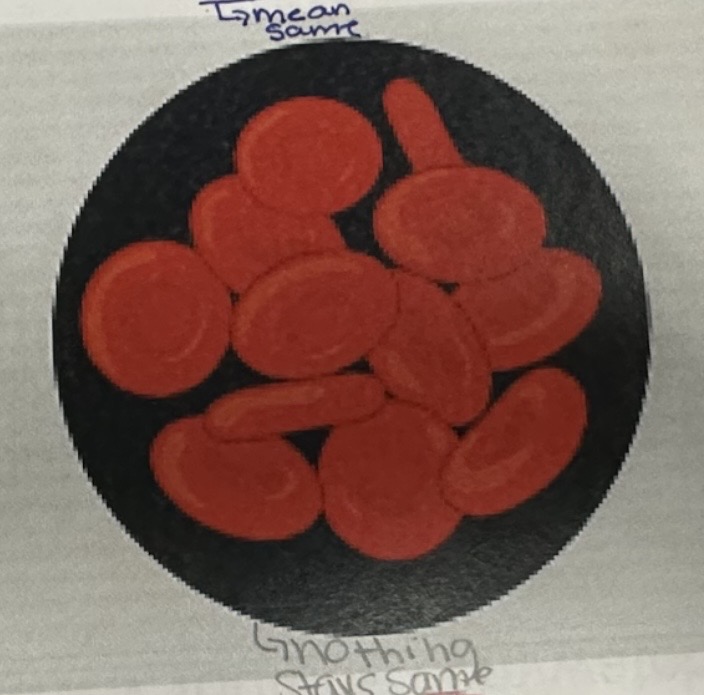
Isotonic solution
Concentration of solutes in the extracellular solution is equal to the solute concentration inside of the cell. There is no net movement of water, although water is still moving into and out of the cell. This is the ideal situation. The Na+CL- concentration of blood is 0.154 M. Please consider this when injecting fluids into someone’s blood stream.
Interphase

Prophase

Metaphase

Anaphase

Telophase
