Psychology Day 1,2,3
 Call Kai
 Learn
Learn Practice Test
 Spaced Repetition
 Match
Match Flashcards
 Knowt Play
1/66

There's no tags or description
Looks like no tags are added yet.
Name | Mastery | Learn | Test | Matching | Spaced | Call with Kai | Chat |
|---|
No analytics yet
Send a link to your students to track their progress
67 Terms
Physical Activity
Any bodily movement produced by skeletal muscles and requires energy expenditure
Exercise
Planned, structured and repeated activity to achieve physical psychological or social benefit
Psychology
Scientific Study of Behavior and mental processes
PA PSYCH
Scientific Study of human behavior within diverse exercise settings
Paradigm Shift
The shift of types of exercise and focuses within a time frame
Pre-1990 Shift
Exercise for fitness
Post-1990 Shift
Exercise for health
Guidelines for 5-17
60 min per day, muscle strengthening 3x/wk
Guidelines for 18-64
150 min/wk, Muscle Strengthening 2x/wk
65+ Guidelines
150min/wk, Fall Prevention 3+days/wk, Muscle Strengthening 2+x/wk
Canadian 24 hr Movement Guideline
Physical Activity: 150 min per wk, Muscle 2+x/wkm Several hours of light pa
Sleep: 7-9 hrs
Sedentary behavior: Limit to 8 hrs, no more then 3 hrs screen time
2 objectives of PA Psycho
Application of psychological principles to the adoption and maintenance of PA behavior
Understanding the psychological consequences of PA
Epidemiology
Study of How a disease or health outcome is distributed in population and what factors influence or determine this distribution.
Goals of Epidemiology
Distribution (Who, When, Where)
Identifying (Risk factors associated with increased probability of disease outcome)
Prevent (Modifying identified risk factors)
Ebola Example
What: Ebola virus disease
Who: Anyone who comes into contact with the virus
When: 2014
Where: West Africa
Why: Virus transmitted from animals to people and through human to human
Measures of Epidemiology
Incident Cases
Prevalent Cases
Rates
Incident Cases
New occurrences of an event during a period of interest (Water flowing into Bathtub)
Prevalent Cases
Number of persons in population that have a particular disease or condition at a specific point in time. (Active Cases) (Water in Tub)
Rates
Number of cases/average population size (How fast/much water is flowing in Tub)
4 Types of Study Designs
Cross-Sectional Studies
Case-Control Studies
Cohort Studies
Randomized controlled Trial
Cross Sectional Studies
Risk factors and presence or absence of disease are measured at the same time (Snapshot of a group)
Case-Controlled Studies
People with presence of disease are matched with controls without disease. Frequency of past exposures to risk factors for disease compared between the two groups (Finding the cause) (Rare diseases)
Cohort Study
A group is followed for a defined period of time to ascertain occurrence of health outcome (Followed until health outcome happens)
Randomized Controlled Trial
A study in which participants are randomly assigned to receive an experimental manipulation or control condition
Goals of PA Epidemiology
Distribution (Who is inactive, when, where)
Identify Risk Factors (of being inactive or active)
Investigate Associations (PA relation of risk of disease)
Prevent (Modifying PA Behavior)
London Busman Study
Drivers had increased myocardial infarction rates compared to conductors
California Longshorman Study
Strenuous activity was protective from coronary heart disease
Harvard Alumni Study
Men who expended >/= 2k cal/wk from activity lived an average of 2.15 years longer than those who expended <500 cal/wk
Aerobics Center Longitudinal Study (ACL)
Higher levels of fitness associated with reduced risk of all cause mortality. Getting at least some PA in helps
Included women
Sedentary Behavior METS
<1.6 METS
Light PA Mets
1.6-2.9 METS
Moderate PA METS
3-5.9 METS
Vigorous PA METS
>6 METS
3 PA Assessment Measures
Self-Reported Measures
Wearable Measures
Direct Observation
Why Measure PA
To accurately recommend PA based on different factors
Main PA Trends
Men more vigorous/Women more moderate
Older=Less Active
More Education= More PA
Main Perceived Reasons to exercise
Physical Health
Mental Health
Social Benefit
Most Common Percieved Barriers
Lack of time
Lack of energy
Lack of motivation
Why are theories essential
They allow us to better understand and predict behavior
Social Cognitive Theory / Self-Efficacy Theory
Behavior is influenced by both personal cognitive factors and environmental influences
Personal Cognitive influences on behavior
Self Efficacy (Belief in yourself)
Collective efficacy (Group Belief Collectively)
Outcome Expectation (What your think will happen after)
Knowledge
Self-Efficacy
Situation Specific Self Confidence
Sources of Self-Efficacy
Past performance (I did it before)
Vicarious experiences (If they can do it, so can I)
Social Persuasion (Support)
Physiological/Affective States (How you feel during it ±)
Socioenvironmental Influences on Behavior
Observational learning (Learning by watching)
Normative Beliefs (social norm)
Social Support (Perception of support from others)
Barriers and Opportunities (Social and Physical Environ ±)
Supporting Behavior Factors
Behavior Skills (What you need)
Intentions (Do you plan to do it)
Reinforcement and Punishment (Increase good/decrease bad)
Postive Reinforcement
Adding something positive to increase exercise behavior
Negative Reinforcement
Taking away something negative to increase exercise behavior
Punishment
Adding something negative to decrease exercise behavior
Extinction
Taking away reinforcement to decrease exercise behavior
Main Constructs of the Social Cognitive Theory
Personal Cognitive Factors
Socioenvironmental Factors
Behavior
Advantages of SCT
Multi Dimensional
Easily applicable to interventions and clinical work
Disadvantages of SCT
MANY constructs make it hard to test
Hard to say which constructs are most important to behavior change
Model vs Theory
Model doesnt show the “WHY”
SCT SUMMARY
←→ Person ←→ Behavior ←→ Environment ←→
Theory of Reasoned Action (TRA)
“Intentions are the best predictor of behavior”
Based on Attitudes and Sugestive norm

TRA Intervention
Increasing your intentions to exercise (Attitude/Suggestive Norms)
Limitations of the TRA
Intentions do not always lead to the intended behavior
Ex: New Years Resolution
Theory of Planned Behavior
Adds the construct of perceived behavior control
More Repeatable

3 Constructs of Theory of Planned Behavior
Attitude
Suggestive Norm
Perceived Behavior Control
Why is perceived behavior control important in the Theory of Planned Behavior
Because it can directly impact ones behavior without having to influence their intentions
Theory of Planned Behavior Advantages
Shown to have small but significant effect on exercise
good job at explaining intentions
Theory of planned behavior disadvantages
only explain 25% of total variability in exercise behavior
cant explain why so many people who intend to exercise dont
Health Belief Model
How likely are you to engage in preventative health measure such as exercising
Health Belief Model Constructs
Perceived Severity
Perceived Susceptibility
Perceived Barriers (Costs)
Perceived Benefits
Health Belief Model Picture
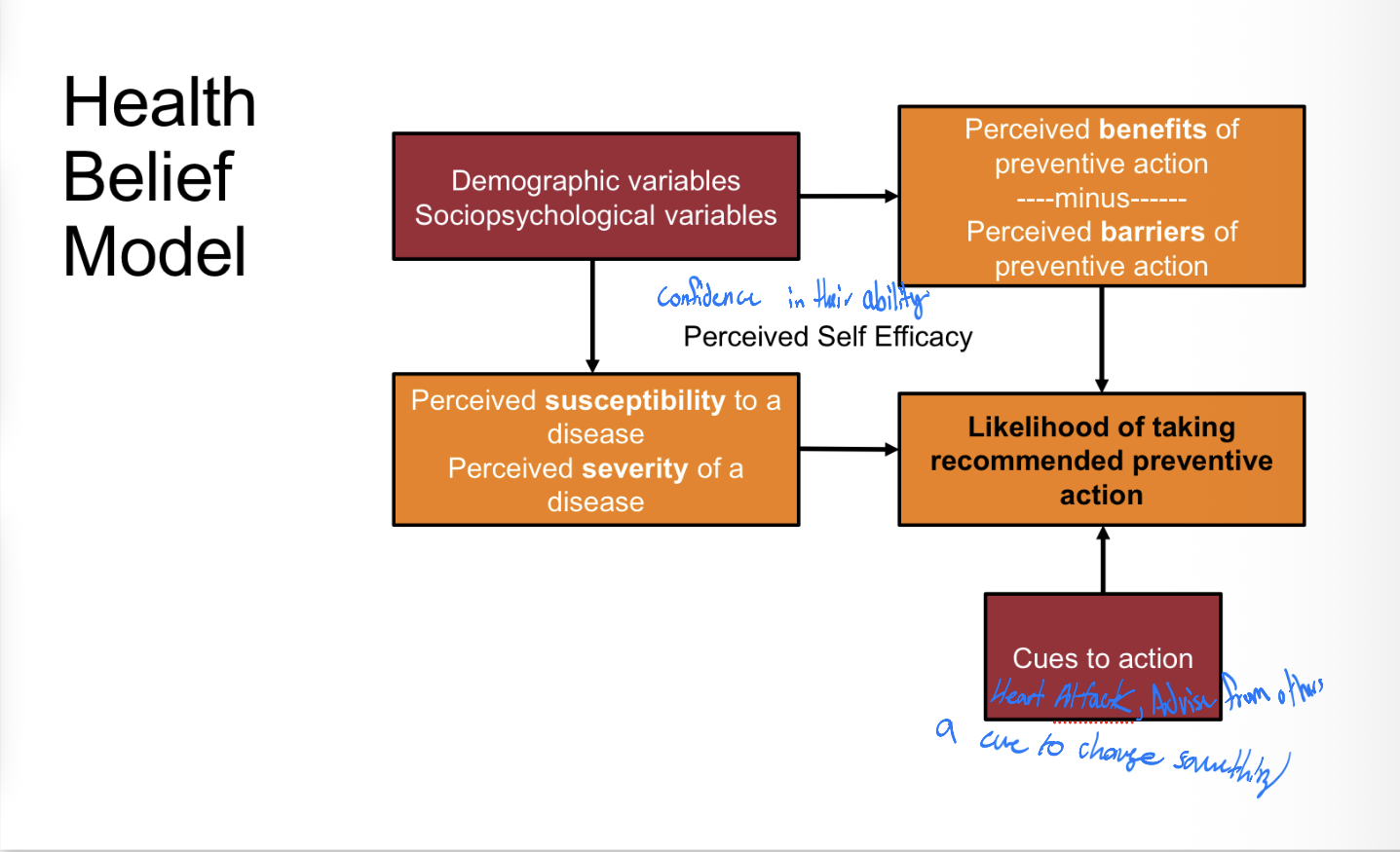
Health Belief Model Advantages
Barries have been shown to be strong predictors of PA
Health Belief Model Disadvantages
Designed just for risk avoiding
only explains 20% variability in behavior