NIFE Aerodynamics - Unit 1
 Call Kai
 Learn
Learn Practice Test
 Spaced Repetition
 Match
Match Flashcards
 Knowt Play
1/39

There's no tags or description
Looks like no tags are added yet.
Name | Mastery | Learn | Test | Matching | Spaced | Call with Kai | Chat |
|---|
No analytics yet
Send a link to your students to track their progress
40 Terms
General Gas Law
Sets the relationship between three properties of air: pressure (P), density (ρ), and temperature (T).
P=ρRT (R is a constant for any given gas)
Trimmed Flight
Exists when the sum of all moments around the center of gravity is equal to zero.
Temperature vs Altitude
Decreases linearly with an increase in altitude at a rate of 2 deg C per 1000 ft until approximately 36,000 ft. After 36,000 ft, the temperature is constant (isothermal)
Humidity vs Air density
As humidity increases, air density decreases
Steady Airflow
Exists if at every point in the airflow static pressure, density, temperature, and velocity remain constant over time.
Continuity equation
A1V1=A2V2
Vector
A quantity that has magnitude and direction. Resultant vector may be divided into separate components.
Density (rho)
Mass per unit volume
Moment
A rotational force around a point or axis
Equilibrium Flight
Exists when the sum of all forces and the sum of all moments around the center of gravity are equal to zero.
Bernoulli's Equation
Total pressure (Pt) equals static pressure (Ps) plus dynamic pressure (q)
Pt=Ps+q
q=(1/2)ρ(V^2)
Order of Airspeeds
Indicated Airspeed (IAS)
Calibrated Airspeed (CAS)
Equivalent Airspeed (EAS)
True Airspeed (TAS)
Ground Speed
Remember "ICE-TG"
Indicated Airspeed (IAS)
Airspeed read directly from the airspeed indicator
Calibrated Airspeed (CAS)
Indicated airspeed corrected for instrument error.
Equivalent Airspeed (EAS)
The true airspeed at sea level on a standard day that produces the same dynamic pressure as the actual flight condition.
Found by correcting calibrated airspeed for compressibility error
True Airspeed (TAS)
Actual speed you are moving through the air
Ground Speed (GS)
True Airspeed corrected for winds; actual speed of airplane over the ground.
Mean chamber line
line drawn halfway between the upper and lower surfaces of a wing.
Chord
precise measurement between the leading and trailing edges measured along the chordline
Camber
maximum distance between the mean camber line and the chord line measured perpendicular to the chord line
Types of camber
Positive - Mean chord is above the chordline
Zero - Symmetric airfoil or flat plate
Negative - Mean chord is below the chordline
Wingspan (b)
The length of a wing, measured from wingtip to wingtip.
Wing Area (S)
Apparent surface area of a wing from wingtip to wingtip; S=bc
Chordwise Flow
Air flowing at right angles to the leading edge of an airfoil.
Spanwise Flow
Airflow that travels along the span of the wing, parallel to the leading edge.
Pitch Attitude
The angle between an airplane's longitudinal axis and the horizon.
Flight Path
The path described by its center of gravity as it moves through an air mass.
Relative wind
the flow of air which moves opposite the flight path of an airplane
Angle of Attack
The angle formed by the wing chord line and the relative wind.
Angle of incidence
The angle between the airplane's longitudinal axis and the chordline of the wing.
Airplane Three-Axis Reference System
Longitudinal axis - passes from the nose to the tail of the airplane
Lateral axis - passes from wingtip to wingtip
Vertical Axis - passes vertically through the center of gravity
Center of Gravtiy
The point at which all weight is considered to be concentrated and about which all forces and moments are measured
Aerodynamic Center
The point along the chordline around which all changes in the aerodynamic force take place.
Two forces considered aerodynamic forces
Lift and Drag
Pressure distribution around an airfoil
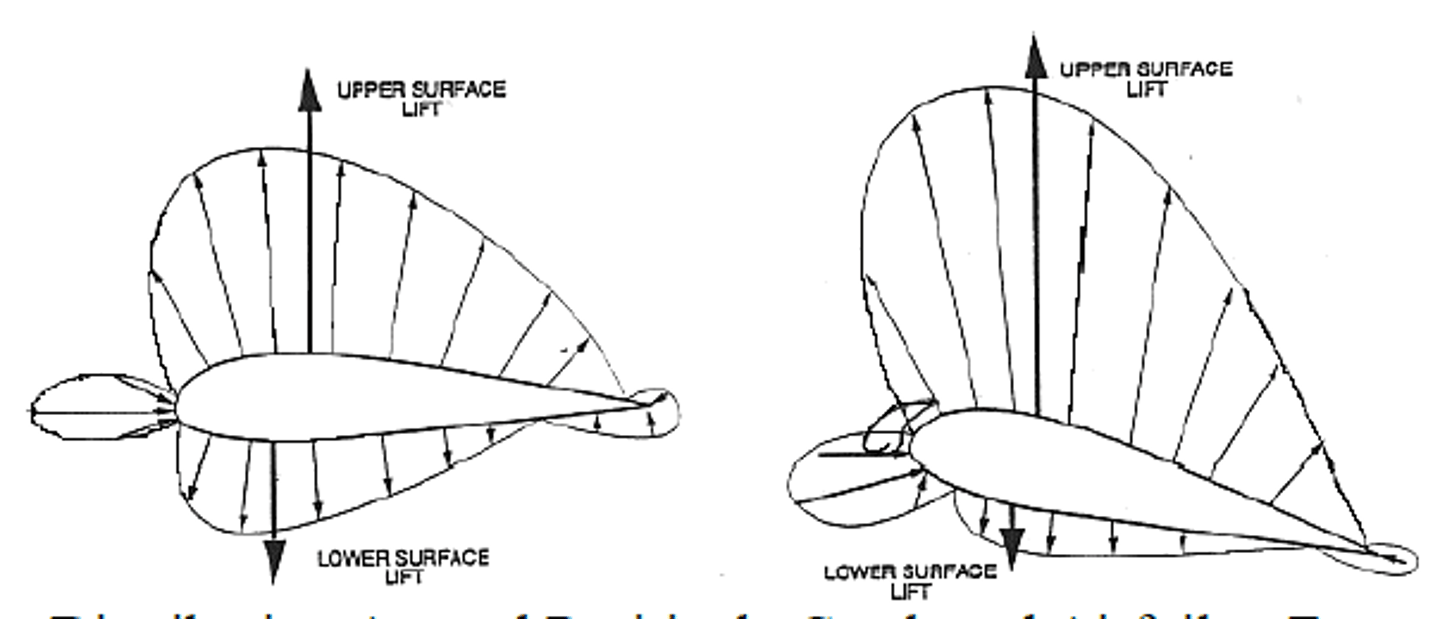
Factors in the lift equation that affect lift production
L = (1/2)ρ(V^2)SCL
Density (ρ)
Velocity (V)
Surface Area (S)
Compressibility
Aspect ratio (AR)
Viscosity (μ)
Angle of attack (α)
Camber
Factors affecting coefficient of lift
Shape of the airfoil
Angle of attack (α)
CL_max
Maximum value for the coefficient of lift
Coefficient of lift vs angle of attack
As angle of attack increases, the coefficient of lift increases.
Any increase in angle of attack beyond CL_max AOA causes a decrease in the coefficient of lift
How flaps affect coefficient of lift
Flaps change the chamber of the airfoil.
Extending flaps adds positive chamber, decreasing the zero-lift AOA