M&B Midterm 1
 Call Kai
 Learn
Learn Practice Test
 Spaced Repetition
 Match
Match Flashcards
 Knowt Play
1/164

There's no tags or description
Looks like no tags are added yet.
Name | Mastery | Learn | Test | Matching | Spaced | Call with Kai | Chat |
|---|
No analytics yet
Send a link to your students to track their progress
165 Terms
Inflation averaged ___% during 1992-2020
1.8%
Inflation surged to ___% in 6/22
7.1%
Inflation went down under ___% by 11/23
3%
Now (6/26), inflation is back up to ___%
3.7%
During 1967-83, inflation was generally above ___%
4%
During 1973-75 and 1979-81, inflation was generally above ___%
10%
National Debt now ___% of GDP
123
2021-23 inflation surge erased ~___% of debt despite large deficits
8%
Between 2008-2021, Fed increased Base ___ fold by buying ___
7.5 fold
Treasury debt + mortgages
Monetary Base = ____ + ____
Currency + Bank Reserves
From 2000-2006, home prices increased by what amount?
Doubled
In 2009, home prices fell by ___%, causing ____
30%
Mortgage defaults
What happened in 2009 after widespread mortgage defaults?
Housing construction fell sharply, led to recession
When was the “Great Recession”?
2008-2014
Unemployment remained above ___% between 08/2008-08/2014, and hit ___% in 10/09
6%
10%
Ben Bernanke on 2008 financial crisis
“The immediate trigger of the crisis … was a sharp decline in house prices, which reversed a previous runup that had been fueled by irresponsible mortgage lending and securitization practices.” – 1/3/14 AEA address
“The bursting of the bubble helped trigger the most severe financial crisis since the Great Depression [of the 1930s].” – 1/3/14 AEA address
“Sept. and Oct. of 2008 was the worst financial crisis in global history, including the Great Depression”
What was the maximum unemployment rate during the Great Recession?
10%
What was the maximum unemployment rate during 1982?
10.8%
What was the maximum unemployment rate during 1932?
22.5%
Remained mostly >10% through 1940
How many banks failed between 2009-12?
Over 100/yr in 2009-10, max 157
How many banks failed between 1982-92?
Over 200 failures per year
How many banks failed between 1930-33?
Thousands of failures per year
Barter (Direct Exchange)
Mutually advantageous direct exchange of commodities
or services
Monetary (Indirect) Exchange
Exchange of less desired commodities or services for more desired commodities etc, by means of the acquisition of, and then disposal of, an even less desired commodity than is originally given up
Why can’t we just use barter, why bother with money?
Barter is always adequate in a 2-person economy
In a larger economy, direct exchange may be incapable of achieving all (or even most) mutually beneficial exchanges
What are the implications of money as an indirect means of exchange?
Purchasing Power of M must be ascertained before it is accepted (Step I), and is determined entirely by experience of prior acceptability
M must be held for a while as M (creates a demand for M)
Why will one good tend to be adopted as the medium of indirect exchange?
By means of contagion. If c is already being accepted by A as M, a fourth person D is more likely to also accept c as M
The right M to use is the one everyone else in your society is using, just as…
…the right language to use is the one everyone else around you understands
6 Desirable Features of M
• Durable
• Portable
• Divisible
• Fungible (uniform and interchangeable)
• Recognizable
• Stable in value
Money Prices do 2 key things
Communicate marginal values and costs of unlike goods in a common unit
Permit rational economic calculation, efficient coordination of decentralized economic plans, and delegation of decisions to managers
Who developed the Indirect Exchange Theory of Money?
Austrian economist Carl Menger, ”On the Origin of Money
Monetary Certificates
Title to a unit of the M commodity, authorizing bearer to take delivery on demand
100% Reserve Deposit
Account backed 1-for-1 by monetary commodity, transferable by check
In US, when did gold certificates circulate until?
1933
In US, when did silver certificates circulate until?
1964
Fractional Reserve Bank Notes and Deposits
Bank could lend out some of reserves to earn interest and still might be able to meet all redemptions
Would help cover operating costs + allow it to pay interest on deposits
Customers ordinarily prefer this arrangement
Fractional reserve bank liabilities are contracts, not titles to property. So the breach of contrast is a ____.
Tort.
Which is not a crime. It may result in bankruptcy and/or lawsuits but not jail.
Why may inconvertible notes and deposits w/ no backing still have value?
received status as M + demand for M
Fiat Money
Paper M that is not, and never will be, redeemable in a physical commodity.
What do governents often do with Fiat Money?
Give themselves a monopoly over creating it + use it as source of profit
State Theory of Money (c.p. Indirect Exchange)
Money is that which the State (government) declares to be money.
It is valuable because the State requires taxes to be paid in units of it.
Colonial Silver Standard
Colonists used Spanish Dollar (aka peso de ocho) = 8 reales (8 “bits”) for transactions.
Name originated as Habsburg Thaler, first minted in St. Joachimsthal
USD designed by Alexander Hamilton to have same silver content as “circulating Spanish dollars
When/what was the Bimetallic Standard?
1972-1861
Use of both silver and gold as currency at a legally fixed value ratio
What are the pros and cons of gold and silver?
Silver heavy and not very portable for large transactions, but quite divisible for small transactions.
Gold more portable, but not very divisible for small transactions
What was the mint price of silver during Bimetallic Standard?
$1.293 / troy oz
Was there free and unlimited coinage for silver/gold during Bimetallic Standard?
Yes
No seigniorage (profit) from minting
What if silver coins were worn down during the bimetallic standard?
Worn coins were only legal tender (valid for payment of debts) by actual weight (50¢, 25¢, 10¢, 5¢ coins w/ prop. silver)
What were the silver coins made of during the bimetallic standard?
Alloy 90% silver + 10% copper (improve durability)
What was the mint price of gold during Bimetallic Standard?
$19.39/oz
What were gold coins made of during Bimetallic Standard?
1 gold Eagle contained 1/1.939 troy oz pure gold.
What was the OG mint ratio?
19.39:1.293 = 15 :1
What was token copper coinage used for during Bimetallic Standard?
1 cent, 2 cent pieces
Legal tender only for very small sums
Supply limited by Demand for small denominations
Created “Seigniorage” profit for Treasury, helped defer costs of gold/silver coinage
1 oz Troy = ___ gm
31.1
Gresham’s Law
If two forms of money are both legal tender, at a mint ratio that differs from the price ratio on the world market, the overvalued money will tend to drive the undervalued money out of circulation
After 1800, the French mint ratio was ___
15.5:1
After 1800, the US mint ratio was ___. What was the impact of this ratio?
15:1
US overvalued silver relative to gold. Silver drove gold out of circulation in US, leaving US on a De Facto (in fact) Silver Standard prior to 1834, even though De Jure (in law) Bimetallic.
When was the US on a De Facto Silver standard?
1792-1834
Since silver was heavy, bank notes became only currency in US for over $1
When was the US on a De Facto Gold standard?
1834-1861
Why did the De Facto Gold standard occur?
Accidental!
Andrew Jackson raised mint price of gold to $20.67 to provide a “hard money” substitute for paper bank notes
US mint ratio changed to 16:1 (c.p. global 15.5:1)
Now, US overvalued gold relative to silver, drove out silver dollar
Subsidiary Silver Coinage (1853-1965)
Silver 50¢, 25¢, 10¢ reduced to 93% of full silver
Nickel 5¢ piece replaced silver half-dime
Minting not free or unlimited (small seigniorage)
Legal tender only for small payments
When was the Greenback Standard?
During the Civil War, 1862-1879
What was a Greenback?
Issued by US Treasury
Originally paid in gold, but by end of 1861 conversion was suspended
February 1862, Made legal tender and drove gold/subsidiary-silver/copper out
When/what was the Coinage Act?
1873, eliminated silver definition of dollar
When was the Monometallic Gold Standard?
1879-1933
Was there any silver as legal tender during Monometallic Gold Standard?
Yes. Some limited minting of legal tender silver dollars, but not enough to drive out gold & mostly used to back silver certificates
By 1894, the mint price of silver decreased to ___
$0.63/oz
When/what was the Bimetallism Movement?
Occurred during 1890s
Advocated restoring unlimited minting of silver and making it legal tender for all future/prior debts
Dominated 1896, 1900 presidential elections
Bimetallism: Wm. Jennings Bryan (D)
"Cross of Gold" speech
"Crime of 1873"
Gold: Wm. McKinley (R, won twice)
What were Federal Reserve Notes?
Introduced in 1914
Originally obligations to pay gold on demand
Backed 40% w gold, 60% w gold-denominated loans
Originally not legal tender
What is the Fiat Money Standard?
1933-present
Banking Crisis at onset of Great Depression, 1930-33
FD Roosevelt declared “banking holiday” March 1933, immediately after inauguration.
Gold coins “temporarily” called in, but actually replaced by Federal Reserve notes as legal tender
What is the current mint ratio (09/26)?
Gold is $4362/oz, Silver $64.11/oz
Ratio = 63.0:1
What is the CPI-U?
Consumer Price Index for All Urban Consumers
What is the current base year for the CPI-U?
1982-4
How often is the CPI-U computed?
Monthly
Who computes the CPI-U?
Bureau of Labor Statistics (BLS) in U.S. Department of Labor
When is the CPI-U released?
In a one-month lag. It is final on release (except for seasonal adjustments).
What scale is better to visualise growth rates? Linear or logarithmic?
Logarithmic. Slope indicates growth rate.
CPI-U grew much ___ during “Great Inflation” of 1967-83 than in 2021-3 surge
More
Inflation
Rate of growth of price level

Deflation
Negative inflation; rate of decline of price level
What was the inflation rate between 8/26 – 8/25 (1982-4 = 100)?
3.3%
What was the inflation rate between 8/25 – 8/24 (1982-4 = 100)?
2.9%
If you use a CPI with a different base rate to compute a given inflation rate, will you get the same result?
Yes
Is month-to-month CPI-U worthwhile?
Month-to-month inflation is mostly noise + rounding error.
Year-over-year is more meaningful.
In 1973-74, 1979-83 inflation was above ___%
≥10%
Between 2008-09 (7/08 - 7/09), the inflation rate was ___%
-2.0%
What are the major categories of the CPI-U?
Food
Energy
Shelter
Vehicles & parts
Transportation services
Apparel
Education & communication services
Recreational services
Medical services
Seasonal Adjustments
Many prices and quantities are highly seasonal
CPI-U is published both with Seasonal Adjustment (SA) and Not Seasonally Adjusted (NSA)
Are SA figures are more commonly reported than NSA?
Yes
Are SA ever revised?
Yes, as new data comes in.
Does seasonality affect year-over-year inflation?
No, except for the revisions
The payments on Treasury Inflation Protection Securities (TIPS) are indexed to ___? Why?
CPI-U (NSA)
CPI-U (SA) would not be suitable because of the revisions to the seasonality
Boskin Congressional Commission Report (1996)
Found CPI-U had overstated "true" inflation by about 1.1%/yr
0.6% due to new products
0.4% due to substitution away from goods whose prices increased
0.1% due to changing shopping locations
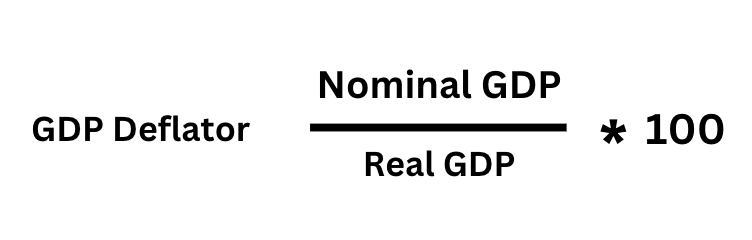
GDP Deflator
Measure of how high prices are in each year as compared with base year (currently 2017)
Released quarterly
Revised repeatedly as new data comes in
Includes investment, gov’t expenditures that are not part of the cost of living
PCE
Personal Consumption Expenditures (PCE) are major component of GDP that directly correspond to the goods whose prices are measured by CPI
What is the PCE-PI?
PCE Price Index
Released monthly since 1959
Base year is same as GDP Deflator
Revised repeatedly as new quantity data comes in (final revision is more accurate than first release CPI-U)
GDP and PCE are almost ___
Identical
Are GDP and PCE the same as the CPI-U?
They are not the same, but they tell a similar story.
What is the Fed’s preferred price index for measuring inflation?
Personal Consumption Expenditures Price Index (PCE-PI)
Since 2000, annual US inflation as measured by the CPI-U has
averaged ___% ___ than PCE inflation
0.36%/yr more
Chained CPI-U
Uses past/future weights, so behaves more like PCE-PI
Is still revised but not as much as PCE PI
Since 2000, exceeds PCE-PI inflation by 0.10%/yr (vs. 0.36%/yr for CPI-U)
Effective 2019, Federal income brackets are indexed with Chained CPI-U, not CPI-U itself