Study Guide P (test 3)
 Call Kai
 Learn
Learn Practice Test
 Spaced Repetition
 Match
Match Flashcards
 Knowt Play
1/193

There's no tags or description
Looks like no tags are added yet.
Name | Mastery | Learn | Test | Matching | Spaced | Call with Kai | Chat |
|---|
No analytics yet
Send a link to your students to track their progress
194 Terms
What would cause “Water Retention”?
ADH hypersecretion
renin release
increased osmolarity of blood
What would cause “Water Loss”?
hemorrhage
Aldosterone hyposecretion
decreased renal tubular reabsorption of water
What is the result of ADH Release?
reduction in urine volume
increased water reabsorption from kidney tubules
increased aquaporin
drinking water
What stimulates the release of ADH?
reduction in total body water
increase blood osmolarity
What stimulates the release of Aldosterone?
higher concentration of K+ in the ECF
Hyponatremia
Hyperkalemia
Hypotension
What is the “result of Aldosterone release”?
increased production of DCT sodium-potassium ATPase pumps
increased potassium secretion
higher urine concentration of potassium
increased sodium reabsorption
What is the order for the homeostasis of Potassium ions?
Potassium ion concentration increases (stimulus)
Adrenal cortex is signaled (receptor)
Aldosterone is secreted (effector)
Renal tubules increase reabsorption of Na+ and increase secretion of K+ (action)
sodium ions are conserved and potassium ions are excreted (response)
What actions of the body would “Decrease” water levels in the body?
sweating, cutaneous transpiration, urinating, defecating, breathing
What actions of the body would “Increase” water levels in the body?
eating, drinking
Diarrhea and hemorrhage are an example of what type of fluid imbalance?
Volume depletion
Kidney’s decrease fluid loss is an example of what type of fluid imbalance?
volume excess
profuse sweating is an example of what type of fluid imbalance?
dehydration
Positive water balance is an example of what type of fluid imbalance?
Hypotonic hydration
Pleural effusion and Edema is an example of what type of fluid imbalance?
Fluid sequestration
“Increased interstitial fluid formation” is caused by?
increased Blood volume
increased hydrostatic blood pressure
increased capillary leakage
“Decreased reabsorption into capillaries” is caused by?
decreased blood colloid osmotic pressure
reduced ability of the liver to produce albumin
“Decreased lymph formation” is caused by?
surgical removal of tissue
following a mastectomy
What are the effects of Angiotensin II?
decreases urine output
What are the effects of ADH?
decrease urine output
What are the effects of Aldosterone?
decreases urine output
What are the effects of ANP?
increase urine output
decreased blood volume
decreases blood pressure
What are examples of Nonelectrolyes?
glucose, creatinine, urea
What are examples of Electrolytes?
sodium hydroxide, hydrochloric acid, sodium chloride
When blood pressure is low, angiotensin II acts on several organs to help raise blood pressure
How do “Blood vessels” respond?
increases peripheral resistance
When blood pressure is low, angiotensin II acts on several organs to help raise blood pressure
How do “Kidney’s” respond?
mesangial cells contract
vasoconstriction of afferent arterioles
decreases in GFR
When blood pressure is low, angiotensin II acts on several organs to help raise blood pressure
How does the “Hypothalamus” respond?
releases ADH
When blood pressure is low, angiotensin II acts on several organs to help raise blood pressure
How does the “Adrenal cortex” respond?
releases Aldosterone
What “decrease” respiratory rate?
increased H+
more CO2 in blood
less CO2 expired
decreased pH
What “increases” respiration rate?
decreased H+
Less CO2 in blood
more CO2 expired
increased pH
What are “Protein buffering system” characteristics?
does ¾ of chemical buffering in body fluids
buffers against pH changes in BOTH the blood and cells
Amine groups buffer acids
carboxylic acid buffers bases
What are “Phosphate buffering system” characteristics?
involved the most common anion within cells
buffers against pH changes ONLY in cells
What are “ Bicarbonate buffering system” characteristics?
buffers against pH changes ONLY in blood
Physiological buffering system involves?
respiratory + urinary system
may take minutes to days
Chemical buffering system involves?
phosphate buffering system
bicarbonate buffering system
protein buffers
works within seconds
Metabolic “Acidosis” involves?
blood H+ increases
causes increased respiration
blood (HCO3)- decreases
Metabolic “Alkalosis” involves?
blood H+ decreases
causes decreased respiration
blood (HCO3)- increases
What causes “ Metabolic Acidosis”?
excess consumption of alcohol
diabetes mellitus
renal dysfunction
diarrhea
What causes “ Metabolic Alkalosis”?
overuse of diuretics
vomiting
excess ingestion of antacid
Place the events of angiotensin II formation in the correct order from stimulus to response
1. low BP
2. sympathetic division stimulation
3. Juxtaglomerular apparatus releases renin into the blood
4. angiotensinogen activated
5. angiotensin I → angiotensin II
6. BP and volume increase
Place the events of ANP release in the correct order from stimulus to response
1. increase in BP or volume
2. stimulation of baroreceptor in atria
3. atria release ANP into blood
4. ANP binds to effectors
5. increase GFR and loss of Na+ in urine
6. decrease in BP or volume
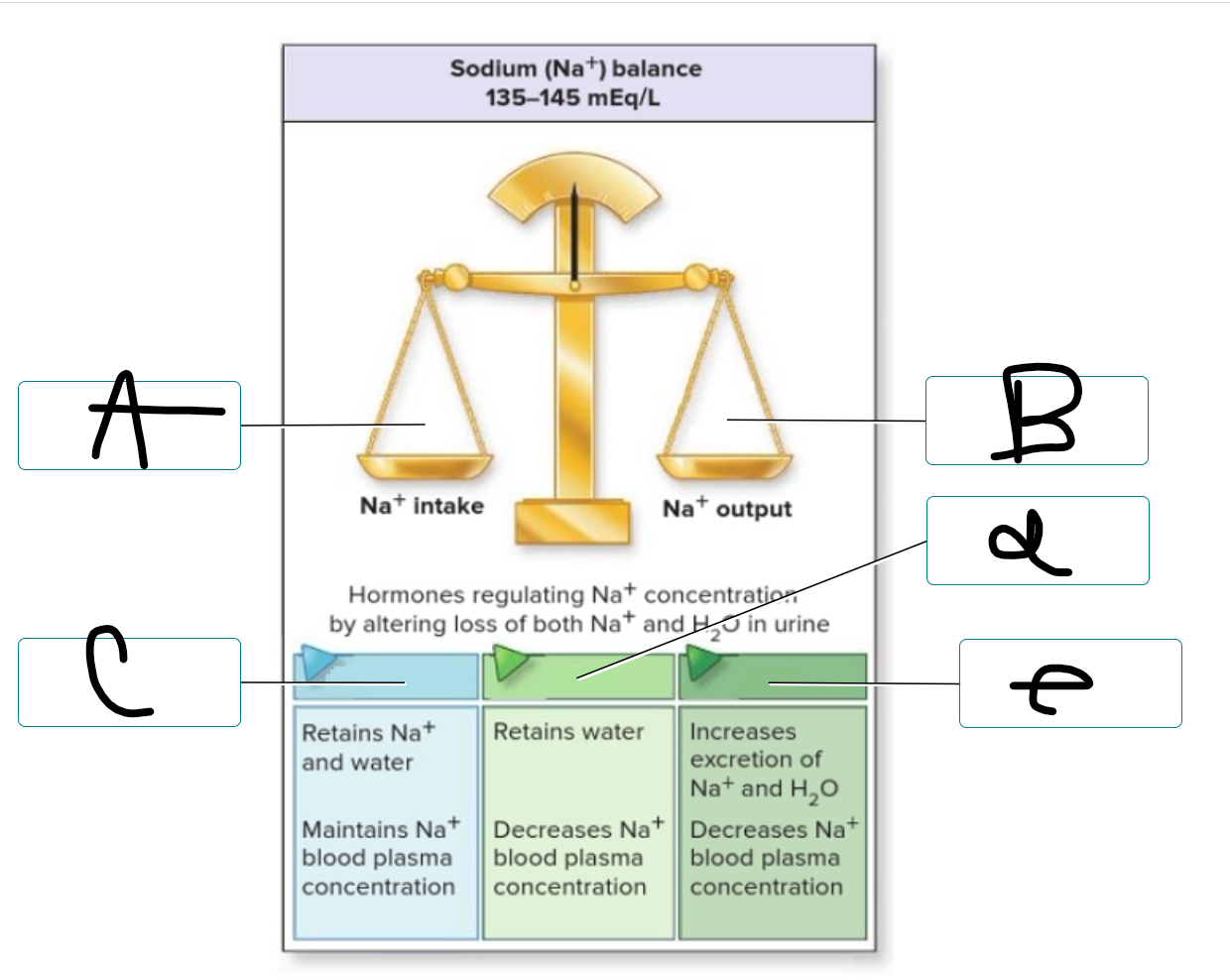
a) diet
b) urine, feces, sweat
c) ALDO
d) ADH
e) ANP
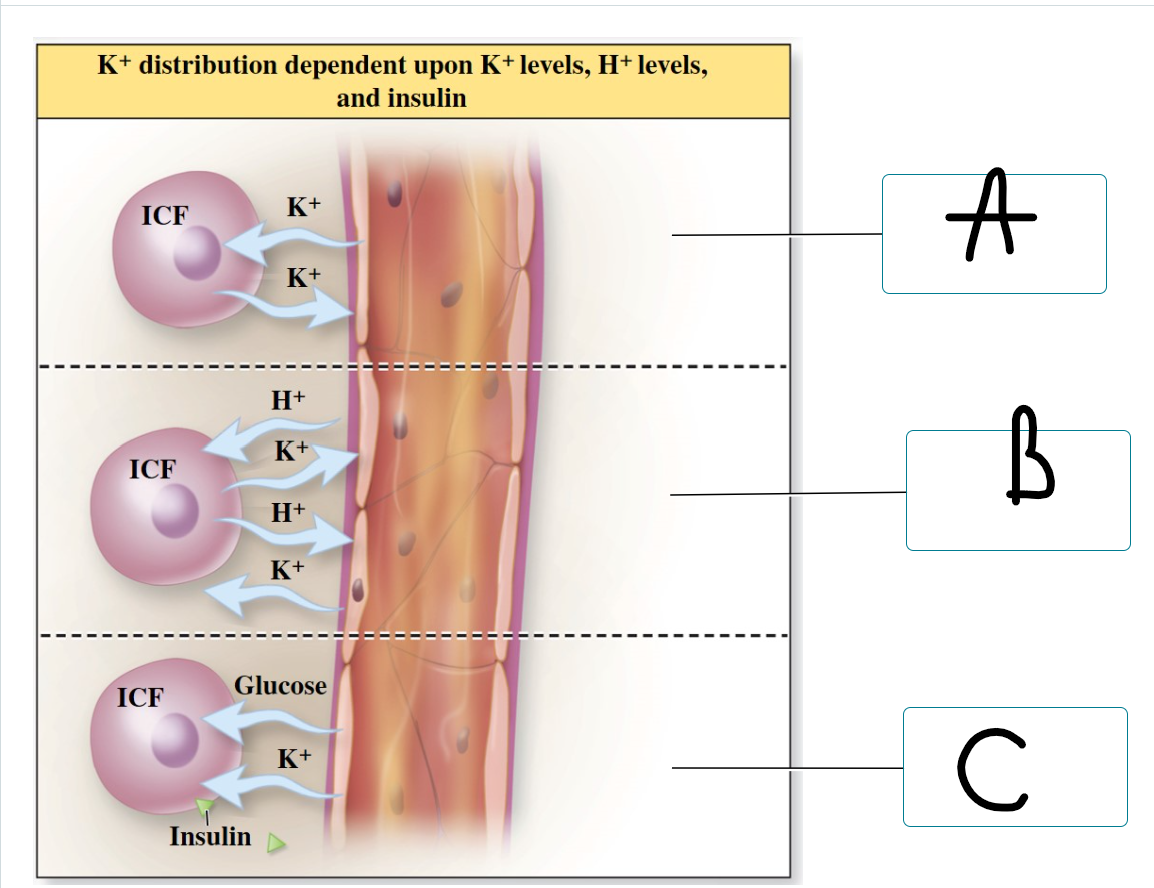
a) normal blood K+ levels maintained
b) blood pH maintained
c) blood K+ levels maintained after eating
What promotes “increase” in BP?
vasoconstriction
increased activity of ACE
increasing levels of ALDO
increased release of renin
What promotes “decrease” in BP?
vasodilation
declining levels of ADH
decreased sodium reabsorption
When blood pH decreases, the kidneys help regulate blood pH by excreting _________ in the urine and by reabsorbing _________.
H+
bicarbonate
When fluid intake is equal to fluid output, and there is a normal distribution of water and solutes, the body is in a state of fluid _________
balance
T or F
On a hot day when fluid output exceeds fluid intake, the body is in danger of a fluid imbalance.
true
What are all of the sources of fluid intake?
ingesting performed water
production of metabolic water from cellular respiration
Urine that is always formed, regardless of the hydration state of the body, is an example of _________ water loss
obligatory
Drinking alcohol increases the production of dilute urine, dehydrating the body. Without the influence of alcohol, what would normally be happening if the body was dehydrated?
facultative water loss would be decreased
T or F
During volume depletion, fluid is lost but there is no net movement of water between intracellular and extracellular compartments.
true
Where is water sequestered in a tissue with edema?
in the interstitial space
Which stimulus for increasing thirst and water intake is monitored by the thirst center directly?
increased blood osmolarity
A decrease in blood pressure results in the
release of renin from the kidneys
What are the stimuli that will “inhibit” the thirst center?
increase salivary secretion
stretched stomach wall
When blood osmolarity drops?
ADH release is decreased
What substance will exert the greatest osmotic pressure?
CaCl2
Ingesting too much sodium may lead to
a hypertonic extracellular fluid
Sodium is an important electrolyte because
it contributes significantly to blood plasma osmolarity
What would “stimulate” angiotensin II formation?
sympathetic stimulation of the kidneys
low BP
What are the “effectors” of angiotensin II?
hypothalamus, kidneys, blood vessels
Angiotensin II stimulates _________release of the adrenal cortex
aldosterone
What are the “effects” of aldosterone?
increased blood volume
increased BP
increased plasma sodium levels
What are the “effects” of ANP?
systemic vasodilation
increased urine output
Lactic acid is an example of a _________ acid.
fixed
Carbonic acid is
regulated by the respiratory system
In response to decreasing blood pH, the kidneys will?
retain bicarbonate
As blood pH becomes too high, the kidneys will?
reabsorb H+
A protein in the blood plasma binds excess H+ after a meal. In this example, the protein is serving as a?
weak base
In response to an acid-base disturbance, the physiological buffering systems respond to bring pH back to normal. This response is known as _________
compensation
A patient has a chronically low blood pH (below 7.35), despite the response of the physiologic buffering systems.
What is happening to the patient?
the pH disturbance is uncompensated
the patient has an acid-base imbalance
After a traumatic event, a patient is hyperventilating.
What is happening?
the patient may reach a state of respiratory alkalosis
blood pH is increasing
After vomiting profusely, a patient has a decreased respiratory rate. This can be explained as
the respiratory response to metabolic alkalosis.
If there is a decrease in the pH of the ECF, which direction will the K+K+ ions move?
From the ICF to the ECF
Patients with a COPD, such as chronic bronchitis, cannot fully exhale causing their carbon dioxide levels to increase. Because of this they are often in a state of?
respiratory acidosis
What is fluid balance?
Exists when fluid intake is equal to fluid output, and a normal distribution of water and solutes is present in the two major fluid compartments.
Two categories of fluid intake
- Ingested water: includes the water absorbed from food and drink taken into the GI tract
- Metabolic water: includes the water produced daily from aerobic cellular respiration and dehydration synthesis
Fluid is lost from the body through the normal mechanisms of:
- Breathing
- Sweating
- Cutaneous transpiration (evaporation of water directly through the skin)
- Defecation
- Urination
What is sensible water loss?
measurable, includes fluid lost through feces and urine
What is insensible water loss?
no measurable; includes both fluid lost in expired air and fluid lost from the skin through sweat and cutaneous transpiration
What is obligatory water loss?
Loss of water that always occurs, regardless of the state of hydration of the body. It included water lost through breathing and through the skin (insensible water loss), as well as fluid lost in the feces and in the minimal amount of urine produced to eliminate wastes from the body.
What is facultative water loss?
Controlled water loss through regulation of the amount of urine expelled from the body. It is dependent upon the degree of hydration of the body and is hormonally regulated in the DCT, collecting tubules, and collecting ducts in the nephrons of the kidneys.
Fluid imbalance with constant osmolarity- When does this occur?
when isotonic fluid is lost or gained
What can lead to volume depletion?
When isotonic fluid loss is greater than isotonic fluid gain.
When does fluid imbalance with changes in osmolarity occur?
when fluid loss or gain that is not isotonic
What is dehydration?
water loss that is greater than solute loss
Causes of dehydration
profuse sweating, diabetes mellitus, intake of alcohol, hypersecretion of ADH, insufficient water intake, or overexpose to cold weather
In each case, the greater loss of water than the loss of solutes results in the blood plasma becoming hypertonic (relatively more concentrated).
What is hypotonic hydration?
water gain (retention) that is greater that solute gain
Causes of hypotonic hydration?
ADH hypersecretion or drinking a large amount of plain water following excessive sweating
The blood plasma becomes hypertonic to the other fluid compartments. Fluid moves from blood plasma into the IF, and then into the cells. Cells may look swollen with fluid.
What is fluid sequestration?
Total body fluid may be normal, but it is distributed abnormally. Fluid accumulates in a particular location, and it is not available for use elsewhere.
What is edema?
Fluid accumulates in the interstitial space around the cells and is characterized by swelling
What can lead to edema?
Either an increased formation of interstitial fluid or a decreased removal of interstitial fluid
What are some other examples of fluid sequestration?
Hemorrhage, ascites, pericardial effusion, and pleural effusion
What is directly measured to regulate fluid balance?
monitoring blood volume, blood pressure, and blood plasma osmolarity (concentration of solutes in blood plasma).
What occurs when fluid intake exceeds fluid output?
An increase in blood volume and increase in blood pressure
What occurs when fluid output exceeds fluid intake?
A decrease in blood volume and a decrease in blood pressure
What regulates fluid intake? Where is it located?
Thirst center located within the hypothalamus
What hormone stimulates the thirst center?
angiotensin II
When receptors in the thirst center detect an increase in osmolarity, they stimulate the release of which hormone?
ADH
What is another mechanism that stimulates the thirst center?
Decreased salivary secretions