Surgery Lecture Exam 3
 Call Kai
 Learn
Learn Practice Test
 Spaced Repetition
 Match
Match Flashcards
 Knowt Play
1/296

There's no tags or description
Looks like no tags are added yet.
Name | Mastery | Learn | Test | Matching | Spaced | Call with Kai | Chat |
|---|
No analytics yet
Send a link to your students to track their progress
297 Terms
What does palliation mean?
treatments that help with the symptoms but does not cure the illness
What are some examples of surgical oncology ancillary procedures?
placement of a vascular access port
spay/neuter
____ - disorders that develop when cancer-fighting antibodies or hormones mistakenly attack healthy cells
paraneoplastic syndrome
What are some aspects to remember when taking a history pertaining to a mass?
location/number
duration
size
changes in appearance
When completing a cancer work-up, we should map the location and size of the masses using a what?
body map
A thorough general exam can sometimes include what other types of examinations?
orthopedic
neurological
What are some clinical pathology tests we can run to help diagnose cancer?
CBC/Chem
Urinalysis
Cytology
ACTH stim test or Dexamethasone suppression test
Ionized calcium
Parathyroid hormone panel
Why do we run radiographs when diagnosing cancer?
We need to see what areas are affected and if it has metastasized yet
What radiographic views do we run when looking for metastasis of cancer cells?
3-view thoracic
2-view abdominal
_____ - diagnostic imaging test that uses a tiny, safe dose of radioactive liquid to find hidden damage in bones and tissue
nuclear scintigraphy
What are the two ways to diagnose what type of cancer?
Biopsy
Surgical removal with histologic examination
What are the indications for biopsying a mass?
treatment will differ depending on the tumor
planning for surgical resection
diagnosis would change owner’s desire to treat
What are two types of tissue sampling techniques?
impression smears
fine needle aspirate
What are three types of minimally invasive biopsy techniques?
needle core biopsy
punch biopsy
image-guided biopsy
What are three types of surgical biopsy techniques?
incisional biopsy
excisional biopsy
biopsy via minimally invasive surgical techniques
____ - press a glass slide against open lesion or cut edge of excised lesion. Direct sampling of superficial ulcerated lesions or other exfoliated cells
impression smear
T or F: Sedation is required for an impression smear.
False, it is noninvasive
When making an impression smear, it is important to remember to do what?
Do not squash, twist, or rub the tissues on the slide.
Fine needle aspiration is easy, cheap, and minimally invasive. What is a con?
low diagnostic yield
What size needle and syringe do we use for fine needle aspirations?
20-22 gauge needle
3-5 cc syringe
Do patients need sedation for FNA?
no
Which FNA technique requires you to place the needle in the mass and quickly stab repeatedly while moving the needle tip direction?
“woodpecker” technique
Which FNA technique requires you to place the needle in the mass and quickly pull the plunger back 1-2 mls? Repeat this in the same spot 3-4 times.
Suction technique
With the FNA suction technique, when should you stop pulling on the plunger?
when you see blood
What are the indications of a needle core biopsy?
when there is no diagnosis with FNA or impression smear
when you need more tissue for characterization
Can we use a needle core biopsy on masses on organs?
Yes, organs visible by ultrasound or CT and are near the body wall (liver, kidney)
Tru-cut biopsy needles are used for what kind of biopsy?
soft tissue
Do needle core biopsies require sedation?
Yes, or local anesthetic
T or F: You should wear sterile gloves when performing a needle core biopsy.
True
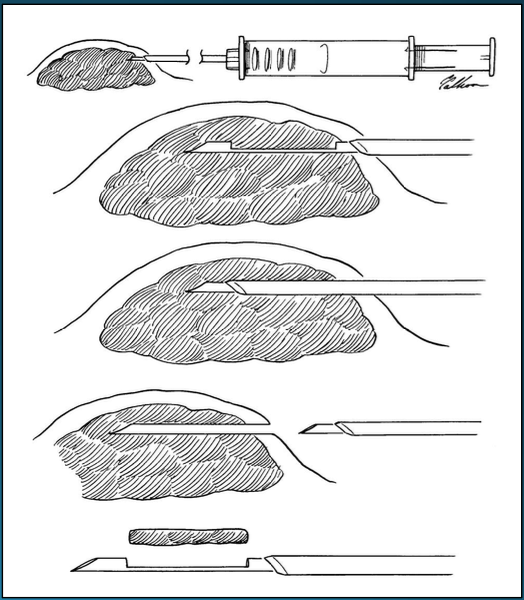
This is an example of what kind of biopsy method?
Tru-cut (needle core biopsy)
Which bone biopsy needle would we use for smaller samples?
Jamshidi
Which bone biopsy needle would we use for larger samples?
Michele trephine
When using a Michele trephine biopsy tool, you have a higher risk of what?
pathologic fractures
T or F: Bone biopsies require general anesthesia and surgical preparation of the site.
True
What are the 4 locations we can use to retrieve bone biopsies?
proximal humerus
ilial wing
proximal femur
proximal tibia (for young dogs only)
What are the indications for a punch biopsy?
cutaneous masses
focal organ masses (liver, pancreas, spleen)
intestinal biopsies
What is the proper name for the punch biopsy tool?
Baker skin biopsy punch
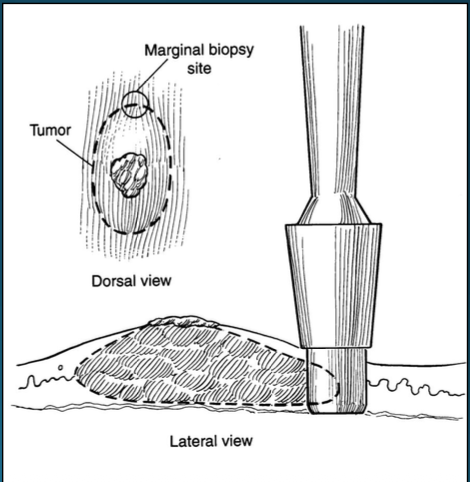
What type of biopsy method is this?
punch biopsy
T or F: When collecting a sample using a punch biopsy, you want to get the sample from the middle of the lesion.
False, sample from the edge to include normal tissue
T or F: Punch biopsies do not require sedation.
False, sedation or anesthesia and a surgical prep
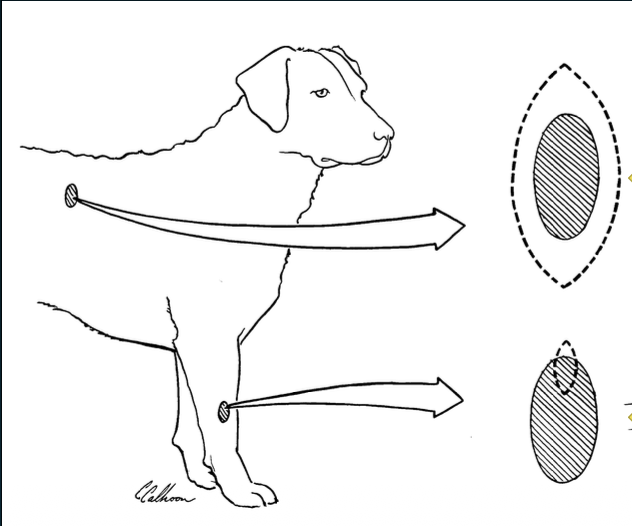
The dotted lines indicate the surgical incision. Which diagram shows an excisional biopsy and which shows an incisional biopsy?
Excisional is on top
Incisional is on bottom
What are the indications for an incisional biopsy?
large, superficial lesions
lesion is located in area where achieving margins and closure might be difficult
when less invasive techniques fail to yield diagnosis
type/aggressiveness of tumor would change treatment plan
Which type of surgical biopsy acts as both a diagnosis and treatment?
excisional biopsy
For which type of biopsy is the treatment choice unchanged by the tumor type?
excisional biopsy
For which type of biopsy would the type/aggressiveness of the tumor change the treatment plan?
incisional biopsy
Which type of biopsy is used on benign tumors/lesions?
excisional
T or F: Complete excision of a cancerous mass cures more patients than any other type of treatment.
True
____ - the amount of normal tissue removed with the tumor
margins
What are the margins for cutaneous carcinomas?
1 cm
What are the margins for mast cell tumors?
2-3 cm
What are the margins for cutaneous sarcomas?
3-5 cm
For which kind of masses do we not need proper margins?
benign tumors with low risk of recurrence (lipoma)
masses in the body cavities
____ - this type of margin collection is classified by the removal of the mass from within the capsule or pseudocapsule
intracapsular
____ - this type of margin collection is classified by the removal of the mass at the margin of tumor
marginal
____ - this type of margin collection is classified by removal of the mass with margins of normal tissue surrounding the tumor
wide excision
____ - this type of margin collection is classified by the removal of the entire affected tissue compartment
radical excision
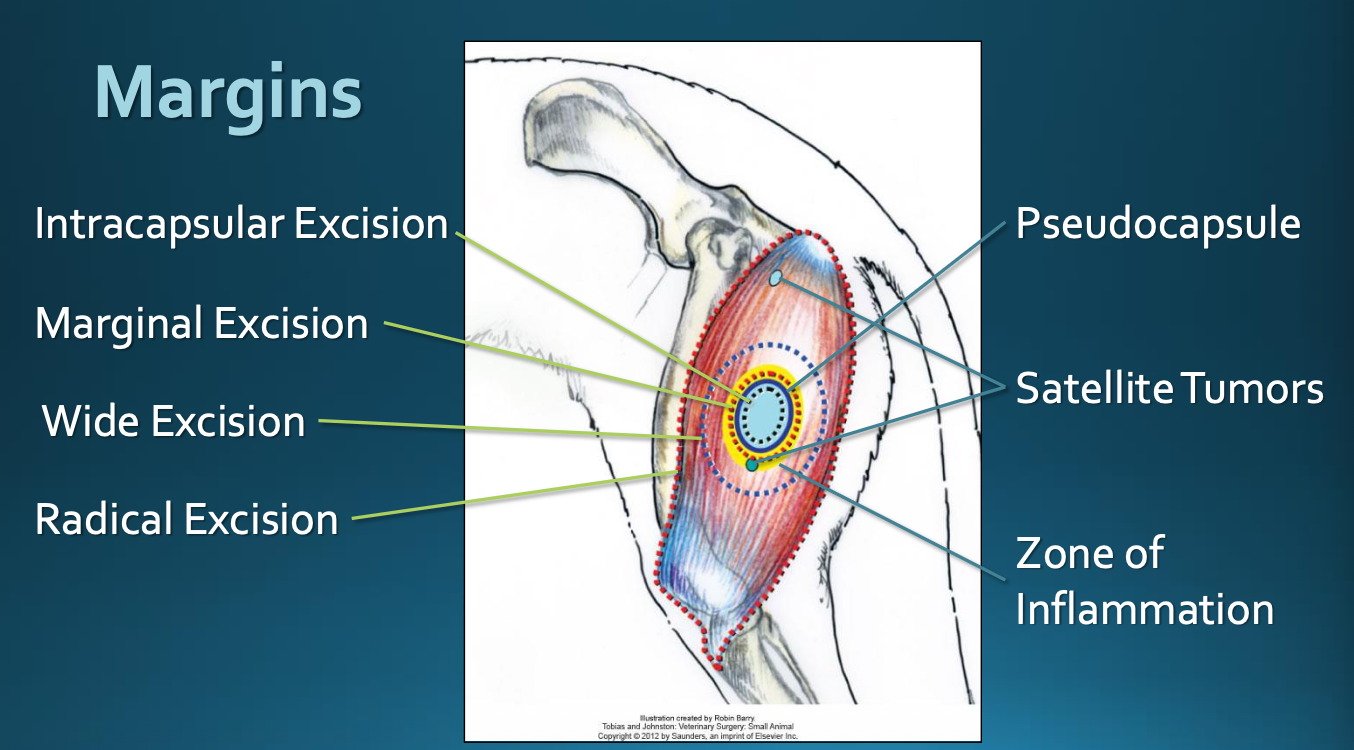
If the capsule is entered during surgical removal what should you do?
lavage surical field
change gloves
new instruments
T or F: When painting margins, you should not double-dip the applicator.
True
We should fix tissue in ___% formalin.
10%
1 part tissue to ___ parts buffered formalin.
10
How deep does formalin penetrate?
1 cm
What technique should we use to fix tissues that are larger than 1 cm?
bread loafing
When labeling slides, why should we not use pen or sharpie?
They tend to come off during staining
What should be included when labeling a sample?
date
patient name and ID number
location of lesion
With ____ surgery, the majority of the mass is removed and it is intended to be followed up with other therapies such as chemo or radiation.
debulking surgery
____ surgery is meant to improve the quality of life and not meant to offer a cure or extend the patient’s life
palliative
____ - a therapy where you inject an ionophore and it goes straight to the tumor. You then shine a light of a specific wavelength on the tumor, and the ionophore heats up and kills the tumor cells.
photodynamic therapy
T or F: When evaluating lymph nodes on a cancer patient, cytologic evaluation by FNA is recommended even if lymph nodes are normal on palpation
True
Spaying will reduce the incidence of ____ tumors.
mammary
Castration can treat/prevent what kind of cancers?
perianal adenomas
testicular tumors
prostatic adenoarcinoma
You should handle biopsies gently to aviod ____
artifacts
Which biopsy technique is used primarily for external skin and oral masses?
punch biopsy
____ represents one of the simplest methods for cytologic evaluation of a mass.
fine-needle aspiration
____ closure is the immediate closure of a wound.
Primary
What types of wounds do we use primary closure for?
clean
clean-contaminated
With ____ closure, the wound is left open for 2-5 days and is closed prior to granulation tissue formation. Permits repeated lavage and debridement to convert the wound to clean-contaminated status appropriate for closure.
delayed primary
With ____ closure, granulation tissue is allowed to form in the wound prior to closure.
Secondary
With secondary wound closure, closure should take place after at least ___ days
5
Secondary wound closure should be performed before ____ has begun
epithelialization
With ___ closure, we don’t physically close the wound. We allow for granulation, epithelialization, and contracture to occur.
Second intention healing
What type of wounds do we allow to heal through second intention?
dirty or infected
How do we close medium-large mildly contaminated wounds?
delayed primary
What is the first action you should complete in initial wound management?
stabilize the patient
Basic concepts for wounds: We want to prevent further wound ____
contamination
Basic concepts for wounds: We want to provide ____ of dead tissue
debridement
Basic concepts for wounds: We want to remove foreign ___ and contaminants
debris
Basic concepts for wounds: We want to provde adequate wound ____
drainage
Basic concepts for wounds: Promotion of a viable ____
vascular bed
Basic concepts for wounds: Selection of appropriate method of ____
closure
What are the first three steps after receiving a wound patient?
stabilize the patient and assess other injuries
cover the wound with bandage during assessment
provide analgesia
Local anesthetics should not penetrate the wound in order to avoid what?
bacterial spread
T or F: When scrubbing the skin, you should also use the chlorhexidine or dilute iodine to clean the actual wound for best results.
False, always avoid actual wound bed with regular scrub solutions
Wound lavage can remove up to ___% of bacteria
90%
What kind of solution should be use to lavage wounds?
saline or balanced electrolyte solution
We should lavage wounds with what psi of pressure?
7-8
___% povidone iodine can be used as a wound lavage
1%
What is the dilution ratio for 1% povidone-iodine being used for sound lavage?
1:10 or 100ml in 1 L
What are some disadvantages of using 1% povidone-iodine as a wound lavage solution?
forms inactive complexes with organic matter
systemic absorption (cats are sensitive)
1% povidone iodine has residual activity for up to how long?
4-6 hours