(1) NHA CCMA GENERAL PATIENT CARE
 Call Kai
 Learn
Learn Practice Test
 Spaced Repetition
 Match
Match Flashcards
 Knowt Play
1/182

Earn XP
Description and Tags
Edited by ME
Name | Mastery | Learn | Test | Matching | Spaced | Call with Kai | Chat |
|---|
No analytics yet
Send a link to your students to track their progress
183 Terms
Normal oral, tympanic, temporal temperature IS?
AND tell me the locations of where oral, tympanic, and temporal is
98.6 °F (37 °C)
Temporal most common for infants
Oral: In the mouth, specifically under the tongue.
Tympanic: In the ear canal.
Temporal: Across the forehead, specifically scanning over the temporal artery.
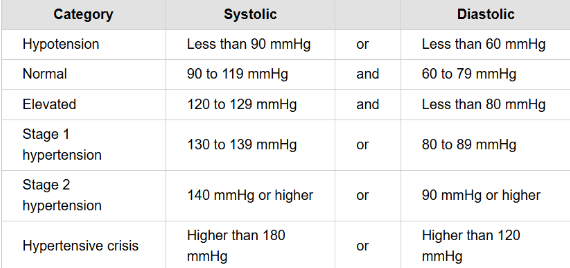
Normal adult BP range
120-90/80-60
I like to write if I forget:
+180 or +120
s2 180-140 or 120-90
S1 140-130 or 90-80
E 130-120/80-60
N 120-90/80-60
H -90 or -60
Start w/ 120-90/80-60 and 130-120/80/60, AND everything else is OR
hypotension adult BP range
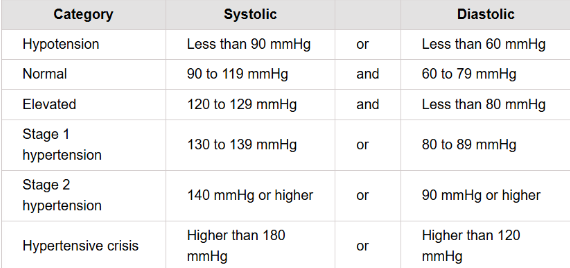
-90 or -60
I like to write if I forget:
+180 or +120
s2 180-140 or 120-90
S1 140-130 or 90-80
E 130-120/80-60
N 120-90/80-60
H -90 or -60
Start w/ 120-90/80-60 and 130-120/80/60, AND everything else is OR
elevated adult BP range
130-120/80-60
I like to write if I forget:
+180 or +120
s2 180-140 or 120-90
S1 140-130 or 90-80
E 130-120/80-60
N 120-90/80-60
H -90 or -60
Start w/ 120-90/80-60 and 130-120/80/60, AND everything else is OR

stage 1 hypertension BP range
140-130 or 90-80
I like to write if I forget:
+180 or +120
s2 180-140 or 120-90
S1 140-130 or 90-80
E 130-120/80-60
N 120-90/80-60
H -90 or -60
Start w/ 120-90/80-60 and 130-120/80/60, AND everything else is OR
hypertensive crisis
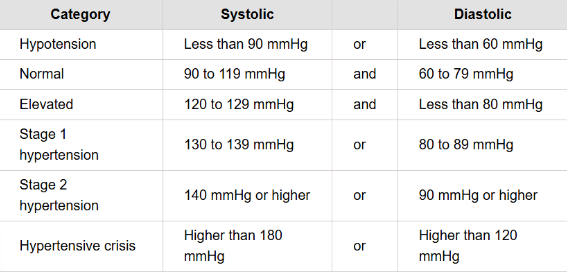
+180 or +120
I like to write if I forget:
+180 or +120
s2 180-140 or 120-90
S1 140-130 or 90-80
E 130-120/80-60
N 120-90/80-60
H -90 or -60
Start w/ 120-90/80-60 and 130-120/80/60, AND everything else is OR

stage 2 hypertension BP range
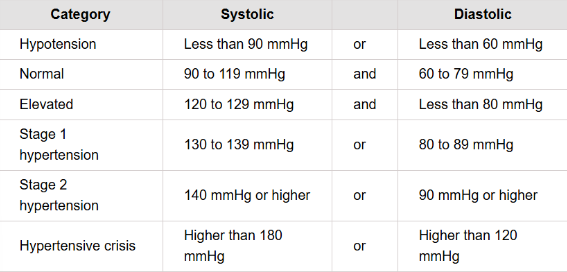
180-140 or 120-90
I like to write if I forget:
+180 or +120
s2 180-140 or 120-90
S1 140-130 or 90-80
E 130-120/80-60
N 120-90/80-60
H -90 or -60
Start w/ 120-90/80-60 and 130-120/80/60, AND everything else is OR
underweight BMI is?
Below 19=underweight
When in doubt Just remember 19-25=normal, 25-30=overweight and go from there
Below 19=underweight
19-25=Normal
25-30=overweight
Over 30=obese
SPECIFICALLY:
30-35=obese class 1
35-40=obese class 2
40+=obese class 3
normal BMI is?
19-25=Normal
When in doubt Just remember 19-25=normal, 25-30=overweight and go from there
Below 19=underweight
19-25=Normal
25-30=overweight
Over 30=obese
SPECIFICALLY:
30-35=obese class 1
35-40=obese class 2
40+=obese class 3
overweight BMI is?
25-30=overweight
When in doubt Just remember 19-25=normal, 25-30=overweight and go from there
Below 19=underweight
19-25=Normal
25-30=overweight
Over 30=obese
SPECIFICALLY:
30-35=obese class 1
35-40=obese class 2
40+=obese class 3
obese BMI is?
Over 30=obese
When in doubt Just remember 19-25=normal, 25-30=overweight and go from there
Below 19=underweight
19-25=Normal
25-30=overweight
Over 30=obese
SPECIFICALLY:
30-35=obese class 1
35-40=obese class 2
40+=obese class 3
obese class 1 BMI is?
30-35=obese class 1
When in doubt Just remember 19-25=normal, 25-30=overweight and go from there
Below 19=underweight
19-25=Normal
25-30=overweight
Over 30=obese
SPECIFICALLY:
30-35=obese class 1
35-40=obese class 2
40+=obese class 3
obese class 2 BMI is?
35-40=obese class 2
When in doubt Just remember 19-25=normal, 25-30=overweight and go from there
Below 19=underweight
19-25=Normal
25-30=overweight
Over 30=obese
SPECIFICALLY:
30-35=obese class 1
35-40=obese class 2
40+=obese class 3
obese class 3 BMI is?
40+=obese class 3
When in doubt Just remember 19-25=normal, 25-30=overweight and go from there
Below 19=underweight
19-25=Normal
25-30=overweight
Over 30=obese
SPECIFICALLY:
30-35=obese class 1
35-40=obese class 2
40+=obese class 3
age range for newborn/infant
0-1 yr
IM needle gauge, length, and angle
20-23 G, 1-3", 90 degrees
Injection type | Needle Gauge & Length | Angle | Location |
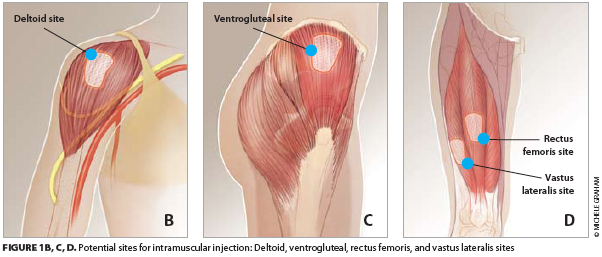
Intramuscular (IM) | 20-23 G x 1-3" | 90° | 1. deltoid ≤ 1 mL 2. ventrogluteal > 1 mL 3. vastus lateralis (pediatrics) |
Subcutaneous (SC) | 25-26 G x 5/8" | 45° | 1. lower abdomen 2. fatty part of upper arm 3. outer thigh |
Insulin (SC) | 31 G x 1/4" | 90° | (Locations shared with Subcutaneous above) |
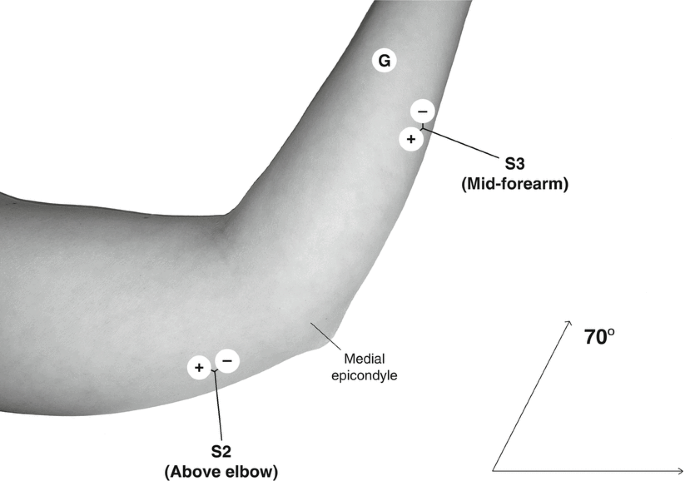
Intradermal (ID) | 27-28 G x 3/8 | 5-15° | 1. mid forearm (PPD testing) 2. back (allergy testing) |
SC needle gauge, length, and angle
25-26 G x 5/8", 45° or 90 degrees if pt is big
IM injection site
1. deltoid ≤ 1 mL (less than 1 mL)
2. ventrogluteal > 1 mL (more than 1mL)
3. vastus lateralis (pediatrics)
Injection type | Needle Gauge & Length | Angle | Location |
Intramuscular (IM) | 20-23 G x 1-3" | 90° | 1. deltoid ≤ 1 mL 2. ventrogluteal > 1 mL 3. vastus lateralis (pediatrics) |
Subcutaneous (SC) | 25-26 G x 5/8" | 45° | 1. lower abdomen 2. fatty part of upper arm 3. outer thigh |
Insulin (SC) | 31 G x 1/4" | 90° | (Locations shared with Subcutaneous above) |
Intradermal (ID) | 27-28 G x 3/8 | 5-15° | 1. mid forearm (PPD testing) 2. back (allergy testing) |
Insulin SC needle gauge, length, and angle
31 G x 1/4", 90°
SC (w/ and w/out insulin) injection site
1. lower abdomen
2. fatty part of upper arm
3. outer thigh
Injection type | Needle Gauge & Length | Angle | Location |
Intramuscular (IM) | 20-23 G x 1-3" | 90° | 1. deltoid ≤ 1 mL 2. ventrogluteal > 1 mL 3. vastus lateralis (pediatrics) |
Subcutaneous (SC) | 25-26 G x 5/8" | 45° | 1. lower abdomen 2. fatty part of upper arm 3. outer thigh |
Insulin (SC) | 31 G x 1/4" | 90° | (Locations shared with Subcutaneous above) |
Intradermal (ID) | 27-28 G x 3/8 | 5-15° | 1. mid forearm (PPD testing) 2. back (allergy testing |
Intradermal (ID) needle gauge, length, and angle
27-28 G x 3/8, 5-15°
ID injection site
1. mid forearm (PPD testing)
2. back (allergy testing)
type | Needle Gauge & Length | Angle | Location |
Intramuscular (IM) | 20-23 G x 1-3" | 90° | 1. deltoid ≤ 1 mL 2. ventrogluteal > 1 mL 3. vastus lateralis (pediatrics) |
Subcutaneous (SC) | 25-26 G x 5/8" | 45° | 1. lower abdomen 2. fatty part of upper arm 3. outer thigh |
Insulin (SC) | 31 G x 1/4" | 90° | (Locations shared with Subcutaneous above) |
Intradermal (ID) | 27-28 G x 3/8 | 5-15° | 1. mid forearm (PPD testing) 2. back (allergy testing) |
age range for toddler
1-2 yr
age range for preschool
3-5 yr
age range for school age
6-15 yr
age range for adult
15+ yr
Normal axillary temperature
97.6 °F (36.4 °C) - remember, its one degree lower than oral
Normal rectal temperature
99.6 °F (37.6 °C) - remembers, its one degree higher than oral
MOST ACCURATE b/c fully in a body cavity
When is body temperature lowest?
morning
When is body temperature highest?
late afternoon
Ways to determine pulse
Auscultation or palpation
Auscultation: The act of listening to the internal sounds of the body. Healthcare providers typically use a stethoscope to auscultate the heart, lungs, and intestines, or to listen for Korotkoff sounds when measuring blood pressure.
Palpation: The act of using the hands and fingers to feel the body during a physical examination. This technique is used to assess the texture, size, consistency, location, and tenderness of internal organs and tissues, or to locate a pulse.
RR for 0-1yr
30-50
0-1 yr: 30-50
1-2 yr: 20-40
3-5 yr:20-30
6-15yr:20-25
15+ yr:12-20
Trend: both your lower and higher RR number goes down as you age
Why? The younger you are, the smaller your lungs so you need to breath faster to get enough oxygen
BP
RR for 15+ yr
12-20
RR (respiration rate)
0-1 yr: 30-50
1-2 yr: 20-40
3-5 yr:20-30
6-15yr:20-25
15+ yr:12-20
Trend: both your lower and higher RR number goes down as you age
Why? The younger you are, the smaller your lungs so you need to breath faster to get enough oxygen
BP for 0-1 month
85-65/50-35 (85/50)
0-1 month: 85-65/50-35 (85/50)
1-2 months:100-70/55-35 (100/55)
1-2yrs: 105-85/60-40 (105/60)
6-9 yrs:115-100/75-55 (115/75)
9-11 yrs:120-100/80-60 (120/80)
11-15 yrs:130-110/80-65 (130/80)
15+ yrs: 120-90/80-60 (120/80)
Trend: as you get other, both the sytolic and distolic increase
This is pressure. As you get get bigger, you need more pressure to get things across the body
HR
BP for 1-2 yr
105-85/60-40 (105/60)
BP
0-1 month: 85-65/50-35 (85/65)
1-2 months:100-70/55-35 (100/55)
1-2yrs: 105-85/60-40 (105/60)
6-9 yrs:115-100/75-55 (115/75)
9-11 yrs:120-100/80-60 (120/80)
11-15 yrs:130-110/80-65 (130/80)
15+ yrs: 120-90/80-60 (120/80)
Trend: as you get other, both the sytolic and distolic increase
This is pressure. As you get get bigger, you need more pressure to get things across the body
BP for 15+ yr
120-90/80-60 (120/80)
0-1 month: 85-65/50-35 (85/65)
1-2 months:100-70/55-35 (100/55)
1-2yrs: 105-85/60-40 (105/60)
6-9 yrs:115-100/75-55 (115/75)
9-11 yrs:120-100/80-60 (120/80)
11-15 yrs:130-110/80-65 (130/80)
15+ yrs: 120-90/80-60 (120/80)
Trend: as you get other, both the sytolic and distolic increase
This is pressure. As you get get bigger, you need more pressure to get things across the body
HR for 0-1 yr
100-160
HR
0-1 yr: 100-160
1-2 yr:100-140
3-5 yr:80-120
6-15 yr:75-120
15+ yr: 60-100
Trend: as you get older, the HR gets lower
Why? As you get older, your heart gets more efficient so it needs to beat less to circulate all the blood
HR for 15+ yr
15+ yr: 60-100
HR
0-1 yr: 100-160
1-2 yr:100-140
3-5 yr:80-120
6-15 yr:75-120
15+ yr: 60-100
Trend: as you get older, the HR gets lower
Why? As you get older, your heart gets more efficient so it needs to beat less to circulate all the blood
Apical pulse (where is it taken and who is it for)
Pulse taken with a stethoscope and near the apex of the heart
Commonly used for infants
Determining respiratory rate
Count respirations while the pt thinks they are obtaining pulse
Cound for 30s and multiply by 2
DO NOT say "breathe normally" or "take deep breaths"
Normal oxygen saturation
95% or higher
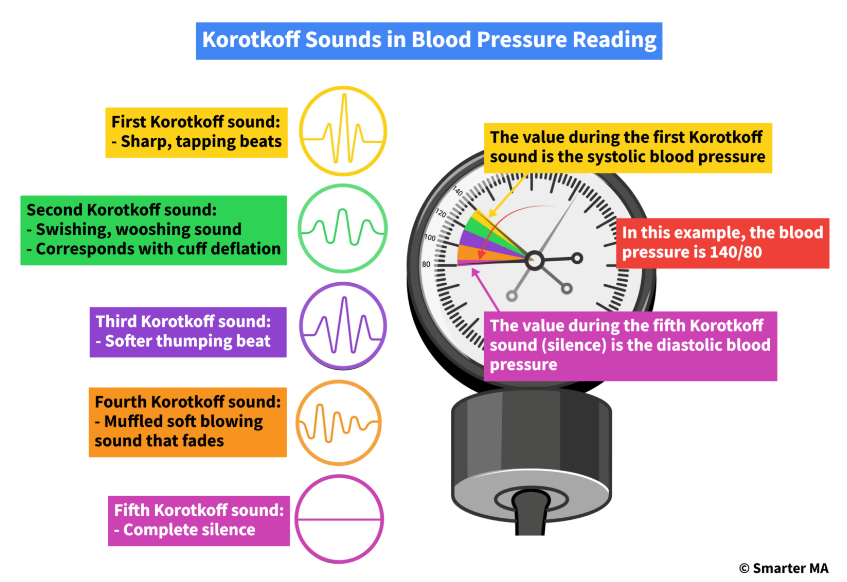
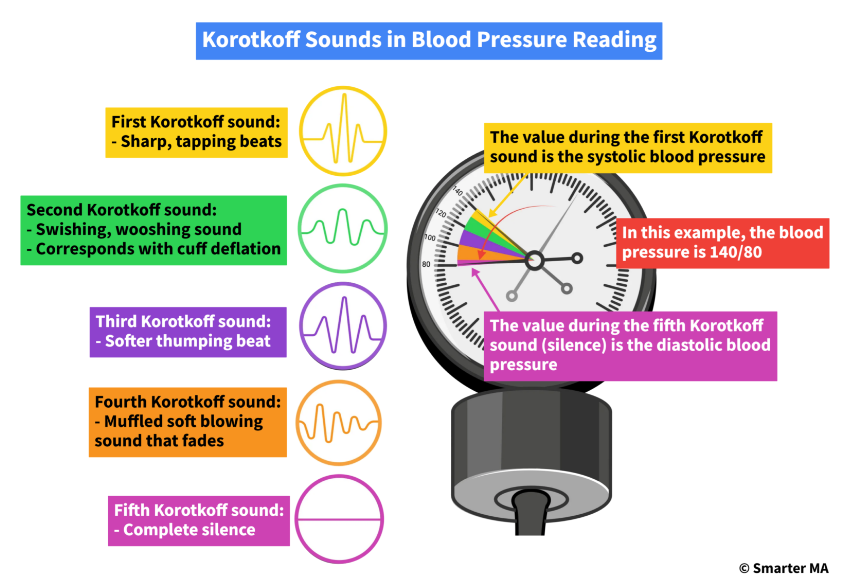
1st Korotkoff sound
The first Korotkoff sound is a sharp tapping that corresponds to the systolic blood pressure.
Smarter Simplify - Korotkoff sounds:
The first Korotkoff sound is a sharp tapping that corresponds to the systolic blood pressure.
The second Korotkoff sound is a swishing/whooshing sound that is heard as the cuff is deflated.
The third Korotkoff sound is a thump that is softer than the first sound.
The fourth Korotkoff sound is a softer, blowing, muffled sound that fades.
The fifth Korotkoff sound is silence, which corresponds to diastolic blood pressure.

2nd Korotkoff sound
The second Korotkoff sound is a swishing/whooshing sound that is heard as the cuff is deflated.
Smarter Simplify - Korotkoff sounds:
The first Korotkoff sound is a sharp tapping that corresponds to the systolic blood pressure.
The second Korotkoff sound is a swishing/whooshing sound that is heard as the cuff is deflated.
The third Korotkoff sound is a thump that is softer than the first sound.
The fourth Korotkoff sound is a softer, blowing, muffled sound that fades.
The fifth Korotkoff sound is silence, which corresponds to diastolic blood pressure.

3rd Korotkoff sound
The third Korotkoff sound is a thump that is softer than the first sound.
Smarter Simplify - Korotkoff sounds:
The first Korotkoff sound is a sharp tapping that corresponds to the systolic blood pressure.
The second Korotkoff sound is a swishing/whooshing sound that is heard as the cuff is deflated.
The third Korotkoff sound is a thump that is softer than the first sound.
The fourth Korotkoff sound is a softer, blowing, muffled sound that fades.
The fifth Korotkoff sound is silence, which corresponds to diastolic blood pressure.
4th Korotkoff sound
The fourth Korotkoff sound is a softer, blowing, muffled sound that fades.
Smarter Simplify - Korotkoff sounds:
The first Korotkoff sound is a sharp tapping that corresponds to the systolic blood pressure.
The second Korotkoff sound is a swishing/whooshing sound that is heard as the cuff is deflated.
The third Korotkoff sound is a thump that is softer than the first sound.
The fourth Korotkoff sound is a softer, blowing, muffled sound that fades.
The fifth Korotkoff sound is silence, which corresponds to diastolic blood pressure.
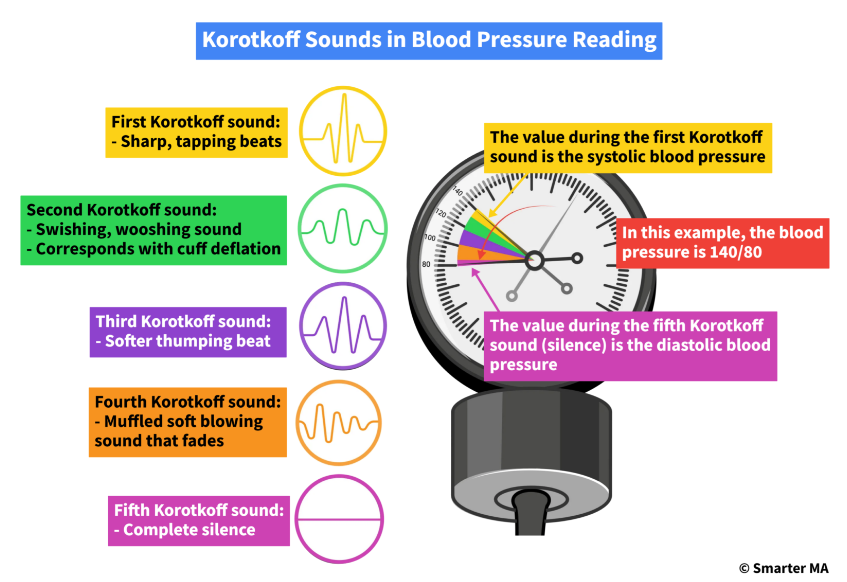
5th Korotkoff sound
The fifth Korotkoff sound is silence, which corresponds to diastolic blood pressure.
Smarter Simplify - Korotkoff sounds:
The first Korotkoff sound is a sharp tapping that corresponds to the systolic blood pressure.
The second Korotkoff sound is a swishing/whooshing sound that is heard as the cuff is deflated.
The third Korotkoff sound is a thump that is softer than the first sound.
The fourth Korotkoff sound is a softer, blowing, muffled sound that fades.
The fifth Korotkoff sound is silence, which corresponds to diastolic blood pressure.
Deltoid injection
90 degrees
DO NOT ASPIRATE VACCINES
Use for vaccinating adults and older children, DO NOT use for infants/children < 3 y/o
Dose should not exceed 1 mL
Massage after administration
Ventrogluteal muscle injection
90 degrees
DO NOT ASPIRATE VACCINES
Deep IM injections, larger doses, viscous meds
Vastus lateralis injection
90 degrees
DO NOT ASPIRATE VACCINES
Use for vaccinating and medicating infants/children < 3 y/o
Wheezing
Whistling sound heard on expiration that is the body's attempt to expel trapped air
Rales
Clicking, crackling sounds heard on inspiration (moist or dry)
Ronchi
Common rattling snoring sounds often associated with chronic lung diseases
Eye ointment (procedure - what you do and what the pt does)
Apply in thin ribbon along conjunctival sac from inner to outer canthus
Close eye and roll eyeball after administration
Do not let tip of containers touch the pt!
Ear medication
Kids under 3? Ear should be facing up and pull EARLOBE DOWN AND BACK
Adults? Ear should be facing up and pull PINNA UP AND BACK
Do not let tip of containers touch the pt!
Ensure room temp (cold = dizzy, hot = pain/burns)
Keep head tilted 5-10 mins and dry runoff with cotton balls

Eye drops
Look up, close eyes and move back-forth, do not keep blinking
Apply parallel and above the eye
Do not let tip of containers touch the pt!
Ear irrigation
removes cerumen from auditory canal
ensure it is body temperature b/c too cold = dizzy, too hot = burns
tilt head in direction of affected ear to facilitate irrigation and drainage and pull pinnae up and back
when procedure is completed and fluid is drained, insert cotton applicator (NOT deep)
do not use too much water or be too rapid b/c can cause pain and dizziness
Contraindication of ear irrigation
Contraindicated if tympanic membrane is torn
Abrasion
Scrape/rub, superficial wound affecting often knees/elbows
Incision
Open injury typically caused by sharp object causing straight cut; can cause profuse bleeding
Laceration
Open injury that is jagged in nature and caused by a sharp object; bleeding can be profuse
Puncture
Open wound caused by an instrument that delivers a stab; small with limited bleeding
Contusion
Closed injury (bruise) caused by blunt force trauma
Concussion
Closed head trauma in which the brain has been jolted/shaken
Strain
stretching or tearing of muscle or tendon
t in strain stands for tendon
Sprain
stretching or tearing of ligaments
Fracture
Break in a bone
Open/compound (skin is broken) or closed/simple (skin is not broken)
Anaphylaxis
Severe allergic reaction in which there is circulatory shutdown and respiratory distress, resulting in shock
Administer oxygen/epinephrine and call 911
Acute abdominal pain
General symptom that can be life-threatening
Keep pt NPO, emesis basin, monitor VS for shock, keep warm
Bleeding
Internal or external
Arterial more serious than capillary
Burns
Electrical, chemical, thermal
1st degree = first layer (sunburn)
2nd degree = subcutaneous layer (blistering)
3rd degree = muscle and bone (black, dry, charred)
Assess using rule of nines
Choking
Airway obstruction, may be unable to speak/breathe and holding the neck
ask "are you choking?" and if they cannot breathe/talk, perform Heimlich, if unconscious, CPR and foreign body removal
Diabetic coma
hyperglycemia
administer insulin
Insulin shock
hypoglycemia
administer glucose
Seizure
Assist pt to lying position
Protect from injury
Tilt head to prevent aspiration
Time the seizure
Stay with pt and observe
If they continue, call 911
Syncope
Fainting
Pale, diaphoresis, chills, nausea, dizziness
Shock
Hypotension, weak pulse, tachypnea, tachycardia, cold, pale, sweaty skin, bluish skin
Anemia
Irregular heartbeat, fatigue, dizziness, pale skin
Transient ischemic attack (TIA)
Cephalgia, vertigo, temporary paralysis on one side of body
"mini stroke"
Oral medication administration
Mouth for quick absorption into bloodstream
MOST COMMON ROUTE
Solids: for multiple-dose bottles, pour pills into the lid first, then medicine cup
Liquids: pour in separate medicine cup (not lid) on flat surface, read at bottom of meniscus at the dose mark and "palm" the label to prevent distortion if meds drip
Sublingual medication administration
Under tongue; bypasses digestive system, absorbed into bloodstream quickly
Example = nitroglycerin tablets and spray
Buccal medication administration
Btwn cheek and gums; bypasses digestive system, resulting in smaller doses for therapeutic effects
Designed to melt while held in cheek area and absorb into bloodstream quickly; DO NOT chew/swallow
Inhalation medication administration
Used for targeted areas like the bronchial passages; can be delivered via a nebulizer
Must hold medication in lungs as long as possible to be effective
When using inhalers/nebulizers, can become shaky/dizzy due to meds and hyperventilation; coach on proper breathing techniques
Topical medication administration
Designed to react locally and systemic absorption is minimal
Can serve as barrier to prevent irritants from damaging skin/treat local condition (acne, athlete's foot)
Liniments (higher oil concentration) for dried or cracked skin
Lotions for itching/inflammation
Monitor for skin irritation or rxn and instruct to apply as Rx
Transdermal medication administration
For continuous slow absorption of meds; used for smoking cessation (nicotine patches), pain meds, hormone delivery
Avoid touching meds when applying the patch
Can shower
Dispose of patch in container inaccessible to children
Place on area without hair on abdomen or upper arm (not below elbows/knees b/c less absorption); monitor skin for irritation but do not apply lotion
Rotate sites and when switching patches, leave old one on for 30 mins after applying new one to maintain therapeutic levels in blood
Extended release medication
Consistent amount of medication to use over period of time
Take it same time each day
Drink with water, NEVER crushed!
How to prepare examination table for the next patient
1:10 bleach
Roll up paper tightly and quickly to minimize transmission of contaminants on paper
Pillow below paper
Signs of infection
warmth, redness, swelling, and pain
think: You can think he WRPS (wraps) the infected area
Redness (rubor)
Rubor means redness
You can think of rubor like ruby, its red
Warmth (calor)
Calor means warm
You can think calor is like carlories, and when you burn those, you generate heat
Swelling (tumor)
I guess tumor means swelling
Tumors grow in size, so they almost swell up
Pain (dolor)
Dolor means pain
You can think dolor sounds like dull-er, so like dull pain
Dressing vs Bandage
Dressing = sterile, cover wound
Bandage = non sterile, cover dressings
Sterile field
Open flaps away from you first
1 inch around is not sterile
Open packages to drop onto the sterile field
Clean vials with alcohol
Hands above waist
NEVER leave sterile field unattended, reach over sterile field, turn your back to the sterile field
Removing sutures/staples procedure
Suture scissors and forceps are needed
Crusting/exudate need soak with saline before
Remove every other suture or staple first and replace each with an adhesive closure strip; if the incision remains securely closed, remove the rest with the same process
For sutures, grasp knot with forceps and cut close to the knot, then pull in the direction of the wound so the wound doesn't rip apart
Count total number of sutures/staples at the end
If any sign of suture line separation (gaping) is evident during the removal process, leave the remaining sutures in place, document a description, and report it to the health care provider
Exams for which Fowler's position is used
EENT, chest
Exams for which semi-Fowler's position is used
Chest, or if pt cannot lay flat/SOB
Exams for which Sims' position is used
Rectal exams, enemas, rectal temperature
Exams for which knee-chest position is used
Gynecological or rectal exams and treatments of spinal adjustments
Exams for which jack-knife position is used
Rectal exams or instrumentation (sigmoidoscopy)
Exams for which lithotomy position is used
Female pelvic exams
Exams for which dorsal recumbent position is used
Catheterizations, genital exams for younger children
Exams for which prone position is used
Exams involving the back of the body including the bottoms of the feet
Exams for which supine position is used
Exams involving the front of the body, CPR
Exams for which (modified) Trendelenburg position is used
Shock