Jacksons Bio Test (4/18/25)
 Call Kai
 Learn
Learn Practice Test
 Spaced Repetition
 Match
Match Flashcards
 Knowt Play
1/34

There's no tags or description
Looks like no tags are added yet.
Name | Mastery | Learn | Test | Matching | Spaced | Call with Kai | Chat |
|---|
No analytics yet
Send a link to your students to track their progress
35 Terms
Taxonomy
Domain, kingdom, phylum , class, order, family, genus (plural, general), and species.
Fossils
A way to tell other things existed and a way to tell how old things are.
Darwin and Wallace
Responsible for creating the theory of evolution.
Natural selection
results in evolutionary adaptation, (process that causes animals to evolve over time. (if a organism is being hunted very easily it might adapt in order for it to survive)
Adaptation
A heritable trait or characteristic that enhances an organism's ability to survive and reproduce in a specific environment, resulting from natural selection over generations.
Evidence for evolution
Homologies
Evolutionary trees
Vestigial structures
DNA evidence
Embryology
Homologies
similar bones in different organisms(common ancestry)
Evolutionary trees
Diagrams that depict the evolutionary relationships between different species or groups of organisms, showing how they are related through common ancestry.
Vestigial structures
Non functional features that show signs of evolution(tailbone on a human)
DNA evidence
DNA evidence of evolution
Embryology
study of embryos
Sources of genetic variation
Mutation
Sexual Selection
Mutation
A change in the DNA sequence of an organism, which can be caused by errors during DNA replication, exposure to mutagens, or viral infection.
Sexual selection
Males or females attracting one another by a certain genetic variation.(peacocks)
Gene pool
the total collection of alleles in a population at any one time
Founder effect
one organism moves into a new environment and becomes a different species
Bottleneck effect
When a population is reduced in size due to natural disasters, habitat loss, or overhunting
Gene flow
the transfer of genetic material (genes) from one population to another, often through the movement of individuals or gametes
Sexual selection
males attracting females to mate
Sexual dimorphism
the systematic difference in form between individuals of different sex in the same species
Outcomes of natural selection
Directional selection
Disruptive selection
Stabilizing selection
Directional selection (def and example)
one trait is favored over another (giraffe neck being long over a short neck, long neck chosen for a higher chance of survival of the future generation because of evolution the neck will get longer over time.
Disruptive selection (example)
Peppered moth could be dark or light depending on whats happening in its environment
Stabilizing selection (def & example)
the average trait is favored over more extremes (8fot giraffe neck average is better than 11 foot extreme)
Pre and post zygotic barriers
pre(habitat isolation, different breeding time, genitalia doesn't match ”lock and key”... Post- after breeding the offspring either dies while being conceited or the offspring is not able to breed itself.
Allopatric speciation
Occurs when populations become geographically isolated, leading to distinct species,
Sympatric speciation
Happens within the same geographic area, with reproductive isolation arising due to factors other than physical separation.
Macroevolution
evolutionary changes that occur above the species level, encompassing the emergence of new species, genera, and higher taxonomic groups over vast periods of time.
Fossil record
how to tell how old something is based off fossils
Geologic time scale
All of earth's time in a scale from 4.8 billion years ago to now
Radiometric dating
Geologists use the term radiometric to measure the decay rate (Based on what is in the rock, they know how old it is)
Plate tectonics
Earth is divided into multiple moving plates
Biogeography
the branch of biology that deals with the geographical distribution of plants and animals.
Mass extinctions
a event that whipped out more than 50 percent of the population
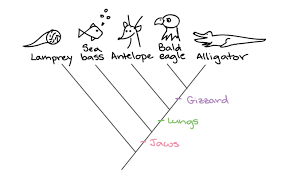
Phylogenetic trees
A diagram that depicts the lines of evolutionary descent of different species, organisms, or genes from a common ancestor (just need to know how to read it)