MCAT Physics
 Call Kai
 Learn
Learn Practice Test
 Spaced Repetition
 Match
Match Flashcards
 Knowt Play
1/176

There's no tags or description
Looks like no tags are added yet.
Name | Mastery | Learn | Test | Matching | Spaced | Call with Kai | Chat |
|---|
No analytics yet
Send a link to your students to track their progress
177 Terms
vectors
Physical quantitates that have both magnitude and direction. Displacement, velocity, acceleration, and force.
scalars
Quantities without direction. Scalar quantities may be the magnitude of vectors, like speed, or may be dimensionless, like coefficients of friction.
vector addition
Tip-to-tail method, or break the vector into its component parts and use Pythagorean theorem
vector subtraction
Change the direction of the subtracted vector and then do a tip-to-tail addition
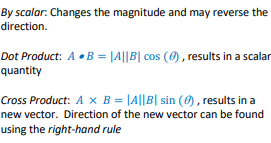
vector multiplication
free body diagrams
Representation of the forces acting on an object
translational equilibrium
Occurs in the absence of any net forces acting on the object
rotational equilibrium
Occurs in the absence of any net torques acting on an object. The center of mass is the most commonly used pivot point
displacement
Vector representation of a change in position. path independent
distance
A scalar quantity that reflects the path traveled
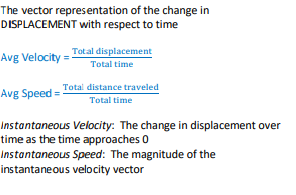
velocity
force
Any push or pull that has the potential to result in an acceleration
gravity
The attractive force between 2 objects as a result of their masses
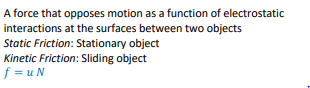
friction
mass
A measure of the inertia of an object - its amount of material
weight
The force experience by a given mass due to the gravitational attraction to the earth
acceleration
The vector representation of the change in velocity over time
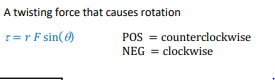
torque
1st law newton
Any object will remain at rest or move with a constant velocity if there is no net force on the object.
2nd law newton
F=ma
3rd law newton
An equal reaction warrants the opposite reaction.
linear motion
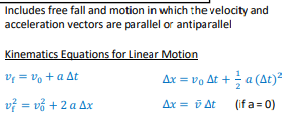
projectile motion
Contains both an x- and y- component. Only force action on object is gravity. X velocity is constant
inclined planes
Force components:
Parallel to the ramp use sin.
Perpendicular to the ramp use cos
circular motion
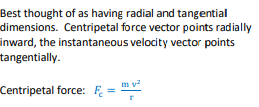
structural proteins
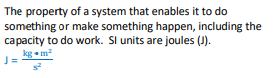
kinetic energy

potential energy
Energy stored within a system
gravitational potential energy

elastic potential energy
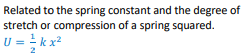
chemical potential energy
Energy stored in the bonds
conservative forces
Path independent and do not dissipate the mechanical energy of a system. Gravity and electrostatic forces
nonconservative forces
Path dependent and cause dissipation of mechanical energy from a system. Friction, air resistance, and viscous drag
work

power

work-energy theorem
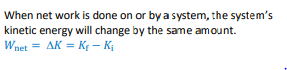
mechanical advantage
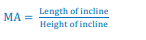
The factor by which a simple machine multiplies the input force to accomplish work. The input force necessary to accomplish the work is reduced and the distance through which the reduced input force must be applied is increased by the same factor
mech advantage of an inclined plane
simple machines
Inclined plane, wedge, wheel and axle, lever, pulley, and screw
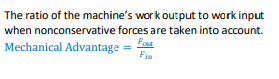
efficiency
thermal equilibrium
When systems have the same kinetic energy and thus the same temperature. No heat transfer
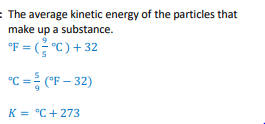
temperature
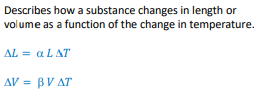
thermal expansion
isolated system
Exchange nothing with surroundings
closed system
Exchange only matter with surroundings
open system
Exchange energy and matter with surroundings
state functions
Pathway independent and are not themselves defined by a process. Pressure, density, temp, volume, enthalpy, internal energy, gibbs free energy, and entropy
process functions
Describe the pathway from one equilibrium state to another. Work and heat
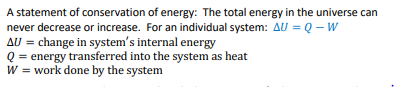
1st law thermo
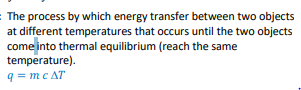
heat
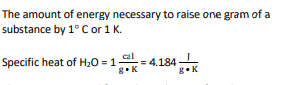
specific heat
heat of transformation
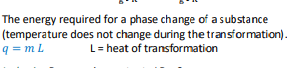
processes with constant variables
Constant Variable: Isobaric: Pressure is constant, P = 0
Isothermal: Temp is constant, T = 0
Adiabatic: No heat is exchanged, Q = 0
Isovolumetric (isochoric): Volume is constant, V = 0, so Work = 0
work of a gas
W=-PV
2nd law of thermo
In a closed system, up to and including the universe, energy will spontaneously and irreversibly go from being localized to being spread out
entropy
A measure of how much energy has spread out or how spread out energy has become
Fluids
Substances that flow and conform to the shape of their containers, includes liquids and gases. They can exert perpendicular forces but not shear forcess.
Solids
Do not flow. They maintain their shape regardless of their container.
Density

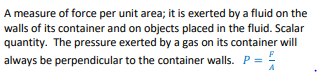
Pressure
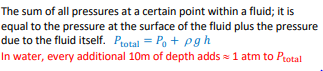
Absolute Pressue
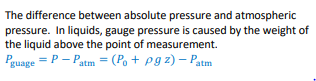
Gauge Pressure
Pascal’s Principle
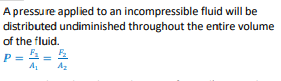
Hydraulic Machines
Operate based on the application of Pascal’s principle to generate mechanical advantage
Archimedes’ Principle
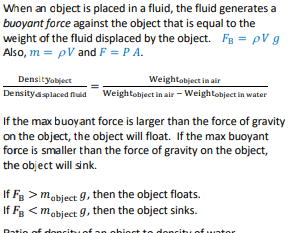
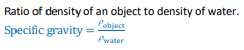
Specific Gravity
Cohesive vs Adhesive
Fluids experience cohesive forces with other molecules of the same fluid and adhesive forces with other materials
Surface tension
Cohesive forces give rise to surface tension
Viscosity
A measure of a fluid’s internal friction. Viscous drag is nonconservative
Laminar FLow
Smooth and orderly
Turbulent flow
Rough and disorderly
Poiseuille’s Law
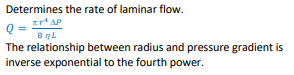
Flow rate
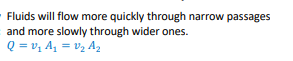
Q = Volume/time = Av
Continuity Equation
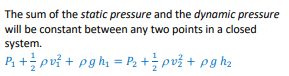
Bernoulli’s Equation
Venturi Effect
The velocity of a fluid passing through a constricted area will increase and its static pressure will decrease
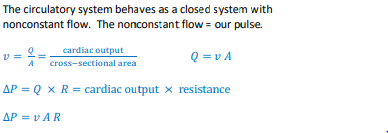
Circulatory System fluid flow
Breathing flow
Inspiration and expiration create a pressure gradient not only for the respiration system, but for the circulatory system too.
Alveoli flow
Air at the alveoli has 0 speed
Coulomb
SI unit of charge
Proton vs electron
Protons have a positive charge and electrons have a negative charge. Both protons and electrons possess the fundamental unit of charge e=1.6×10^19 C. Different masses
Attraction and repulsion
Opposite charges exert attractive forces, and like charges exert repulsive forces
Conductors
Free and uniform passage of electrons when charged
Insulators
Resist the movement of charge and will have localized area of charge that don’t distribute over the surface of the material
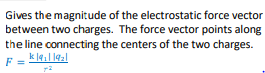
Coulomb’s law
Electric field
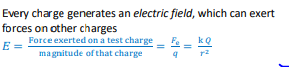
Field lines
Used to represent the electric field vectors for a charge. + charge would move away from a positive charge and toward negative charge. North to south. Stronger field when closer
Equipotential lines
A line on which the potential at every point is the same. Always perpendicular to the electrical field lines. Work is only done when one charge is moved between equipotential lines.
Electric dipole
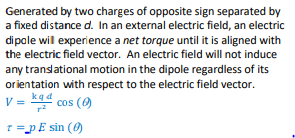
Net torque

Dipole moment
Product of charge and separation distance p=qd
Electric potential energy
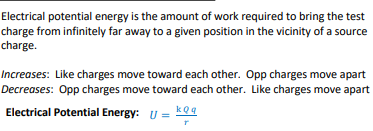
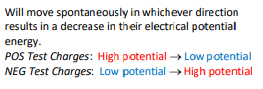
Electric potential
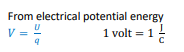
Test charge
Magnetic field
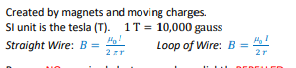
Diamagnetic materials
Possess no unpaired electrons and are slightly repelled by a magnet
Paramagnetic materials
Possess some unpaired electrons and become weakly magnetic in an external magnetic field
Ferromagnetic materials
Possess some unpaired electrons and become strongly magnetic in an external magnetic field
Characteristics of Magnetic Fields
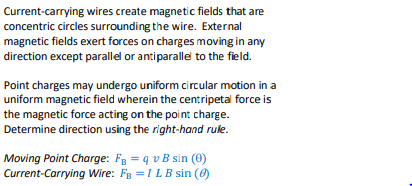
Lorentz Force
Sum of electrostatic and magnetic forces acting on a body