NICE fetal monitoring - 1.4
 Call Kai
 Learn
Learn Practice Test
 Spaced Repetition
 Match
Match Flashcards
 Knowt Play
1/50

There's no tags or description
Looks like no tags are added yet.
Name | Mastery | Learn | Test | Matching | Spaced | Call with Kai | Chat |
|---|
No analytics yet
Send a link to your students to track their progress
51 Terms
1.4.1 What should be reviewed as part of the hourly risk assessment?
Review the previous CTG
Other antenatal or intrapartum risk factors
Determine if there are any changes in the baseline, variability or decelerations
1.4.2 What should be done if fetal heart rate pattern changes over time?
Review antenatal or intrapartum risk factors for hypoxia
1.4.3 What must be assessed and documented when reviewing a CTG trace?
Assess and document
contractions
baseline fetal heart rate
variability
presence (and characteristics of decelerations) or absence of decelerations
presence of accelerations.
1.4.4 When should usual care continue?
If there is a stable baseline FHR between 110 and 160 bpm and normal variability
As the risk of fetal acidosis is low
1.4.5 How often should maternal and fetal heartbeats be differentiated?
Hourly, or more often if there are concerns
1.4.6 What options are available to differentiate maternal and fetal heart rate?
Fetal heart rate auscultation with a Pinard stethoscope
Bedside ultrasound scanning
Continuous maternal heart rate monitoring (using a pulse oximeter or the facility on the CTG equipment)
Fetal scalp electrode (be aware this may detect maternal heart rate if there is no fetal heartbeat, so should always be used in conjunction with maternal heart rate monitoring)
Simultaneous palpation of the woman's pulse while listening to the fetal heart rate.
1.4.7 When is it particularly important to confirm FHR?
During the second stage of labour
It is easier to mistakenly auscultate maternal rather than FHR.
1.4.8 What should be done if concerns about differentiation remain?
If concerns about differentiation or if a FH cannot be heard, obtain an urgent review by an obstetrician or senior midwife.
1.4.9 What should be done if CTG trace quality is poor?
Take action to improve the trace (for example, by repositioning the tocodynamometer, the transducer or by using a fetal scalp electrode).
Ensure that the CTG trace is of high quality
1.4.10 What should be considered when reviewing CTG traces?
Evaluate changes on traces over time to ascertain changes in the baby's condition
Document any changes in the CTG trace from the previous review
Review the changes alongside any existing and new intrapartum risk factors
Think about the possible reasons for any changes, and take these and the whole clinical picture into account when planning ongoing care
What are the 4 CTG features and how should they be categorised?
4 features of the CTG trace (contractions, baseline fetal heart rate, variability, decelerations) and use the presence of accelerations
To classify the overall CTG trace as white, amber or red (indicating increasing levels of concern)
1.4.11 How should contraction frequency and length be recorded?
Use a tocodynamometer to record on the CTG trace.
1.4.12 How are contractions categorised?
white
fewer than 5 contractions in 10 minutes
amber
5 or more contractions in 10 minutes, leading to reduced resting time between contractions (uterine tachysystole)
a single contraction lasting 2 minutes or longer (hypertonus)
1.4.13 What should be evaluated if decelerations are present?
Their timing related to contractions
1.4.14 What actions are required if ≥5 contractions per 10 minutes (AMBER)?
Perform a full risk assessment
Take action to reduce contraction frequency
Explain to the woman what is happening, and ensure that she has adequate pain relief
How is baseline fetal heart rate determined?
Looking at the mean FHR (excluding accelerations and decelerations), over a period of 10 minutes when the FHR is stable.
When deciding if there is any change in baseline FHR, compare it with earlier CTG traces or recordings of FHR
1.4.15 How is baseline fetal heart rate categorised?
white
stable baseline of 110 to 160 beats a minute
amber
increase in baseline fetal heart rate of 20 beats a minute or more from the start of labour or since the last review an hour ago
100 to 109 beats a minute
unable to determine baseline
red
below 100 beats a minute
above 160 beats a minute.
1.4.16 When are lower or higher baseline fetal heart rates expected?
Lower baseline fetal heart rates are expected with high gestational age
Higher baseline rates in lower gestational age
1.4.16 What may a rise in baseline fetal heart rate represent?
Either developing infection or hypoxia
1.4.16 When should usual care continue with a baseline fetal heart rate of 100–109 bpm (AMBER)?
Continue usual care if this has been stable throughout labour and there is normal variability and no variable or late decelerations
How is variability determined?
Looking at the minor oscillations in the FHR, which usually occur at 3 to 5 cycles a minute.
Measure it by estimating the difference in beats per minute between the highest heart rate and the lowest heart rate in a 1-minute segment of the trace between contractions, excluding decelerations and accelerations.
1.4.17 What should be done if there is absence of variability?
Carry out a review of the whole clinical picture with a low threshold for expedited birth
This is a very concerning feature
1.4.18 How is fetal heart rate variability categorised?
white
5 to 25 beats a minute
amber
fewer than 5 beats a minute for between 30 and 50 minutes
more than 25 beats a minute for up to 10 minutes
red
fewer than 5 beats a minute for more than 50 minutes
more than 25 beats a minute for more than 10 minutes
sinusoidal.
1.4.19 When are variability considered normal?
Intermittent periods of reduced variability, especially during periods of quiescence ('sleep')
1.4.19 What effect can certain medicines have on variability and what should be reviewed?
Certain medicines, such as opioids, may lead to a reduction in variability
All other intrapartum risk factors should be carefully reviewed as a potential cause
1.4.19 What does increased variability refer to?
Oscillations around the baseline FHR of more than 25 beats a minute
Shorter episodes lasting a few minutes may represent worsening fetal condition
1.4.20 When should urgent review and consideration of expedited birth occur (variability)?
By an obstetrician or senior midwife and consider expediting birth if:
An isolated reduction in variability to fewer than 5 bpm for more than 30 minutes when combined with antenatal or intrapartum risk factors, as this is associated with an increased risk of adverse neonatal outcomes
A reduction in variability to fewer than 5 bpm combined with other CTG changes, particularly a rise in the baseline FHR, as this is a strong indicator for fetal compromise.
How are decelerations defined?
Transient episodes when the FHR slows to below the baseline level by more than 15 bpm, with each episode lasting 15 seconds or more.
An exception to this is that in a trace with reduced variability, decelerations may be 'shallow'.
1.4.21 What should be considered when assessing the significance of decelerations?
Their timing (early, variable or late) in relation to the peaks and duration of the contractions
Duration of the individual decelerations
Whether the fetal heart rate returns to the baseline heart rate
How long they have been present for
Whether they occur with over 50% of contractions (defined as repetitive)
Presence or absence of shouldering
Variability within the deceleration
1.4.23 How should decelerations be described?
'early', 'variable' or 'late'
Do not use the terms 'typical' and 'atypical', as they can cause confusion
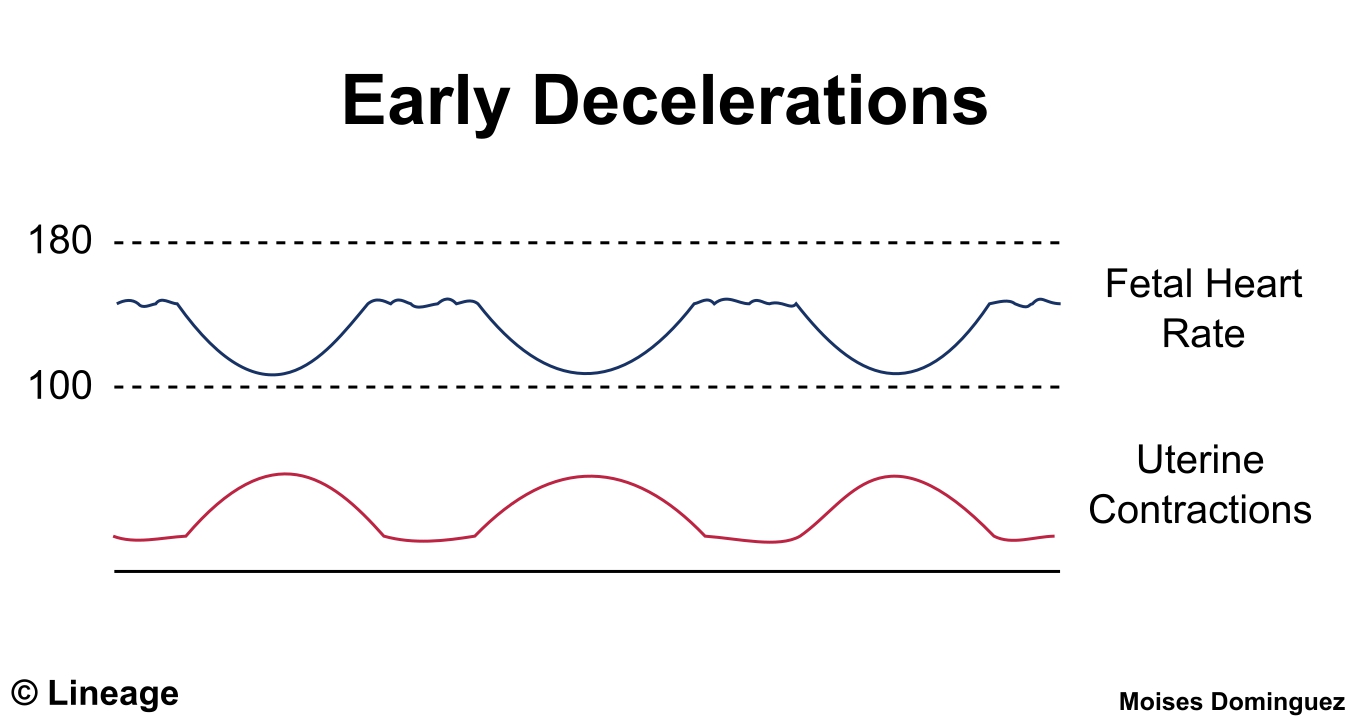
Define early decelerations
Repetitive and periodic slowing of the FHR with onset early in the contraction and return to baseline at the end of the contraction
These are uncommon
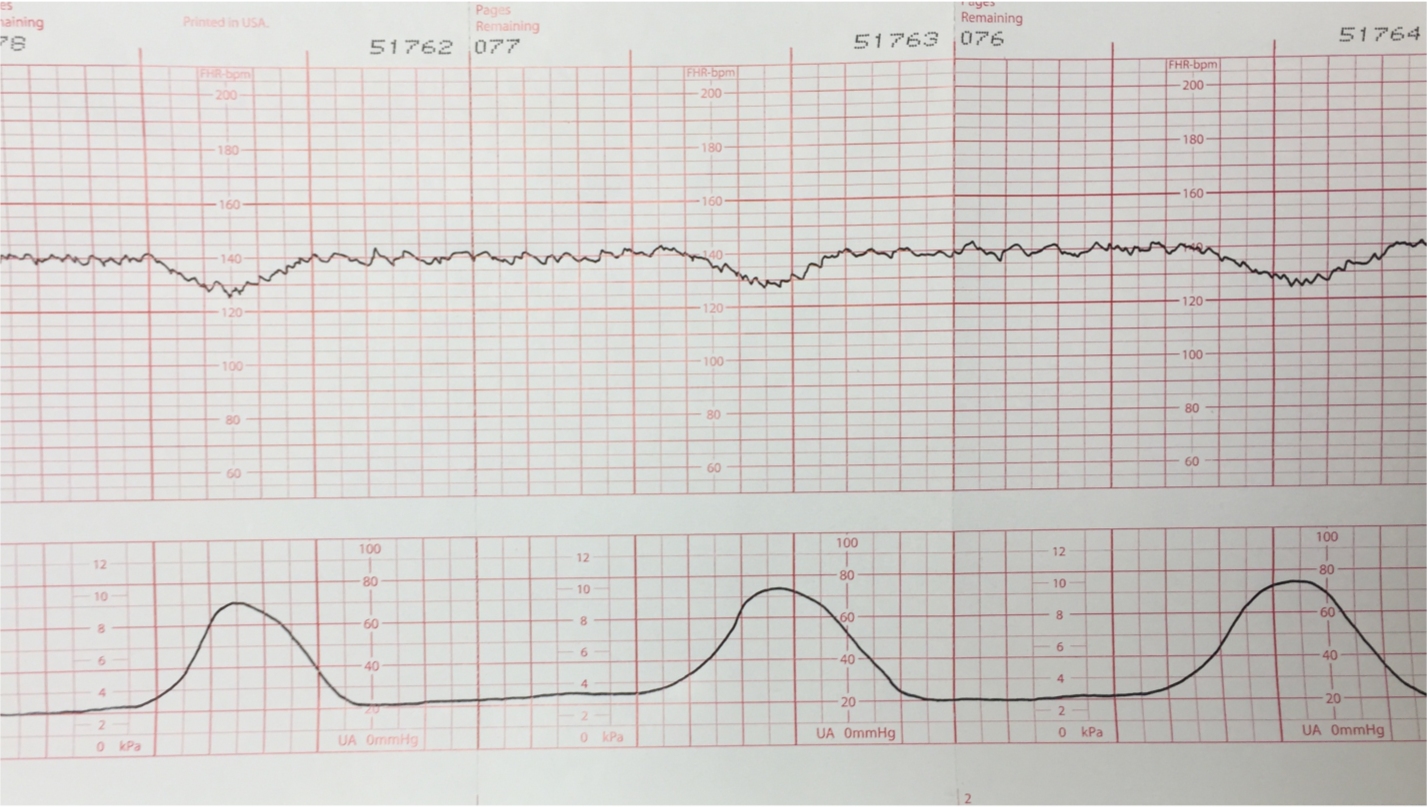
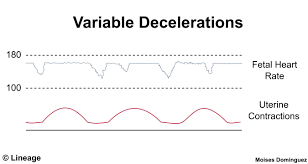
Define variable decelerations
Intermittent and periodic slowing of the fetal heart rate with a variable time in relation to the contraction.
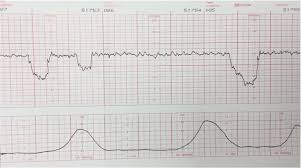
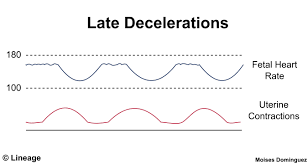
Define late deceleration
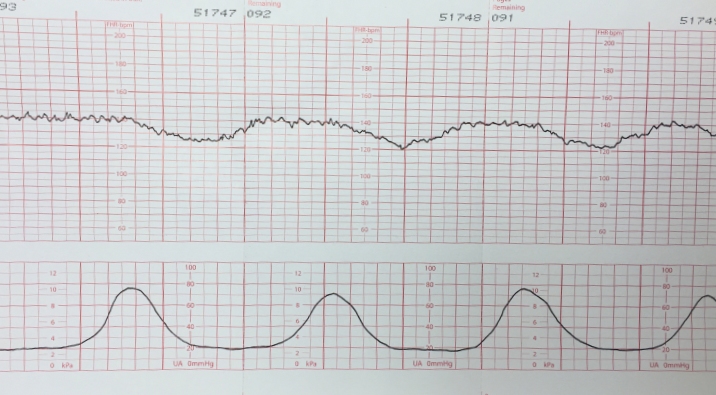
Repetitive and periodic slowing of the FHR with onset mid to end of the contraction and the lowest point more than 20 seconds after the peak of the contraction, and ending after the contraction.
1.4.22 What are concerning characteristics of variable decelerations?
• Lasting more than 60 seconds
• Reduced variability within the deceleration
• Failure or slow return to baseline fetal heart rate
• Loss of previously present shouldering.
1.4.24 How are decelerations categorised?
white
no decelerations
early decelerations
variable decelerations that are not evolving to have concerning characteristics
amber
repetitive variable decelerations with any concerning characteristics for less than 30 minutes
variable decelerations with any concerning characteristics for more than 30 minutes
repetitive late decelerations for less than 30 minutes
red
repetitive variable decelerations with any concerning characteristics for more than 30 minutes
repetitive late decelerations for more than 30 minutes
acute bradycardia
single prolonged deceleration lasting 3 minutes or more
1.4.25 What increases the risk of fetal compromise with decelerations?
Longer and later the individual decelerations, the higher the risk of fetal compromise
(particularly if the decelerations are accompanied by a rise in the baseline, a tachycardia or reduced or increased variability)
1.4.26 What should be done if decelerations last longer than 30 minutes with other changes?
Start conservative measures
Carry out an urgent obstetric review if there are decelerations lasting longer than 30 minutes in the presence of either a rise in the baseline heart rate or reduced variability.
Look at antenatal and intrapartum risk factors, such as suspected sepsis, the presence of meconium, slow progress of labour or the use of oxytocin, to determine whether there is a need for expedited birth
1.4.27 What should be done if variable decelerations persist with other CTG changes?
Obtain an urgent review by an obstetrician and a senior midwife
There is a risk of fetal compromise and acidosis.
1.4.28 What should be done if variable deceleration persist with no other CTG changes (including no rise in the baseline)?
Very common, can be a normal feature in an otherwise uncomplicated labour and birth
Usually a result of cord compression
Support the woman to change position or mobilise
1.4.29 Categorising early decelerations
Uncommon, benign
Associated with head compression
Not accommpanied by any other CTG changes (such as reduced variability, a rise in the baseline)
How are accelerations defined?
Transient increase in the FHR of 15 beats a minute or more, lasting 15 seconds or more
1.4.30 What does the presence and absence of accelerations mean?
Presence and with reduced variability - generally a sign that the baby is healthy
Absence and normal CTG trace - does not indicate fetal acidosis
1.4.31 CTG categorisation
A part of the full assessment of the condition of the woman and baby
Tool to quickly communicate the current state of the CTG
Must be used together with the antenatal and intrapartum risk factors to assess changes over time
1.4.32 How should CTG traces be categorised overall?
Normal
no amber or red features (all 4 features are white)
Suspicious
any 1 feature is amber
Pathological
any 1 feature is red
2 or more features are amber
1.4.34 Interpreting a CTG during the second stage
More challenging than in first stage
Have a lower threshold for seeking a second opinion or assistance
1.4.35 How often should fetal and maternal HR be differentiated in second stage?
At least once every 5 minutes
Consider monitoring with a fetal scalp electrode if there are concerns
1.4.36 What should be considered if accelerations are recorded in the second stage?
Most likely maternal pulse
1.4.36 What should be considered if decelerations are recorded in the second stage?
Look for other signs of hypoxia (eg rise in baseline, reduced in variability)
1.4.37 Hypoxia and second stage
Onset is common
More rapid in active second stage
1.4.37 Rise in baseline of more than 20 bpm in the first stage vs the second stage
First stage - Amber feature
Second stage - Red feature
1.4.38 What actions should be taken if any CTG concerns arise in the active second stage?
Obtain obstetric review
Consider discouraging pushing and stopping any oxytocin infusion to allow the baby to recover, unless birth is imminent
Agree and document a clear plan with time limits for the next review