Week 2 - Acids and bases
 Call Kai
 Learn
Learn Practice Test
 Spaced Repetition
 Match
Match Flashcards
 Knowt Play
1/29

Earn XP
Description and Tags
Week 2
Name | Mastery | Learn | Test | Matching | Spaced | Call with Kai | Chat |
|---|
No analytics yet
Send a link to your students to track their progress
30 Terms
Amphoteric
can accept and donate protons
How to identify acids vs bases vs conjugate acids vs conjugate bases
Ex) HNO3 + NH3 → NH4^+ + NO3^-
pair similar looking molecules together
HNO3 and NO3^-, NH3 and NH4^+
look on the products side. in the pairs, whichever reactant that matches to that product became MORE negative is the acid (donated a proton), and whichever became MORE positive is the base (accepted the proton).
Acid: HNO3
base: NH3
Conjugate bases and acids are flipped: NO3^- is the conjugate base (opposite of the NH3 group) and NH4^+ is the conjugate acids (opposite of the HNO3 group)
pH of acids, neutral, and bases
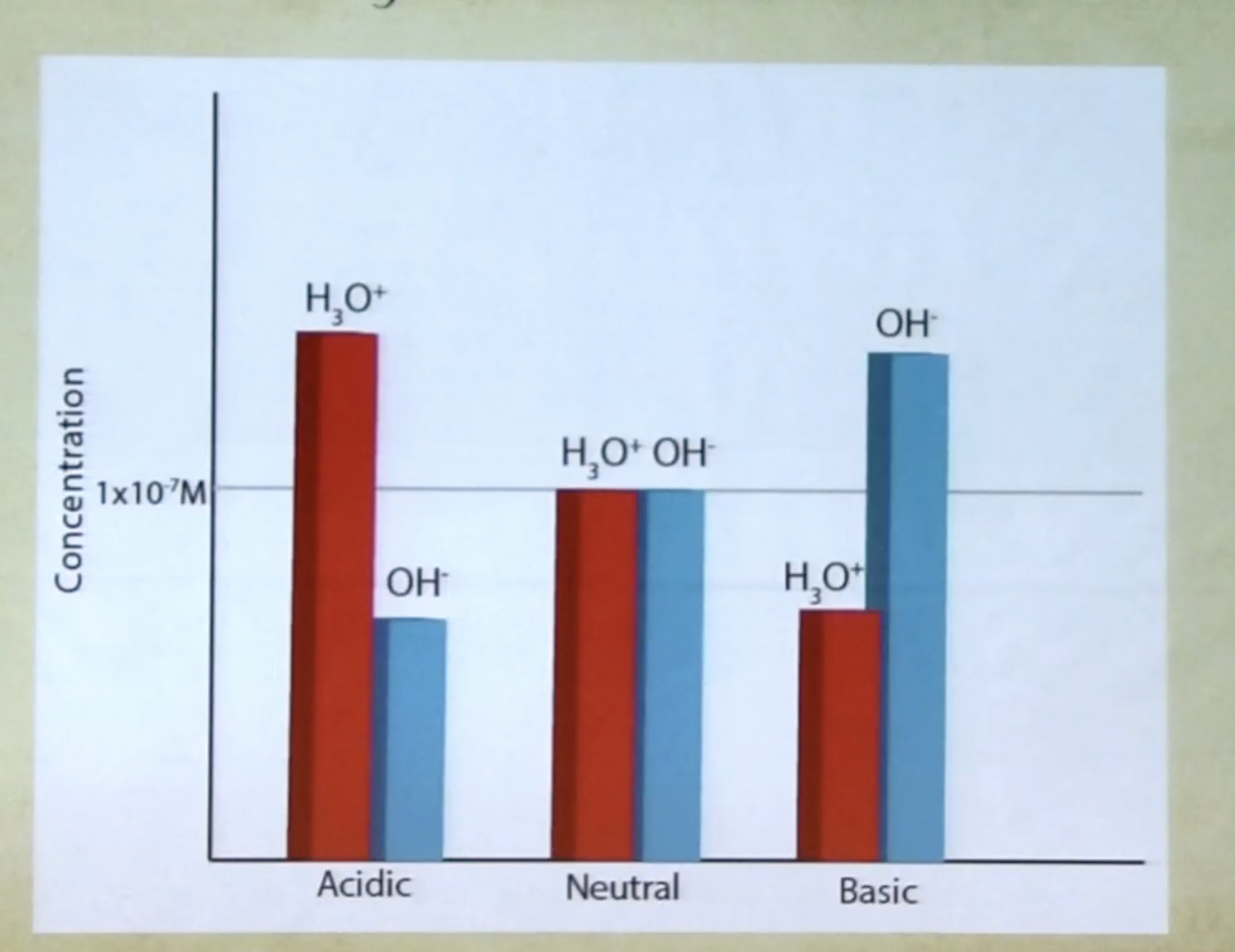
Acid: pH<7 and H^+>10^-7
natural pH=7
bases (alkaline): pH>7 and H^+<10^-7
Acids vs bases
acids - donate a proton (accepts an electron pair)
bases - accept a proton (donates an electron pair)
Types of acids
Hydrohalic acids: HF, HCl, HBr, HI
oxoacids: central element is surrounded by oxygens
Carboxylic acids: COOH group
Types of bases
First and second column of the periodic table AND an OH group
When a nitrogen has 3 bonds and a lone pair
Bronsted-lowry vs Arrhenius vs Lewis definition acid and bases definition
Bronsted-lowry
acids: donates H^+
bases: accepts H^+
Arrhenius
acids: donates H^+
bases: Donates OH^-
Lewis
acids: accepts electron pair, + charged
bases: donates electron pair, - charged, has a lone pair
How to write conjugate acids vs bases
How to write conjugate acids: add an H, add a + 1 charge (if there are multiple hydrogens, add one more H just to the last hydrogen in the formula)
How to write conjugate bases: Remove an H, add - 1 charge
conjugate bases do NOT have H in front (bc they are not acids)
Relation of H3O+ and OH^- in solutions (concentration vs acid, base, neutral)
Image
How to find pH vs pOH
-log(H+) = pH
-log(OH^-) = pOH
also, p(OH)+p(H) = 14
pH + pOH = ?
14
(H^+)(OH^-) = ?
1 times 10^-14 (at 25 degrees celsius)
H^+ and OH^- relationship
Inversely proportional
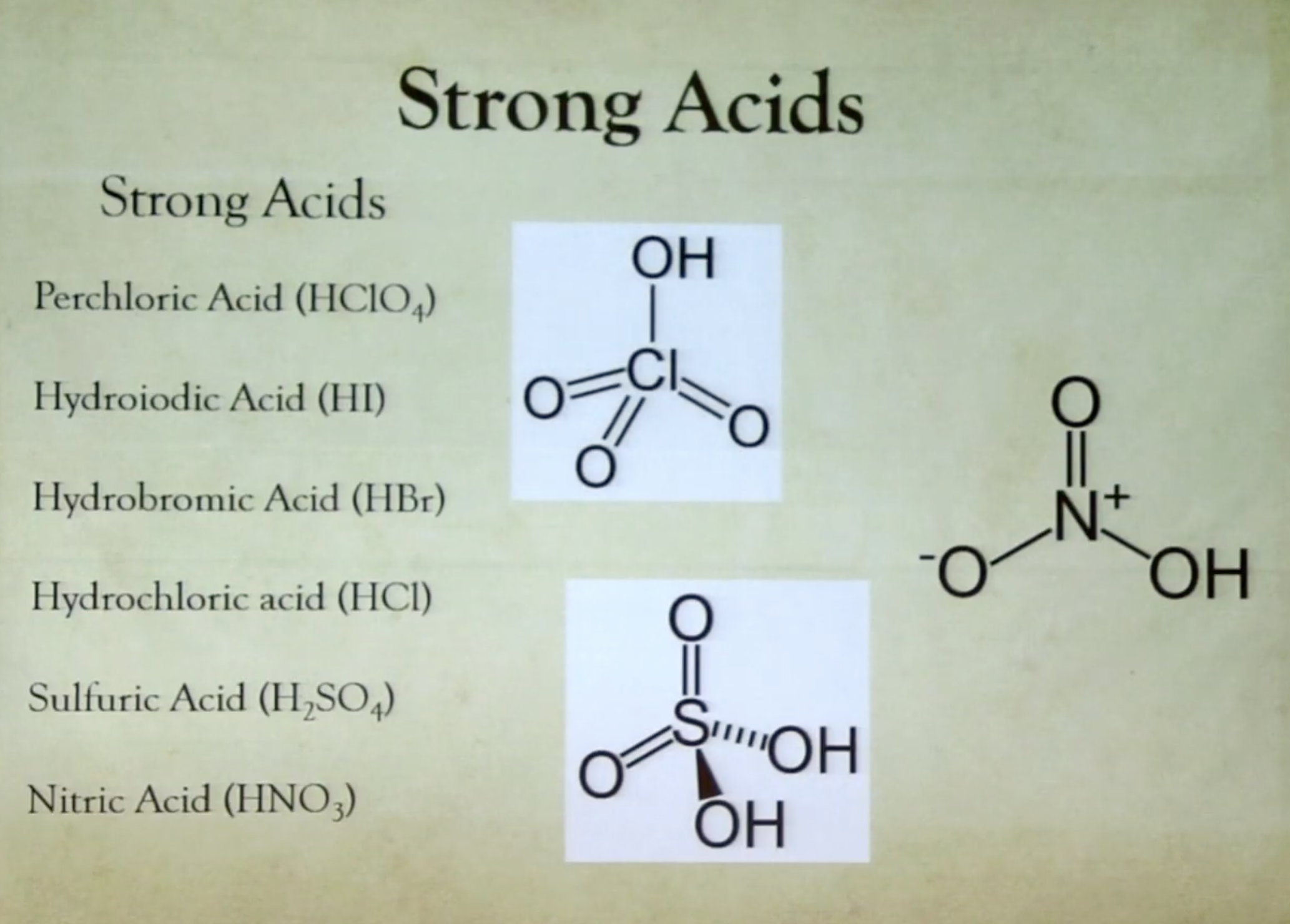
List the chemical formula and names of strong acids
Image
Strong acids and bases (definition not list)
we assume they completely ionize, and equilibrium to far to the right
Weak acids and bases (definition not list)
We assume they do NOT completely ionize, and equilibrium to far to the left
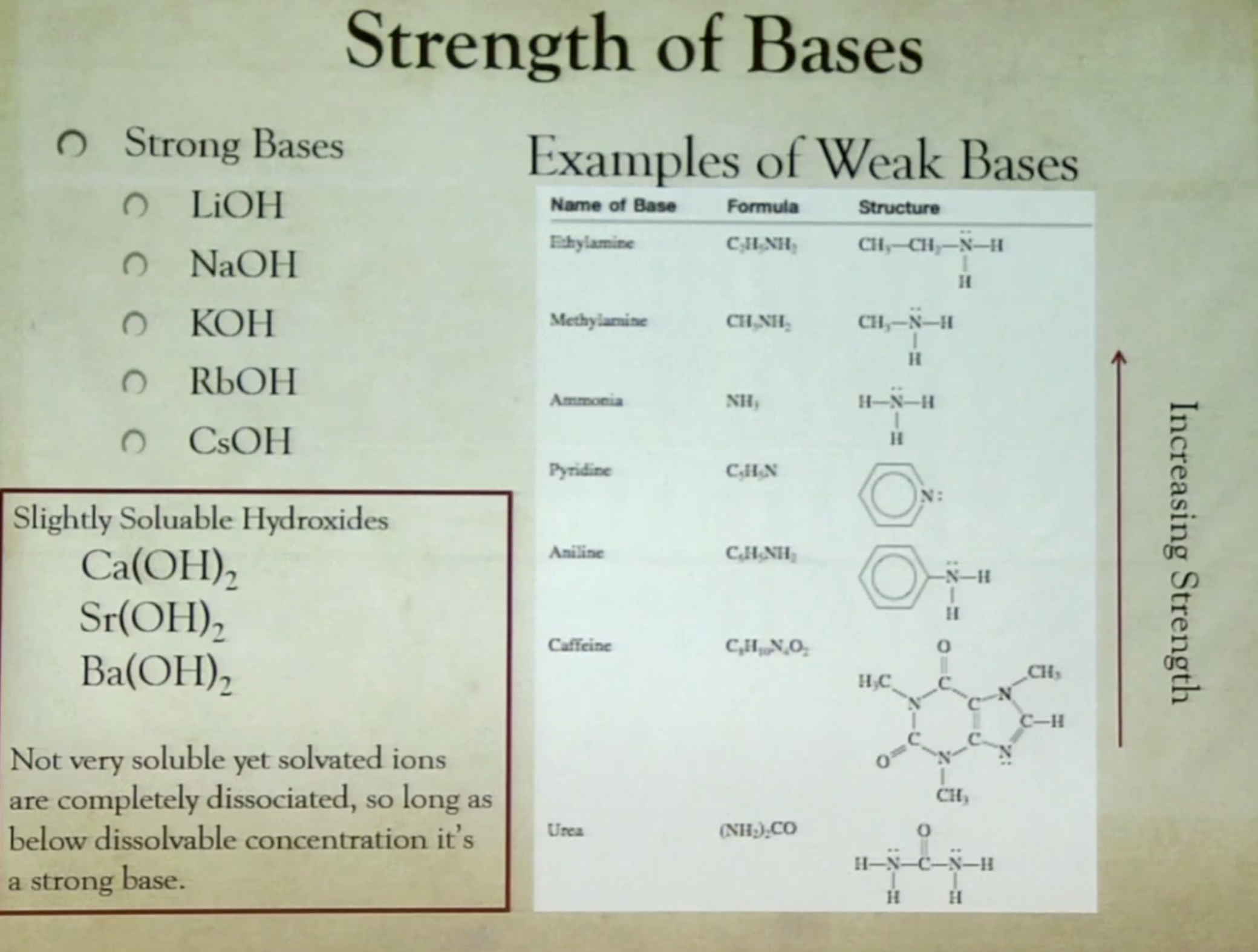
List strong bases
image (assume the box means also strong bases, for now)
Trick for memorizing strong vs weak acids and bases?
Just memorize all the strong acids and bases, the rest are weak
When something refers to “concentration", what does it mean?
10^-pH or 10^-pOH
Bond enthalpy (length) and acid strength relationship (periodic table)
As you go DOWN the periodic table, strength of acids INCREASES
Anion and acid strength relationship
the MORE you stabilize the anion, the STRONGER the acid (make it stay as an anion)
How to determine strength of oxoacids?
Different central atoms but same oxidation number
more electronegative element in the middle → stronger oxoacid (bc electronegativity of central atom stabilizes the negative charge that happens bc of dissociation. it spends more time dissociated)
Same central atoms but different oxidation number
greater oxidation number surrounding central atom → stronger oxoacid
greater number of oxygens → more resonance structures → stronger acids
oxidation number - greater number of oxygens around central atom (generally)
How to determine strength of carboxylic acids?
More stable conjugate base (anion) → stronger carboxylic acid
situations that stabilize anion:
electronegative atoms in R group
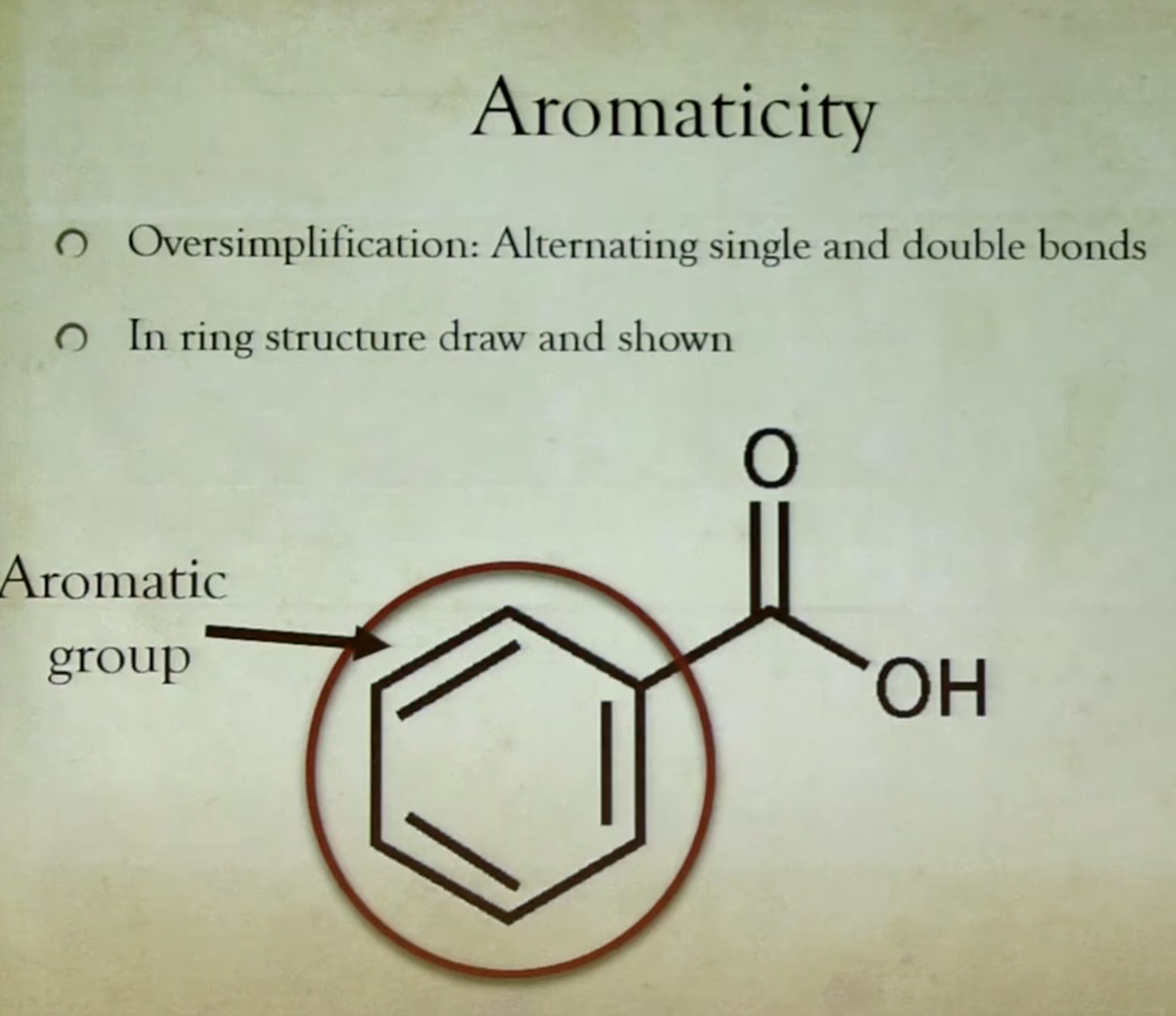
aromaticity in R group (alternating single and double bonds)
What is the difference between carboxylic acids and alcohols?
Alcohols have an -OH group and are effectively neutral (NOT ACIDIC)
carboxylic acids have a -COOH group and are acidic
How to rank carboxylic acid strength?
Look for most electronegative atom next to COOH
the more electronegative atom next to COOH is the stronger carboxylic acid
Ka
ion predict constant (same as Kc) prod/reactants, except you don’t have to deal with superscripts
[H+][A^-]/[HA]
HA: acid
H+: proton
A^-: conjugate base of acid
Relationship between Ka and acid strength and pH
Larger Ka, stronger acid, lower pH
Kb
base ionization constant (same as Kc) prod/reactants, except you don’t have to deal with superscripts
Relationship between Kb and base strength and pH
Larger Kb, stronger base, higher pH.