Neurons and Neuronal Communication
 Call Kai
 Learn
Learn Practice Test
 Spaced Repetition
 Match
Match Flashcards
 Knowt Play
1/38

There's no tags or description
Looks like no tags are added yet.
Name | Mastery | Learn | Test | Matching | Spaced | Call with Kai | Chat |
|---|
No analytics yet
Send a link to your students to track their progress
39 Terms
By receiving stimuli, converting them into electrical signals, transmitting and integrating those signals across neurons, and producing an appropriate response.
How does the nervous system process information?
The brain’s ability to process, store and use information. Largely through the vast number of neurons and their interconnections (synapses), which allow for complex processing like combining signals (e.g., via spatial and temporal summation), pattern recognition, and decision-making.
What is computational power in psychology?
Branching structures that receive signals from other neurons.
What are Dendrites?
The part of the neuron that contains the nucleus and maintains the cell.
What is the cell body (soma)?
The nucleus, genes and proteins needed for the neuron to function.
What does the cell body contain?
An electrical signal that travels down the axon to transmit information.
What is an action potential?
An insulating layer around the axon that speeds up action potentials.
What is the myelin sheath?
They are released from the axon terminal, cross the synaptic cleft and bind to receptors on the next neuron, triggering a response.
How does neurotransmission work?
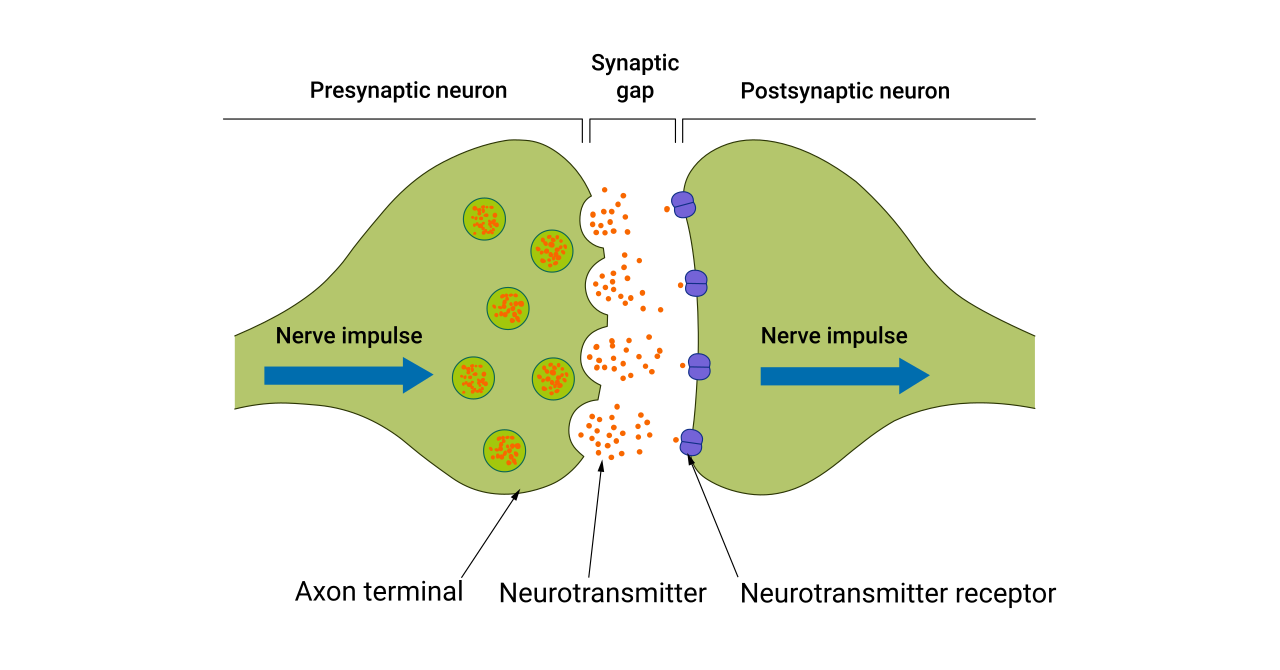
A brief period when a neuron cannot fire another action potential.
What is the absolute refractory period?
When repeated signals arrive quickly and combine, making a neuron more likely to reach its firing threshold.
What is temporal summation?
When multiple signals arriving at different locations on a neuron combine at the same time to reach the threshold needed for it to fire.
What is spatial summation?
It increases the likelihood that the postsynaptic neuron will fire an action potential.
What is the function of an excitatory neurotransmitter?
It decreases the likelihood that the postsynaptic neuron will fire an action potential.
What is the function of an inhibitory neurotransmitter?
The main excitatory neurotransmitter; involved in learning and sensory information.
What is glutamate?
The main inhibitory neurotransmitter in the nervous system.
What is GABA?
A neurotransmitter involved in muscle contraction and cortical arousal.
What is acetylcholine (ACh)?
Nicotine stimulates ACh receptors.
What does nicotine do to ACh?
A neurotransmitter involved in cortical arousal.
What is noradrenaline?
Reward and motivation, movement, learning, attention and emotional regulation.
What is dopamine involved in?
It increases dopamine and is used to treat Parkinson’s disease.
What is L-Dopa used for?
Many antipsychotic drugs reduce dopamine signalling by blocking dopamine receptors, particularly D2 receptors. This can reduce excessive dopamine activity in certain brain pathways and help relieve symptoms such as hallucinations and delusions.
How do antipsychotic drugs affect dopamine?
They inhibit serotonin reuptake, increasing serotonin activity in the synapse.
How do SSRIs affect serotonin?
Chemicals that influence the likelihood of neurons firing across wider areas of the brain.
What are neuromodulators?
They signal that something important is happening and should receive attention.
What do neuromodulators signal?
though multiple excitatory and inhibitory signals received from other neurons. These signals are combined, mainly at the cell body and axon hillock, to determine whether the neuron reaches the threshold needed to fire an action potential.
How do neurons integrate information?
A drug that increases or mimics the effect of a neurotransmitter by activating its receptors or increasing its activity.
What is an Agonist drug?
It can mimic the neurotransmitter and activate its receptors, or increase the neurotransmitter’s availability (e.g., by blocking reuptake).
How can agonists increase neurotransmitter activity?
A drug that reduces or blocks the effect of a neurotransmitter, usually by binding to its receptor without activating it.
What is an antagonist drug?
The brain’s ability to change and adapt through experience.
What is neuroplasticity?
The process of forming myelin around axons, speeding up neural communication.
What is myelination?
An insulating layer around axons that speeds up nerve signals.
What is myelin?
What happens to synaptic connections through experience?
They can strengthen, making neural communication and information retrieval faster and easier.
Dendrites can grow more branches, allowing neurons to receive more signals and process information more effectively.
How can dendrites change through experience?
They create more inputs that can influence whether the postsynaptic neuron fires.
What happens when neurons form new synaptic connections?
The process of generating new neurons.
What is neurogenesis?
In certain brain regions, such as the hippocampus.
Where might adult neurogenesis occur?
They are chemical messengers, such as noradrenaline, dopamine, serotonin and acetylcholine, that alter neural activity.
What are neuromodulators made of?
Noradrenaline mainly acts in the brain and nerves; adrenaline mainly acts as a hormone in the body.
What is the difference between noradrenaline and adrenaline?