Chapter 15
 Call Kai
 Learn
Learn Practice Test
 Spaced Repetition
 Match
Match Flashcards
 Knowt Play
1/44

There's no tags or description
Looks like no tags are added yet.
Name | Mastery | Learn | Test | Matching | Spaced | Call with Kai | Chat |
|---|
No analytics yet
Send a link to your students to track their progress
45 Terms
Q: What is adaptive (acquired) immunity in terms of line of defense?
A: It is the third line of defense.
Q: What is a key feature of adaptive immunity related to memory?
A: It has memory and remembers pathogens it has been exposed to.
Q: What does it mean that adaptive immunity is specific?
A: It targets specific pathogens that it has previously been exposed to.
Q: Where does antibody immunity (B-cells) mature?
A: B-cells mature in the bone marrow.
Q: Where does cellular immunity (T-cells) mature?
A: T-cells mature in the thymus after coming from the bone marrow.
Q: What is immunocompetence?
A: It is the ability of the body to interact with a wide spectrum of foreign substances.
Q: What is an antigen?
A: A molecule that stimulates a response by T-cells (cytotoxic cells) and B-cells (antibodies).
Q: What are examples of antigens?
A: Capsule, cell wall, fimbriae, flagella, pili, toxins, vaccines, and pollen.
Q: What is an antibody?
A: A protein of the immune system that binds to an antigen, and is part of adaptive immunity.
Q: What is an epitope?
A: The specific part of an antigen that binds an antibody.
Q: How many epitopes can an antigen have?
A: An antigen can have one or many epitopes.
Q: What does the primary vs. secondary immune response chart show over time?
A: After the initial exposure, antibody concentration rises slowly and modestly (primary immune response); after the secondary exposure, antibody concentration rises faster and to a much higher peak (secondary immune response).
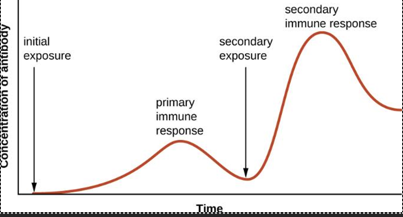
Q: What happens to the amount of leftover antibody after a secondary exposure compared to a primary exposure?
A: The leftover amount is greater after secondary exposure, meaning antibodies stay in the body longer.
Q: What are the two main regions of antibody structure?
A: A variable region and a constant region.
Q: What is the function of the variable region (Fab) of an antibody?
A: It binds to the antigen.
Q: What is the function of the constant region (Fc) of an antibody?
A: It is recognized by immune cells.
Q: What are the key characteristics of IgG?
A: It is the most abundant antibody in the human body, can cross the placenta and tissues, and opsonizes, agglutinates, and neutralizes.
Q: What are the key characteristics of IgA?
A: It is common in secretions such as breast milk, tears, and saliva, and neutralizes by trapping bacteria in mucus.
Q: What are the key characteristics of IgE?
A: It is present in low concentration in blood, functions against parasites and allergies, stimulates inflammation, and activates basophils and mast cells to release histamine.
Q: What are the key characteristics of IgM?
A: It is the first antibody produced, is a pentamer (5-arm structure) that agglutinates, and also opsonizes and neutralizes.
Q: What are the key characteristics of IgD?
A: It is found on the B-cell membrane, where it binds antigen.
Q: What are all the functions of antibodies against pathogens?
A: They neutralize pathogens, opsonize for phagocytosis, activate complement, and mediate cell-mediated cytotoxicity.
Q: What do Natural Killer (NK) cells kill?
A: Pathogens that are too big for other mechanisms to handle.
Q: How do NK cells recognize antibody-coated pathogens?
A: They have an Fc receptor that binds the constant region of an antibody attached to a pathogen.
Q: What do NK cells release to kill target cells?
A: Perforin and granzyme, which are cytotoxins.
Q: How do NK cells participate in innate immunity?
A: By recognizing and killing virus-infected cells and cancer cells that lack MHC I.
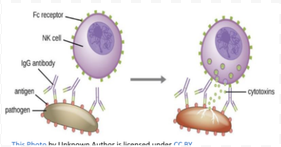
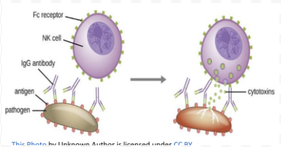
Q: What does this diagram illustrate about NK cell activity?
A: An NK cell's Fc receptor binds the constant region of IgG antibodies coating a pathogen, and the NK cell then releases cytotoxins onto the pathogen.
Q: What are the main antigen presenting cells?
A: Dendritic cells, macrophages, and B cells.
Q: What do antigen presenting cells do to bacteria?
A: They eat (phagocytose) bacteria.
Q: How do antigen presenting cells activate T-cells?
A: They present antigen on MHC II, which is needed to activate T-cells.
Q: Where do T-cells mature and gain function?
A: T-cells mature in the thymus.
Q: What happens to naive T-cells after they mature?
A: They migrate to the lymph nodes, spleen, and tonsils, where they encounter antigens and become activated.
Q: What is the function of regulatory T-cells?
A: They suppress the immune response when it is no longer needed.
Q: How do regulatory T-cells prevent autoimmune disease?
A: By stopping the immune system from attacking the body's own cells.
Q: What role do regulatory T-cells play in immune tolerance?
A: They help maintain immune tolerance and prevent excessive inflammation.
Q: What is the role of cytotoxic T-cells?
A: They are the primary cells of cell-mediated immunity and recognize and kill infected body cells containing intracellular pathogens such as viruses.
Q: What do cytotoxic T-cells recognize to identify infected cells?
A: Antigens presented on MHC I molecules.
Q: How do cytotoxic T-cells destroy infected cells?
A: They release perforin, which creates pores, and granzymes, which enter through the pores and trigger apoptosis, destroying the infected cell and pathogens inside.
Q: What is the overall function of helper T-cells?
A: They activate antibody immunity, activate T-cell immunity, and enhance killing by macrophages and NK cells.
Q: What are the characteristics of Th1 helper cells?
A: They are short lived, stimulate cytotoxic T-cells, activate cytokines, and stimulate macrophages, neutrophils, and NK cells to become more effective at killing.
Q: What are the characteristics of Th2 helper cells?
A: They are short lived, activate the antibody immune response, and secrete cytokines that activate B cells.
Q: What are the characteristics of Th3 helper cells?
A: They are long lived, remember a specific antigen, and allow for a faster and stronger antibody response.
Q: What is the difference between what antibodies and T cells fight?
A: Antibodies fight extracellular pathogens, while T cells target intracellular pathogens inside infected body cells.
Q: What immune response are T lymphocytes responsible for?
A: The cell-mediated immune response.
Q: How do cytotoxic T cells kill infected cells?
A: They recognize antigens on MHC I and kill infected cells by releasing perforin and granzymes.