obsetirc haemorrhage: postpartum haemorrhage
 Call Kai
 Learn
Learn Practice Test
 Spaced Repetition
 Match
Match Flashcards
 Knowt Play
1/41

There's no tags or description
Looks like no tags are added yet.
Name | Mastery | Learn | Test | Matching | Spaced | Call with Kai | Chat |
|---|
No analytics yet
Send a link to your students to track their progress
42 Terms
What is the leading preventable cause of maternal mortality around the world?
Postpartum haemorrhage
How rapid can a massive haemorrhage lead to maternal death if not recognised and managed effectively?
Within 2 hours
What are some factors that can decrease the adverse outcomes from the 3rd world countries? (5)
All patients should have free / affordable maternity care
Anemia should be prevented / treated in pregnancy
Emergency transport should be available
HCW should have the knowledge and skills to diagnose complications
Facilities should be available and maintained
Define primary PPH
Abnormal blood loss from the genital tract writhing 24 hrs of delivery (most common type of major OH)
Define secondary PPH
Abnormal blood loss occurs after 24 hrs up to 12 weeks post delivery
According to ACOG, define PPH
A cumulative blood loss greater than 1000mls in association with some level of maternal hypovolaemia and / haemodynamic instability regardless of mode of delivery
According to SOGC, define PPH
Any blood loss that causes haemodynamic instability
According to RCOG, define PPH
Blood loss >500 mls irrespective of route of delivery with mild 500-1000mls, moderate 1000-2000 mls and severe >2000mls
According to WHO, define PPH
>500 mls regardless of route of delivery / blood loos >300 mls associated with haemodynamic instability
Define life threatening PPH
Bleeding that has comprised the mother’s condition through haemorrhage shock, collapse / acute organ failure needing life-threatening interventions
Define refractory PPH
Bleeding test has not responded to 1st line treatment bundle
What happens during the 3rd stage of labour?
The uterus contracts, separates and expels the placenta with a higher contractile intensity and constricts its blood flow.
What are the 3 hallmark signs of placental separation? (3)
Contraction of the uterus which changes shapes of the fundus to be globular
A gush of blood from the vagina
Lengthening of the umbilical cord
What is the function for blood volume expansion during pregnancy?
Reduce the impact of postpartum blood loss (+the feed the baby)
Which system in pregnancy contributed to support clot formation for cessation of blood loss?
Coagulation system
Patients may experience PPH without risk factors and therefore what should clinicians be prepared for?
Unexpected bleeding after every delivery (always prepare the delivery room for the worst)
What is the most common cause of PPH?
Uterine atony (failure of uterine contraction adequately after childbirth)
What are the 4Ts that cause a risk for PPH?
Tone > 70% of pts
Trauma > genital tract 20%
Tissue > retained products of conception (placenta) 9%
Thrombin > coagulopathy 1%
What are 4 cusses that can cause uterine atony?
Uterine overdistension > polyhdramnios, multiple gestation, macrosomia
Uterine exhaustion > precipitous / prolonged labour, general anaesthesia, anemia
Infection > prolonged rupture of membranes, chorioamnionitis
Dysfunctional uterine activity > fibriods, placenta praevia
How can we prevent PPH?
Using uterotonic agents that increase the strength of uterine contractions > accelerate delivery of placenta & involution placental site
Name 4 uterotonic agents
Oxytocin
Carbetocin
Ergometrine
Prostaglandins
How do the uterotonic agents work
Oxytocin > usually released by pituitary gland to increase intra cellular calcium / give 5-10U IV with an onset of 3-5 mins and half-life of 5 mins
Carbetocin > synthetic oxytocin with a longer half life and more heat stable (more expensive)
Ergometrine > ergot alkaloid (fungus) agonist of serotonergic receptors but exact mechanism unknown, 3 hrs action
Prostaglandins > misoprostol = synthetic E1 (protects the stomach), taken oral / carboprost = injectable PGF2
Ergometrine is contra-indicated in which patients? (Vasoconstrictor) (2)
Hypertension
Cardiac disease
What are the side effects of misoprostol? (5)
Nausea + vomiting
Diarrhoea
Heading
Shivering
Hyperthermia
What is best uterotonic combination post vaginal delivery?
Ergometrine & oxytocin
What is best uterotonic combination post C/S?
Carbetocin & oxytocin
Which drug is a non-uterotonic drug that inhibits fibrinolysis (inhibition of resulting in the reduction of breakdown of blood clots to decrease bleeding and has an immediate onset of action when given IV?
Tranexamic acid
Tranexamic acid is contra-indicated in which patients?
Venous thromboembolism
Which trail proved that TXA plus oxytocin had a formed significant reduction in the need for additional uterotonics?
Tranexamic Acid for Prevention of PPH (TRAAP)
What was the E-Motive RCTC?
Primary outcome = calibrated blood-collection drape used to assess clinically significant blood loss, resulted in significant 60% reduction in severe PPH
What are other methods to prevent PPH?
Delayed cord clamping
Early skin-to-skin contact
Controlled cord traction > done
What is the dose and route of Tranexamic acid?
1g IV over 30-60 s / half-life of 2h
What is the dose and route of misoprostol?
200-400 ug sublingual / oral
What are the steps to manage PPH? (5)
Quantification of blood loss
First response treatment
Treatment of refractory / life-threatening PHH
Blood transfusion and blood products
Time critical steps
What is a way to accurately assess blood loss after childbirth?
Calibrated blood collection drapes > easy to use, cost-effective, applied immediately after childbirth but before placental delivery for at least 1 hr
How to measure blood loss intra-operatively? (3)
Soaked swabs + linen + blood in suction bottles
How to manage blood loss post-operatively?
Monitoring the patient’s vitals and signs of internal bleeding
What does MOTIVE stand for in the first response treatment for PPH?
M - massage of uterus until contracted / 1 min
O - oxytocic drug of 5-10 UI IV + 20 UI IV for mantaince in diluted 1L saline over 4 hr
T - Tranexamic acid 1 g IV injection in 200 ml crystalloid over 10 mins
IV - IV fluids if clinically indicated
E - examination of genital tract & escalation (Rx for refractory PPH)
Name 5 items inside PPH carry case
Tourniquet
21 / 23 G needles
5 / 10 mL syringes
Catheter bag
Alcohol swabs
What is the proposed algorithm of surgical technique to control postpartum haemorrhage refractory to medical treatment?
Severe postpartum haemorrhage > bilateral uterine artery ligation > uterine compression sutures > bilateral internal iliac artery ligation > peripartum hysterectomy
What are the 3 methods to manage PPH of the uterus using surgical intervention?
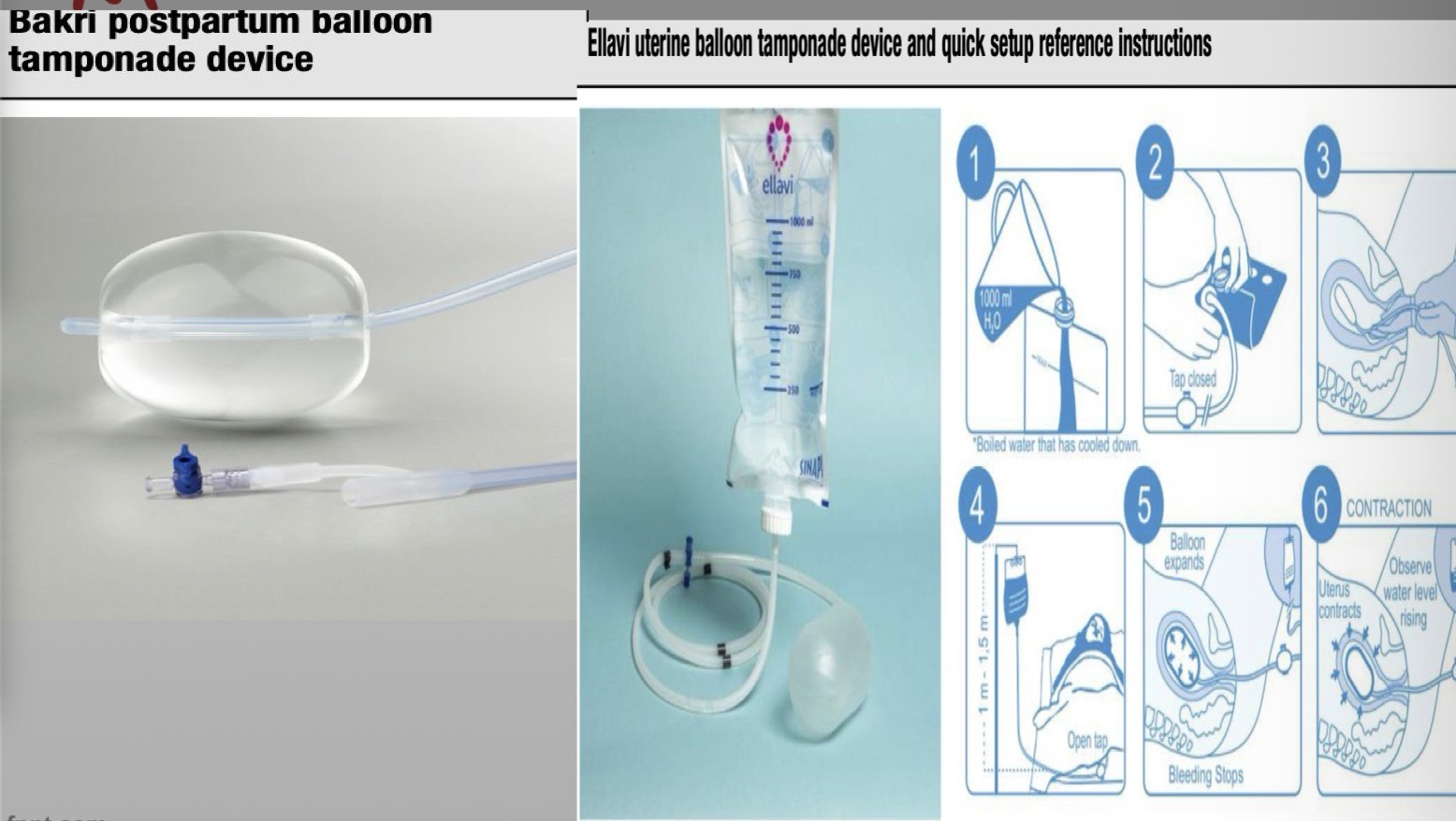
Bakri Ballon Tamponade
Uterine compression B-lynch suture
Uterine artery ligation