body fluids & their disturbances

0.0(0)
Studied by 0 people
call kaiCall Kai
Locked
learnLearn
examPractice Test
spaced repetitionSpaced Repetition
heart puzzleMatch
flashcardsFlashcards
GameKnowt Play
Card Sorting

1/47

flashcard set

Earn XP

Description and Tags

Comprehensive vocabulary flashcards covering body fluid distribution, measurement, and clinical disturbances based on the lecture notes.

Last updated 8:07 AM on 9/14/26
Name
Mastery
Learn
Test
Matching
Spaced
Call with Kai
Chat

No analytics yet

Send a link to your students to track their progress

48 Terms

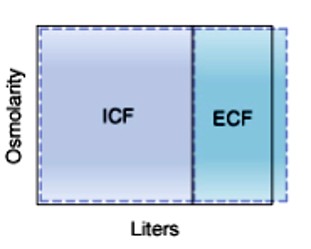
1
New cards

total body water (TBW)

the total amount of water in a person's body

  • consisting of intracellular fluid (ICF) and extracellular fluid (ECF)

  • typically accounting for about 60% of body weight in adults


2
New cards

intracellular fluid (ICF)

the fluid present inside the cells (cytoplasm) comprising of the total body water (TBW)

  • major cations - K+ & Mg2+

  • major anions - proteins & phosphates (PO43−)


3
New cards

extracellular fluid (ECF)

the fluid present outside the cells comprising of the total body water (TBW)

  • consisting of plasma (¼) and interstitial fluid (¾) separated by capillary endothelium

    • plasma - fluid portion of blood

    • interstitial fluid - fluid in spaces between cells in tissues/organs

  • contains high concentrations of Na+, Cl, & bicarbonate (HCO3)


4
New cards

plasma

the fluid portion of blood that makes up about ¼ of the extracellular fluid (ECF) volume

  • contains clotting factors

  • has large amount of proteins (impermeable through capillary membrane)


5
New cards

interstitial fluid

fluid found in spaces between cells in tissues and organs comprising about ¾ of the extracellular Fluid (ECF) volume

6
New cards

60-40-20 rule

a principle used to estimate body fluid distribution

  • approximately 60% of total body weig

    ht is water of which

    • 40% is intracellular fluid

    • 20% is extracellular fluid → (25% plasma + 75% interstitial fluid)


<p>a principle used to estimate body fluid distribution</p><ul><li><p>approximately 60% of total body weig</p><p>ht is water of which</p><ul><li><p><span style="color: blue;"><strong>40% is intracellular fluid</strong></span></p></li><li><p><span style="color: rgb(99, 47, 255);"><strong>20% is extracellular fluid</strong> </span>→ (25% plasma + 75% interstitial fluid)</p></li></ul></li></ul><p></p>
7
New cards

blood volume

the total amount of blood circulating within the cardiovascular system

  • typically about 7-8% of body weight

  • includes plasma and cellular components (red blood cells, white blood cells, & platelets)

  • calculated as Plasma volume1Hct\frac{\text{Plasma volume}}{1 - Hct}


8
New cards

hematocrit (Hct)

the fractional concentration of red blood cells (RBCs) in the blood relative to the total blood volume

9
New cards

Plasma volume1Hct\frac{\text{Plasma volume}}{1 - Hct}

blood volume

10
New cards

dilution method

a quantitative approach used to determine the volume of a specific body fluid compartment by tracking how an indicator distributes within that compartment

  • relies on a marker that stays exclusively within the compartment being measured

  • after equilibration → indicator concentration reflects compartment volume

  • Volume of comparment (mL) =Amount of marker injected (mg)Concentration of the marker (mg/mL)\text{Volume of comparment (mL) }=\frac{\text{Amount of marker injected (mg)}}{\text{Concentration of the marker (mg/mL)}}


11
New cards

Amount of marker injected (mg)Concentration of the marker (mg/mL)\textcolor{black}{\frac{\text{Amount of marker injected (mg)}}{\text{Concentration of the marker (mg/mL)}}}

volume of the fluid compartment (dilution method)

12
New cards

D2O (deuterium oxide), tritiated water, antipyrine, or urea

markers for total body water (TWB)

13
New cards

inulin, mannitol, sodium, or sucrose

markers for ECF volume

14
New cards

radioactive albumin or Evans blue

markers for plasma volume

15
New cards

ICF volume calculation

TBWECF\textcolor{blue}{\bm{TBW-ECF}}

  • need two markers

    • TWB → D2O (deuterium oxide), tritiated water, antipyrine, or urea

    • ECF → inulin, mannitol, sodium, or sucrose


16
New cards

interstitial fluid (IF) volume calculation

ECFPlasma volume\textcolor{blue}{\bm{ECF-}}\textcolor{blue}{\text{Plasma volume}}

  • need two markers

    • ECF → inulin, mannitol, sodium, or sucrose

    • plasma volume → radioactive albumin or Evans blue


17
New cards

tonicity

the effective osmotic pressure gradient of a solution determining the direction of water movement across a semipermeable membrane

  • influences cell shape and function based on the relative concentrations of solutes inside and outside the cell


18
New cards

isotonic solution

a solution that does not change the volume of the body cells

  • equal concentrations of solutes on both sides of the cell membrane → no net water movement


19
New cards

hypertonic solution

a solution that causes body cells to shrink

  • due to a higher concentration of solutes outside the cell → net water movement out of the cell


20
New cards

hypotonic solution

a solution that causes body cells to swell

  • due to a lower concentration of solutes outside the cell → net water movement into the cell


21
New cards

steady state osmolarity

a condition where the concentration of solutes in the body fluids remains stable

  • maintains equilibrium between intracellular and extracellular fluids

  • ~ 300 mOsm/L


22
New cards

plasma osmolarity

the total concentration of dissolved osmoles in plasma reflecting the osmolarity of both the extracellular and intracellular fluid compartments

  • primarily determined by impermeant ECF osmoles → NaCl contributes most of the effective osmolarity of plasma

  • normal plasma osmolarity ≈ 280–295 mOsm/L


23
New cards

estimated plasma osmolarity (Posmolarity)

a rapid clinical approximation of plasma osmolarity based on the fact that sodium salts dominate the effective osmoles of the ECF

  • twice the [Na+] = good index

  • calculated as 2 × plasma sodium concentration


24
New cards

accurate plasma osmolarity

a calculated measure of plasma osmolarity that includes all major solutes contributing to osmotic pressure

  • Posm=2([Na+])+[glucose]18+BUN2.8\textcolor{blue}{P_{osm}=2([Na^{+}])+\frac{[glucose]}{18}+\frac{BUN}{2.8}}

    • glucose and BUN terms convert mg/dL → mmol/L

  • accounts for osmoles that become significant in disease states:

    • ↑ glucose → uncontrolled diabetes mellitus

    • ↑ BUN → chronic renal failure


25
New cards

Posm=2([Na+])+[glucose]18+BUN2.8P_{osm} = 2([Na^+]) + \frac{[glucose]}{18} + \frac{BUN}{2.8}

accurate plasma osmolarity

26
New cards

body fluid disturbances

changes in the composition or volume of body fluids that can result from various conditions

  • two conditions

    • volume expansion → increase ECF

    • volume contraction → decrease ECF

  • volumes after only in ECF or in both ECF & ICF

  • also depend on osmolarity changes in ECF


27
New cards

volume & osmolarity changes principles

  1. any changes in volume will first affect the ECF volume

  2. the change in volume of ICF occurs only by changes in ECF osmolarity

  3. at equilibrium (steady state), the ICF and ECF osmolarity will be the same


28
New cards

volume expansion

an increase in the extracellular fluid (ECF) volume often due to fluid retention or infused fluids

  • 3 states

    • isosmotic

    • hyperosmotic

    • hyposmotic


<p>an <span style="color: blue;"><strong>increase in the extracellular fluid (ECF) volume</strong></span> often due to fluid retention or infused fluids</p><ul><li><p>3 states</p><ul><li><p><span style="color: green;"><strong><mark data-color="green" style="background-color: green; color: inherit;">isosmotic</mark></strong></span></p></li><li><p><span style="color: rgb(44, 192, 0);"><strong><mark data-color="green" style="background-color: green; color: inherit;">hyperosmotic</mark></strong></span></p></li><li><p><span style="color: green;"><strong><mark data-color="green" style="background-color: green; color: inherit;">hyposmotic</mark></strong></span></p></li></ul></li></ul><p></p>
29
New cards

isosmotic volume expansion

a type of body fluid disturbance characterized by an increase in extracellular fluid (ECF) volume without a change in ICF volume or ICF + ECF osmolarity

  • no shift in water between ECF & ICF (↑ ECF + ICF vol + ECF & ICF osm)

  • ↑ in BP

  • examples

    • infusion of isotonic NaCl (0.9%)

    • gain of isotonic fluid


<p>a type of body fluid disturbance characterized by an <span style="color: blue;"><strong><em>increase</em> in extracellular fluid (ECF) volume</strong></span> <span style="color: blue;"><strong>without a change in ICF volume or ICF + ECF osmolarity</strong></span></p><ul><li><p><span style="color: purple;"><strong><mark data-color="purple" style="background-color: purple; color: inherit;">no shift in water between ECF &amp; ICF</mark> </strong></span>(↑ ECF + <span data-name="left_right_arrow" data-type="emoji">↔</span> ICF vol + <span data-name="left_right_arrow" data-type="emoji">↔</span> ECF &amp; ICF osm)</p></li><li><p><span style="color: red;"><strong><mark data-color="red" style="background-color: red; color: inherit;">↑ in BP</mark></strong></span></p></li><li><p>examples</p><ul><li><p><span style="color: green;"><strong><mark data-color="green" style="background-color: green; color: inherit;">infusion of isotonic NaCl (0.9%)</mark></strong></span></p></li><li><p><span style="color: green;"><strong><mark data-color="green" style="background-color: green; color: inherit;">gain of isotonic fluid</mark></strong></span></p></li></ul></li></ul><p></p>
30
New cards
term image

isosmotic volume expansion

31
New cards
<p></p>


isosmotic volume expansion (table)

32
New cards

hyperosmotic volume expansion

a type of body fluid disturbance characterized by an increase in extracellular fluid (ECF) volume with an increase in osmolarity

  • water shift from ICF → ECF (↑ ECF vol + ↓ ICF vol + ↑ ECF & ICF osm)

  • ↑ BP & alderstone (salt + H2O)

  • examples

    • infusion of hypertonic fluids

    • syndrome of inappropriate ADH (SIADH)

    • polydipsia


<p>a type of body fluid disturbance characterized by an <span style="color: blue;"><strong><em>increase</em> in extracellular fluid (ECF) volume </strong></span>with an<span style="color: blue;"><strong> increase in osmolarity</strong></span></p><ul><li><p><span style="color: purple;"><strong><mark data-color="purple" style="background-color: purple; color: inherit;">water shift from ICF → ECF</mark></strong></span> (↑ ECF vol + ↓ ICF vol + ↑ ECF &amp; ICF osm)</p></li><li><p><span style="color: red;"><strong><mark data-color="red" style="background-color: red; color: inherit;">↑ BP </mark></strong></span><span style="color: rgb(0, 0, 0);"><strong><mark data-color="red" style="background-color: red; color: inherit;">&amp;</mark></strong><mark data-color="red" style="background-color: red; color: inherit;"> </mark></span><span style="color: red;"><strong><mark data-color="red" style="background-color: red; color: inherit;">↑ </mark><em><mark data-color="red" style="background-color: red; color: inherit;">alderstone </mark></em><mark data-color="red" style="background-color: red; color: inherit;">(salt + H<sub>2</sub>O)</mark></strong></span></p></li><li><p>examples</p><ul><li><p><span style="color: green;"><strong><mark data-color="green" style="background-color: green; color: inherit;">infusion of hypertonic fluids</mark></strong></span></p></li><li><p><span style="color: green;"><strong><mark data-color="green" style="background-color: green; color: inherit;">syndrome of inappropriate ADH (SIADH)</mark></strong></span></p></li><li><p><span style="color: green;"><strong><mark data-color="green" style="background-color: green; color: inherit;">polydipsia</mark></strong></span></p></li></ul></li></ul><p></p>
33
New cards
term image

hyperosmotic volume expansion

34
New cards
term image

hyperosmotic volume expansion (table)

35
New cards

hyposmotic volume expansion

a type of body fluid disturbance characterized by an increase in extracellular fluid (ECF) volume with a decrease in osmolarity

  • water shift from ECF → ICF (↑ ECF & ICF vol + ↓ ECF & ICF osm)

  • ↑ BP & ADH (only H2O)

  • examples

    • infusion of hypotonic fluids

    • ingesting dry NaCl (eating lots of salty foods)

    • Conn’s Syndrome

    • oat cell carcinoma of the lungs


<p>a type of body fluid disturbance characterized by an <span style="color: blue;"><strong><em>increase</em> in extracellular fluid (ECF)</strong></span> volume with a <span style="color: blue;"><strong>decrease in osmolarity</strong></span></p><ul><li><p><span style="color: purple;"><strong><mark data-color="purple" style="background-color: purple; color: inherit;">water shift from ECF → ICF</mark></strong></span> (↑ ECF &amp; ICF vol + ↓ ECF &amp; ICF osm)</p></li><li><p><span style="color: red;"><strong><mark data-color="red" style="background-color: red; color: inherit;">↑ BP </mark></strong></span><span style="color: rgb(0, 0, 0);"><strong><mark data-color="red" style="background-color: red; color: inherit;">&amp;</mark></strong><mark data-color="red" style="background-color: red; color: inherit;"> </mark></span><span style="color: red;"><strong><mark data-color="red" style="background-color: red; color: inherit;">↑ </mark><em><mark data-color="red" style="background-color: red; color: inherit;">ADH </mark></em><mark data-color="red" style="background-color: red; color: inherit;">(only H<sub>2</sub>O)</mark></strong></span></p></li><li><p>examples</p><ul><li><p><span style="color: green;"><strong><mark data-color="green" style="background-color: green; color: inherit;">infusion of hypotonic fluids</mark></strong></span></p></li><li><p><span style="color: green;"><strong><mark data-color="green" style="background-color: green; color: inherit;">ingesting dry NaCl (eating lots of salty foods)</mark></strong></span></p></li><li><p><span style="color: green;"><strong><mark data-color="green" style="background-color: green; color: inherit;">Conn’s Syndrome</mark></strong></span></p></li><li><p><span style="color: green;"><strong><mark data-color="green" style="background-color: green; color: inherit;">oat cell carcinoma of the lungs</mark></strong></span></p></li></ul></li></ul><p></p>
36
New cards
term image

hyposmotic volume expansion

37
New cards
term image

hyposmotic volume expansion (table)

38
New cards

volume contraction

a decrease in extracellular fluid (ECF) volume resulting from water loss or solute gain

  • 3 states

    • isosmotic

    • hyperosmotic

    • hyposmotic


<p>a <span style="color: blue;"><strong>decrease in extracellular fluid (ECF) volume</strong></span> resulting from water loss or solute gain</p><ul><li><p>3 states</p><ul><li><p><span style="color: green;"><strong><mark data-color="green" style="background-color: green; color: inherit;">isosmotic</mark></strong></span></p></li><li><p><span style="color: rgb(44, 192, 0);"><strong><mark data-color="green" style="background-color: green; color: inherit;">hyperosmotic</mark></strong></span></p></li><li><p><span style="color: green;"><strong><mark data-color="green" style="background-color: green; color: inherit;">hyposmotic</mark></strong></span></p></li></ul></li></ul><p></p>
39
New cards

isosmotic volume contraction

a type of body fluid disturbance characterized by a decrease in extracellular fluid (ECF) volume without a change in ICF volume or ICF + ECF osmolarity

  • no shift in water between ECF & ICF (↓ ECF vol + ICF vol + ECF & ICF osm)

  • ↓ in BP

  • examples

    • loss of isotonic fluid

    • diarrhea (↑ Hct)

    • hemorrhage (↓ Hct)

    • severe vomiting


<p>a type of body fluid disturbance characterized by a <span style="color: blue;"><strong><em>decrease</em> in extracellular fluid (ECF) volume</strong></span> <span style="color: blue;"><strong>without a change in ICF volume or ICF + ECF osmolarity</strong></span></p><ul><li><p><span style="color: purple;"><strong><mark data-color="purple" style="background-color: purple; color: inherit;">no shift in water between ECF &amp; ICF</mark> </strong></span>(↓ ECF vol + <span data-name="left_right_arrow" data-type="emoji">↔</span> ICF vol + <span data-name="left_right_arrow" data-type="emoji">↔</span> ECF &amp; ICF osm)</p></li><li><p><span style="color: red;"><strong><mark data-color="red" style="background-color: red; color: inherit;">↓ in BP</mark></strong></span></p></li><li><p>examples</p><ul><li><p><span style="color: green;"><strong><mark data-color="green" style="background-color: green; color: inherit;">loss of isotonic fluid</mark></strong></span></p></li><li><p><span style="color: green;"><strong><mark data-color="green" style="background-color: green; color: inherit;">diarrhea (↑ Hct)</mark></strong></span></p></li><li><p><span style="color: green;"><strong><mark data-color="green" style="background-color: green; color: inherit;">hemorrhage (↓ Hct)</mark></strong></span></p></li><li><p><span style="color: green;"><strong><mark data-color="green" style="background-color: green; color: inherit;">severe vomiting</mark></strong></span></p></li></ul></li></ul><p></p>
40
New cards
term image

isosmotic volume contraction

41
New cards
term image

isosmotic volume contraction - hemorrhage (table)

42
New cards
term image

isosmotic volume contraction - diarrhea (table)

43
New cards

hyperosmotic volume contraction

a type of body fluid disturbance characterized by an decrease in extracellular fluid (ECF) volume with an increase in osmolarity

  • water shift from ICF → ECF (↓ ECF & ICF vol + ↑ ECF & ICF osm)

  • ↓ BP & ADH (only H2O)

  • examples

    • infusion of hypotonic fluids

    • diabetes insipidus

    • water deprivation

    • drinking alcohol

    • excessive sweating

    • fever


<p>a type of body fluid disturbance characterized by an <span style="color: blue;"><strong><em>decrease</em> in extracellular fluid (ECF) volume </strong></span>with an<span style="color: blue;"><strong> increase in osmolarity</strong></span></p><ul><li><p><span style="color: purple;"><strong><mark data-color="purple" style="background-color: purple; color: inherit;">water shift from ICF → ECF</mark></strong></span> (↓ ECF &amp; ICF vol + ↑ ECF &amp; ICF osm)</p></li><li><p><span style="color: red;"><strong><mark data-color="red" style="background-color: red; color: inherit;">↓ BP </mark></strong></span><span style="color: rgb(0, 0, 0);"><strong><mark data-color="red" style="background-color: red; color: inherit;">&amp;</mark></strong><mark data-color="red" style="background-color: red; color: inherit;"> </mark></span><span style="color: red;"><mark data-color="red" style="background-color: red; color: inherit;">↓</mark><strong><mark data-color="red" style="background-color: red; color: inherit;"> </mark><em><mark data-color="red" style="background-color: red; color: inherit;">ADH </mark></em><mark data-color="red" style="background-color: red; color: inherit;">(only H<sub>2</sub>O)</mark></strong></span></p></li><li><p>examples</p><ul><li><p><span style="color: green;"><strong><mark data-color="green" style="background-color: green; color: inherit;">infusion of </mark><em><mark data-color="green" style="background-color: green; color: inherit;">hypotonic</mark></em><mark data-color="green" style="background-color: green; color: inherit;"> fluids</mark></strong></span></p></li><li><p><span style="color: green;"><strong><mark data-color="green" style="background-color: green; color: inherit;">diabetes insipidus</mark></strong></span></p></li><li><p><span style="color: green;"><strong><mark data-color="green" style="background-color: green; color: inherit;">water deprivation</mark></strong></span></p></li><li><p><span style="color: green;"><strong><mark data-color="green" style="background-color: green; color: inherit;">drinking alcohol</mark></strong></span></p></li><li><p><span style="color: green;"><strong><mark data-color="green" style="background-color: green; color: inherit;">excessive sweating</mark></strong></span></p></li><li><p><span style="color: green;"><strong><mark data-color="green" style="background-color: green; color: inherit;">fever</mark></strong></span></p></li></ul></li></ul><p></p>
44
New cards
term image

hyperosmotic volume contraction

45
New cards
term image

hyperosmotic volume contraction (table)

46
New cards

hyposmotic volume contraction

a type of body fluid disturbance characterized by an decrease in extracellular fluid (ECF) volume with a decrease in osmolarity

  • water shift from ECF → ICF (↓ ECF vol + ↑ ICF vol + ↓ ECF & ICF osm)

  • BP & aldosterone (salt + H2O)

  • examples

    • infusion of hypertonic fluids

    • Addison’s disease

    • aldosterone deficiency


<p>a type of body fluid disturbance characterized by an <span style="color: blue;"><strong><em>decrease</em> in extracellular fluid (ECF)</strong></span> volume with a <span style="color: blue;"><strong>decrease in osmolarity</strong></span></p><ul><li><p><span style="color: purple;"><strong><mark data-color="purple" style="background-color: purple; color: inherit;">water shift from ECF → ICF</mark></strong></span> (↓ ECF vol + ↑ ICF vol + ↓ ECF &amp; ICF osm)</p></li><li><p><span style="color: red;">↓<strong><mark data-color="red" style="background-color: red; color: inherit;"> BP &amp;</mark></strong><mark data-color="red" style="background-color: red; color: inherit;"> </mark>↓<strong><mark data-color="red" style="background-color: red; color: inherit;"> </mark><em><mark data-color="red" style="background-color: red; color: inherit;">aldosterone </mark></em><mark data-color="red" style="background-color: red; color: inherit;">(salt + H<sub>2</sub>O)</mark></strong></span></p></li><li><p>examples</p><ul><li><p><span style="color: green;"><strong><mark data-color="green" style="background-color: green; color: inherit;">infusion of </mark><em><mark data-color="green" style="background-color: green; color: inherit;">hypertonic </mark></em><mark data-color="green" style="background-color: green; color: inherit;">fluids</mark></strong></span></p></li><li><p><span style="color: green;"><strong><mark data-color="green" style="background-color: green; color: inherit;">Addison’s disease</mark></strong></span></p></li><li><p><span style="color: green;"><strong><mark data-color="green" style="background-color: green; color: inherit;">aldosterone deficiency</mark></strong></span></p></li></ul></li></ul><p></p>
47
New cards
term image

hyposmotic volume contraction

48
New cards
term image

hyposmotic volume contraction (table)