Spirochetes
 Call Kai
 Learn
Learn Practice Test
 Spaced Repetition
 Match
Match Flashcards
 Knowt Play
1/35

Earn XP
Description and Tags
Borrelia, Treponema, and Leptospira
Name | Mastery | Learn | Test | Matching | Spaced | Call with Kai | Chat |
|---|
No analytics yet
Send a link to your students to track their progress
36 Terms
genera
- Borrelia
- Treponema
- Leptospira
characteristics
- helically coiled
- motile
- GN cell wall characteristics
- do NOT gram stain well
- not classified as GP or GN
Borrelia characteristics (oxygen, morphology, motility, staining)
-Microaerophilic
-Helically coiled
-Corkscrew or oscillating motility
-Stain with Giemsa
-Generally require vectors such as lice and ticks to initiate infection
relapsing fever
a bacterial infection caused by spirochetes in the Borrelia genus
Borrelia enters the blood and lesions form in the spleen, liver, or kidneys
symptoms
fever, muscle pain, bone pain, confusion, hepatosplenomegaly
the disease can relapse due to changes in the organism’s antigenicity
how do we ID relapsing fever?
–Based on clinical symptoms
–Difficult to culture Barbour-Stoenner-Kelly media
–Thick blood films with Giemsa stain during febrile episode
Borrelia burgdorfei characteristics and infection
spirochete carried by several tick species
causes Lyme Disease
varied presentation
first stage of Lyme disease
erythema migrans (EM) "bull's eye" rash
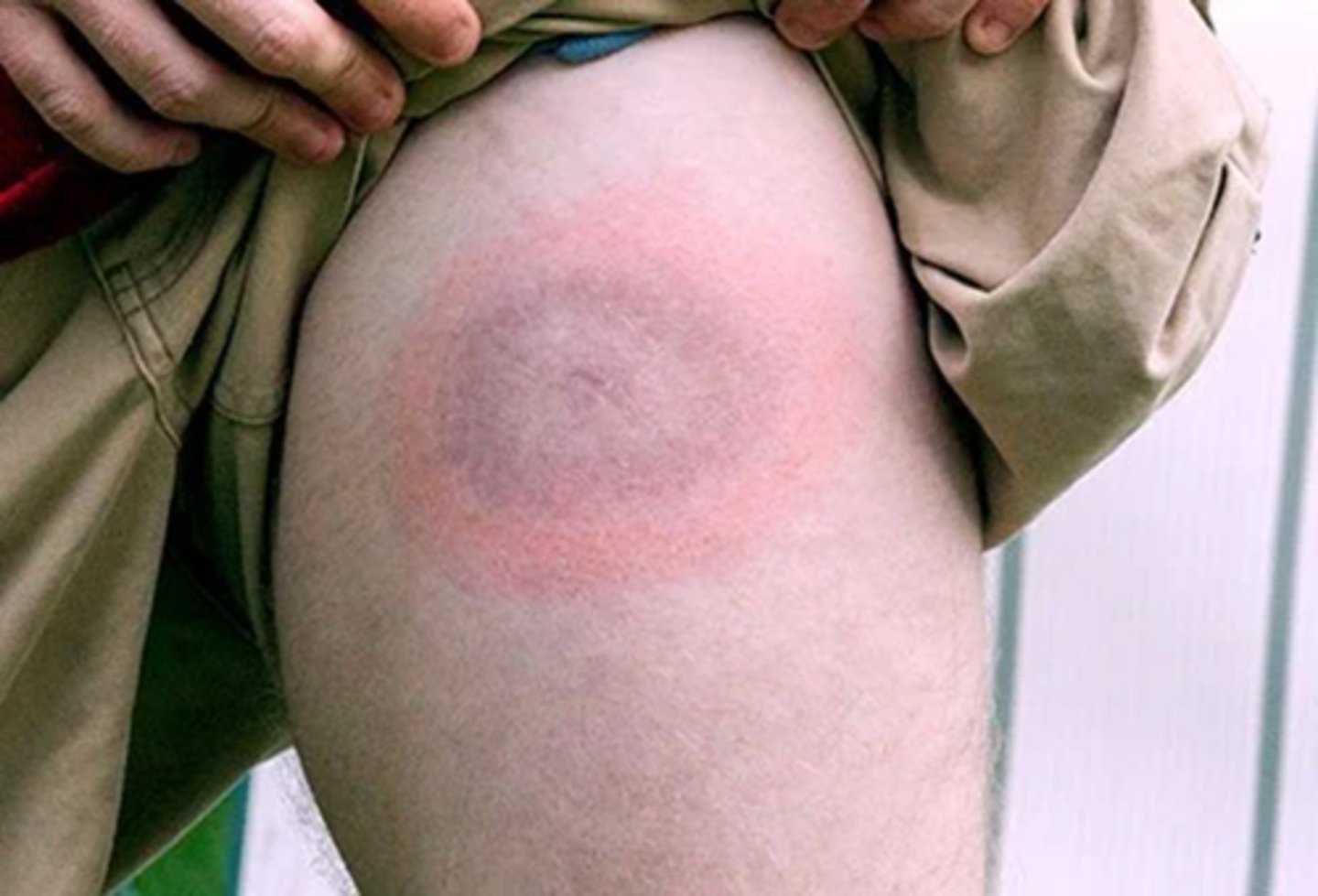
second stage of Lyme disease
Spirochete spread through blood to
- Bones (arthritis)
- CNS (meningitis, facial palsy, other neurological signs)
- Heart
- Liver
third stage of Lyme disease
- chronic arthritis of large joints
- skin lesions
- peripheral neuropathy
how can we prevent Lyme disease?
- person protective measures
- tick check & remove ticks
- preventative antibiotics after a tick bite
how can we treat Lyme disease?
Doxycycline or amoxicillin for 3-4 weeks
diagnosing Lyme disease
- EM rash
- biopsy & silver stain
- serology
- two-tier testing (EIA/IFA and Western Blot)
- PCR
- culture
Treponema
- thin, helically shaped with tight coils
– Some are normal microbiota in oral cavity, gastrointestinal tract, and genital tract of humans and other animals
– Most are anaerobic
– Microaerophilic species are pathogenic
– Never cultured on or in artificial media
- T. pallidum subsp. pallidum
- T. pallidum subsp. pertenue
- T. pallidum subsp. endemicum
- T. carateum
T. pallidum subsp. pallidum
Venereal Syphilis
- transmitted through sexual contact or trans-placentally
- incubate 10-90 days (14-21 days)
- chancre
primary stage of syphilis
- Hallmark sign is painless chancre at portal of entry
- Regional lymphadenopathy
secondary stage of syphilis
- Occurs 3-10 weeks after chancre
- Widespread skin rash on palms and soles
- Lesions are infectious
- Lymphadenopathy; fever; involvement of liver, eye, bone, CNS
how do we diagnose syphilis?
- Dark-field for early secondary
- Serology for late secondary
tertiary stage of syphilis
- Months to years after primary syphilis
- CNS involvement with neurological disorders
- Cardiovascular abnormalities
- Gummas
- Intense cellular immune response
gummas
granulomatous inflammation
- Painless ulcers that may contain a few spirochetes
latent syphilis
- Absence of clinical symptoms
- Positive serological tests
- Relapses are possible
congenital syphilis
Trans-placental transfer from mother to fetus during primary, secondary or latent syphilis
what can congenital syphilis cause?
- Stillbirth or miscarriage
- Bone malformations, widespread rash, meningitis, hepatosplenomegaly, blindness, deafness
non-treponemal testing
- screening tests (RPR, VDRL)
- first tests to become positive & useful to monitor treatment
- detects reagin
- high sensitivity but low specificity (false pos, confirm with treponemal test)
treponemal testing
confirmatory tests are specific
- FTA-Ab (Fluorescent Treponemal Antibody Absorbed)
- TP-PA (T. pallidum Particle Agglutination)
- EIA
- become positive later & remain positive for life
- NOT useful to monitor treatment
T. pallidum subsp. pertenue
Yaws
– Chronic, non-venereal disease of skin and bones
– Found in tropical areas of Africa, South America, and Indonesia
– Direct contact with infected skin lesions
– Resembles T. pallidum subsp. pallidum genetically and morphologically
T. pallidum subsp. endemicum
Bejel
– Non-venereal, endemic syphilis
– Found in arid climates of India, Asia, Africa, Middle East
– Oral lesions that may become widespread in the skin and bones
T. pallidum subsp. carateum
Pinta
- found in South and Central America
- infected skin lesions
- Papule with red halo that later become brown to black and then de-pigmented
- Antibodies cross-react with those from T. pallidum subsp. pallidum
miscellaneous spirochetes
- several spirochetes found in gingival plaque in human oral cavity & colon
- strict anaerobes
- rarely pathogenic
- may cause gingivitis or periodontal disease
- T. socranskii
- T. denticola
- T. pecintovorum
Leptospira
– Flexible, tightly coiled spirochete
– Stain faintly with aniline dyes
– Ends of cell are pointed or bent into hook
– Obligate aerobes
– Motile
– Oxidase positive
– Catalase positive
- L. biflexa
- L. interrogans
L. biflexa
non-pathogenic
L. interrogans
- Human and animal leptospirosis
- Found in rodents, cattle, dogs, cats, and raccoons and shed in urine
- Humans acquire infection through contact with infective animal urine or contact with contaminated soil or water
How does L. interrogans cause disease?
bacteria enter the blood and can disseminate to the brain, liver, lungs, heart, and kidneys, causing hemorrhage and necrosis
L. interrogans symptoms
- fever, headache, chills, vomiting, jaundice, multi-organ involvement (liver, kidney and CNS)
- icteric form known as Weil's syndrome is severe
who is at risk for L. interrogans?
Slaughterhouse workers, farmers, veterinarians, pet owners, sewage plant workers, campers, rodent-infested areas
diagnosing L. interrogans
- paired sera: IgM and IgG
- microscopic agglutination test (MAT)
- dark-field on blood, CSF, urine
- culture
L. interrogans culture requirments
- rabbit or bovine serum albumin
- may need 6-13 weeks to grow