Chapter 1 - A Brief History of Cognitive Neuro
 Call Kai
 Learn
Learn Practice Test
 Spaced Repetition
 Match
Match Flashcards
 Knowt Play
1/30

There's no tags or description
Looks like no tags are added yet.
Name | Mastery | Learn | Test | Matching | Spaced | Call with Kai | Chat |
|---|
No analytics yet
Send a link to your students to track their progress
31 Terms
cognitive science helps us learn the connections between what two things?
the mind and the brain
one of the main findings of cognitive neuroscience is that…
certain brain regions are associated with cognitive functions/behaviors
T/F: brain regions are connected
true
what two fields does cognitive neuroscience combine?
cognitive psychology and neuro
describe some aspects of cognition
critical thinking, decision making, understanding and comprehending, judgement, creativity, intuation, language
what is cognitive psychology
the study of mental function (perception, memory, attention, language, problem-solving, reasoning, decision making)
define neuroscience
the study of how the nervous system is organized and functions
define memory
encoding and retrieving stored info
define cognitive neuroscience
understanding how the brain works, how it is structed and how it functions
describe the original view of the physical brain vs the intangible mind
the original view was that the physical brain and intangible mind are separated
describe Rene Descartes view on the brain
Descartes believed that our body and thoughts are two different things but that they interact with each other
he believed that the mind was a nonmaterial thinking substance (not physical)
the mind and brain are independent and separate but they interact at a single brain structure (the pineal gland)
dualism!!!
define dualism
the belief that the mind is not a result of machination of the brain, but appears from elsewhere
are the mind and brain separated (reality)?
no
the conscious mind is a __________ of our brain’s physical activity
product
what did brain lesions studies help determine?
that the mind and brain are not separated and that specific parts of the brain have specific functions
define neuropsychology
how the brain affects behavior, emotions and cognition (investigates brain injuries)
neuropsychology led to what viewpoint on the brain?
localization
what was Franz Joseph Gall’s main idea?
localization
describe Gall’s beliefs/ideas
the brain is the organ of the mind
each cognitive function is localized in a specific region of the cerebral cortex
phrenology
Gall would “read” people’s skulls by touching thier heads
define phrenology
the belief that the shape of your skull provided information about cognitive functions and personalities
(parts of the brain will “grow with use”)
what happened to the idea of phrenology?
it was questioned due to pseudo-science (scientific method not followed)
what was Marie-Jean-Pierre Flourens main idea?
the aggregate field theory (the whole brain participates in behavior)
what did Flourens do to advance his findings?
Flourens tested animals by destroying parts of their brains to see which functions disappeared
what functions could not be pinpointed through Flourens work?
advanced functions, like memory or cognition
causal relationship
one event or variable directly causes another event or variable
what does focal brain damage cause?
specific behavioral deficits
if Broca’s area is damaged, what occurs?
difficulty in producing language, but comprehension is still intact
if Wernicke’s area is damaged, what occurs?
difficulty with language comprehension but production of language remains intact
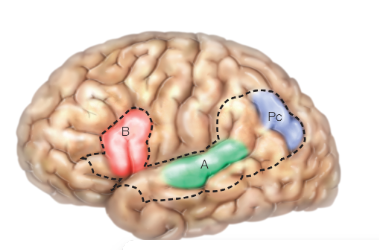
a = Wernicke’s sensory speech
b = Broca’s area for speech
pc = Wernicke’s area concerned with language comprehension and meaning
define cytoarchitectonics
how cells differ between brain regions
define volition
the power of making your own conscious choices and decisions