Epithelial Tissue
 Studied by 0 people
 Call Kai
 Learn
Learn Practice Test
 Spaced Repetition
 Match
Match Flashcards
 Knowt Play
1/35

There's no tags or description
Looks like no tags are added yet.
Name | Mastery | Learn | Test | Matching | Spaced |
|---|
No study sessions yet.
36 Terms
Epithelial tissue cell are arranged in
sheets and are densely packed
ET cell junctions
many cell junctions present
cells attach to
a basement membrane
Epithelial tissue vascularity
avascular but does have a nerve supple
Epithelial tissue mitosis
mitosis occurs frequently
Main functions of ET
protection
absorption
filtration
excretion
secretion
sensory reception
ET apical surface (free side)
exposed to surface or cavity
some have microvilli
ET basal surface (attached side)
inwards toward body
attached to basement membrane
adhesive sheet holding basal surface of epithelial cells to underlying cells
defines epithelial boundary
Cancerous epithelial cells
not contained like other cells
penetrate the boundary and invade underlying tissues, resulting in spread of cancer
First name of ET indicates
number of cell layers
simple, pseudostratified, stratified
simple
single layer
simple ET functions
diffusion, osmosis, filtration, secretion, absorption
Pseudostratified ET
single layer that looks like many layers
Pseudostratified ET functions
similar functions as simple ET
Often have cilia or goblet cells (mucus production)
Stratified ET
2+ layers
Stratified ET function
protection
Second name indicates
cell shape
squamous, cuboidal, columnar, transitional
squamous
flattened and scale-like
rapid passage
cuboidal
box-like cube
secretion and absorption
columnar
tall columns
protection, secretion, absorption
transitional
change shape from cuboidal to squamous and back
allows for stretch/distension
naming of stratified epithelia
named according to the shape in the apical layer
Squamous categories
simple, stratified
Cuboidal categories
simple, stratified
columnar categories
simple (nonciliated, ciliated), pseudo-stratified (ciliated, nonciliated), stratified
glandular ET categories
endocrine, exocrine
Gland
single cell or mass of epithelial cells adapted for secretion
endocrine Glandular epithelia
ductless
secretions (hormones) enter interstitial fluid and diffuse into blood
Exocrine glandular epithelia
have ducts
secretions enter ducts that empty onto surface of a covering/lining epithelium
unicellular exocrine glands
mucous cells and goblet cells
found in epithelial linings of intestinal and respiratory tracts
all produce mucin = a sugar-protein that can dissolve in water to form mucus, which functions as a slimy protective, lubricating coating
Structure of multicellular exocrine glands
composed of duct and secretory unit
many cells that form a distinctive microscopic structure or a macroscopic organ
Structural classification of multicellular exocrine glands
simple tubular, simple branched tubular, simple coiled tubular, simple acinar, simple branched acinar, compound tubular, compound acinar, compound tubuloacinar
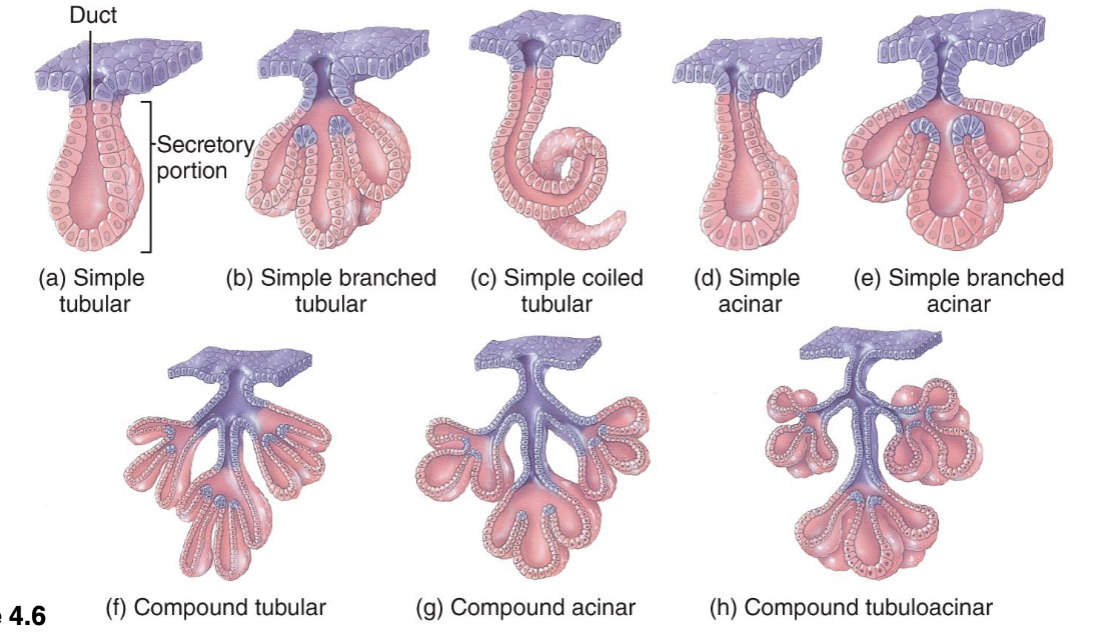
Functional classification in multicellular exocrine glands
merocrine
apocrine
holocrine
merocrine
fluid product released through exocytosis
ex: sweat, pancreas, salivary
apocrine
accumulate products within, but only apex ruptures
ex. mammary, ceruminous
holocrine
entire cell ruptures releasing secretions and cell fragments
eg: sebaceous