Metaphysics UNIT 4
 Call Kai
 Learn
Learn Practice Test
 Spaced Repetition
 Match
Match Flashcards
 Knowt Play
1/61

There's no tags or description
Looks like no tags are added yet.
Name | Mastery | Learn | Test | Matching | Spaced | Call with Kai | Chat |
|---|
No analytics yet
Send a link to your students to track their progress
62 Terms
Abrahamic God
Omniscient, Omnipotent, Omnipotent
Omniscient
All-knowing
Omnipotent
All-powerful
Omnibenevolent
All-loving
Ontological Argument
God must exist because the concept of a non-existent god is self-contradictory
Deductive, Anselm
Anselm's Argument
1. God is a being so perfect that a more perfect version can't be imagined
2. God exists as an idea in the mind
3. A being that exists in the mind AND reality is better than one only in the mind
4. We can't imagine something greater than God
C. God exists
Flaws of Ontological Argument
- Begs the Question: Underlying premise
It is possible for a perfect being to exist
and a perfect being is just God
- Jumps from Epistemic truths to Metaphysical truths
Cosmological Argument
The universe requires God as an original Cause to prevent infinite regression
(Cosmo- universe), Deductive, Aquinas
Aquinas's Cosmological Argument
1. Everything that exists has a cause
2. The Universe exists
C1. The Universe has a Cause
3. If the Universe has a cause, then a powerful being that exists out of causation must have caused it
C2. A powerful being that exists outside of causation caused the universe
Cosmological Argument Flaws
- Argument from Ignorance - just because we can't explain the universe doesn't mean it was caused by a being
- This being isn't neccassarily Abrahamic God
- We don't know if all things need causes
Teleological Argument
Intelligent design
The high degree of logic and order in the universe suggests an intelligent creator
(teleo- perfect), Inductive, Paley
Paley's Watchmaker Analogy
We'd assume a watch in a desert had an intelligent designer because of the high degree or intelligence and order in it's design. The same applies to the universe with God.
Natural Evil
Evil originating from the natural world (e.g. disaster and disease)
Moral Evil
Evil caused by human action (e.g. murder, war)
Logical Problem of Evil
Claims existence of God is incompatible with the existence of evil
Deductive
Evidential Problem of Evil
Claims that the existence of evil makes it unlikely that God exists
Inductive
Epicurus's Argument
Is God willing to prevent evil, but not able? Then he is not omnipotent.
Is he able, but not willing? Then he is malevolent.
Is he both able and willing? Then whence cometh evil?
Is he neither able nor willing? Then why call him God?
Mackie's Argument
Omnipotence = power to prevent evil
Omnibenevolence = motivation to prevent evil
Something cannot exist if there is a being with the power and motivation to eliminate it
Evil exists
God cannot exist
Inconsistent Triad
Omnipotence, omnibenevolence, and evil cannot coexist.
Hume's argument
Inductive
We can only justify believing what evidence suggests. Evidence shows imperfection exists (i.e. evil) so we are justified in believing in imperfection, and not a perfect being.
Theodicy
Arguments against the problem of evil
Augustine's Theodicy
Evil is a result of original sin stemming from the Fall. Evil is either sin or punishment for sin.
Weak, begs the question.
Plantinga's Free Will Theodicy
Evil is a result of the misuse of free will. Life would be meaningless without free will. Therefore it's omnibenevolent and omnipotent of God to allow evil.
Strong for moral evil, not natural evil
John Hick's Soul-Making Theodicy
We do not know of God's existence, so the choice to be good and worship God is more effective in spiritual development
Ireneus's Theodicy
Human being's were made in Gods IMAGE, not LIKENESS. We are born with potential for good, but must choose to do good to complete creation and reach perfection
Traditional Epistemic Argument for God
Argues God exists (e.g. cosmological, teleological, ontological, religious experience)
Pragmatic Arguments of God
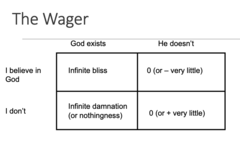
Believing in God is beneficial to us (e.g. Pascal's Wager)
Pascal's Wager
The benefits of believing in God are so great that it's worth doing even if there is a minute chance he's real
Flaws: There are many Gods, worship requires commitment
William James
Believing in something without evidence is justifiable if it's a live, forced, and momentous option. This applies to God
Live Option
All the hypotheses you're choosing are live (possible)
Dead Option
All the hypotheses you're choosing are dead(impossible)
Forced Option
The hypotheses exhaust all possible options; the choice is unavoidable
Avoidable Option
The hypotheses do not exhaust all available options; the choice is avoidable
Momentous Option
The choice is unique, has significant stakes, or is irreversible
Trivial Option
The choice is not unique, has low stakes, and is reversible/of little consequence
W.K. Clifford on Epistemic Responsibility
We have a responsibility to believe in claims with evidence. If you don't have evidence, you are morally obligated to refrain from the belief (withhold judgment)
W.K. Clifford's Boat Example
An owner of a boat would be responsible for its capsizing if he didn't have evidence for its stability beforehand and chose to believe it was safe.
Faith
Based on inspiration, revelation, or authority
Rationality
Based on reason and facts
Conflict Model
The aims, objects, or methods of reason and faith seem to be very much the same
Thus, when they seem to be saying different things, there is a genuine rivalry
Incompatibilist Model
The aims, objects, or methods of reason and faith are understood as distinct
Compartmentalisation is possible
Reason aims at empirical truths
Religion aims at divine truths
Thus, there is no true rivalry
Divisions of the Incompatibilist Model
Faith is transrational or higher than reason
Faith is irrational
Religious language is purely metaphorical
Weak Compatibility Model
Commonality is possible between faith and reason, though both maintain distinct realms of evaluation and cogency
Strong Compatibility Model
Faith and Reason have an organic connection, maybe even equivalency
Eudaimonia
"flourishing" - Aristotle
Living a well-lived life, done through living virtuously
Epicureanism
Happiness is pleasure, all things are dont for pleasant feelings. Happiness comes with close friends and community.
Epicurus on Death
there is no need to fear death, because it is only the end of sensation and consciousness, which must be painless (just like before birth)
Aquinas on Meaning
Beatitudo is impossible on Earth, but Felicitas is possible.
Believes Reason can justify Faith (Cosmological Argument)
Beatitudio
Perfect Happiness
Felicitas
Imperfect Happiness
Existentialism
Existence precedes Essence
Life is fundamentally meaningless, but we can give it meaning ourselves
Theistic Existentialism
Existentialism, God exists (Kierkegaard)
Atheistic Existentialism
Existentialism, No God (Nietzsche, Sartre, De Beauvoir
Soren Kierkegaard
God didn't provide us with meaning prior to existence, but we must create a meaningful relationship with God, using our own free will to make the leap of faith
Leap of Faith
Kierkegaard
To believe in God, even if it is absurd and beyond all reason
Nietzsche
Life has no meaning. One must overcome the limitations of society and become a master of one's own fate.
Ubermensche
"Superman" - one who moves beyond social norms give their own life meaning
Jean Paul Sartre
We must use our radical freedom to live authentically, even if this decision comes from angst
Radical Freedom
We have absolute freedom to choose our own path and actions
Bad Faith
When individuals live inauthentically by yielding to the external pressures of society, adopting false values to escape their own radical freedom
Absurdity
The universe is irrational and meaningless
Simone de Beauvoir
Women (and, by extension, other marginalised groups) have their radical freedom limited by the second-class status imposed upon them by society