AP Biology 1.1 - 1.5
 Call Kai
 Learn
Learn Practice Test
 Spaced Repetition
 Match
Match Flashcards
 Knowt Play
1/66

There's no tags or description
Looks like no tags are added yet.
Name | Mastery | Learn | Test | Matching | Spaced | Call with Kai | Chat |
|---|
No analytics yet
Send a link to your students to track their progress
67 Terms
Water
H2O; held together by polar covalent bonds, electrons are unevenly shared within the molecule; can form hydrogen bonds with one another and other polar molecules
Polar molecule
molecule with an unequal distribution of charge, resulting in a positive and negative end
Nonpolar molecule
molecule that shares electrons equally and does not have oppositely charged ends
Hydrogen bonds
weak attraction between a partially positive hydrogen atom in one polar bond and a partially electronegative atom (such as oxygen); helps stabilize the structures of large biological molecules (like DNA); holds water together
Covalent bonds
bonds created by sharing electrons with other atoms
Cohesion
attraction between molecules of the same substance
Surface tension
the force that acts on the surface of a liquid and that tends to minimize the area of the surface; cohesion at the surface of water creates a strong surface layer
Surfactants
molecules that reduce surface tension of water; interfere with cohesive interations among water molecules at a surface
Amphipathic
A molecule that has both a hydrophilic and hydrophobic region
Adhesion
Attraction between different types of molecules
Capillary action
movement of water through narrow spaces due to both adhesion and cohesion
Water’s high specific heat
it takes a lot of energy to increase water’s temperature; compared to other substances, water can absorb large amounts of heat before its temperature increases significantly
Why does water heat up slowly?
water molecules form hydrogen bonds with one another; absorbed heat energy is used to disrupt hydrogen bonds before increasing molecular motion
Water’s high heat of vaporization
it takes a lot of energy to turn liquid water to a vapor
Evaporative cooling
the temperature of a surface decreases as water evaporates
Why is ice less dense than liquid water?
because hydrogen bonds form a stable crystalline lattice that spaces water molecules farther apart than liquid water as water freezes
Water is a solvent, why?
water is polar so it can easily make other hydrogen bonds and dissolve other substances
pH
measure of the hydrogen ion concentration of a solution
Acidic solution
any solution in which the hydrogen-ion concentration is greater than the hydroxide-ion concentration (below 7)
Neutral solution
any aqueous solution in which hydrogen and hydroxide are equal (7)
Basic solution
any solution in which the hydroxide-ion concentration is greater than the hydrogen-ion concentration (above 7)
Buffer
helps organisms resist sudden changes in pH by accepting or releasing hydrogen
Six elements most important to life
Carbon, Nitrogen, Oxygen, Phosphorus, Hydrogen, and Sulfur
Organic molecules
carbon-based molecules that typically contain carbon bonded to hydrogen; like carbohydrates, lipids, proteins, and nucleic acids
Monomers
small molecular subunits that can be joined together to form larger polymers
Polymers
large molecules made of repeating or similar monomer subunits bonded together
Dehydration synthesis
a chemical reaction in which two molecules covalently bond together with the removal of a water molecule; enzymes are required for this reaction to occur
Dehydration synthesis for carbohydrates
Monosaccharides are bonded by glycosidic bonds into polysaccharides
Dehydration synthesis for lipids
Fatty acids and glycerol are bonded with more fatty acids and glycerol by ester bonds to form glycerides (triglyceride)
Dehydration synthesis for proteins
amino acids are ponded by peptide bonds to form peptides, polypeptides, and proteins
Dehydration synthesis for nucleic acids
Nucleotides are joined by phosphodiester bonds to form DNA and RNA
Hydrolysis
breaking down complex molecules by the chemical addition of water; sped up by enzymes
Functional groups
groups of atoms attached to a molecule that give it characteristic properties; helps determine how a molecule behaves and interacts with other molecules; can affect a molecule’s polarity, solubility, and reactivity
Functional groups examples
hydroxyl, carboxyl, amino, phosphate
Carbohydrates
immediate energy, energy storage, structure, transport of sugar
Monosaccharides
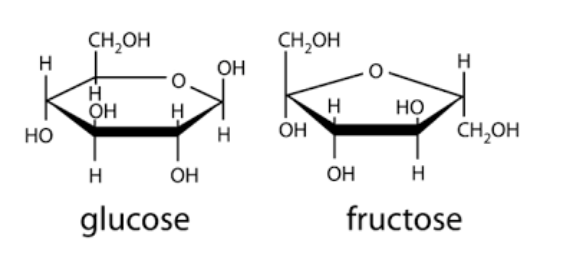
monomers, simple sugars, ex: glucose, fructose, galactose
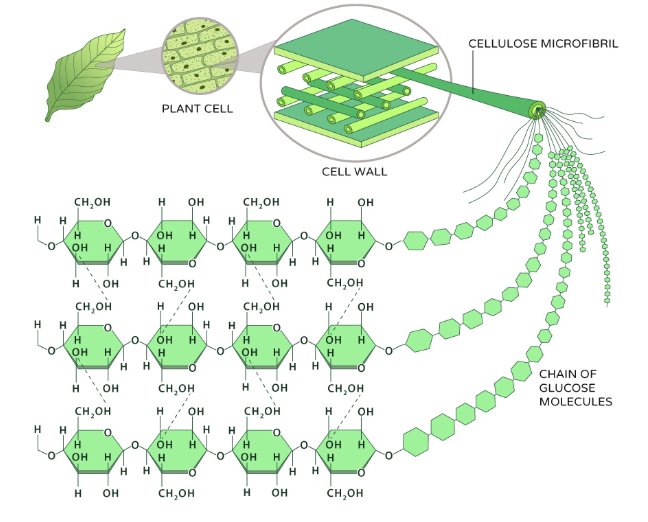
α-glucose
forms starch in plants and glycogen in animals
β-glucose
forms cellulose in plant cell walls
Disaccharides
two monosaccharides joined by a glycosidic bond; formed through dehydration synthesis; ex: sucrose, lactose, maltose
Polysaccharides
long chains of many monosaccharides; called complex carbohydrates; can be branched or unbranched; ex: starch, glycogen, cellulose
Isomers
compounds with the same formula but different structures
Branched carbohydrates
functions as energy storage; more branches means more monomers can be made available for cellular respiration, increasing ATP production (ex: glycogen)

Structural carbohydrates
have linear structure and are able to stack; provide stability, allowing for formation of rigid structures for structural support
Lipids
Function in long-term energy storage and as major components of cell membranes; includes facts, oils, waxes, phospholipids, and steroids; mostly nonpolar and hydrophobic; making them poorly soluble in water
Lipid structure
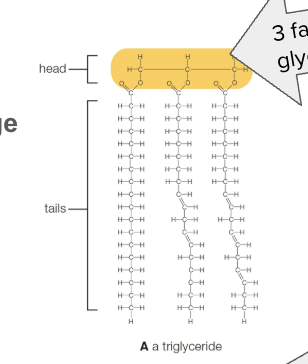
glycerol and 3 fatty acids; CHO and sometimes P
Fatty acids
molecules consisting of a long hydrocarbon chain with a carboxyl group at one end

Hydrocarbon tail
nonpolar and hydrophobic
Carboxyl group
polar and hydrophilic
Saturated fatty acids
contain only single bonds between carbon atoms in their hydrocarbon tails; are “saturated” with hydrogen because each carbon holds the maximum possible number of hydrogen atoms

Saturated fatty acids structure
Have relatively straight hydrocarbon tails, which allow them to be packed tightly together; will be solid at room temperature
Unsaturated fatty acids
contain one or more carbon-carbon double bonds (C=C) in the hydrocarbon chain

Unsaturated fatty acids structure
Double bonds create bends or “kinks” in the hydrocarbon tails; the bent tails cannot pack tightly together and will be liquid at room temperature
Monounsaturated
one double bond
Polyunsaturated
two or more double bonds
Fats
Glycerol and fatty acids; the carboxyl group of a fatty acid can form a covalent bond with the hydroxyl group (OH) of glycerol
Ester bond
The bond formed when fatty acid molecules are joined to glycerol molecules in condensation reactions to form a fat
Triglycerides
an energy-rich compound made up of a single molecule of glycerol and three molecules of fatty acid; used primarily for long-term energy storage
Phospholipids
1 glycerol + 2 fatty acids + phosphate-containing group; major component of cell membranes

Waxes
lipids made primarily of long-chain fatty acids bonded to long-chain alcohols (molecules with a long hydrocarbon chain and an hydroxide group at the end); hydrophobic and water-resistant

Wax structure
long nonpolar hydrocarbon chains; molecules pack closely together making them firm
Steriods
lipids that have different functions but are all characterized by four fused carbon rings

Cholesterol
A lipid that forms an essential component of animal cell membranes and acts as a precursor molecule for the synthesis of other biologically important steroids
Glucose structure
monosaccharide, C6H12O6

Triglyceride structure
glycerol + 3 fatty acids; HCO

How is a triglyceride formed?
Formed when the 3 fatty acids are linked to the glycerol backbone through dehydration synthesis to form an ester linkage
Glucose function related to structure
primary energy source and building block in living organisms because its six-carbon ring structure, hydroxyl groups, and reactive sites allow for easy water solubility, cellular transport, and chemical polymerization
Triglyceride’s function related to structure
compact, long-term energy storage and insulation units because of their hydrophobic hydrocarbon structure