labquiz#3_microbio
 Call Kai
 Learn
Learn Practice Test
 Spaced Repetition
 Match
Match Flashcards
 Knowt Play
1/21

There's no tags or description
Looks like no tags are added yet.
Name | Mastery | Learn | Test | Matching | Spaced | Call with Kai | Chat |
|---|
No analytics yet
Send a link to your students to track their progress
22 Terms
12. strict/obligate aerobes
must have oxygen to metabolize (make energy)
12. strict/obligate anaerobes
must have oxygen-FREE environment to survive
metabolism = no O2
so can’t protect itself from ROS (toxic byproducts of oxygen; reactive oxygen species)
lack catalase and superoxide dismutase
so in presence of oxygen cells will die
12. facultative anaerobes
can grow in either presence
two forms of metabolism
aerobic
anaerobic (but this pathway results in less growth
12. aerotolerant anaerobes
indifferent to presence of oxygen
“can survive in O2 even tho don’t use it for energy
metabolism is only anaerobic fermentation but are ABLE to remove ROS species (toxic byproducts of oxygen)
12. Microaerophiles
require oxygen but at a reduced levels
below 21% in the atmosphere
likes low concentration..if higher levels of oxygen = may inhibit enzymes critical for growth or may be toxic to the cell
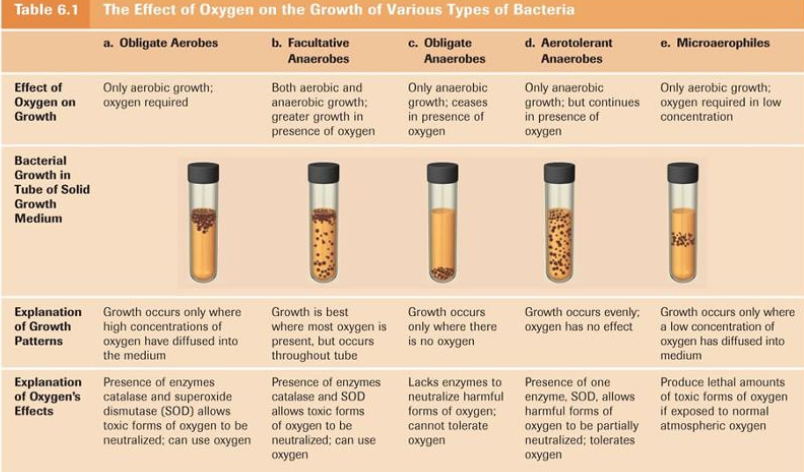
12. Describe the Tube of each bacteria growth affected by oxygen.
Strict aerobes (High O2) needs
Near top
Microaerophilic (need O2 but in low concentrations)
Found in like middle
Facultative anaerobe (cool with both)
dispersed throughout tube
Aerotolerant anaerobes (can grow throughout) (prefer anaerobic conditions for growth but are capable of removing ROS)
Strict anaerobe (no o2)
bottom
basically, Strict aerobes will grow only at the top of the tube, strict anaerobes only at the bottom, facultative and aerotolerant anaerobes throughout the tube, and microaerophiles somewhat below the surface.
12. What is Fluid thioglycollate Broth? What does it contain?
is a reducing medium, that is, it contains compounds that react with molecular oxygen (O2) keeping the free levels low
contains the indicator dye resazurin which turns pink in the presence of oxygen.
Since oxygen is present at the surface of the medium, the upper layer is usually pink whereas the dye is colorless in the remainder of the tube.
A low percentage of agar to give semisolid consistency
prevents the infiltration of O2 below the surface
12. Anaerobic Jars
vessels in which an anaerobic environment is generated after inoculated media are sealed into the chamber
add gas generator envelopes that are placed in the jar just prior to sealing to rid O2
Chemicals in the envelope react with O2, reducing levels to below 1% within 30 minutes
indicator strip is usually placed in the jar to verify that the O2 has been removed
12. If an organism is a strict anaerobe, it cannot survive in the presence of O2 even
for a short time. How might you culture these organisms? Explain biochemically
why it cannot grow in an environment with O2.
Strict anaerobes can be cultured using anaerobic chambers, gas packs, or thioglycollate broth, which remove or prevent oxygen exposure. Biochemically, they lack enzymes like superoxide dismutase and catalase, which neutralize reactive oxygen species (ROS). Without these defenses, oxygen generates toxic radicals that damage cellular components, leading to cell death.
14. Semisolid Agar
has a reduced agar concentration
allows flagellated bacteria to migrate from the site of inoculation.
is prepared in tubes and are inoculated through most of their length by a single stab with a needle
Background: Motile bacteria require liquid to move and can propel themselves in broth or across the surface of a wet agar plate. They will not however move when embedded in 1.5% agar, the minimum
concentration found in most agar media.
14. What is the purpose of Experiment 14: Motility Agar?
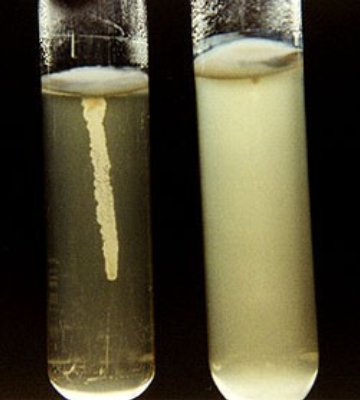
Using semisolid agar to distinguish between motile bacteria
growth (after 48hrs) observed as
motile organism (right) = a turbid region extending from the stab
bacteria will swim away from line to find nutrients causing cloudiness throughout medium
Nonmotile bacteria (left) will only grow along the stab/incoulation line (no growth)
14. skip unless have time
1. What are some advantages of the semisolid agar over the wet mount method?
disadvantages?
2. How might motility contribute to the pathogenicity of a microbe?
morphology of flagella
Semisolid Agar vs. Wet Mount: Semisolid agar allows for prolonged observation of motility, prevents drying out, and helps distinguish motile from non-motile bacteria more clearly. However, it requires incubation, takes longer for results, and may show false positives due to bacterial growth. Wet mounts provide instant results but dry out quickly and can be harder to interpret.
Motility and Pathogenicity: Motility helps microbes reach favorable environments, invade host tissues, and evade immune defenses. For example, Helicobacter pylori uses flagella to penetrate the stomach lining, and Pseudomonas aeruginosa moves to form biofilms that resist treatment. This ability enhances their ability to infect and persist in the host.
Bacillus
skip unless have time
BIOCHEMICAL REACTIONS: enzyme production
What are endoenzymes?
How do we differentiate between bacteria in biochemical tests?
What is Bacteria’s form of metabolism?
What are exoenzymes?
Endoenzymes
produced in the cell and catalyze intracellular reactions.
Ability to Respire
Besides fermentation reactions other techniques are designed to differentiate bacteria based on their ability to respire.
Respiration
is the conversion of glucose to energy in the form of ATP by way of glycolysis, the Krebs cycle, and oxidative phosphorylation in the electron transport chain (ETC). In aerobic respiration, the final electron acceptor at the end of the ETC is the inorganic molecule oxygen (O2)
Anaerobic respiration (such as in the gastrointestinal tract) occurs using only glycolysis
In fermentation, the organic molecule pyruvate acts as the final electron acceptor.
In strict anerobic respiration, inorganic molecules that act as the final electron acceptor may be nitrate or sulfate
Exoenzymes
are excreted and commonly used to degrade large polymers found in the environment (media) into smaller compounds so they can be transported across the cell walls and membranes and into the cell
if detect can confirm species
skip unless have time
BIOCHEMICAL REACTIONS: types of exoenzymes that help confirm identification of unknown
Describe the following exoenzymes
Amylase
Gelatinase
Casease
Lipase
Coagulase
Hemolysin
a) Amylase released into the surrounding medium is involved in starch digestion
(hydrolysis). Starch is a large polysaccharide that cannot pass across the cell membrane because
of its size. Amylase breaks starch into smaller sugar residues that can enter the cell and be
processed by respiration or fermentation.
b) Gelatinase causes the liquefaction of media containing gelatin. Gelatin is a protein
derived from collagen, a component of animal connective tissue. Hydrolyzed gelatin produces
individual amino acids that the cell can absorb and use.
c) Casease hydrolyzes casein, the major protein component in milk. As a result of
enzymatic proteolysis (breakdown of protein (hydrolysis) - also called peptization) of milk
incorporated into agar medium loses its characteristic white appearance and becomes transparent.
The hydrolysis of milk proteins supplies the bacteria with amino acids.
d) Lipase production is common to bacteria that grow in foods rich in fats such as butter
and mayonnaise. This enzyme breaks fat into its components, glycerol and fatty acids via
hydrolysis. Agar that contains lipids prepared from egg yolks is used in identifying lipolytic
activity. The agar loses its opacity surrounding growth of a lipase-producing bacterium.
Pathogenic bacteria often secrete proteins that increase their ability to survive in the human host
or damage the host as part of the disease process. One example of such an enzyme that can be
used to identify bacteria in the laboratory is:
e) Coagulase, an enzyme that can clot plasma. Most strains of Staphylococcus aureus
are positive for coagulase production, whereas most other staphylococci do not produce this
enzyme.
f) Hemolysin, an enzyme that can disrupts the red blood cell membrane by cleaving the phospholipids providing the bacteria access to iron. The membrane can be fully hydrolyzed or
only partially.
15. What is the purpose of Experiment 15: Catalase Production? What is being Observed? What reagent/medium are we using?
To determine if the organism has the catalase gene/produces the catalase enzyme, which breaks down hydrogen peroxide (H₂O₂), a toxic byproduct of oxygen metabolism, into water and oxygen which is lethal if it accumulates in the cell
……..2 H2O2 → 2 H2O + O2
observed as
Positive = oxygen produced seen as bubbles
“When hydrogen peroxide is added to a colony of catalase-producing bacteria, it is broken down”
Negative = no oxygen produced; no reaction
“When hydrogen peroxide is added to a colony of a non catalase-producing bacteria, it is unreactive
How?
Inoculating Loop
3% hydrogen peroxide (located in the lab-stock storage refrigerator)
clean slide
15. skip unless have time
BACKGROUND INFO: catalase production
What is catalase?
When is Hydrogen peroxide present?
What is flavoprotein, where is it found and what does it result in?
How is damage (detoxification) by hydrogen peroxide prevented?
How does each category of organism that does not have the catalase gene
detoxify hydrogen peroxide? Discuss each one separately.
Catalase
is an enzyme that splits hydrogen peroxide into water and oxygen
Hydrogen Peroxide
Hydrogen peroxide is produced as a byproduct in the presence of large amounts of oxygen and is lethal if it accumulates in the cell.
One molecule in the ETC, flavoprotein, can transfer an electron directly to oxygen (O2) as opposed to its adjacent partner in the ETC.
Doing so results in the formation of the oxygen radical superoxide (O2) which then can be broken down to hydrogen peroxide (H2O2) by superoxide dismutase.
Both compounds are highly reactive and can damage DNA, proteins, and other important molecules in the cell
Preventing Hydrogen Peroxide based on Catalase Gene
To prevent damage by hydrogen peroxide, all organisms growing in the presence of large amounts of oxygen therefore must have some mechanism for detoxification of hydrogen peroxide.
Catalase production is one of the most common methods. When hydrogen peroxide is added to a colony of catalase-producing bacteria, it is broken down, and the oxygen that is produced is seen as bubbles.
No Catalase Gene
Some bacteria use peroxidase, which breaks down H₂O₂ into water using alternative electron donors like NADH or glutathione. Others rely on superoxide dismutase (SOD) to first convert superoxide radicals into H₂O₂, which is then degraded by peroxidase.
16. What is the purpose of Experiment 16: Oxidase Production? What is being Observed? What reagent/medium are we using?
To determine if the bacteria has cytochrome c oxidase present, an enzyme involved in the electron transport chain for aerobic respiration which means they reduce oxygen as the final electron acceptor in the ETC
observed as
Positive = Dark purple Cue Tip
“The test utilizes a colorless reagent (artificial electron donor) that is reduced in the presence of cytochrome c oxidase and O2 to form a purple compound.”
Negative = No color Change Cue Tip
“no cytochrome c oxidase present”
How?
Oxidase reagent (tetramethyl-p-phenylenediamine solution)
squeeze tube to break glass vial releasing reagent)
Sterile swabs
16. skip unless have time
BACKGROUND INFO: oxidase production
What presence are we looking for via the oxidase test?
What are oxidases?
Some Bacteria reduce O2 but give a negative result to the oxidase test. Why?
why is this detection of cytochrome c important
What is the method for reduction of oxygen in Enterobacteriaceae?
How is ATP generated by the electron transport system?
Cytochrome C. Oxidase
designed to identify the presence of cytochrome c oxidase.
Oxidase
Oxidases are enzymes that catalyze the reduction of oxygen (O2) via cytochrome c oxidase
i.e. in most Gram positive and many Gram negative bacteria, cytochrome c oxidase performs the final step in electron transport, transferring an electron from cytochrome c and reducing O2 to H2O.
Negative Result
Other bacteria, (family Enterobacteriaceae) reduce O2 using another terminal oxidase system and give a negative result for the oxidase test
detection of cytochrome c oxidase is a valuable tool in differentiating among bacteria.
End of Experiment Q’s
Reduction of Oxygen in Enterobacteriaceae: Enterobacteriaceae are typically facultative anaerobes, meaning they can use oxygen when available but can also switch to anaerobic respiration or fermentation. When using oxygen, they reduce it via alternative terminal oxidases (such as cytochrome bd oxidase) instead of cytochrome c oxidase.
ATP Generation by the Electron Transport System (ETS): In aerobic respiration, electrons from NADH and FADH₂ pass through the ETS, creating a proton gradient across the membrane. This proton motive force drives ATP synthase, which converts ADP and inorganic phosphate (Pi) into ATP through oxidative phosphorylation.
17. What is the purpose of Experiment 17: Citrate Utilization? What is being Observed? What reagent/medium are we using?
To determine whether a bacterium can use citrate as its sole carbon source for growth, which helps assess its ability to survive in environments where citrate is the only available carbon.
observed as
Positive = medium turns blue
“ indicating the organism can utilize citrate as its sole carbon source, producing alkaline byproducts.”
Negative = medium remains green
“meaning the organism cannot use citrate, and no pH change occurs”
How?
Simmons citrate agar
Defined medium which means the amount and source of all ingredients are carefully controlled
contains citrate as the sole carbon source and ammonium dihydrogen phosphate as the sole nitrogen source
needle to stab butt
17. skip unless have time
BACKGROUND INFO: citrate utilization
How to differentiate between enterobacteriaceae?
What is contained in Simmons Citrate Agar?
Since the only carbon source is in the media, What must the organism be able to import?
How is the agar pH increased?
What dye is present?
Are u more likely to get a false positive or a false negative in this test?
Why is it necessary to both streak the slant and stab the butt of the agar
Why does the agar become alkaline when bacteria grow?
Differentiation Based on Metabolism of citrate
Some bacteria may be able to use organic compounds other than sugars as their sole source of carbon
The ability to metabolize citrate (a non- carbohydrate molecule that is part of the citric acid cycle (TCA Cycle) is useful for differentiating among Enterobacteriaceae (facultative anaerobes)
Some have citrate permease and citrate lyase enzymes and other members do not.
Simmons Citrate Agar is a Defined Media
Simmons Citrate agar is a defined media (the amount and source of all ingredients are carefully controlled)
contains citrate as the sole carbon source and ammonium dihydrogen phosphate as the sole nitrogen source.
To Perform Citrate Fermentation
Since the only carbon source is in the media, the organism must be able to import citrate into the cell to perform citrate fermentation.
This involves the protein citrate permease a transmembrane protein which transports citrate into the cell and citrate lyase which enzymatically converts citrate to oxaloacetate and acetate.
Oxaloacetate is then converted to pyruvate which can be converted to a variety of products, depending on the pH of the environment.
Increasing pH of agar (shown by Bromothymol blue dye) by converting ammonium
Organisms that metabolize citrate also convert ammonium dihydrogen phosphate (H2NH4PO4) to ammonia (NH3) and ammonium hydroxide (NH4OH), both increase the pH of the agar.
Bromothymol blue dye is present in the medium as the pH indicator.
It is green at pH 7.0 (neutral pH) and deep blue above pH 7.6 (basic pH).
False Negative from incomplete incubation
Occasionally a citrate-positive organism will grow on a Simmons Citrate slant without producing a change in color.
This is generally because of incomplete incubation (incubate it longer to see conclusive result) however growth on the slant indicates that citrate is being utilized and is evidence of a positive reaction.
EEQ’s
Streaking the slant and stabbing the butt: This allows the bacteria to grow in both aerobic (slant) and anaerobic (butt) conditions, providing a better chance to detect different metabolic capabilities based on oxygen availability.
Agar becomes alkaline: When bacteria metabolize certain compounds (like citrate) in the medium, they produce basic (alkaline) byproducts like ammonia, raising the pH and turning the agar color to blue.
18. What is the purpose of Experiment 18: Urea Hydrolysis? What is being Observed? What reagent/medium are we using?
To determine whether a bacterium produces the enzyme urease, which enables it to hydrolyze urea into ammonia and carbon dioxide, helping the bacterium survive in alkaline environments.
observed as
Positive = medium turns pink
“indicating that the bacterium produced urease, which hydrolyzes urea into ammonia and carbon dioxide, increasing the pH.”
Negative = medium remains yellow or orange
“indicating no urease activity, meaning the bacterium did not hydrolyze urea”
How?
Urea Broth containing Phenol Red pH indicator
needle
18. skip unless have time
BACKGROUND INFO: Urea Hydrolysis
What is urea the product of?
How do bacteria hydrolyze urea and why?
What is contained in urea agar/broth?
What pH indicator is being used in this experiment and how does it entail?
What advantage does a microbe have that can hydrolyze urea?
Why is it important to use a pH indicator in the growth media?
Why called Urea Hydrolysis?
Urea
Urea is the product of the decarboxylation of certain amino acids.
Nitrogen has usable source of energy
Bacteria containing the enzyme urease can hydrolyze urea into ammonia (NH3) and carbon dioxide (CO2) thus providing the organism with a usable source of nitrogen.
Peptones and Urea
The urease test can be carried out using urea agar or urea broth that contains both peptones and urea
Phenol Red
Phenol red is the pH indicator…after 24 hour incubation
urease Positive = red or pink above pH 8.4 (basic)
urease Negative: orange/yellow below pH 6.8 (acidic)
EEQ’s
Advantage of hydrolyzing urea: A microbe that can hydrolyze urea gains the ability to survive in alkaline environments by neutralizing acidic conditions through the production of ammonia, which can help in colonizing certain areas, such as the stomach or urinary tract.
Importance of pH indicator: A pH indicator in the growth media helps detect changes in pH, signaling whether urea hydrolysis has occurred, as the production of ammonia raises the pH and causes a color change in the medium.
the process involves the chemical breakdown (hydrolysis) of urea into its components, ammonia and carbon dioxide. This reaction occurs when the enzyme urease catalyzes the splitting of urea by adding water.