6D- amines, amides and polyamides
 Call Kai
 Learn
Learn Practice Test
 Spaced Repetition
 Match
Match Flashcards
 Knowt Play
1/43

There's no tags or description
Looks like no tags are added yet.
Name | Mastery | Learn | Test | Matching | Spaced | Call with Kai | Chat |
|---|
No analytics yet
Send a link to your students to track their progress
44 Terms
what are the functional groups where nitrogen atoms are found
amine, amide and nitrile
why do most amines have a higher boiling point than the comparable alkane (alkane with closest number of electrons)
amines can form hydrogen bonds
why is the boiling point of N,N-dimethylethylamine not significantly higher than that of pentane
doesn’t have N-H bonds so can’t form hydrogen bonds
what reagent is normally used to react an aldehyde or ketone to form a nitrile
NaCN in acid solution- H2SO4
which functional group will always be present in the product molecule from the formation of a nitrile from an aldehyde or ketone
alcohol
what is the mechanism for the reaction of an aldehyde or ketone to form a nitrile
nucleophilic addition
what is the reactant needed to convert a haloalkane to a nitrile
NaCN
why is ethanol the solvent used to convert a haloalkane to a nitrile
both haloalkane and the cyanide will dissolve in it
water would react with the haloalkane under alkaline conditions to make an alcohol and the reaction would not progress as planned
what solvent is used to convert a haloalkane into a nitrile
ethanol
what is the mechanism used to convert a haloalkane to a nitrile
nucleophilic substitution
what should a haloalkane be reacted with to produce an amine and what conditions should be used
heated with excess conc. ammonia in an ethanol solvent, product is made alkaline by the addition of sodium hydroxide solution
what needs to be controlled when making a primary amine
the haloalkane is not present in excess to prevent further substitution of the amine product to form a secondary or tertiary amine
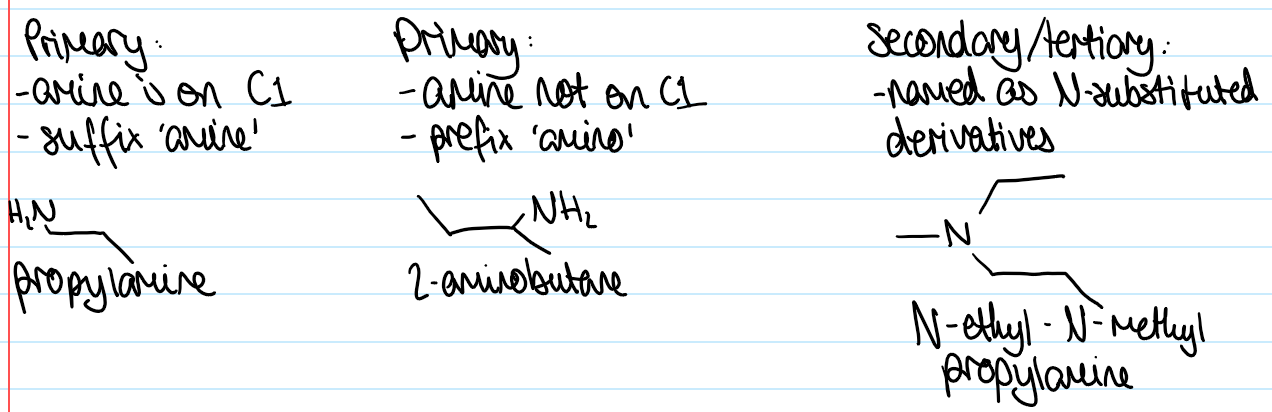
how to name amines
primary amines:
amine is on C1- suffix ‘amine’ used
amine not on C1- prefix ‘amino’ used
secondary/tertiary amines:
named as N-substituted derivative e.g. N-methylethylamine
how can amines be bases
weak bases- the lone pair on the nitrogen atom can accept a proton
what is a characteristic of amines
smelly
what causes amines to loose their smell
acid, will reappear if a stronger base is added
what impacts the base strength of amines
depends on how well N lone pair can accept H+
the higher the electron density of the N lone pair the stronger the base
how can amines be made from nitriles
150’C, nickel catalyst and hydrogen
what can amines be made from
nitriles, nitrobenzene, haloalkanes
how can an amine be made from benzene
benzene reacts with conc. HNO3 and conc. H2SO4 catalyst to form nitrobenzene
nitrobenzene reacts with tin catalyst and conc. HCl- heat under reflux, then add aqueous alkali e.g. NaOH
write the equation for the reaction of nitrobenzene to form phenylamine

what type of reaction is that of nitrobenzene to form phenylamine
reduction
why can’t phenylamine be prepared by reacting chlorobenzene with ammonia
carbon atoms in the benzene ring can’t be attacked by nucleophiles such as NH3, they are attacked by electrophiles instead
how to make a primary amine
reaction happens in two stages
reactants are ammonia and a primary haloalkane
in first stage a salt is formed as amines are bases
e.g. CH3CH2CH2Br + NH3 → CH3CH2CH2NH3+Br-
a reversible reaction can then take place between this salt and excess ammonia in the mixture
e.g. CH3CH2CH2NH3+Br- + NH3 ←→ CH3CH2CH2NH2 + NH4+Br-
the ammonia removes a hydrogen ion from the propylammonium ion to leave a primary amine
the more ammonia there is in the mixture the more the forward reaction is favoured, therefore the reaction is often completed with a high excess of ammonia reagent in order to maximise yield of the product

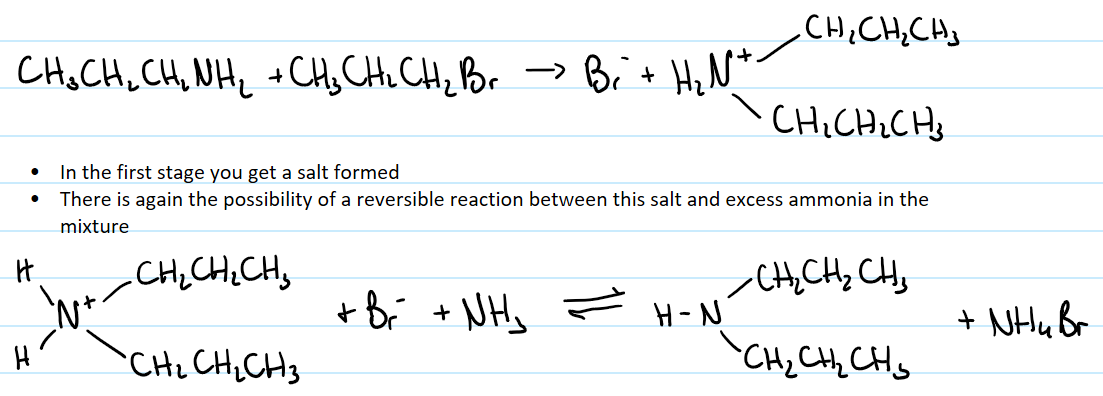
how to make a secondary amine
reaction continues from making a primary amine
same two stages:
first stage forms a salt
reversible reaction between salt and excess ammonia in the mixture to form a secondary amine
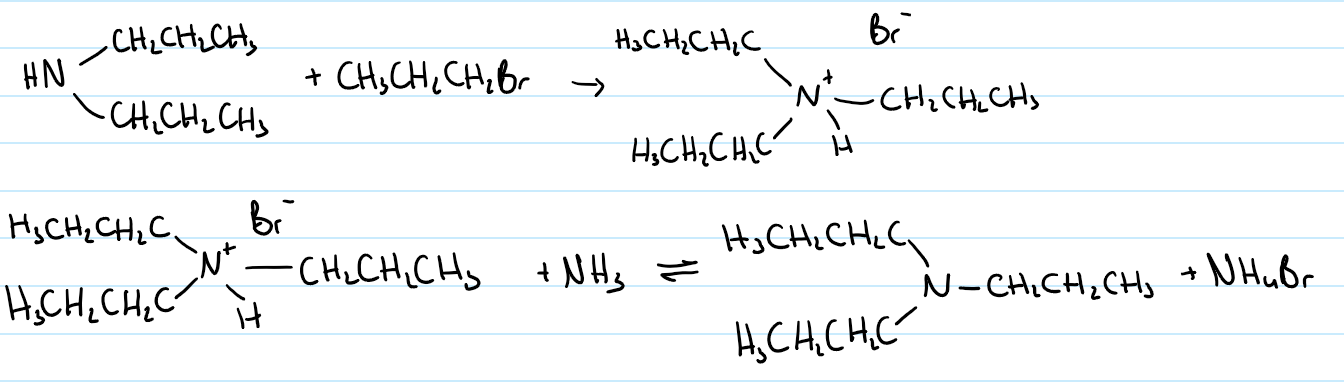
how to make a tertiary amine
reaction continues from a secondary amine (which came from a primary amine)
same two steps:
first stage forms a salt
reversible reaction between salt and excess ammonia in the mixture to form a secondary amine
what is a molecule where a nitrogen has 4 alkyl chains attached
NOT an amine, uses the lone pair of electrons on nitrogen to bond to a fourth alkyl chain, creates a quaternary ammonium salt
how to make a quaternary ammonium salt
tertiary amine reactions with haloalkane
cannot be reacted further as no more hydrogens to lose and remains as a salt

what are the functional groups of amino acids
carboxylic acid and amine
what is the state of amino acids at RTP
solids- have much higher melting and boiling points than other structures with a similar Mr
how do amino acids nomally exist
as zwitterions
what is a chiral carbon
a carbon attached to 4 different groups of atoms (not functional groups just groups)
what type of isomerism uses chiral carbons
optical isomerism
what is the name for a carbon attached to 4 different groups of atoms
chiral carbon
what are optical isomers
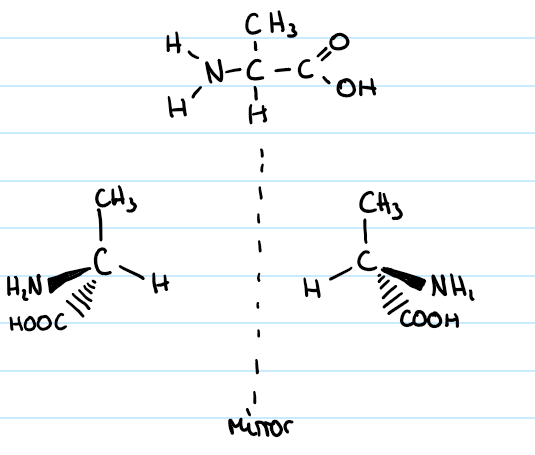
non superimposable mirror image isomers- when placed on top of each other they are not the same shape e.g. your hands
how to draw optical isomers
draw chiral carbon and bonds emerging from it first in 3D
then draw mirror image
draw smallest group near the mirror
draw in all other groups using structural formula
then draw its mirror image
what happens if acid is added to an amino acid solution (pH is lower than isoelectric point- don’t need to know this term)
all the places where the H+ could go are occupied
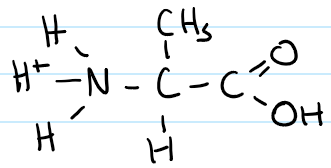
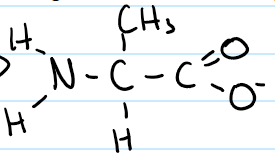
what happens if an alkali is added to an amino acid solution (pH is higher than isoelectric point- don’t need to know this term)
all places where H+ could be lost are empty
what types of polyamine hydrolysis are there
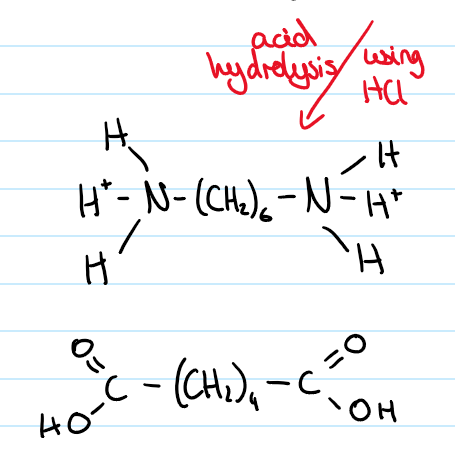
acid hydrolysis
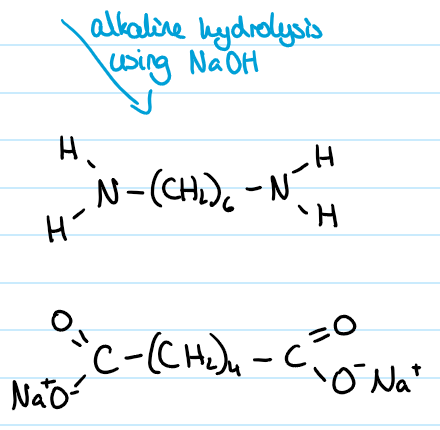
alkali hydrolysis
what are the reactants and products of acid hydrolysis of polyamides
using HCl(aq)
forms protonated diamine and dicarboxylic acid
what are the reactants and products of alkaline hydrolysis of polyamides
using NaOH(aq)
forms diamine and deprotonated dicarboxylic acid forming dicarboxylate salt
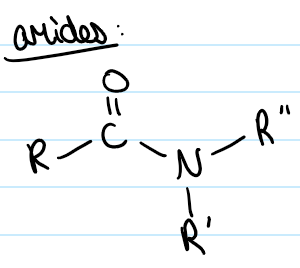
what are amides
contain a nitrogen adjacent to a carbonyl bond
what can amides be made from
can be made from a single monomer containing a carboxylic acid or acyl chloride group and an amine group- half an amide forms at either end, 1 molecule of water made per condensation
can be made from two monomers: a dicarboxylic acid or diacyl dichloride and a diamine- one amide forms in the middle and half at either end, 2 molecules of water made per condensation
(similar way to esters)
what type of polymerisation is used for polyamides
condensation polymerisation