bio 301 exam 3
0.0(0)
Studied by 2 people Call Kai
 Learn
Learn Practice Test
 Spaced Repetition
 Match
Match Flashcards
 Knowt Play
Card Sorting
1/111

Earn XP
Description and Tags
Last updated 12:40 PM on 10/27/22
Name | Mastery | Learn | Test | Matching | Spaced | Call with Kai |
|---|
No analytics yet
Send a link to your students to track their progress
112 Terms
1
New cards
altruism
unselfish regard for the welfare of others
-exists because indirect fitness
-exists because indirect fitness
2
New cards
direct fitness
individuals doing something that is good for themselves
-getting copies of their genes into the next generation
-getting copies of their genes into the next generation
3
New cards
indirect fitness
the fitness that an individual gains by helping relatives (with which it shares genes through a common ancestor) pass on copies of their genes
4
New cards
inclusive fitness
the sum of direct fitness and indirect fitness
5
New cards
direct selection
selection that favors direct fitness
6
New cards
indirect selection (kin selection)
selection favoring indirect fitness
7
New cards
coefficient of relatedness
the numerical probability of an individual and its relatives carrying copies of the same genes from a recent common ancestor
*share half DNA with mom, dad, brother sister,
*25% with grandparents, niece & nephew
*share half DNA with mom, dad, brother sister,
*25% with grandparents, niece & nephew
8
New cards
indirect fitness benefit
B x r
B=benefit given to a recipient relative
r= coefficient of relatedness between donor and recipient
-altruism will be favored when B times the recipients r is greater than the direct fitness cost to the donor
-to get altruism, the cost benefit ratio must be less than r
B=benefit given to a recipient relative
r= coefficient of relatedness between donor and recipient
-altruism will be favored when B times the recipients r is greater than the direct fitness cost to the donor
-to get altruism, the cost benefit ratio must be less than r
9
New cards
altruism example
male turkeys display to females alone or in a coalition
-when a coalition displays together, only the dominant male gets the breed (they work together as a group to attract the female)
-males that are displayed alone on avg are gonna have 0.9 offspring. Dominant males in a coalition have an avg 6.1 offspring
-coalition is typically related so their genes are being carried on anyways
-when a coalition displays together, only the dominant male gets the breed (they work together as a group to attract the female)
-males that are displayed alone on avg are gonna have 0.9 offspring. Dominant males in a coalition have an avg 6.1 offspring
-coalition is typically related so their genes are being carried on anyways
10
New cards
tiger salamanders
can develop predatory morphology under high density
-sometimes eat baby salamanders
-but delay eating other salamanders when raised with siblings, delayed development of predatory morphology
-sometimes eat baby salamanders
-but delay eating other salamanders when raised with siblings, delayed development of predatory morphology
11
New cards
probability of helping
will help more the more they are related to the babies
12
New cards
eusocial animals
-distinguished by 4 characteristics
1. several adults living together in a group
2. overlapping generations of parents and offspring living together in the same group
3. cooperation in nest building and brood care
4. reproductive dominance by one or a few individuals, and the presence of sterile individuals (normally a queen)
-typically insects (bees, ants, wasps, termites)
1. several adults living together in a group
2. overlapping generations of parents and offspring living together in the same group
3. cooperation in nest building and brood care
4. reproductive dominance by one or a few individuals, and the presence of sterile individuals (normally a queen)
-typically insects (bees, ants, wasps, termites)
13
New cards
caste
individuals within a social group sharing a specialized form of behavior (each one has a Dif job. queen, worker bee, drone)
14
New cards
queen
the dominant, egg-laying female in eusocial insect societies, typically mate once during their lives
-sons are made by laying unfertilized eggs and daughters are made by laying fertilized eggs (haplodiploid system)
-sons are made by laying unfertilized eggs and daughters are made by laying fertilized eggs (haplodiploid system)
15
New cards
haplodiploid
a sex determination system in which one sex is haploid and the other sex is diploid
-nonreproductive progeny of a queen gather food and care for developing brothers and sisters
-nonreproductive progeny of a queen gather food and care for developing brothers and sisters
16
New cards
societies
include sterile female workers, reproductive drones, and future queens
17
New cards
daughters
diploid and are produced when a queen's haploid gamete is fertilized by a drone's haploid gamete
18
New cards
drones (sons)
haploid and are produced when a queens gamete remains unfertilized
19
New cards
relatedness among society (r)
-between mother & daughter: 0.5
-between daughters: 0.75
-between brothers and sisters: 0.25
since relatedness between daughters is greater than between mothers and daughters, caring for a sister provides more benefit than carrying for offspring
since r between brothers and sisters is lower than r between daughters, it benefits females to take care of sisters instead of brothers
-this explains why broods of reproductive individuals usually favor females to males 3:1
-between daughters: 0.75
-between brothers and sisters: 0.25
since relatedness between daughters is greater than between mothers and daughters, caring for a sister provides more benefit than carrying for offspring
since r between brothers and sisters is lower than r between daughters, it benefits females to take care of sisters instead of brothers
-this explains why broods of reproductive individuals usually favor females to males 3:1
20
New cards
termites
-dominated by king & queen
-both produce sons and daughters by sexual reproduction, both types of offspring serve as workers
-offspring remain sexually immature unless kind or queen sees
-both produce sons and daughters by sexual reproduction, both types of offspring serve as workers
-offspring remain sexually immature unless kind or queen sees
21
New cards
mole rats
-A single queen and several kings are responsible for all reproduction.
-All individuals are diploid, but workers forego reproduction in favor of caring for younger siblings and the colony.
-Research suggests offspring are not willingly subordinate.
-The dominant female harasses offspring, which increases stress, reduces levels of sex hormones, and makes them less motivated to breed
-All individuals are diploid, but workers forego reproduction in favor of caring for younger siblings and the colony.
-Research suggests offspring are not willingly subordinate.
-The dominant female harasses offspring, which increases stress, reduces levels of sex hormones, and makes them less motivated to breed
22
New cards
organs of eusociality
-has independently evolved many times
-being haplodiploid favors the evolution eusociality, it is not required for its evolution
-eusocial behavior could evolve if the cost of leaving a colony is high due to a low likelihood of surviving, this reduces the cost of foregoing reproduction
ex. some mole rats leave home colony to form new colonies, most of these colonies do not persist for more than a year, leading to a reduced direct benefit, under these conditions a large r is no longer required to favor eusociality
-being haplodiploid favors the evolution eusociality, it is not required for its evolution
-eusocial behavior could evolve if the cost of leaving a colony is high due to a low likelihood of surviving, this reduces the cost of foregoing reproduction
ex. some mole rats leave home colony to form new colonies, most of these colonies do not persist for more than a year, leading to a reduced direct benefit, under these conditions a large r is no longer required to favor eusociality
23
New cards
neutralism
-no effect/insignificant effect interaction
-unlikely to exist, difficult to prove
ex. lice & gut bacteria. On the same organism but don't impact each other
-unlikely to exist, difficult to prove
ex. lice & gut bacteria. On the same organism but don't impact each other
24
New cards
amensalism
negative impact for one, no effect for other
ex. hippo steps on a snail
ex. hippo steps on a snail
25
New cards
commensalism
no effect for one, positive effect for other
ex. barnacles on whales. whale unaffected. barnacles get a free ride to the best spots to feed
ex. barnacles on whales. whale unaffected. barnacles get a free ride to the best spots to feed
26
New cards
competition
-negative effect for both species
ex. collards & radishes going after the same resources
ex. collards & radishes going after the same resources
27
New cards
mutualism
-beneficial for both species
ex. clown fish stays safe by staying in anemone & clown fish cleans anemone
ex. clown fish stays safe by staying in anemone & clown fish cleans anemone
28
New cards
consumer-resource interactions
positive/negative impact
-predator/prey
-plant/herbivore
-parasitoid/host
-parasite/host
-predator/prey
-plant/herbivore
-parasitoid/host
-parasite/host
29
New cards
short and casual with low probability of death
grazers and browsers
ex. deer eating leaves
ex. deer eating leaves
30
New cards
Short and casual with high probability of death
predators
ex. hawk getting rish
ex. hawk getting rish
31
New cards
long and close with low probability of death
parasites and many arthropod herbivores
ex. parasite on bat wing
ex. parasite on bat wing
32
New cards
long and close with high probability of death
parasitoids
-going to cause death
-going to cause death
33
New cards
population cycles
the synchrony of population cycles between consumers and the populations they consume suggests that these oscillations are the result of interactions between them
ex. snowshoe hares and Canada lynx predators exhibit population cycles of 9-10 years, with lynx cycles lagging 2 years behind hare cycles
ex. snowshoe hares and Canada lynx predators exhibit population cycles of 9-10 years, with lynx cycles lagging 2 years behind hare cycles
34
New cards
predator-prey cycles in the lab
Gause and protists
-paramecium (prey)
-Didinium (predator)
paramecium pop inc so didinium inc so paramecium dec, didinium dies out
-paramecium (prey)
-Didinium (predator)
paramecium pop inc so didinium inc so paramecium dec, didinium dies out
35
New cards
Carl Huffaker
conducted experiment using western predatory mites as predators and 6spotted mites as prey
-established pops of 6spotted mites on trays of oranges that served as the habitat and food. rubber balls were interspersed among the oranges
*without predators, prey pops reached high numbers
*with predators, predator populations consumed the prey & both pops went extinct
*extinction of both pops took longer if oranges were spread far apart; it took longer for predators to find prey
-then introduced batters to predatory dispersal (predatory mites disperse by walking whereas prey mites disperse by jumping from orange to orange)
-barrier: trail of vaseline spread among the oranges that prevented or slowed dispersal of predators among oranges
-Wooden posts were placed on trays as jumping points between oranges to give prey mites a dispersal advantage.
-This arrangement mimicked a metapopulation and produced a series of three population cycles over 8 months.
Stable predator-prey population cycles can be achieved when the environment is complex so that predators cannot easily find prey.
-established pops of 6spotted mites on trays of oranges that served as the habitat and food. rubber balls were interspersed among the oranges
*without predators, prey pops reached high numbers
*with predators, predator populations consumed the prey & both pops went extinct
*extinction of both pops took longer if oranges were spread far apart; it took longer for predators to find prey
-then introduced batters to predatory dispersal (predatory mites disperse by walking whereas prey mites disperse by jumping from orange to orange)
-barrier: trail of vaseline spread among the oranges that prevented or slowed dispersal of predators among oranges
-Wooden posts were placed on trays as jumping points between oranges to give prey mites a dispersal advantage.
-This arrangement mimicked a metapopulation and produced a series of three population cycles over 8 months.
Stable predator-prey population cycles can be achieved when the environment is complex so that predators cannot easily find prey.
36
New cards
species interactions
direct: wolves eat elk
indirect: wolves eat elk which eat dogwood. wolves have indirect effect on dogwood
indirect: wolves eat elk which eat dogwood. wolves have indirect effect on dogwood
37
New cards
resources
any substance or factor that is both consumed by an organism and supports increased population growth rates as its availability increases
-consumed: availability decreases
-used for maintenance & growth
-reduced availability reduces population growth
-consumed: availability decreases
-used for maintenance & growth
-reduced availability reduces population growth
38
New cards
limiting resource
a resource whose available quantity cannot meet a populations requirement for it
39
New cards
population growth & resources
-if environment was constant, its time to change that

40
New cards
Lotka-Volterra predator prey Model
a model of predator-prey interactions that incorporates oscillations in predator and prey populations and shows predator numbers lagging behind those of their prey
41
New cards
dN/dt= rN-cNP
growth of prey populations depends on the growth rate of a prey population (rN) and the rate of individuals killed by predators (cNP)
N=number of prey
P=number of predators
c=probability of an encounter between a predator and prey leading to the preys capture
N=number of prey
P=number of predators
c=probability of an encounter between a predator and prey leading to the preys capture
42
New cards
dP/dt=acNP-mP
growth of predator populations depends on growth rate of predator populations (acNP) minus the rate of predator death (mP)
a=the efficiency of a predator converting consumed prey into predator offspring
m=per capita mortality rate of predators
a=the efficiency of a predator converting consumed prey into predator offspring
m=per capita mortality rate of predators
43
New cards
dV/dt=0
P = r/c
P = r/c
prey pop is stable when its rate of change is 0 (when addition of prey is balanced by the consumption of prey)
44
New cards
rV > cVP
P < r/c
P < r/c
the prey population will increase when the addition of prey exceeds the consumption of prey
45
New cards
rV < cVP
P > r/c
P > r/c
prey population will decrease
46
New cards
slide 40 on chap 14
chap 14 *******
47
New cards
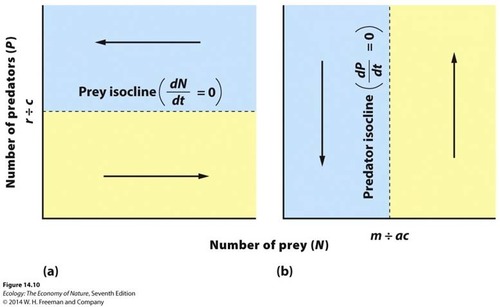
Equilibrium (zero growth) isocline
the population size of one species that causes the population of another species to be stable
-this occurs when P=r/c for prey & V=m/ac for predators
as the number of predators or prey changes and moves away from the equilibrium isoclines populations will increase or decrease
-this occurs when P=r/c for prey & V=m/ac for predators
as the number of predators or prey changes and moves away from the equilibrium isoclines populations will increase or decrease
48
New cards
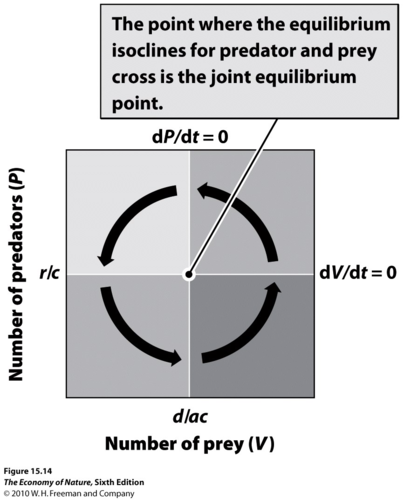
equilibrium isoclines
-bottom right: a rise in the prey pop is followed by a rise in pop
-top right: an increased # of predators causes a decline in the prey pop
-top left: as the prey pop falls, it will support fewer predators
-bottom left: with fewer predators, the prey pop rises again
-top right: an increased # of predators causes a decline in the prey pop
-top left: as the prey pop falls, it will support fewer predators
-bottom left: with fewer predators, the prey pop rises again
49
New cards
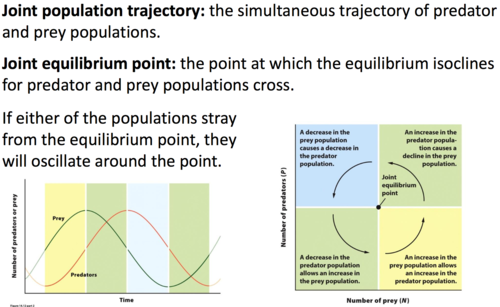
joint population trajectory
the simultaneous trajectory of predator and prey populations
50
New cards
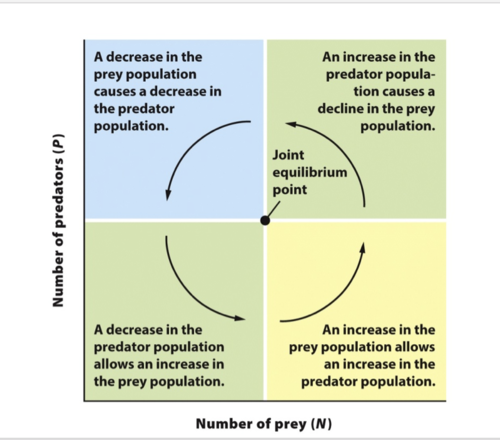
joint equilibrium point
the point at which the equilibrium isoclines for predator and prey populations cross
-if either of the populations stray from the equilibrium point, they will oscillate around the point
-if either of the populations stray from the equilibrium point, they will oscillate around the point
51
New cards
Modelling predator-prey cycles
-victim growth rate (r) is in the victim isocline equation, but not the predator isocline equation
-prediction: increasing victim growth rate will increase predator population size, but not the prey population size
-prediction: increasing victim growth rate will increase predator population size, but not the prey population size
52
New cards
predator responses
functional and numerical
53
New cards
functional response
-how individual predators consume prey according to density of prey items
-the relationship between the density of prey and an individual predators rate of food consumption
-whenever prey density inc and a predator can consume a higher proportion of those prey, the predator can regulate the growth of the prey pop
-the relationship between the density of prey and an individual predators rate of food consumption
-whenever prey density inc and a predator can consume a higher proportion of those prey, the predator can regulate the growth of the prey pop
54
New cards
numerical response
a change in the number of predators through pop growth or immigration/emigration
55
New cards
type II functional response
when a predator's rate of prey consumption begins to slow as prey density increases and then plateaus; often happens because predators must spend more time handling more prey or become satisfied
-any inc in prey density is associated with a slowing rate of prey consumption
-any inc in prey density is associated with a slowing rate of prey consumption
56
New cards
type III functional response
when a predator exibits low, rapid, and slowing prey consumption under low, moderate, and high prey densitie
-low consumption at low prey densities may occur for 3 reasons
1. prey can easily find refuges to hide
2. predators may have less practice at locating and catching prey but develop a search image at higher prey densities
3. predators may exhibit prey switching by changing their diet preferences to the more abundant prey
-low consumption at low prey densities may occur for 3 reasons
1. prey can easily find refuges to hide
2. predators may have less practice at locating and catching prey but develop a search image at higher prey densities
3. predators may exhibit prey switching by changing their diet preferences to the more abundant prey
57
New cards
type 1 functional response
when a predator's rate of prey consumption increases in a linear fashion with an increase in prey density
-as prey density inc, predators consume a constant proportion of prey
-as prey density inc, predators consume a constant proportion of prey
58
New cards
defenses against predators
behavioral, structural, chemical, costs of defenses
59
New cards
defenses against herbivores
structural, chemical, tolerance, costs of defenses
60
New cards
Predator hunting strategies
Predators that exhibit active hunting strategies spend most of their time moving around looking for prey (e.g., birds foraging on lawns for worms).
Predators that exhibit ambush (sit-and-wait) hunting strategies lie in wait for a prey to pass by (e.g., chameleons waiting for insect prey).
Hunting can be thought of as a series of events, including detecting, pursuing, catching, handling, and consuming prey.
Prey have evolved numerous defenses to thwart predators at different points in this process.
Predators that exhibit ambush (sit-and-wait) hunting strategies lie in wait for a prey to pass by (e.g., chameleons waiting for insect prey).
Hunting can be thought of as a series of events, including detecting, pursuing, catching, handling, and consuming prey.
Prey have evolved numerous defenses to thwart predators at different points in this process.
61
New cards
defenses
-avoidance (run away)
-armor (armadillo_
-mobbing
-alarm calling warns relatives that predators are approaching
-spatial avoidance occurs when a prey moves away from a predator
-some prey reduce activity to avoid being detected by a predator
-armor (armadillo_
-mobbing
-alarm calling warns relatives that predators are approaching
-spatial avoidance occurs when a prey moves away from a predator
-some prey reduce activity to avoid being detected by a predator
62
New cards
crypsis
camouflage that either allows an individual to match its environment or breaks up the outline of an individual to blend in better with the background environment
63
New cards
structural defenses
reduce a predator's ability to capture, attack, or handle prey
ex. a porcupines sharp, barbed quills can penetrate the flesh of an attacking predator
ex. a porcupines sharp, barbed quills can penetrate the flesh of an attacking predator
64
New cards
chemical defenses
-can deter a predator
-more effective at deterring predators if the prey can convey the defense before an attack occurs
ex. monarch butterflies sequester milkweed toxins in their bodies to make themselves unpalatable to predators
-more effective at deterring predators if the prey can convey the defense before an attack occurs
ex. monarch butterflies sequester milkweed toxins in their bodies to make themselves unpalatable to predators
65
New cards
warning coloration
a strategy where distastefulness evolves in association with very conspicuous colors and patterns
-predators have innate aversions to aposematic colors, others learn to avoid certain colors and markings through experience
-predators have innate aversions to aposematic colors, others learn to avoid certain colors and markings through experience
66
New cards
Batesian mimicry
when palatable species evolve warning coloration that resembles unpalatable species
ex. hover flies and hornet clearwings resemble the common wasp
ex. hover flies and hornet clearwings resemble the common wasp
67
New cards
mullein mimicry
when several unpalatable species evolve a similar pattern of warning coloration
ex. several species of poison dart frogs have evolved similar warning coloration
ex. several species of poison dart frogs have evolved similar warning coloration
68
New cards
Acoustic mimicry
-Tiger moth/big brown bat
•Mullerian mimic of ultrasonic signals
-Milkweed tiger moth
•Batesian mimic of ultrasonic signals
-Burrowing owls mimic rattlesnake warning rattle
•Mullerian mimic of ultrasonic signals
-Milkweed tiger moth
•Batesian mimic of ultrasonic signals
-Burrowing owls mimic rattlesnake warning rattle
69
New cards
agressive mimicry
-angler fish
-alligator snapping turtle
-alligator snapping turtle
70
New cards
Eyespots - aposematism
-Serval
-Sunbittern
-Polyphemus
-Swallowtail butterfly larvae
-Butterfly fish
-Sunbittern
-Polyphemus
-Swallowtail butterfly larvae
-Butterfly fish
71
New cards
defense against herbivores
selective pressure from herbivores has caused the evolution of plant defenses, some have phenotypically plastic defenses induced by attack, whereas others have fixed defenses
-structural defenses (sharp spines, hair) deter herbivores from consuming leaves, stems, flowers, and fruits
-chemical defenses include sticky resins and latex compounds that are hard to consume and alkaloids (caffeine, nicotine, morphine) that have a wide range of toxic effects
-structural defenses (sharp spines, hair) deter herbivores from consuming leaves, stems, flowers, and fruits
-chemical defenses include sticky resins and latex compounds that are hard to consume and alkaloids (caffeine, nicotine, morphine) that have a wide range of toxic effects
72
New cards
tolerance
increased production of plant tissue after herbivory
73
New cards
costs of defenses
some plants employ the strategy of tolerating herbivory and can rapidly replace tissues that are consumed or grow more tissue in areas that are not being consumed
-many plants produce defensive chemicals at the cost of reduced fitness
ex. tobacco plants respond to herbivores by producing chemicals including nicotine, researchers damaged 2 groups of tobacco plants, but treated one group with a hormone that blocked nicotine production, the group without hormones produced more nicotine and fewer seeds
-many plants produce defensive chemicals at the cost of reduced fitness
ex. tobacco plants respond to herbivores by producing chemicals including nicotine, researchers damaged 2 groups of tobacco plants, but treated one group with a hormone that blocked nicotine production, the group without hormones produced more nicotine and fewer seeds
74
New cards
coevolution
reciprocal process in which adaptations in one population promote the evolution of adaptations in another population
-mediated by biological agents
-unlike evolutionary responses to physical factors because biological factors stimulate mutual responses, not so with environment and biological agents foster diversity of adaptations, rather than similarity
-mediated by biological agents
-unlike evolutionary responses to physical factors because biological factors stimulate mutual responses, not so with environment and biological agents foster diversity of adaptations, rather than similarity
75
New cards
convergence
organisms responding to similar physical stresses tend to evolve similar adaptations
76
New cards
identifying coevolutionary responses
limited to reciprocal evolution between interacting populations
-hyena jaws and muscles not coevolutionary since bones not evolved to resist being eaten
-herbivore resistance to plant toxins is coevolution
-hyena jaws and muscles not coevolutionary since bones not evolved to resist being eaten
-herbivore resistance to plant toxins is coevolution
77
New cards
slide 86 of chap 14?
78
New cards
parasite
something that lives on or in other organism
-consumes host resource
-causes harm to host
ex. zombie ants. carpenter ants become infected with a fungus, the fungal infection forces them to crawl down from the canopy and die, the fungus consumes. host resources and releases spores, spores infect other ants
-consumes host resource
-causes harm to host
ex. zombie ants. carpenter ants become infected with a fungus, the fungal infection forces them to crawl down from the canopy and die, the fungus consumes. host resources and releases spores, spores infect other ants
79
New cards
pathogen
a type of parasite that causes infectious disease
80
New cards
endoparasite
lives inside organism
-low exposure of natural enemies
-low exposure to external environment
-high difficulty of movement to and from host
-high exposure to hosts immune system
-high ease of feeding on host
-low exposure of natural enemies
-low exposure to external environment
-high difficulty of movement to and from host
-high exposure to hosts immune system
-high ease of feeding on host
81
New cards
ectopatasites
live on outside of host
-high exposure of natural enemies
-high exposure to external environment
-low difficulty of movement to and from host
-low exposure to hosts immune system
-low ease of feeding on host
-high exposure of natural enemies
-high exposure to external environment
-low difficulty of movement to and from host
-low exposure to hosts immune system
-low ease of feeding on host
82
New cards
factors that influence the probability of host infection
Mechanism of transmission
Mode of entering the host
Ability of parasite to jump between species
Existence of reservoir species
Counterattacks to host's immune system
Mode of entering the host
Ability of parasite to jump between species
Existence of reservoir species
Counterattacks to host's immune system
83
New cards
horizontal transmission
when a parasite moves between individuals other than parents and offspring
84
New cards
vertical transmission
when a parasite is transmitted from a parent to its offspring
85
New cards
mode of entering host
Piercing tissue (e.g., leeches)
Reliance on a vector (e.g., malaria)
Reliance on a vector (e.g., malaria)
86
New cards
Ability of parasite to jump between species
A lethal parasite that specializes on one host may face extinction;
solution is to infect multiple species (e.g., bird flu, HIV)
solution is to infect multiple species (e.g., bird flu, HIV)
87
New cards
reservoir species
species that can carry a parasite but do not succumb to the disease that the parasite causes in other species
88
New cards
Counterattacks to host's immune system
Avoiding detection by incorporating into chromosomes (e.g., HIV)
Form protective outer layer (e.g., schistosomes)
Form protective outer layer (e.g., schistosomes)
89
New cards
Coevolution
when 2 or more species continue to evolve in response to each others evolution
ex. invasive rabbit populations in australia cause massive crop damage, the government released a virus into the population that killed 99.8% of the rabbits, this favored resistant rabbits and less lethal viruses, over time, both virus and rabbit populations coevolved and began increasing in abundance
ex. invasive rabbit populations in australia cause massive crop damage, the government released a virus into the population that killed 99.8% of the rabbits, this favored resistant rabbits and less lethal viruses, over time, both virus and rabbit populations coevolved and began increasing in abundance
90
New cards
coevolution model
rr. host-Vv pathogen-Rr hose-vv pathogen-rr host
-rr hose=susceptible, RR and Rr=resistant
-vv=avirulent, Vv and VV=virulent
-rr hose=susceptible, RR and Rr=resistant
-vv=avirulent, Vv and VV=virulent
91
New cards
intraspecific competition
competition among individuals of the same species
-negative density dependence is a common type of intraspecific competition, where an increase in a populations density causes a decline in the growth rate of the population
-negative density dependence is a common type of intraspecific competition, where an increase in a populations density causes a decline in the growth rate of the population
92
New cards
interspecific competition
competition among individuals of different species
-interspecific competition can cause the population of one species to decline and eventually die out
-interspecific competition can cause the population of one species to decline and eventually die out
93
New cards
renewable resources
resources that are constantly regenerated (seeds, sunlight)
94
New cards
nonrenewable resources
resources that are not regenerated (space)
95
New cards
Leibig's law of the minimum
law stating that a population increases until the supply of the most limiting resource prevents it from increasing further
ex. silica is a limiting resource for diatoms, the 2 species of diatoms have Dif demands of this limiting resources. diatom 1 populations c=reach carrying capacity when they draw silica down to 1uM. diatom 2 populations reach carrying capacity when silica goes down to 0.4uM. diatom 2 reaches carrying capacity, the abundance of silica in the environment is not sufficient to support the pop of diatom 1. when growing together diatom 2 persists where diatom 1 declines to extinction
ex. silica is a limiting resource for diatoms, the 2 species of diatoms have Dif demands of this limiting resources. diatom 1 populations c=reach carrying capacity when they draw silica down to 1uM. diatom 2 populations reach carrying capacity when silica goes down to 0.4uM. diatom 2 reaches carrying capacity, the abundance of silica in the environment is not sufficient to support the pop of diatom 1. when growing together diatom 2 persists where diatom 1 declines to extinction
96
New cards
interaction among resources
An increase in one resource can have a much larger effect on a population when there is also an increase in a second resource.
ex. researchers examined the growth of small balsam when provided with fertilizer, light, or both. half of the plants received fertilizer, all were exposed to varying light intensity, plants grown in low-feet soil benefited slightly from inc light, plants grow in low light benefited slightly from fertilization, plants with fertilizer and high light grew larger than predicted based on the sum of the separate effects of light and fertilizer
ex. researchers examined the growth of small balsam when provided with fertilizer, light, or both. half of the plants received fertilizer, all were exposed to varying light intensity, plants grown in low-feet soil benefited slightly from inc light, plants grow in low light benefited slightly from fertilization, plants with fertilizer and high light grew larger than predicted based on the sum of the separate effects of light and fertilizer
97
New cards
competitive exclusion principle
two species cannot coexist indefinitely when they are both limited by the same resource
-when two species are limited by the same resource, one species is often a better competitor survives when resources are scarce
-when two species are limited by the same resource, one species is often a better competitor survives when resources are scarce
98
New cards
competition: related species
-Darwin suggested that competition is most intense between related species because they have similar traits and consume similar resources.
-For related species that compete strongly, natural selection should favor differences in habitat use.
ex. heath bedstraw prefers to grow on acidic soils whereas the related white bedstraw prefers to grow on alkaline soil
-Arthur tensely planted them separately and together in boxes with acidic or alkaline soil
-each species grew best in the soil type of its natural habitat and outcompeted the other species when grown in its natural soil type
-For related species that compete strongly, natural selection should favor differences in habitat use.
ex. heath bedstraw prefers to grow on acidic soils whereas the related white bedstraw prefers to grow on alkaline soil
-Arthur tensely planted them separately and together in boxes with acidic or alkaline soil
-each species grew best in the soil type of its natural habitat and outcompeted the other species when grown in its natural soil type
99
New cards
competition: non related species
competition can also be intense among distantly related species that consume a common resource
ex. competition for space on rocks in the intertidal zone occurs between barnacles, muscles, algae, and sponges,
ex. competition for space on rocks in the intertidal zone occurs between barnacles, muscles, algae, and sponges,
100
New cards
possible outcomes of competition
-coexistance
-species 1 wins (drives species 2 to local extinction)
-species 2 wins (drives species 1 to local extinction)
-species 1 wins (drives species 2 to local extinction)
-species 2 wins (drives species 1 to local extinction)