1: Relict Leopard Frog Part 1 - Taxonomic Confusion
 Call Kai
 Learn
Learn Practice Test
 Spaced Repetition
 Match
Match Flashcards
 Knowt Play
1/49

There's no tags or description
Looks like no tags are added yet.
Name | Mastery | Learn | Test | Matching | Spaced | Call with Kai | Chat |
|---|
No analytics yet
Send a link to your students to track their progress
50 Terms
What do species originate from?
along lines of descent from ancestral species
What are species usually composed of?
groups of populations each having spatial and temporal cohesion, maintained by an array of genetic and ecological mechanisms
What is a population?
a group of the same species inhabiting the same area
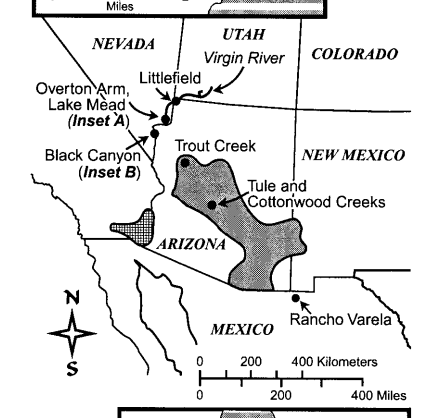
What was the general region of interest for relict leopard frogs?
Mojave, Sonoran, Arizona, Chihuahan
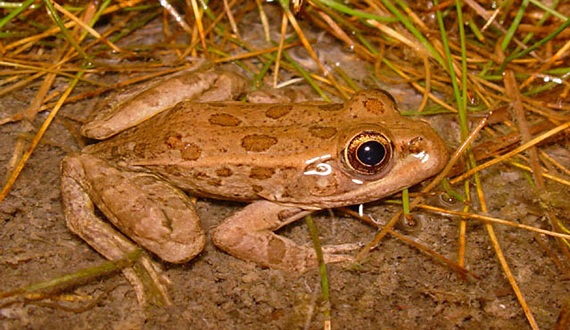
What is a relict leopard frog?
Rana onca
When were Rana onca discovered?
1875, by Cope from samples collected in Utah
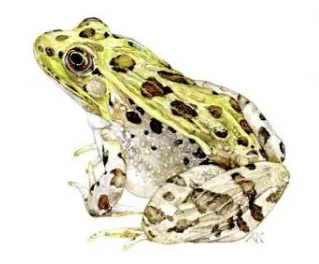
What is a Vegas Valley Leopard Frog?
Rana fisheri
When were Rana fisheri discovered?
1893, by Stejneger from samples collected from a few sites in the Las Vegas Valley
What were Rana fisheri concluded to be in the 1800s?
to just be Rana onca
When were the last specimens of Rana fisheri collected?
1942
After the last specimens of Rana fisheri were collected in 1942, what followed?
extinction
What were likely reasons for the decline/extinction of Rana fisheri?
loss of spring-fed habitat
introduction of exotic predators
What did loss of spring-fed habitats involve?
loss of water, large industrialization
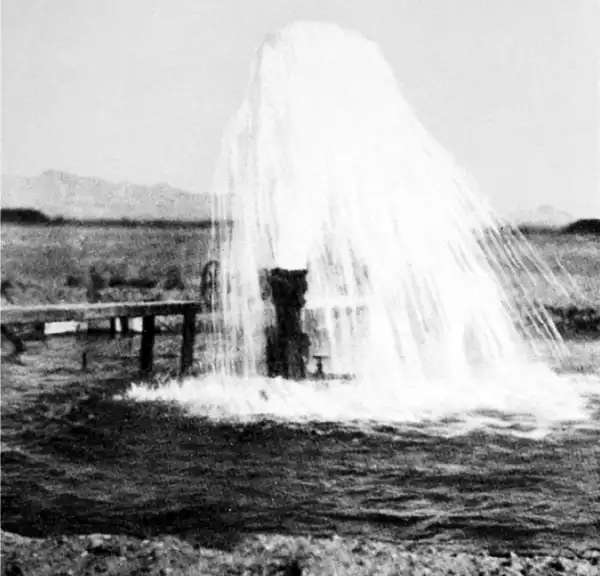
The Las Vegas Valley: Artesian well
Water came from wells in the valley, lakes now continues to lose water
What were some introductions of exotic predators?
bullfrogs, crayfish, fishes, and introduced disease
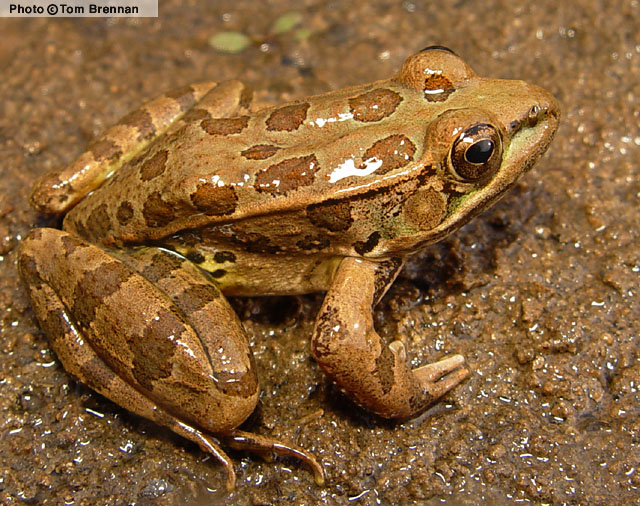
What are Lowland Leopard Frogs?
Rana yavapaiensis
When were Rana yavapaiensis discovered?
In 1984 by Platz and Frost in Black Canyon
After Rana yavapaiensis was discovered, what was concluded?
That Rana onca was extinct and a new species was found
Rana yavapaiensis included populations found along?
the Virgin River
Systematic/Taxonomic confusion in the 1990s:
Conservation of the remnant populations in Southern Nevada was stymied by the uncertainty
What uncertainty was present about leopard frogs?
Was it:
One variable species?
Two distinct species?
Three distinct species?
Early morphological analysis of regional leopard frogs in 1995 was conducted to address the issue; which included?
PCA on numerous morphometric charcteristics
Frogs on the Virgin River (purported ‘onca’) are physically different than the purported fisheri
Purported onca and yavapaiensis overlap in terms of physical characteristics, but there is a pattern of physical difference
Chiricahua Leopard frog
What are Chiricahua Leopard frogs?
Rana chiricahuensis, main distribution in Arizona
What were fisheri “classified” to be?
academic/extinct
Jennings et al. 1995
Compared principal Components
13 Characteristics in a principal component analysis
What did Jennings et al. 1995 determine?
There were morphological, ecological, and nuclear DNA differences between the species
Historical Distribution of onca
In the 1990s, frogs only present in three general areas
By 2001, only a few occupied sites in two general areas
By 2001, only a few occupied sites in two general areas:
two of the remaining sites were extirpated, leading only Northshore and Black Canyon areas occupied
Phylogenetics and phylogeography:
assessing geographic patterns of populations using genetic data
What methods did assessing geographic patterns of populations use?
Phylogenetic tree of MtDNA (Maximum Likelihood Tree)
Multidimensional scaling of RAPD data (nuclear data)
Historical Distribution: Amphibian Survey of Western Grand Canyon
46 surveys 2007-2009
Surprise discovery in Surprise Canyon (Western Grand Canyon)
Phytogeography - onca, yavapaiensis, and Surprise Canyon frogs
MtDNA (N2) haplotype network of MtDNA: 276 samples
Climate Change:
Glacial-interglacial cycles
Rana onca diverged sometime earlier, surprise canyon animals diverged sometime more recently, but still possess genetic differences
Climate has fluctuated with warmer and colder periods
Lead to expansion, loss of populations, and then lead to differentiations
Rana onca changed
Morphologically look very different
Rana onca diverged ___________, while surprise canyon animals diverged ___________
sometime earlier; sometime more recently
Even though Rana onca diverged sometime earlier and Surprise canyon animals diverged sometime more recently, they still:
possess genetic differences
Historical break between yavapaiensis and onca
Onca and yavapaiensis are distinct species
Fisheri are extinct (academic), forgettable
What was the hypothesis driving the observed phylogenetic patterns?
With differences in genetic mtDNA, physicality, and nuclear DNA, what was determined about these frogs?
R. onca is distinct from R. yavapaiensis
Remnant leopard frog populations along Virgin and Colorado rivers are R. onca
Jumping forward to 2001 - Phylogenetic evaluation of fisheri
Archival DNA
Tree analysis mtDNA and nuclear genes
Network analysis of mtDNA
Alternative explanation for the presence of fisheri
Archival DNA was extracted from?
15 ethanol-preserved leopard frogs collected in 1913 from the Las Vegas Valley
Tree analysis mtDNA and nuclear genes:
Analysis of mtDNA and nuclear DNA
very genetically different from R. fisheri
What was R. fisheri determined to be genetically?
R. chiricahuensis (Western and South/eastern)
Some form of isolation, sometime in the past, South and eastern R. chiricahuensis was isolated from Western R. chiricahuensis:
evolved for a long time, and came back together
R. fisheri could have ended up in the Las Vegas Valley through some form of human activity, and they retained:
a genetic history of previous isolation
Resolving the systematic/taxonomic confusion:
Determined to be three distinct species, kinda sorta…
Resolving the systematic/taxonomic confusion of R. fisheri:
were extirpated in Nevada, but appears to be the same species as R. chiricahuensis in Arizona
Resolving the systematic/taxonomic confusion of R. onca:
is extant and unique from R. yavapaiensis
Although R. onca is extant and unique from R. yavapaiensis, they were recognized to be?
more similar than some other recognized anuran subspecies (not all that different)
Support from most recent:
unpublished genetic assessment analysis
R. chiricahuensis was endangered and listed, but since they were determined to be the same, R. fisheri has nomenclature priority, thus:
R. fisheri is listed as endangered