Human Phys Post Lab Quiz-Action Potentials
 Call Kai
 Learn
Learn Practice Test
 Spaced Repetition
 Match
Match Flashcards
 Knowt Play
1/76

There's no tags or description
Looks like no tags are added yet.
Name | Mastery | Learn | Test | Matching | Spaced | Call with Kai | Chat |
|---|
No analytics yet
Send a link to your students to track their progress
77 Terms
Where are sensory receptors located?
Dendrites
Contaneous receptors
Eyes, ears, nose, mouth and skin
Where do sensory neurons send action potentials
Central nervous system
What does the central nervous system do?
Process action potential: interprets and precieves sensation
What does sensory acuity mean?
Ability to precisely locate and distinguish one stimulus from another; sharpness of preception
What two factors effect sensory acuity?
Size of receptor field and lateral inhibition
Size of receptor field
Varies inversely with the number of receptored contained in field
Smaller the receptor field
The greater the density of receptors
Increase receptor field
decrease density of receptors
Two point discrimination
The point at which the distance we can distinguish two separate sensations
What is lateral inhibition
Receptors where touch is the strongest are stimulated more than areas where touch is lighter.
Receptors that are most strongly stimulated inhibit those around them
This allows us to percieve well-defined sensation at a single location instead of “fuzzy” boarder
phasic receptors
Touch and pressure:
-adapt quickly
-respond when stimulus first applied
-cease to respond
-some may produce second response
-recognize changes in stimuli
tonic receptors
-Adapt slowly
-Continue to produce response as long as stimulus persists
-stimuli that require constant monitoring
Examples of tonic receptors
pain, stretching
Referred pain
Visceral pain felt at a site other than place of origin
Why does visceral pain occur?
both somatic sensory and visceral sensory coverage are on the same tract.
Anatomy of the ear

Anatomy of middle ear

Anamtomy of Cochlear Duct
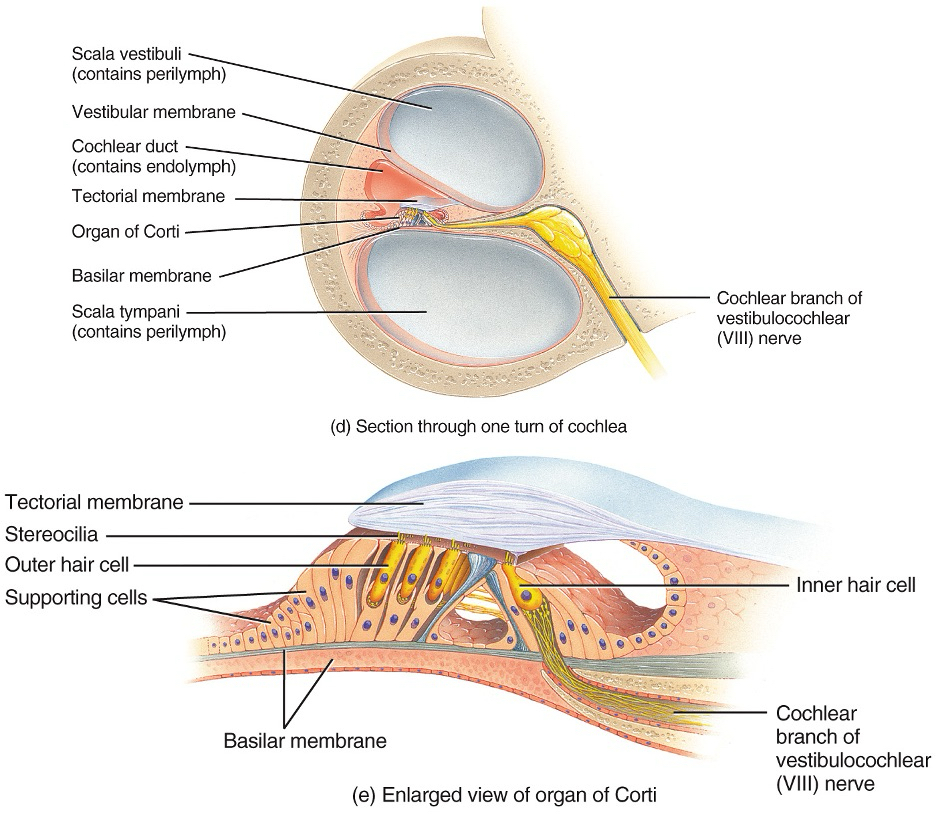
Sound frequency-pitch
The amplitude of the sound wave does not change but frequency does
Higher pitch
Higher frequency
Conduction deafness
Movement of sound waves through external and middle ear is interrupted
Impairs hearing at all frequencies
Sensorineural deafness
Transmission of nerve impulses is impaired from damage to inner hear and neural components.
Impairs hearing at some frequencies more than others.
Function of dendrites
Receive incoming signals
Function of node of Ranvier
action potential jumps
Myelin sheath
Insulates neuron
Schwann cells
Lays myelin in peripheral nervous system
Oligodendrocytes
Lay myelin in CNS
Speed of action potential in unmyelinated region of neuron
Slower (1 m/s)
Speed of action potential in myelinated region of neuron
Fast (300 m/s)
Function of the axon hillock
Trigger zone
Function of axon
Propagates action potentials
Neuron
Functional unit of the nervous system
What is the resting membrane potential
The membrane potential when neuron is inactive/at rest
What is the value of the resting membrane potential
-70 mV
Membrane potential
The difference in charge across the membrane
Inside the membrane
Negative
Outside the membrane
Positive
What is the resting membrane potential established by
More K leak channels than Na ion pumps
Na/K ATPase: 3 Na out, 2 K in
Anionic molecules in the cell (DNA, proteins, ATP)
Action potential
How neurons communicate
What does it mean that action potentials are unidirectional?
only travel in one direction
Depolarization
More positve, increase membrane potential
What causes depolarization?
Voltage Na channel open- large influx of Na
Repolarization
Decrease membrane potential; becomes more negative
What causes repolarization
Na voltage gated ion channels are inactivated, K ion channels open and K flows out of cell
Hyperpolarization
Overshot of resting membrane potential
What causes hyperpoalrization?
K ion channel are slow to close
At low resting membrane potential what is the permeability of Na and K
Low Na permeability, higher K permeability
At depolarization what happens to Na permability
Increases
What happens to Na and K permeability during repolarization?
Decrease in Na permeability and increase in K permeability
What happens to Na and K permeability during hyperpolarization?
Low Na permeability, K permeability slowly decreases
Refractory periods
Recovery time after responding to stimulus
Absolute refractory period
Absolutely no action potentials no matter how strong the stimuli
What causes the absolute refractory period
Inactived Na channels
Relative refractory period
Action pontential requirs an extra strong stimulus
What causes the relative refractory period
Continued outward diffusion of K
Propagation
Movement of action potential down axon and is unidirectional
Continous conduction
Unmyelinated neurons. Action potential is generated at every point down the axon until it reaches the end
Saltatory conduction
Myelinated neurons. Action potentials generated at nodes of Ranvier, much faster AP
All-or-none principle
A graded potential needs to reach threshold in order to trigger an action potential. Amplitude does not change but frequency does
Supthreshold
No Action potential
Thershold
Action potential
Suprathreshold
Action potential with increased frequency
Oscilloscope
Plots electrical potential over time
Exteroceptors
Receptors that receive stimuli from outside the body
Interoceptors
Receptors that are located deep within muscles tendons and other structures and which detect changes within the body
Weber’s law
The size of the just noticeable difference is a constant proportion of the original stimulus.
Referred pain
Perception of pain in one area of the body when another area is actually receiving the painful stimulus
Trigeminal nerve
Divides into the opthalmic, maxillary, and mandibular brances
Rinne Test
Compares air conduction of sound with bone conduction of sound
Autogram
A pure tone audiometer that is an instrument for measuring hearing acuity
In the Wber Test if an individual suffers from conduction deafness
The sound will be heard louder in the deaf ear than in the normal ear because in the normal ear the sound wil be partially masked by environmental noise to which the defective ear is less sensitive
In the weber test if an individual has sensorineural deafness
The sound will be heard better in the normal ear than in the deaf ear because neurla activity is essentail for hearing
In the Rinne Test if someone has conduction deafness
They will hear the sound as long as or longer through bone conduction than through air condution
In the Rinne Test, if someone has sensorineural deafness
Will hear the sound longer through air conduction than through bone conduction but usually requires a louder sound to hear at all.
Where are high pitch sounds found?
Closer to base (cross coclear duct)
Where are low pitch sounds found
Cross cochlear duct at apex