Kinesiology Unit 1 Chapter 1
 Call Kai
 Learn
Learn Practice Test
 Spaced Repetition
 Match
Match Flashcards
 Knowt Play
1/107

There's no tags or description
Looks like no tags are added yet.
Name | Mastery | Learn | Test | Matching | Spaced | Call with Kai | Chat |
|---|
No analytics yet
Send a link to your students to track their progress
108 Terms
kinesiology
the scientific study of human movement encompassing the anatomical, physiological, biomechanics, and neurological principles that govern motion.
kinesis
to move
logy
to study
anatomy
the science of the shape and structure of the human body and its part
biomechanics
A discipline that uses principles of physics to quantitatively study how forces interact within a living body
physiology
biologic study of living organisms; the study of how the body and its parts work or function
kinematics
study of motion WITHOUT considering the forces and torques involved
translation, rotation
two types of motion in kinematics
translation
linear motion in which all parts of a rigid body move parallel to and in the same direction as every other part of the body. (i.e. straight line (rectilinear), curved linear (curvilinear)
straight line (rectilinear)

curved line (curvilinear)

rotation
an assumed rigid body moves in a circular path around some pivot point.
All points in the body simultaneously rotate in the same angular direction (clockwise or counterclockwise)
fixed axis
During rotation, everything is moving around a ________
axis of rotation
pivot point for angular change
The point where motion of the rotating body IS ZERO.
Generally, most limbs or trunk movement axis of rotation is within or near the joint.
No, the axis of motion does not always stay in a single location; while some joints, like the elbow, have relatively fixed axes, others, such as the shoulder and knee, have more complex, shifting axes due to the changing shapes and positions of the articulating bones during movement
Do axes of motion always stay in a single location throughout joint's ROM?
osteokinematics
the motion of bones relative to the three cardinal planes of the body
anatomical position
To stand erect with arms at the sides and palms of the hands turned forward
sagittal plane
divides body into left and right
frontal plane
front and back halves
horizontal (transverse) plane
divides the body into superior and inferior sections
flexion/extension, plantarflexion/dorsiflexion
example of sagittal plane movement
abduction/adduction
example of frontal plane movement
internal/external rotation of arm, transverse abduction/adduction
example of transverse (horizontal) plane movement
perpendicular
bones rotate around a joint in a plane that is ___________ to the axis of rotation
convex member of the joint
Generally, one can assume the axis passes through the...
three; it moves in three cardinal planes
Shoulder has ____ axes of rotation because ______
the axis moves to the injured location; immobilize problem in order to move axis back to convex member of joint
what happens when there is a dislocation or fracture
sagittal axis (Anterior-posterior axis)
Frontal plane = what axis
frontal axis (medial-lateral axis)
sagittal plane = what axis
longitudinal (vertical) axis
horizontal (transverse) plane = what axis
degrees of freedom
number of planes of movement that is voluntarily controlled by a muscle at a joint. Max 3 planes of movement
single degree of freedom
phalanges of fingers; joints flex and extend only

two degrees of freedom
MCP joints; flex/ext + abd/add

three degrees of freedom
shoulder joint - flex/ext + abd/add + int/ext rotation

closed kinetic chain
distal segment is fixed to the ground or to an immovable object
seated leg extension
example of open kinetic chain
open kinetic chain
distal segment is not fixed to the ground or to an immovable object
squats, pushups
example of closed kinetic chain
arthrokinematics
the movements that occurs between the joint surfaces during motion

roll, spin, glide
three types of arthrokinematic movements

Roll
MULTIPLE points along one ROTATING surface contacts MULTIPLE points on another surface
radioulnar joint
What is the only joint that TRUELY spins?
spin
a SINGLE point on one surface ROTATES on a SINGLE point on another surface.
glide/slide
a SINGLE point on one surface contacts MULTIPLE points on another surface.
convex on concave rule

concave on convex rule

roll in one direction, glide in opposite direction
roll/glide directions of convex on concave
roll in one direction, glide in same direction
roll/glide directions of concave on convex
A. concave on convex rule: tibia moving on femur, roll/glide same direction, open kinetic chain.
B. Convex on concave rule: femur moving on tibia, roll/glide in opposite directions, closed-kinetic chain.
Understand:
Which one is concave on convex rule AND which one is Convex on concave rule
Explain what is moving on what
Directions of glide/roll
Also fixed or open kinetic chain.

convex on concave rule
humeral head is moving on glenohumeral joint capsule
rolling and gliding in opposite directions.
open-kinetic chain
During abduction of shoulder:
concave on convex rule or Convex on concave rule
Explain what is moving on what
Directions of glide/roll
fixed or open kinetic chain.
*TAKE NOTE THAT RIGHT PICTURE THERE IS NO GLIDE WITH ROLL.

congruence
stable =
close-packed position
Type of joint positioning:
maximal stability of the joint OR joint is most closely together,
max congruence OR most stable position,
joint capsule and ligaments are taut,
creates a natural stability to joint,
most accessory movements are minimal
maximal
most
stable
taut
natural
minimal
In a close-packed position:
[maximal/minimal] stability of the joint OR joint is [most/least] closely together,
max congruence OR most [stable/unstable] position,
joint capsule and ligaments are [taut/loose],
creates a [natural/unnatural] stability to joint,
most accessory movements are [maximal/minimal]
open-packed position
Type of joint positioning:
also known as loose-packed,
less stable,
better position for joint mobilization,
any other position compared to the other joint positioning,
ligament and capsules are slackened, not fitting together nicely
Loose
less
better
slackened
doesn't
With open-packed position:
also known as _______-packed,
[more/less] stable,
[better/worse] position for joint mobilization,
ligament and capsules are [slackened/tightened], [does/doesn't] fitting together nicely,
close-packed position, tight ligaments lead to easier to snap or tear
which joint position is greater risk for injury?
kinetics
the forces that cause or influence motion.
Focuses on why movement occurs examining internal (muscle contraction) and external (gravity/friction) forces.
Forces impact the body during functional activities (walking, lifting, jumping) and critical for injury prevention, rehab, and performance optimization.
force
The effect of a push or pull on a movement.
load
a force that acts on the body or an object to create or stop a movement.
internal forces
Type of force: muscles and ligaments; we generate these forces within us, muscles are a pulling force not a pushing force.
external forces
Type of force: gravity, anything in the outside world that pulls or pushes on the body
unloaded, tension, compression, bending, shear, torsion, combined loading
list the forces/loads (7)
unloaded

tension

compression

bending

Shear

torsion

combined loading

Strain = change in length, stress = tension caused by strain.
FOUR MAJOR REGIONS:
1. Toe regions: collagen fibers unfurl with increased strain on the ligament or tendon.
2. elastic region: collagen fibers stretch with 100% elastic recoil. ELASTIC DOES NOT MEAN STRETCH.
If yield point is past, those collagen fibers will NOT go back to resting length. That is when we get into plastic region...
3. plastic region: recoil diminishes from the yield point to the failure point. Sometimes it's therapeutic, not necessarily causing injury. Microtears occur.
4. Ultimate failure point: this is where we have injury past failure point. Stress falls because structure completely ruptures/tears.
If the goal is to lengthen tendons, we would want to be in the plastic region, elastic region is not enough stretch but after failure point is way too much.
explain this graph

elastic recoil
able to go back to its original length
Stiffness
amount of tension a tissue can handle
Flexion/extension, lateral flexion, rotation
Sagittal plane, frontal plane, transverse plane
Sagittal axis, frontal axis, longitudinal axis
three degrees of freedom
cervical spine: primary motions, plane of motion, axis of rotation, degrees of freedom
Flexion/extension, internal rotation/external rotation, transverse abduction/adduction
Sagittal plane, frontal plane, transverse plane
Sagittal axis, frontal axis, longitudinal axis
three degrees of freedom
shoulder: primary motions, plane of motion, axis of rotation, degrees of freedom
Flexion/extension, abduction/adduction
Sagittal plane, frontal plane
Sagittal axis, frontal axis
two degrees of freedom
wrist: primary motions, plane of motion, axis of rotation, degrees of freedom
Flexion/extension, LITTLE IR/ER
Sagittal plane, transverse plane
frontal axis, longitudinal axis
two degrees of freedom
knee: primary motions, plane of motion, axis of rotation, degrees of freedom
PF/DF, inversion/eversion, abductin/adduction
Sagittal plane, frontal plane, transverse plane
Sagittal axis, frontal axis, longitudinal axis
three degrees of freedom
foot: primary motions, plane of motion, axis of rotation, degrees of freedom
vectors
a quantity that has direction and magnitude
magnitude
numerical size of the force; it acts along the humeral shaft (the vector's line of action).
Magnitude = size of the force; it acts along the humeral shaft
Internal force acting upward (positive numbers), external force (gravity) always acting downward and negative number.
base of the arrow = origination of force (point of application)
joint reaction force = point of application for bone
explain how this depicts vectors:
what is the magnitude?
positive vs negative numerical value?
point of application for origination of force?
point of application for bone?

magnitude, spatial orientation, direction, point of application
four ways to describe a vector
angle of insertion
the angle that is formed between a tendon of a muscle and the long axis of the bone in which it inserts
center of mass
the center of where all the mass is
translation
in terms of vectors, a push or pull of all forces acted on the body forms this; the sum of all forces determining how the bone moves
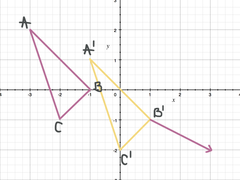
torque
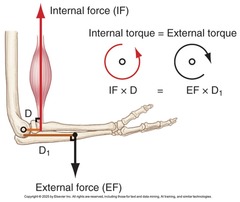
force that has the capacity to cause rotation, also known as a moment
moment arm
the perpendicular distance between the axis of rotation of the joint and the force exerted on the body (represented as D)

internal torque
an internal force (in most cases it is muscle) that is coupled with an internal moment arm creates a torque or a moment

external torque
an external force (in the picture is gravity) that is coupled with the external moment arm creates a torque or a moment
isometric, concentric, eccentric
three types of muscle activation
isometric contraction
the muscle is creating a pulling force while maintaining a constant length
equal
in an isometric contraction, the external and internal forces are...
concentric contraction
a muscle produces a pulling force (or shortens) as it contracts
greater
in an concentric contraction, internal torque is ______ than the external torque
eccentric contraction
a muscle produces a pulling force as it is being elongated by another more dominant force; lengthening under tension
less
in an eccentric contraction, internal torque is ______ than the external torque
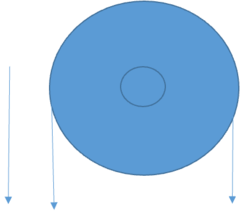
force couple
formed when TWO or more muscles simultaneously produce forces in different linear (opposite) directions; although, the resulting torques act in the SAME rotatory directions

yes, pull at same time and creates a force couple that creates a ROTARY motion
is this a force couple? why?

no, there will be a rectilinear translation, object will move down instead of in a rotatory motion.
is this a force couple? why?
1st class lever (teeter-totter)
what type of lever is this?
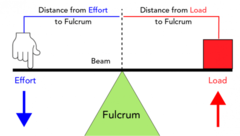
fulcrum in middle, load and effort arm on either side
equal
in a first class lever, where are fulcrum, effort, and load located.
Also the effort and load need to ______ to remain balanced