Fundamentals of Metal Forming 1
 Studied by 0 people
 Call Kai
 Learn
Learn Practice Test
 Spaced Repetition
 Match
Match Flashcards
 Knowt Play
1/30

There's no tags or description
Looks like no tags are added yet.
Name | Mastery | Learn | Test | Matching | Spaced |
|---|
No study sessions yet.
31 Terms
Metal Forming
Plastic Deformation is used to change the shape or metal workpieces
Applies stresses that exceed the yield strength of the metal, the metal takes a shape determined by the geometry of…
die
4 Types of Bulk Deformation
Rolling, Forging, Extrusion, Wire and bar drawing
4 types of sheet metalworking
Bending, Deep drawing, cutting, miscellaneous processes
Characterized by significant deformations and massive shape changes. “ “ refers to workparts with low area-to-volume ratios
Bulk Deformation Processes
Rolling
The slab is heated in a furnace and rolled between powered rollers until the plate is made with desirable thickness.
Forging
process of forming metal by impacting/squeezing a preheated part between two halves of a die. succession of dies may be needed to achieve the final shape.
Extrusion
Billets are preheated and forced by a ram through one or more dies to achieve desired cross section. The product is long relative to its cross-sectional dimensions and has a cross section other than that of rod and bar and pipe and tube.
Wire and Bar Drawing
the cross-section of solid rod, wire or tubing is reduced or changed in shape by pulling it through a die.
Sheet Metalworking
Forming and related operations on metal sheets, strips, and coils. High surface area-to-volume ratio of starting metal
Sheet Metal Bending
Straining of metal sheet or plate to take an angle
Deep Drawing
Forming of a flat metal sheet into a hollow or concave shape by stretching the metal
Shearing of Sheet Metal
Cuts the work by using a punch and die
Plastic region
Plastic region of stress-strain curve is primary interest because material is plastically deformed and expressed by the flow curve:
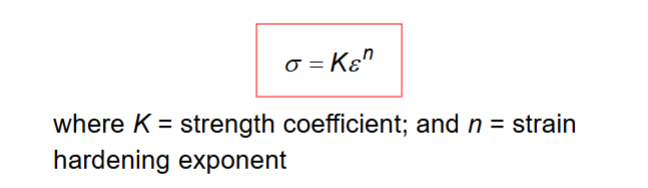
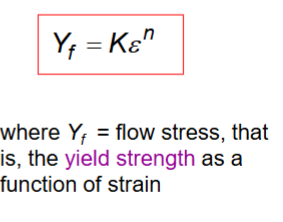
What is flow stress and what is the equation?
instantaneous value of stress required to continue deforming the material
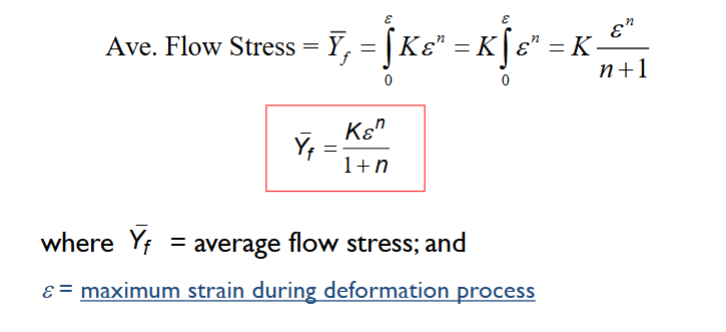
Average Flow Stress equation
How does higher temperature effect K and n in the flow curve
Both strength (K) and strain hardening (n) are reduced at higher temperatures. Ductility is increased at higher temperatures.
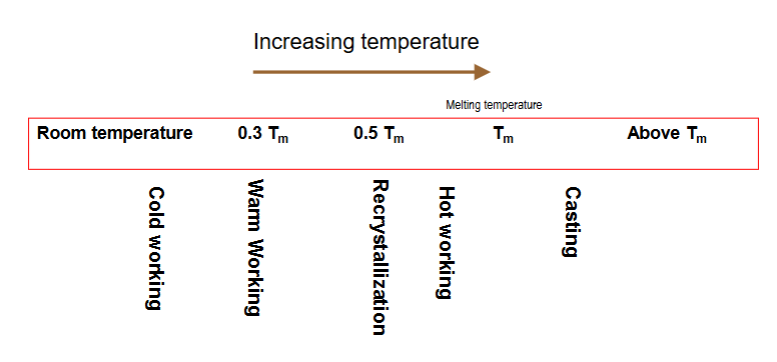
What are the three temperature ranges in metal forming?
Cold Working, Warm working, Hot working
What is cold working?
refers to plastic deformation that occurs usually but not necessarily at room temperature.
What is warm working?
Carried out at intermediate temperatures. Acts as a compromise between cold and hot working
What is hot working?
Refers to plastic deformation carried out above the recrystallization temperature.
What processes occur with increasing temperature relative to melting point (Tm)?
Facts about cold working:
Performed at or slightly above room temperatures, important for mass production operations, minimum or no machining required, tends to be near net shape processes.
Advantages of cold forming
Better accuracy, closer tolerances, between surface finish, strain hardening increases strength and hardness, grain flow causes desirable directional properties in product, no heating of work required.
Disadvantages of cold forming
Higher forces and power required in the deformation operation, workpiece must be free of scale and dirt, ductility and strain hardening limit the amount of forming that can be done
Warm Working
Performed at temperatures above room temp but below recrystallization temp, often defined by 0.3 Tm
Advantages of warm working
Lower forces and power than in cold working, more complex work geometries possible, need for annealing e be reduced or eliminated
Hot Working
Deformation occurs at temps above the recrystallization temperature, recrystallization temp about 0.5 of melting point
Why would people use hot wokring?
Capability for substantial plastic deformation of the metal, far more than possible with cold working or warm working. Strength coefficient (K) is substantially less than at room temperature, Strain hardening (n) is zero (theoretically), ductility is significantly increased
Advantages of Hot Working
Workpart shape can be significantly altered, lower forces and power required, metals that fracture in cold working can be hot formed, strengths properties are generally isotropic, no strengthening of part occurs from work hardening
Disadvantages of Hot Working
lower dimensional accuracy, higher total energy required, work surface oxidation, poorer surface finish, shorter tool life