3-A Identity, Social, and Emotional Development
 Call Kai
 Learn
Learn Practice Test
 Spaced Repetition
 Match
Match Flashcards
 Knowt Play
1/15

There's no tags or description
Looks like no tags are added yet.
Name | Mastery | Learn | Test | Matching | Spaced | Call with Kai |
|---|
No analytics yet
Send a link to your students to track their progress
16 Terms
Domains of Human Development
While all human development theorists built off of the work of their predecessors, emphasis is put on how they expand our understanding of social, physical, moral, and cognitive development. Cognitive, physical, social, and moral domains are described in stages of individual progress. Each stage has a range of typical variances because not all children progress at the same pace. In addition, it is possible for children to demonstrate characteristics across more than one stage of development at the same time. An atypical variance is when a child is far out of the expected age range - either above or below peers. It is important to document these atypical variances because they may be a sign a larger problem that will only be identified when a pattern of differences is observed.
Cognitive Development
Cognitive development involves thinking, reasoning, problem-solving, understanding. Jean Piaget is widely known for his stages of cognitive development. This is a framework for how students develop intellectually through various stages. Piaget asserted that cognitive development was a reorganization of mental processes resulting from biological maturation and environmental experience (1972).
Piaget's 4 Stages of Cognitive Development
Sensorimotor
0–2 years
Children at this stage figure out the world through sensory and motor experiences. Object permanence and separation anxiety are hallmarks of this stage.
Preoperational
2–6 years
Children at this stage identify and use symbols for objects but do not have the ability to apply logical reasoning. They know how to play pretend and are egocentric.
Concrete operational
7–12 years
Logical reasoning about concrete objects kicks in during this stage. Conservation, reversibility, serial ordering, and understanding cause and effect relationships are hallmarks of this stage, but thinking is still limited to the concrete.
Formal operational
12 years– adult
Abstract thinking such as logic, deductive reasoning, comparison, and classification are demonstrated by the individual in this stage.
Social Development
Social development involves interpersonal skills, initiating play, interactions with peers. Theorists like Vygotsky, Bandura, and Erikson are credited with theories in early childhood social development.
Lev Vygotsky
Lev Vygotsky stressed the fundamental role of social interaction in the development of cognition. He believed strongly that community plays a central role in the process of making meaning.
Vygotsky is most widely known for the Zone of Proximal Development (ZPD), which he asserted is the distance between the actual developmental level as determined by independent problem solving and the level of potential development as determined through problem-solving under adult guidance, or in collaboration with more capable peers (Vygotsky, 1978).
Helping someone move through the Zone of Proximal Development depends on
1) presences of a more knowledgeable person,
2) social interactions, and
3) scaffolding or supportive activities developed by the educator.
Albert Bandura
Albert Bandura is best known for his social learning theory on modeled behaviors or observational learning. He stressed that students learn from what they observe and that teachers can be proactive about how they demonstrate and promote behaviors.
He asserted that students are more likely to emulate a behavior if they value the outcome and admire the modeler. His theory builds on the central elements of Vygotsky’s learning theirs which also emphasize social learning.
Bandura’s social learning theory has four stages: attention (observation of modeled behaviors), retention (memory), motor reproduction (practice and replication of behaviors), and motivation (self-efficacy and personal motivation to use new behaviors). (Bandura, 1972)
Erik Erikson
Erik Erikson argues that development is determined by how a person is treated and the environment they inhabit.
After that, he argues that a person’s development is mostly impacted by a person’s choices or how they react to external factors. In all stages, the context, which can be controlled, impacts growth and development.
Erikson in the early childhood classroom:
• Provide opportunities for students to participate more regularly in creating, building, modeling, and learning
• Encourage students to develop a sense of pride for their accomplishments and capability
• Give students responsibilities to develop ownership and independence
Lawrence Kohlberg
Lawrence Kohlberg built on Piaget’s research to explore the development of morality and came up with 3 levels of morality with two stages at each level. He argued that everyone works through the stages sequentially but at varying rates, and not everyone reaches the highest stages. Understanding these stages of moral development is helpful when answering questions about norms and social behavior on the exam.
[Kohlberg's levels of mortality]
Level 1:
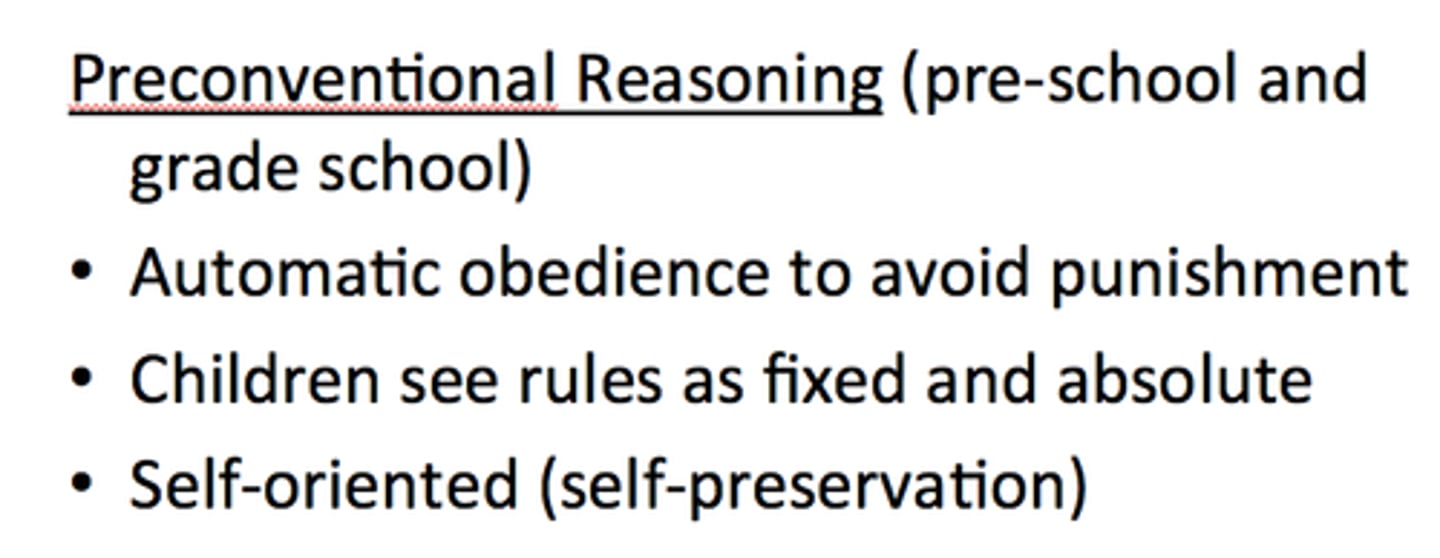
Preconventional Morality
Behaviors are based on perceived individual consequences. ages 5-10+
Stage 1:
Punishment and Obedience Orientation
A child’s incentive to obey is to not be punished.
Explanation/Example
Did my mom say this is ok? What will happen if I take this cookie?
Stage 2:
Instrumental Purpose Orientation
behavior based on receiving rewards or satisfying personal needs
Explanation/Example
Is this self-serving? Can I do this without an adult knowing?
[Kohlberg's levels of mortality]
Level 2:
Conventional Morality
Behaviors determined by the rules of adults, peers, and government ages 10-15+
Stage 3:
Good Boy/Nice Girl Orientation
behavior based on social approval
Explanation/Example:
Am I following the school rules? Will my peers and teachers be happy with my actions?
Stage 4:
Law and Order Orientation
behavior based on laws and social rules.
Explanation/Example:
Individual begins to look beyond their own ties to the abstract, “greater good.” They are more aware of laws, and social norms of society
[Kohlberg's levels of mortality]
Level 3:
Postconventional or Principled Morality
Behaviors based on abstract principles and values. Age 15+
Stage 5:
Social Contract Orientation
When the individual feels they’re in a conflict between personal rights and the law, exceptions are made.
Explanation/Example
Laws are not always clear-cut. For example, my father had a heart attack and I need to rush him to the emergency room so I will break the speed limit.
Stage 6:
Universal Ethical Principal Orientation
Behaviors based on abstract ethical principles which take in multiple differing perspectives simultaneously.
Explanation/Example:
Person acts to defend principals of equality, justice, equity. Personal conduct, intentions, character all play a role in decision making. Not everyone reaches this highest level.
Self-Efficacy
Self-efficacy reflects confidence in the ability to exert control over one's own motivation, behavior, and social environment. An example of students using self-efficacy would be working out a conflict on the playground without yelling or resorting to violence.
Self-Concept
Self-concept can be defined how children view their abilities. A child's self-concept begins to develop at birth. It also begins with how people interact with the child. As children grow, their ability to interact successfully with their environment nurtures a healthy self-concept. Teachers must nurture students' self-concept by modeling confidence and helping students navigate success and failure. Positive feedback when a student does something desirable helps to build self-concept.
Self-Awareness
Self-awareness is the ability to see yourself clearly and objectively through reflection and introspection. Teachers of young children can help students become self-aware by talking through their feelings and helping them to self-reflect on their actions.
Self-Regulation
Self-regulation is the ability to monitor your own thoughts, emotions, and actions. Developmentally, school -aged children have not mastered self-regulation but are refining this skill on varying growth curves. Many students need scaffolded support to build self-regulation competencies in various learning settings. An example of this would be sitting quietly for story time even though the student wants to get up and play.