Chapter 2: Cellular Level of Organization
 Call Kai
 Learn
Learn Practice Test
 Spaced Repetition
 Match
Match Flashcards
 Knowt Play
1/46

Earn XP
Description and Tags
Anatomy
Name | Mastery | Learn | Test | Matching | Spaced | Call with Kai | Chat |
|---|
No analytics yet
Send a link to your students to track their progress
47 Terms
What are the two categories of similarities between me and amoeba?
Structural and functional
What are the structural similarities between me and amoeba?
made of cells, many organelles, plasma membrane
what are the functional similarities between me and amoeba?
cellular boundaries, get/use energy and matter, get rid of waste and toxins
What are the three points of cell theory?
all living things are made of cells, cells are the smallest unit of life, all cells come from other cells
What structures maintain cellular boundaries?
Plasma membrane
What structures get energy and matter (eat)?
Plasma membrane and mitochondria
What structures use energy and matter?
mitochondria, free ribosomes, rough ER, and golgi apparatus
which structures get rid of wastes and toxins?
lysosomes and plasma membrane
what property should the molecules that make up your body’s cell membranes have to maintain cellular boundaries?
hydrophobic and hydrophilic properties
What two parts make up a phospholipid?
hydrophilic head, hydrophobic tail
What does hydrophilic mean?
attracted to water
what does hydrophobic mean?
repelled by water
What’s a phospholipid bilayer?
makes up most of the plasma membrane (boundary of the cell)
can a water molecule pass through the phospholipid bilayer?
Yes via diffusion
What are the 4 ways molecules move in and out of the cell?
passive transport, active transport, endocytosis, exocytosis
What is passive transport?
Molecules move across the cell membrane from high to low concentration without using energy
What are the 4 main types of passive transport?
simple and facilitated diffusion, osmosis, filtration
How does simple diffusion work?
molecules like CO2 and O2 pass through the plasma membrane
How does facilitated diffusion work?
larger molecules like glucose move through the plasma membrane using protein channels
How does osmosis work?
Water molecules cross the plasma membrane from more to less water concentration
How does filtration work?
pressure pushes water and small molecules through the plasma membrane from high to low pressure
How does active transport work?
molecules move from low to high concentration using atp and proteins to cross the plasma membrane
How does endocytosis work?
the cell moves through the plasma membrane by creating a vesicle
How does exocytosis work?
a cell moves out of the cell membrane using a vesicle
What does the golgi apparatus do?
modifies proteins and lipids, sorts them, packages them into vesicles, and ships them
What does lysosomes do?
destroys damaged cell parts, breaks down and gets ride of bacteria/waste and recycles useful materials
how does the highly folded inner membrane help with mitochondria function?
increases surface area creating more atp
How does the nucleus and ribosomes create new molecules?
Nucleus has DNA (instructions to make proteins) and ribosomes reads the DNA and joins amino acids together to make new molecules
What do Amino acids and ATP provide to the process of creating new molecules?
matter and energy
What’s one big difference between us and amoebas?
we are multicellular and amoebas are unicellular
What are the three types of cell junctions?
tight, anchoring, communicating (gap) junctions
What does a tight junction do?
seal cells and prevents leaks
What do anchoring junctions do?
hold cells together
What does gap/communicating junctions do?
allows cells communicate
What are the 4 stages of a cell life cycle?
G1 growth, S DNA synthesis, G2 growth and preparation for mitosis, M mitosi
What acronym can be used to help remember mitosis?
PPMAT
What does PPMAT stand for?
Prophase, prometaphase, metaphase, anaphase, telophase
What comes before prophase and what happens in that stage?
G2 interphase: cell grows and prepares for mitosis
What comes after telophase?
Cytokinesis

What phase is this?
G2 interphase

What phase is this?
Prophase
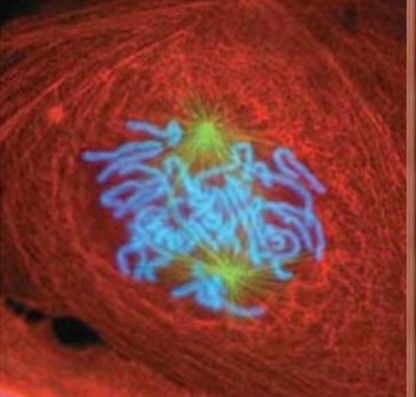
what phase is this
prometaphase
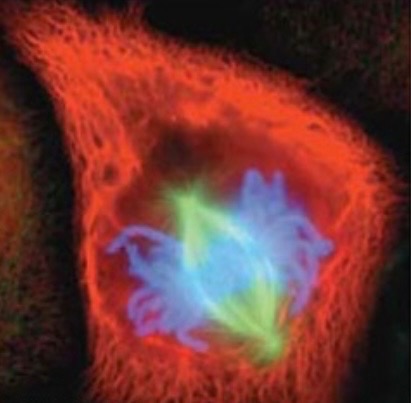
what phase is this?
metaphase

what phase is this?
anaphase
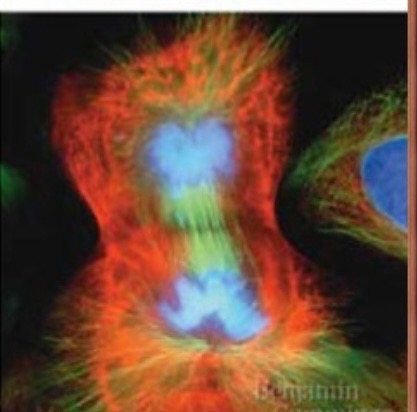
what phase is this?
telophase
What is mitosis?
Mitosis is when duplicated chromosomes divide so that the 2 daughter cells receive the same genetic material
How does cancer relate to cell division?
Cancer happens when cells divide uncontrollably