2. Glucose & Diabetes Testing
 Call Kai
 Learn
Learn Practice Test
 Spaced Repetition
 Match
Match Flashcards
 Knowt Play
1/40

There's no tags or description
Looks like no tags are added yet.
Name | Mastery | Learn | Test | Matching | Spaced | Call with Kai | Chat |
|---|
No analytics yet
Send a link to your students to track their progress
41 Terms
What are the 2 forms of carbohydrates?
Aldose: Contain aldehyde group (terminal carbonyl)
Ketose: Contain ketone group (internal carbonyl)

What are the 3 monosaccharides, 3 oligosaccharides, and 4 polysaccharides? Which is the most abundant carbohydrate in nature?
mono: glucose, fructose, galactose
oligo: maltose, lactose, sucrose
poly: starch, glycogen, cellulose, inulin
D-glucose
What makes monosaccharides and maltose/lactose reducing sugars? What’s an example of a compound they donate electrons to?
They contain a free aldehyde/ketone group that can easily reduce oxidizing agents like H2O2
Copper (II) ions in Benedict’s solution
What monosaccharides make up the 3 primary disaccharides?
maltose: glucose + glucose
lactose: glucose + galactose
sucrose: glucose + fructose
What is the only monosaccharide used by the body for energy? What and where are the other two monosaccharides converted?
glucose
galactose & fructose converted into glucose by liver enzymes
What are the definitions of glycogenesis, glycogenolysis, gluconeogenesis?
glycogenesis: glucose converts to glycogen & stored in liver
glycogenolysis: glycogen broken down into glucose
gluconeogenesis: formation of glucose from non-carbohydrate sources (a.a., lactate, or lipids)
Which hormone is responsible for decreasing blood glucose level? Increasing blood glucose level?
decreasing: insulin
increasing: glucagon, epinephrine, cortisol, thyroxine
What is the purpose of somatostatin?
It is the universal inhibitor hormone that stops or slows down the release of hormones coming from the β or α pancreatic cell (insulin & glucagon)

What is the structure of insulin?
A chain and B chain peptide held together by disulfide bridges
Has a C-peptide that is an inactive by-product (supposedly)

How is insulin activated before being secreted into the bloodstream?
Pro-insulin is cleaved by a protease → activation of insulin + a C-peptide
What is the mechanism of insulin that allows glucose into the liver, muscle, & adipose tissue?
It increases the membrane permeability by binding to receptors of the liver, muscle, and adipose tissues and opens the cell channels
Create & memorize the table for metabolic action of insulin on slide 16
bet
What is the blood glucose concentration for someone that’s hypoglycemic? Why are infants more capable of handling short-term hypoglycemia than adults?
<70 mg/dL
Because they have higher capacity for ketone production & fat metabolism = alternative energy
At what blood glucose concentration is it considered symptomatic hypoglycemia for infants or newborns?
<40 mg/dL
What are the 5 potential causes of hypoglycemia?
insulinoma (pancreatic cell islet tumor)
glycogen-storage depleted
rigorous exercise
fasting
liver disease
What is the renal threshold for glucose? What happens when that threshold is exceeded?
200 mg/dL
Glucose appears in the urine if threshold is exceeded (glucosuria)
What is the MOST important insulin-dependent tissue?
muscle
What is the etiology of Type 1 Diabetes?
Autoimmune destruction of β cells of the pancreas → lack of insulin production & secretion
What are the 3 P’s associated with Type 1 Diabetes?
Polyuria (increased urination), Polydipsia (increased thirst), Polyphagia (increased hunger)
What are some of the symptoms & tendencies besides the 3 P’s observed in Type 1 Diabetic patients? (6)
fatigue, familial tendencies (genetics), increased frequency of infections, insulin dependent, rapid onset, weight loss
What is the life threatening complication associated with Type 1 Diabetes? What does the body do to try & compensate for it?
Diabetic Ketoacidosis (DKA)
Overproduction of keto-acids lowers blood pH → uses up all bicarbonate → metabolic acidosis
rapid breathing to increase excretion of CO2 and H+
What are the 3 potential symptoms caused by DKA?
Coma, ketosis, osmotic diuresis (increased urination caused by excess unabsorbed glucose which osmotically pulls water out of kidneys → renal tubes)
What is the etiology of Typer 2 diabetes?
act of insulin resistance → decline in insulin action
What are the 6 associative factors for Type 2 diabetes?
inability to produce enough insulin
abdominal obesity
lack of physical excercise
family history of diabetes
previous diagnosis of gestational diabetes
high blood pressure
What is the life threatening complication associated with Type 2 Diabetes? What does it result from?
Hyperosmolar coma
Results from hyperglycemia → urinary loss of water, glucose & electrolytes WITHOUT sufficient fluid replacement
What is the definition of gestational diabetes? What are the 3 effects of it?
Diabetes diagnosed during pregnancy
1) increased tissue cell resistance to insulin 2) inability to compensate with increase insulin secretion 3) can increase risk of developing type 2 diabetes
What are the 4 complications that can arise from gestational diabetes?
Large baby, severely hypoglycemic baby at birth, congenital malformations, perinatal mortality
What are the diagnostic criteria for gestational diabetes for the FPG, 1 hr glucose, and 2 hr glucose?
FPG: ≥92 mg/dL
1 hour glucose: ≥180 mg/dL
2 hour glucose: ≥153 mg/dL
What are the 3 types of ketones and their percentage of prevalence? Which one do we test?
Acetoacetate (20%), Beta-hydroxybutyrate (70-80%), Acetone (Least)
We test acetoacetate
What is the complication that happens as a direct result (sequelae) of inadequately treated diabetes? What is an example of that complication?
Glycosylation of proteins can occur (gradual attachment of glucose to proteins)
Hgb A1c
What are the 3 forms of glycosylated hemoglobin? Which one is the major form?
Hgb A1A, Hgb A1B, Hgb A1C
Hgb A1C is the the major form (80%)
Which terminal does glucose bind to the hemoglobin? Does it interfere with hemoglobin functions?
N-terminal amino acid of both beta chains
No
What are the 4 complications that can arise from glycosylation due to inadequately treated diabetes?
renal failure
atherosclerosis → stroke
blindness
vascular disease → peripheral neuropathy & ulcers → amputations
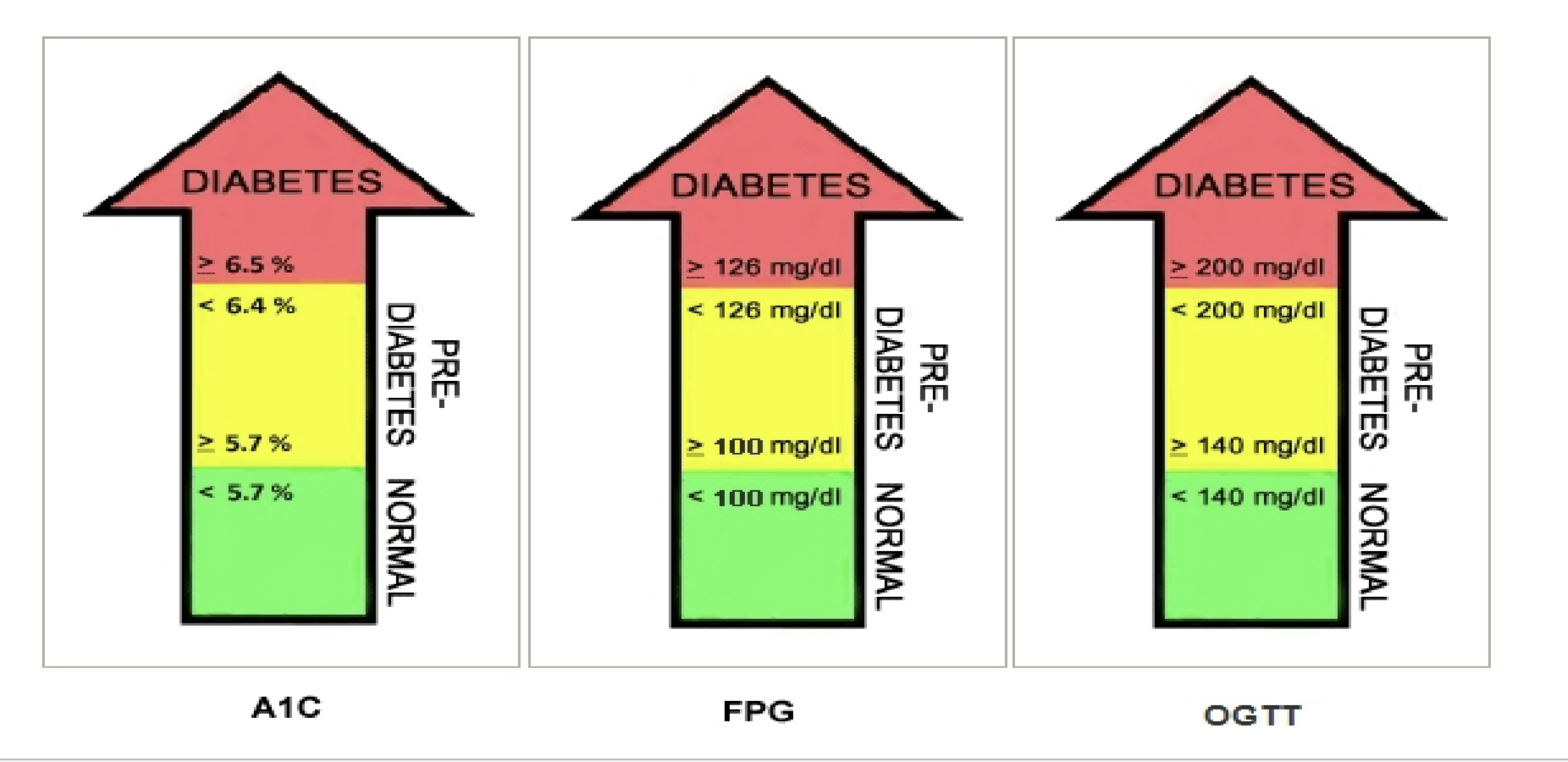
What are the criteria/thresholds for diagnosing diabetes from 1) casual plasma glucose (CPG) 2) Fasting Plasma Glucose (FPG) 3) Oral Glucose Tolerance Test (OGTT) 4) Hemoglobin A1c
CPG: ≥200 mg/dL + symptoms of diabetes
FPG: ≥126 mg/dL on 2 or more occasions
OGTT: ≥200 mg/dL + confirmation by FPG or CPG
Hemoglobin A1c: ≥6.5%
What are the steps of performing an oral glucose tolerance test (OGTT)?
A FPG sample is done first. If FPG<126 mg/dL, continue with OGTT. If ≥126 mg/dL, OGTT is discontinued.
Patient must drink the glucola (75 g glucose solution) within 5 minutes
A 2 hour post load sample is drawn & glucose [ ] measured
If ≥200 mg/dL & confirmed by FPG or CPG, patient diagnosed w/ diabetes
![<ol><li><p>A FPG sample is done first. If FPG<126 mg/dL, continue with OGTT. If ≥126 mg/dL, OGTT is discontinued.</p></li><li><p>Patient must drink the glucola (75 g glucose solution) within 5 minutes</p></li><li><p>A 2 hour post load sample is drawn & glucose [ ] measured</p></li><li><p>If ≥200 mg/dL & confirmed by FPG or CPG, patient diagnosed w/ diabetes</p></li></ol><p></p>](https://assets.knowt.com/user-attachments/e8c07735-16ea-4b46-ad8b-231379fb7aeb.png)
What is fructosamine? Over what time frame does it indicate the effect of blood sugar levels?
glucose that’s bonded to plasma albumin
2-3 weeks W
What is microalbuminuria? How does chronic hyperglycemia lead to microalbuminuria? How can detecting microalbuminuria be useful?
increase of albumin levels in urine
chronic hyperglycemia → damage to renal glomeruli membrane → increased plasma albumin filtered into urine
Useful as early indicator of diabetes causing renal disease
What are the 2 ways serum and urine ketones can be assayed?
acetoacetic acid + nitroprusside
acetoacetic acid enzymatic reaction
What is the concentration of whole blood glucose to plasma/serum glucose? CSF glucose to blood glucose?
whole blood is 15-20% less than plasma/serum
CSF is 60% of blood glucose (because the brain constantly constantly consumes glucose)
What is the general rule of thumb when it comes to diagnosing diabetes in regards to same or different day?
If performing the same test, repeat the test on a different day
If performing 2 different tests, they can be done on the same day