Unit 3
 Call Kai
 Learn
Learn Practice Test
 Spaced Repetition
 Match
Match Flashcards
 Knowt Play
1/389

There's no tags or description
Looks like no tags are added yet.
Name | Mastery | Learn | Test | Matching | Spaced | Call with Kai | Chat |
|---|
No analytics yet
Send a link to your students to track their progress
390 Terms
All of the chemical reactions in an organims:
Metabolism
Series of chemical reactions that either build complex molecules or break down complex molecules:
Metabolic pathways
What does metabolic pathways start with and end with?
Substrate → intermediate → product
What turns substrate into intermediate and intermediate into product?
Enzymes
Types of metabolic pathways:
Catabolic and anabolic
Pathways that release energy by breaking down complex molecules into simpler compounds:
Catabolic pathways
Pathways that consume energy to build complicated molecules from simpler compounds:
Anabolic pathways
The ability to do work:
Energy
What do organisms need energy to do?
Survive and function
What does a loss in energy flow result in?
Death
Energy associated with motion:
Kinetic energy
Energy associated with the movement of atoms or molecules:
Thermal energy
Stored energy:
Potential energy
Potential energy available for release in a chemical reaction:
Chemical energy
Example of chemical energy:
ATP
The study of energy transformations in matter:
Thermodynamics
What do thermodynamics laws apply to?
Whole universe
1st law of thermodynamics:
Energy cannot be created or destroyed, but can be transferred or transformed
What energy is transformed into what energy when nut gives energy for squirrel to climb tree?
Chemical (potential) energy to kinetic energy
2nd law of thermodynamics:
Energy transformation increases the entropy of the universe
Entropy:
Disorder
During energy transfers or transformations, is all energy usable?
No
During energy transfers or transformations, what happens to unusable energy?
Lost as heat
Example of 2nd law of thermodynamics:
As squirrel climbs tree, some energy released as heat
What does free energy determine?
Likelihood of reactions in organisms or if reactions are energetically favorable
What does the free energy change of reactions determine?
Whether or not reaction occurs spontaneously
What do spontaneous reactions not require?
Outside input energy
Based on free energy changes, what can chemical reactions be classified as?
Exergonic and endergonic
Reactions that release energy:
Exergonic reactions
Example of exergonic reaction:
Cellular respiration
Reactions that absorb energy:
Endergonic reactions
Example of endergonic reaction:
Photosynthesis
Diagram of exergonic reaction:

Diagram of endergonic reaction:

Are exergonic reactions spontaneous?
Yes
Are endergonic reactions spontaneous?
No
Why are endergonic reactions not spontaneous?
Absorb free energy
What do living cells have a constant flow of?
Materials in and out of membrane
Are cells at equilibrium?
No
What kinds of work do cells perform?
Mechanical, transport, chemical
Mechanical work:
Movement
Examples of mechanical work that cells perform:
Beating cilia, movement of chromosomes, contraction of muscles cells
What transport work do cells perform?
Pumping substances across membranes against spontaneous movement
What chemical work do cells perform?
Synthesizing molecules
Example of synthesizing molecules in cells:
Building polymers from monomers
Molecule that organisms use as a source of energy to perform work:
ATP
What does ATP stand for?
Adenosine triphosphate
What does ATP couple to power cellular work?
Exergonic reactions and endergonic reactions
When ATP powers cellular work, what drives the endergonic process?
Exergonic process
How do organisms obtain energy from ATP?
By breaking bond between 2nd and 3rd phosphate
What reaction breaks bond between 2nd and 3rd phosphate of ATP?
Hydrolysis reaction
What does hydrolysis reaction turn ATP into?
ADP
The released phosphate from ATP moves to another molecule to give energy:
Phosphorylation
Diagram of ATP:

What can ADP be regenerated to?
ATP
What can ADP be regenerated to ATP via?
ATP cycle
What is required to turn ADP into ATP?
Energy from another exergonic process
Do laws of thermodynamics describe rate of reaction?
No
Do some spontaneous reactions move quickly or slowly?
Slowly
What do spontaneous reactions moving slowly mean for cells utilizing them?
Cannot utilize them efficiently
How long does the hydrolysis of sucrose to glucose take to happen spontaneously?
1000 years
Macromolecules that catalyze reactions by lowering the activation energy:
Enzymes
What does catalyze mean?
Speed up
Are enzymes consumed by reaction?
No
What are enzymes a type of?
Protein
What do enzyme names end in?
-ase
What does enzyme act on?
Substrate
Areas for substrates to bind to on enzymes:
Active site
Process of enzymes catalyzing reactions:
Substrates held in active site, converted to products, released
What are substrates held in active site by?
Weak interactions
What do enzymes hold substrates to form?
Enzyme-substrate complex
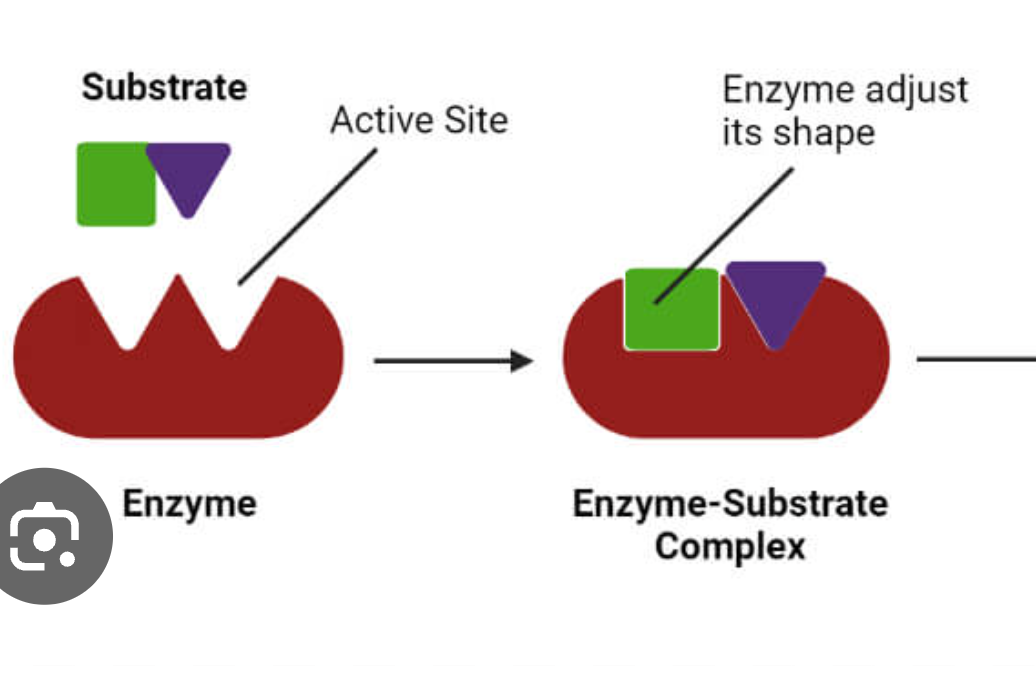
How do enzymes allow substrate to bind better?
By changing shape of their active site
Enzymes changing shape of their active site to allow substrate to bind better:
Induced fit
Diagram of induced fit:
What does enzyme catabolism mean?
Enzymes help to break down complex molecules
What does enzyme anabolism mean?
Enzymes help to build complex molecules
What can the 3D shape of enzymes be affected by?
Temperature, pH, chemicals
What does changing the shape of enzymes affect?
Efficiency of enzymes
What does a change in shape mean?
Change in function
The conditions (temp and pH) that allow enzymes to function optimally:
Optimal conditions
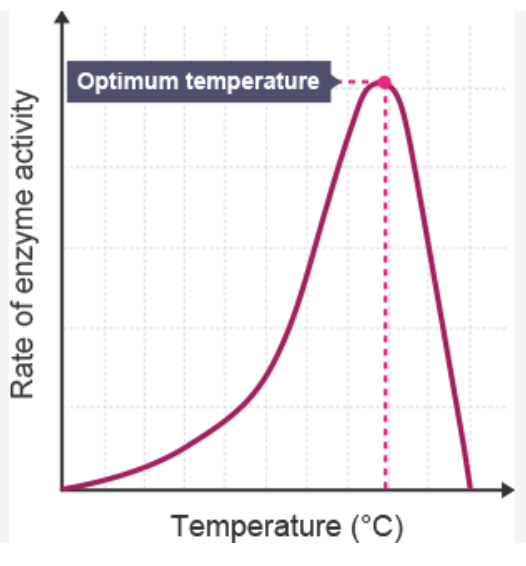
How does the rate of enzyme activity change with temperature?
Increases up to a certain point
Why does rate of enzyme activity increase with temperature?
Due to collisions
Enzymes function best at a ______ pH
Specific
What happens when enzyme is outside normal pH range?
Hydrogen bonds in enzyme break
What happens when hydrogen bonds in enzyme break?
Shape of enzyme changes
Graph of enzyme activity rate vs pH:

Graph of enzyme activity rate vs temperature:
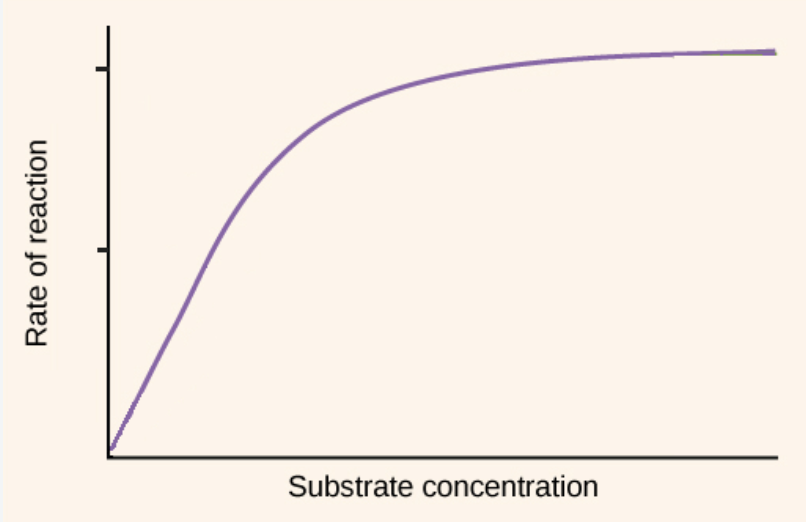
Graph of enzyme activity rate vs substrate concentration:
Non-protein molecules that assist enzyme function:
Cofactors
What do inorganic cofactors consist of?
Metals
How can enzyme cofactors be bound?
Loosely or tightly
An enzyme with the cofactor attached:
Holoenzyme
Organic cofactors:
Coenzymes
Example of coenzyme:
Vitamins
Diagram of holoenzymes:

What do enzyme inhibitors do?
Reduce activity of specific enzymes
Are inhibition from enzyme inhibitors permanent or reversible?
Can be either permanent or reversible
What does enzyme inhibitor bind with to produce permanent inhibition?
Covalent bonds
What does enzyme inhibitor bind with to produce reversible inhibition?
Weak interactions
Example of permanent inhibition:
Toxins and poisons