chapter 3
 Call Kai
 Learn
Learn Practice Test
 Spaced Repetition
 Match
Match Flashcards
 Knowt Play
1/159

There's no tags or description
Looks like no tags are added yet.
Name | Mastery | Learn | Test | Matching | Spaced | Call with Kai | Chat |
|---|
No analytics yet
Send a link to your students to track their progress
160 Terms
All living organisms require energy to
power muscle
pump blood
absorbs nutrients
exchange respiratory gases
synthesise new molecules
establish cellular ion concentrations
Energy
capcity to do work
ex. potential & kinetic
both can be converted from 1 class to the other
no mass and does not take up space
Potential energy
energy of position or stored energy
must be converted to the latter beforehand to do work
forms
chemical energy
ex
glycogen
water at top of a dam
chemical bonds
concentration gradients
Na^+ ions (outside cell) in high concentration have _
electrons in high-energy shells have ___
Kinetic energy
energy of motion
can be harnessed to do work
forms
electrical energy
mechanical energy
sound energy
radiant energy
heat
ex
glucose
falling water
Na^+ ions moving to area of low concentration (inside cell) have __
electrons passing from high-energy shells to low energy state
Concentration gradient
exists across plasma membrane
boundary between inside & outside of cell
Chemical energy
one form of potential energy
energy stored in a molecule’s chemical bonds, released when bonds are broken
used for
movement, molecule synthesis, establishing concentration gradients
ex of molecules that function in __ ___ storage
triglycerides
glucose
ATP
ex. plants convert solar energy to __
Triglycerides
involved in long term energy storage in adipose connective tissue
Glucose
stored in liver & muscle tissue in the form of the polymer glycogen
ATP
used as the energy currency for energy-requiring processes within the cell
stored in all cells in limited amounts
cell cannot stockpile __ so typically only a few secs worth of __ is present
is produced continuously & used immediately for cells energy requiring proceses
formed from glucose oxidation/cellular respiration
the energy RELEASED from glucose is used to make __ (not broken down)
Electrical energy
movement of charged particles
ex. movement of ions across the plasma membrane of a neuron
Mechanical energy
exhibited by objects in motion due to applied force
ex. muscle contractions for walking
ex. pumping action of heart to circulate blood
Sound energy
molecule compression caused by vibrating object
ex. the sense of __ is initiated when __ waves cause vibration of the eardrum (tympanic membrane) in the ear
Radiant energy
energy of electromagnetic waves
ex. visible light striking the retina
Heat
kinetic energy from movement of atoms, ions, molecules
usually not available to do work / unusable form of energy / waste product
accompanies all changes in energy
measured as the temperature of a substance
Electromagnetic spectrum
the full range of all types of electromagnetic radiation, organized by frequency or wavelength
divided into seven main regions, ordered from lowest energy (longest wavelength and lowest frequency) to highest energy (shortest wavelength and highest frequency)
highest frequency
gamma rays > x-rays > UV light > visible light > infared light > radio waves

what part of the electromagnetic spectrum can humans see
visible light
What has high electromagnetic energy
gamma rays
x rays
UV light
(range capable of entering the body & damaging DNA, causing mutations)
Electromagnetic waves
travel at the speed of light in a vacuum / empty space
Thermodynamics
study of energy transformations
1st Law of thermodynamics
energy can neither be created nor destroyed, it can only change in form (transformed)
2nd law of thermodynamics
when energy is transformed, some energy is lost to heat
the amount of usable energy decreased
ex. moving around to warm up on a cold day
as chemical energy converts to mechanical energy, heat is produced
Metabolism
all biochemical reactions in living organisms
Chemical reactions
occur when chemical bonds in existing molecular structures are broken
new bonds formed
expressed as chemical equation
reactants
products
arrow indicates direction of change
classified based on 3 criteria
changes in chemical structure
changes in chemical energy
whether the reaction is irreversible or reversible
classified based on changes in chemical structure
decomposition reactions
synthesis reactions
exchange reactions
Reactants
substances present prior to start of a chemical reaction
the substrates
written on left side of equation
A + B → C
__ would be A & B
arrow indicates reaction direction
in a balanced equation, # of elements are = on both sides of the reaction
Products
substances formed by the reaction
written on right side of equation
A + B → C
__ would be C
arrow indicates reaction direction
in a balanced equation, # of elements are = on both sides of the reaction
Decomposition reaction (Classification of Chemical Reactions)
initial large molecule broken down to smaller structures
AB → A + B
ex
hydrolysis reaction of sucrose into glucose & fructose
all __ in the body are referred to as catabolism or catabolic reactions
release energy

Synthesis reaction (Classification of Chemical Reactions)
2 or more structures (atoms, ions, molecules) combined to form a larger structure
A + B → AB
ex
dehydration synthesis reaction forming a dipeptide
all __ in the body are referred to anabolism or anabolic reactions
require energy input

Exchange reaction (Classification of Chemical Reactions)
groups (atoms, molecules, ions, electrons) exchanged between 2 chemical structures
has both decomposition & synthesis components
most prevalent in human body
AB + C → A + BC
ex.
production of ATP in muscle tissue
creatine phosphate + ADP → creatine + ATP

Oxidation-reduction (redox) reaction
exchange reaction where electrons moved from one chemical structue to another
OIL RIG
structure that loses an electron = oxidized during oxidation (+)
structure that gains an electron = reduced during reduction (-)
reactions always occur together
electrons may be moved alone or w a hydrogen ion
ex. Nicotinamide adenine dinucleotide
(NAD^+): oxidized
(NADH): reduced
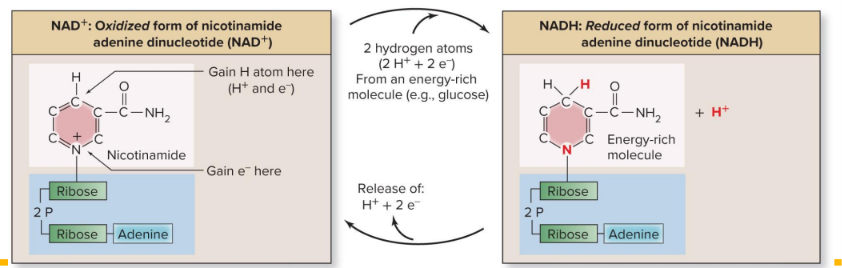
Nicotinamide Adenine Dinucleotide
energy rich molecule (glucose) is oxidized
gives up 2 hydrogen atoms
NAD^+ reduced to NADH
gains both a hydrogen ion & 2 electrons
energy movement of electrons can be used to do work
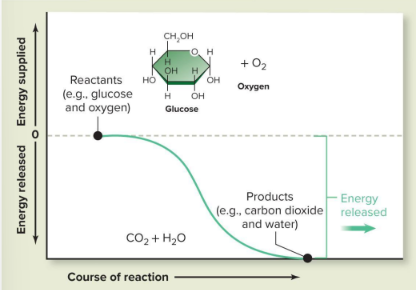
Exergonic reactions
reactants with more energy within their chemical bonds/reactants than products
energy released with net decrease in potential energy
ex
decomposition reactions
glucose + o2→ co2 + water
ATP splitting
Endergonic reactions
reactants with less energy within their chemical bonds than products
energy required/ supplied with a net increase in potential energy
ex
synthesis reactions
amino acids → dipeptide
ATP formation


ATP cycling
continous formation & breakdown of ATP
ATP formed when energy is released in exergonic reactions
fuel molecules from food are oxidized
energy in their bonds transferred to ADP + free phosephate to form ATP
ATP oxidized to aid energonic reactions
energy released from ATP hydrolysis provides energy
only a few secs worth of ATP present at a time
formation of ATP occurs continously to provide energy
Irreversible reacion
net loss of reactants & a net gain in products
chemical reaction is moving forward, using up the starting materials to create new substances
proceed in only 1 direction (single arrow)
A + B → AB or AB → A + B
Reversible reaction
does not proceed only to the right (double arrow)
A + B ← → AB
no net change in concentration of either reactants or products / formation of products = formation of reactants = equilibrium
increase in reactants or decrease in products drives equation to the right
decrease in reactants or increase in products drives equations to the left
ex.
carbonic acid reaction
CO2 + H2O ← → H2CO3
newly formed carbonic acid is unstable & dissociates to form bicarbonate (HCO3^-) & a hydrogen ion (H^+)
CO2 + H2O ← → H2CO3 ← → H^+ + HCO3^-
occurs in blood transport of CO2 & maintaining acid-base balance
Driving equation to the right
Increase Reactants: Adding more starting materials forces the reaction to move forward and use up the extra reactants to make more products.
Decrease Products: Taking away the finished results forces the reaction to make more to replace what was lost.
What it means: The reaction accelerates in the forward direction to produce more substances on the __ side of the arrows.
The result: You consume more reactants and create more products
Driving equation to the left
decrease in reactants or increase in products
Decrease in reactants: The system shifts left to make more reactants and replace what was lost.
Increase in products: The system shifts left to use up the extra products that were added & make more reactants
What it means: The reaction accelerates in the backward direction to produce more substances on the __side of the arrows.
The result: You break down products to recreate the original reactants.
Reaction rate
measure of how quickly a chemical reaction takes place
determines the amount of product formed per unit of time
dependent upon the concentrations of both the enzyme, substrate, temp, & pH
Activation energy (Ea)
energy required to break existing chemical bonds (for the chemical reaction to proceed)
a primary factor determining reaction rate
overcoming the __ __
in lab, increasing temp provides energy to break bonds
significant temp increase in a cell would denature proteins
protein catalysts called enzymes are used instead
ex.

Explain the effect a fever would have on chemical reaction rates within the body. What is the risk to protein structure with a high fever?
initially speeds up chemical reaction rates in the body by increasing the kinetic energy and collision frequency of molecules. Cellular metabolism and immune responses temporarily become more active to help fight off infection
denature: the excessive heat disrupts the weak chemical bonds (like hydrogen bonds) holding proteins together. Essential biochemical reactions slow down or stop entirely, which can lead to cellular damage and organ failure
catalyst
a substance that speeds up a chemical reaction without being changed or used up itself

Enzymes
protein molecules / biologically active organic catalysts that accelerate chemical reactions
increase reaction rates by decreasing activation energy (Ea) of cellular reactions
uncatalyzed: no enzyme present
catalyzed: enzyme present
only facilitate reaction that would alr occur
increase rate of product formation
most __ are globular proteins
multiple __ usually required to convet initial substrate to final product
6 major funcitonal classes:
Transferases
Hydrolases
Oxidoreductases
Isomerases
Ligases
Lyases
Globular proteins
spherical, water-soluble protein that performs active metabolic, transport, and regulatory functions in the body
range in size from small (60 amino acids) to large (2500 amino acids)
unique 3-dimensional structure in protein chain called active site
temporarily forms enzyme substrate complex

Active sites specfifity
permits only a single substrate to bind
helps catalyze only one specific reaction
Location of enzymes
some remain within cells
ex. DNA polymerase, helps form new DNA
some become embedded in plasma membrane
ex. lactase in walls of small intestine cells helps digest lactose
some are secreted from the cell
ex. pancreatic amylase released from pancreas to participate in starch digestion
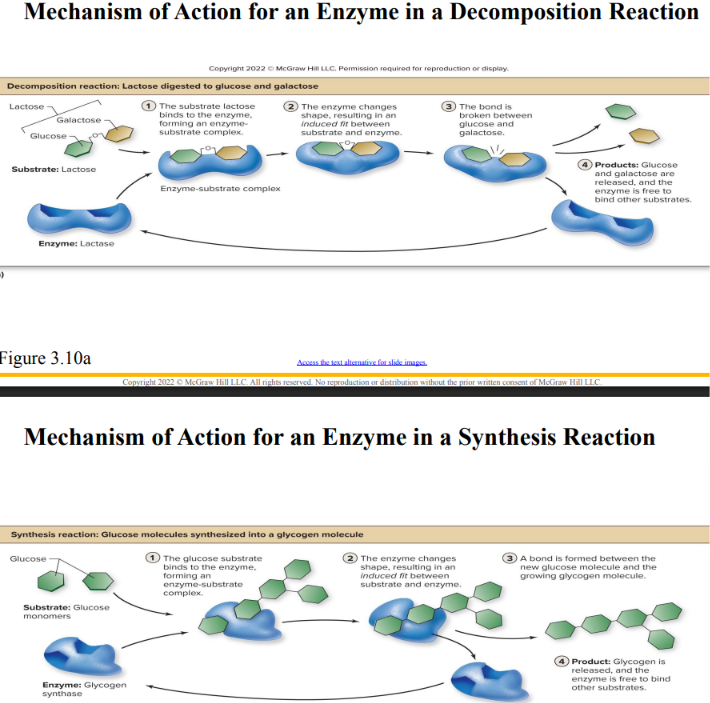
Mechanism of Enzyme Action
substrate enters active site, forming enzyme-substrate complex
enzyme changes shape slightly, resulting in even closer fit (induced fit model)
change in enzyme shape stresses chemical bonds, permitting new bonds to be formed
products are released. enzyme may repeat process
Cofactors
molecules or “helper” ions required to ensure that a reaction occurs
nonprotein structure thats either organic or inorganic substance
inorganic cofactors
ex. zinc ion required for carbonic anhydrase to function
organic cofactors (carbon-based) called coenzymes
ex. vitamins or modified nucleotides serving as coenzymes
inorganic cofactors
attached to the enzyme
required for normal function
ex. zinc ion required for carbonic anhydrase to function
organic cofactors / coenzymes
carbon based
not attached to enzymes, still assist them
ex. vitamins, nucleotides like NAD
cofactors vs coenzymes
cofactor: any non-protein helper molecule that an enzyme needs to function
coenzyme: specific type of organic cofactor
All coenzymes are cofactors, but not all cofactors are coenzymes
Oxidoreductases (enzyme class)
redox reactions
dehydrogenases involved in electron transfer
ex.
dehydrogenases uses NAD^+ or a molecule other than oxygen as electron acceptor
peroxidase uses hydrogen peroxide (H2O2) as electron acceptor
Dehydrogenase
involved in electron transfer
participate in redox reactions by moving hydrogen from 1 molecule to a diff molecule
subcategory of enzymes within the oxidoreductase class
Transferases (enzyme class)
transfer atoms or molecules between chemical structures
kinases transfer phosphate groups
ex.
phosphorylase transfers a phosphate (PO4³-) to a diff substance
kinase transfers a phosphate (PO4³-) usually from ATP to a diff substance
Kinases
transfer phosphate groups (usually from ATP to another molecule)
specific subgroup of transferases
Hydrolase (enzyme class)
split chemical bonds using water
ex.
phosphate removes phosphate
protease digests proteins
lipase splits lipids (triglyceride)
sucrase splits sucros
Isomerases (enzyme class)
covert one isomer to another
ex
mutase transfers atoms within a molecule
Ligases (enzyme class)
bond 2 molecules together
ex
synthetase bonds 2 molecules using ATP
Lyases (enzyme class)
split bonds without using water
ex
decarboxylase cleaves a molecule to release co2
synthase catalyzes a synthesis process
Naming of enzymes
based on
name of substrate or product or type of chemical reaction
subclass
suffix: -ase
ex.
pyruvate dehydrogenase transfers hydrogen from pyruvate
DNA polymerase helps form DNA
lactase digests lactose
Rate of a chemical reaction may be accelerated by
increase in enzyme concentration
increase in substrate concentration
increases only up to the point of saturation (so much substrate is present that all enzyme moloecules are engaged in reaction)

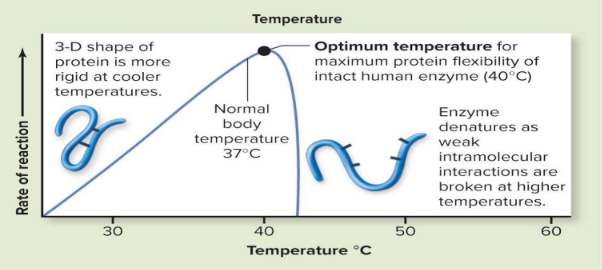
Effect of temp on enzymes
3-dimensional shape of enzymes dependent on temp
human enzymes function best at optimal temp (usually 40C, 104F)
moderate fever
results in more efficient enzyme activity
severse increase in temp
cause protein denaturation w loss of function
Enzymes & pH
enzymes function best at optimal pH
between pH of 6-8 for most enzymes
changes in H^+ disrupt electrostatic interactions
enzyme loss of shape, denaturation
optimal pH may diff
ex. enzymes working in the lower pH of the stomach

Inhibitors
bind enzymes & turn them off
prevents overproduction of product
later release of inhibitor allows enzyme to function again
inhibitors can be competitive or noncompetitive

Competitive inhibitor
resembles substrate & binds to active site of enzyme
compete for occupation of active site
with greater substrate
less likely competitive inhibitor will occupy site
with less substrate
more likely inhibitor will occupy site
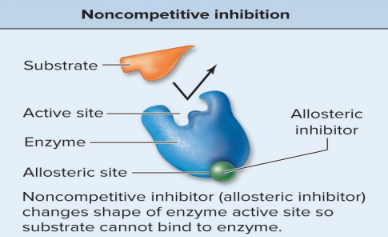
Noncompetitive inhibitor / allosteric inhibitors
do not resemble substrate
bind a site other than active site (allosteric site)
induce conformational change to enzyme & active site
makes it so that substrate cannot bind to enzyme
not influenced by concentration of substrate
Metabolic pathways
connected chains of chemical reactions inside a cell that change a starting molecule into a final product
using a series of enzymes
product of one enzyme becomes substrate of the next
regulated by negative feedback to maintain the needed amount of the final product
ex. chemical breakdown of glucose
forms ATP, the “energy currency” of cells

Multienzyme complex
group of attached enzymes
work in a sequence of reactions to convert substrate → final product
physically attached to each other through noncovalent bonds
ex. pyruvate dehydrogenase involved in breakdown of glucose
advantages
since the product of one reaction is passed directly to the next enzyme in the complex, its less likely substance will diffuse away into diff biochemical pathway
single complex can be regulated rather than individual enzymes
pathways regulated through negative feedback
product from metabolic pathway acts as an allosteric inhibitor
turns off enzyme early in pathway
as more product accumulates = the pathway is slowed or shut down = leading to less product formed
as less product accumulates = inhibition is lifted = more product formed
Phosphorylation
addition of phosphate group
performed by phosphorylases or kinases
turns on some enzymes, turns off others
Dephosphorylation
removal of phosphate group
performed by phosphatases
turns on some enzymes, turns off others
Drugs as enzyme inhibitors
drugs increase or decrease specific enzyme activity
ex
penicillin targets a bacterial enzyme, slowing spread of infection
sildenafil (viagra) inhibits phosphodiesterase type 5
treats erectile dysfunction by vasodilation of blood vessels of the weewee
Lactose intolerance
caused by a deficiency in lactase or abnormal lactase
lactase is required to break down lactose into glucose & galactose
common in older adults
symptoms: abdominal upset, nausea, diarrhea, bloating, gas
treatment: lactase enzymes, avoidance of milk, or drinking lactose-free milk
How do changes in substrate concentration, temperature, and pH affect the reaction rate of enzyme-catalyzed chemical reactions?
Substrate Concentration
Low concentration: The reaction rate is slow. Molecules bump into each other less often.
Increasing concentration: Adding more substrate makes molecules collide more often. This speeds up the reaction rate.
Saturation: When all enzyme active sites are full, the reaction rate stops rising. It reaches a maximum speed. More substrate cannot make it go faster because no free enzymes are left
Temperature
Low temperature: Molecules have low kinetic energy (movement energy). They move slowly, collide rarely, and have a low reaction rate.
Rising temperature: Warming up the mixture gives molecules more energy. They collide more often and react faster.
Optimum temperature: This is the best temperature where the reaction rate is highest (usually around 37°C for humans).
High temperature (Denaturation): Past the best temperature, too much heat breaks the bonds holding the enzyme together. The active site changes shape. The substrate no longer fits, and the reaction rate drops fast
pH (Acidity)
Optimum pH: Each enzyme works best at a specific pH level, called the optimum pH. For example, stomach enzymes like acidic conditions (low pH), while most other body enzymes prefer a neutral pH around 7. [1, 2]
Extreme pH (Denaturation): If the pH is too high or too low, it changes the electrical charges of the amino acids in the enzyme. This breaks the protein's internal bonds. The active site warps, the substrate cannot bind, and the reaction rate decreases. [1, 2, 3, 4]
The Role of Negative Feedback in Enzyme Regulation / Feedback inhibition
a self-regulating control system where the final product of a pathway slows down or turns off an enzyme involved earlier in that same pathway
Noncompetitive inhibitors fit this role because the end-product binds to a separate allosteric site on the enzyme rather than the active site.
occurs when a plentiful end product binds to an enzyme’s active site, which prohibits substrate binding & inactivates the metabolic pathway
What two processes involve phosphate and are commonly used to regulate enzymes in a metabolic pathway or a multienzyme complex?
Phosphorylation: Adds a phosphate group to an enzyme, typically using [ATP]. This step is catalyzed by enzymes called kinases. It can turn an enzyme's activity on or off
Dephosphorylation: Removes the phosphate group from the enzyme. This step is catalyzed by enzymes called phosphatases. It reverses the effect of the kinase, returning the enzyme to its original state
Cellular Respiration
exergonic multistep metabolic pathway
organic molecules oxidized & disassembled by a series of enzymes
potential energy in chemical bonds released (in glucose, fatty acids, amino acids)
energy used to synthesize ATP (which is an endergonic process)
oxygen required for maximum ATP production
involves at least 20 diff enzymes (located cytosol & mitochondria)
Glucose oxidation
step-by-step breakdown of glucose with energy release for the synthesis of ATP
glucose: energy-rich molecule with many C—C, C—H, C—O bonds
products: co2 & water
net chemical reaction: C6H12O2 + 6O2 → 6CO2 + 6H2O
(+ 30 net ATP (38 total) released through energy of broken bonds)
so __ is broken down into carbon dioxide & water
cellular location
20 diff enzymes required
enzymes found in both
cytosol: semifluid cell contents of the cell
mitochondria: small cellular organelles
Pathways for ATP production
energy from broken bonds used to attach phosphate group to ADP
energy can be used directly
least common
substrate-level phosphorylation
energy can be used indirectly
most common
energy first released to coenzymes, then energy transferred to form ATP
oxidative phosphorylation
Glucose oxidation
occurs within cells through cellular respiration
step by step breakdown of glucose w energy release (to synthesize ATP)
CO2 & water formed
net chemical reaction: C6H12O2 + 6 O2 → 6 CO2 + 6 H2O
Substrate-level phosphorylation
ATP produced DIRECTLY
least common
a metabolic process that creates ATP (adenosine triphosphate) or GTP by directly transferring a phosphate group from a reactive intermediate molecule to ADP or GDP (from energy directly released from a substrate)
occurs during glycolysis & citric acid cycle
no membrane, channel, ETC, It does not use proton gradients or ATP synthase
works in aerobic (with oxygen) and anaerobic (without oxygen) conditions.

Cellular respiration/ Glucose Oxidation proceeds in 4 stages
Glycolysis
Pyruvate oxidation / intermediate stage
Krebs cycle (aka Citric Acid cycle)
Electron Transport Chain (ETC)
Good People Keep Empathy
What stages of glucose oxidation require oxygen
intermeditate stage
citric acid cycle
ETC

Glycolysis
metabolic process
“sugar splitting”
glucose (initial substrate) → 2 pyruvate molecules
occurs in cytosol
doesn’t require oxygen
10 enzymes in cytosol participate
regulated through negative feedback
ATP acts as an allosteric inhibitor to “turn off” PFK
conversion of fructose to fructose 1,6-diphosphate
conversion of glucose to glucose 6-phosphate
conversion of pyruvic acid to lactic acid (if lack of oxygen)
lactate produced
to regenerate NAD^+ so this stage can continue
Oxidized: the 6-carbon sugar glucose
Reduced: NAD^+ → NADH
Product: 2 pyruvate molecules
Net product: 2 ATP (2 invested, 4 formed) & 2 NADH (per glucose)

Glycolysis Steps
steps 1-5
glucose split into 2 molecules of G3P (glyceraldehye 3 phosphate)
2 ATP “invested” at steps 1 & 3
phosphate groups transferred to break down products of glucose
kinase enzymes transfer P from ATP to glucose & the breakdown products of glucose
steps 6-7
occur 2x in glucose oxidation
step 6: unattached Pi added to substrate, 2 hydrogen atoms released to NAD^+ to form NADH
step 7: Pi transferred to ADP to form ATP
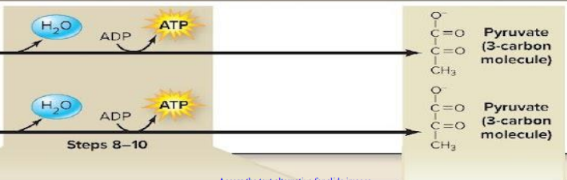
steps 8-10
occur 2x in glucose oxidation
step 8: molecule from step 7 converted to an isomer
step 9: loss of water molecule
step 10: Pi transferred to ADP to form ATP
Simplified
2 ATP donates 2 phosphates (one each) to a glucose, which then becomes 2 ADP
Glucose (6 carbon molecule) splits into two 3 carbon molecules each containing 1 phosphate group
Each phosphate group is removed from the 3 carbon molecules, which produces 2 ATP for each so 4 total
During the process of removing the phosphate group, an electron is stored in a molecule called NADH (2 of them), which was orginally NAD^+
when NAD^+ takes on an electron (reduced), it becomes NADH
Regulation of glycolysis
through negative feedback
ATP acting as allosteric inhibitor to “turn off” phosphofructokinase (PFK)
as ATP increases, PFK inhibited
Phosphofructokinase
a vital enzyme that controls the speed of glycolysis
Fate of pyruvate depends on…
oxygen availability
if sufficient o2 available = pyruvate enters mitochondria
if insufficient o2 available = pyruvate converted to lactate
Fate of Pyruvate with insufficient oxygen
activity of ETC decreases
lvls of NADH & FADH2 accumulate
decreased levels of NAD^+ & FAD
cell becomes more dependent upon glycolysis
requires NAD^+ to continue
glycolysis eventually shuts down
due to lack of NAD^+
NAD must be regenerated for glycolysis to continue
Other fuel molecules that are oxidized in cellular respiration
fatty acids
enzymatically change 2 carbons at a time to form acetyl CoA: beta oxidation
acetyl CoA enters pathway at citric acid cycle
can only be oxidized aerobically
amino acids
diff pathway if protein is used for fuel
point of entry depends upon specific type
amine group is a waste product
converted to urea
excreted by kidneys
basically glucose, fatty & amino acids can be used to generate ATP
Mitochondrion structure
double membrane organelle
inner membrane has folds called cristae
space between membranes is the outer compartment (fluid filled)
innermost space is the matrix
multienzyme complex of intermediate stage resides here
enzymes of citric acid cycle reside here
molecules of ETC system embedded in cristae


Intermediate stage / Pyruvate oxidation
aerobic process (requires oxygen)
pathway is inhibited without it
occurs in mitochondria (matrix)
substrate: pyruvate (2) (becomes oxidized)
multienzyme complex: catalyzed by pyruvate dehydrogenase
pyruvate + coenzyme A (CoA) = acetyl CoA
during decarboxylation, a carboxyl group is released from pyruvate as 1 CO2
energy released during this as 2 hydrogen atoms (2 electrons + 2 hydrogen ions) and NAD^+ → NADH (becomes reduced, energy released)
Acetyl CoA enters citric acid cycle
Product
1 cycle = 1 Acetyl CoA, 1 CO2
2 cycles = 2 Acetyl CoA, 2 CO2 (waste product)
Net product
1 cycle = 1 NADH
2 cycles = 2 NADH
Intermediate stage / Pyruvate oxidation Steps
Decarboxylation (Remove CO2): A carboxyl group is removed from pyruvate, releasing CO2
Oxidation (Create NADH): The remaining two-carbon fragment is oxidized (acetate), and the electrons are transferred to NAD^+ forming NADH (reduced)
Formation of Acetyl CoA: The oxidized two-carbon acetyl group attaches to Coenzyme A, forming Acetyl CoA.

Citric Acid Cycle (Krebs cycle)
aerobic process (requires oxygen)
without it pathway is inhibited
occurs in mitochondria (matrix)
substrate: Acetyl CoA (2 from each glucose)
oxidizes acetyl-CoA to harvest high-energy electrons
cyclic metabolic pathway
9 enzymes in the mitochondrial matrix
Acetyl CoA (initial substrate)→ 2 CO2
CoA released
conversion of malic acid to oxaloacetic aid
oxaloacetic acid invollved in 1st step & regenerated in last step
conversion of citric acid to isocitric acid
by the end of this all 6 carbon atoms originally present in one glucose molecule are fully oxidized and liberated as 6 CO2 molecules
Product
1 cycle = 2 CO2 (per acetyl CoA)
2 cycle = 4 CO2
Net product
1 cycle = 1 ATP, 3 NADH, 1 FADH2 (per acetyl CoA)
2 cycles = 2 ATP, 6 NADH, 2 FADH2
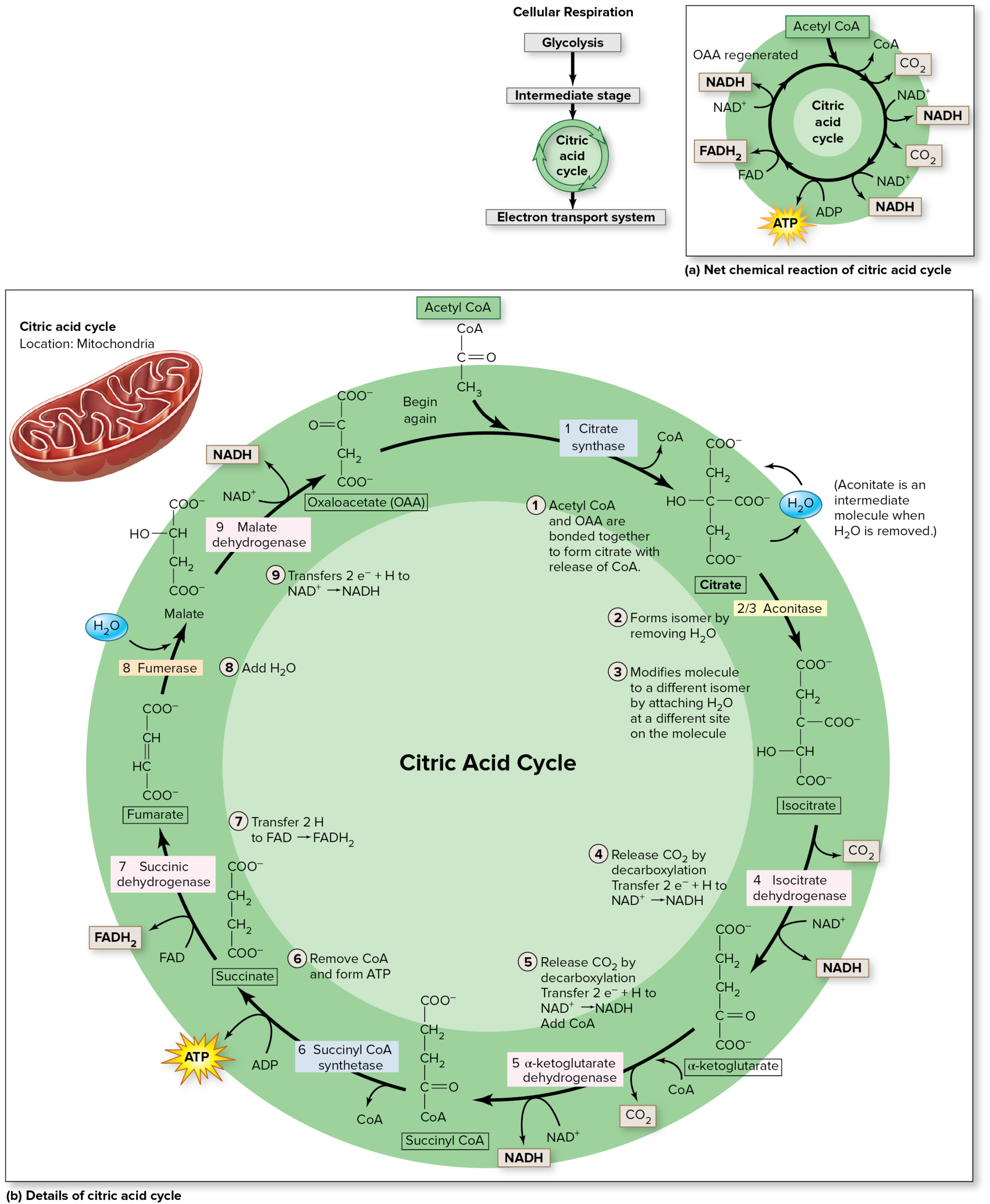
Citric Acid Cycle steps
Acetyl CoA + oxaloacetate = citrate
& 3: Isomer formed by removing a water molecule, then reattaching elsewhere
& 5: Transfer of hydrogen to NAD^+ to form NADH; CoA attached
Removal of CoA & the formation of ATP (through substrate-level phosphorylation)
Dehydrogenase transfers hydrogens to FAD to form FADH2
Water removed
Dehydrogenase transfers hydrogen to NAD to form NADH; oxaloacetate regenerated
Simpler
Oxaloacetate (OAA) is a vital 4-carbon molecule (C4H4O5) reacts with acetyl-CoA to initiate energy production and creates citrate (6 carbon)
Coenzyme A is released and recycled to deliver more acetate
the acetyl group's two carbon atoms is oxidized to two molecules of carbon dioxide (CO2)
the electron carriers 3 NAD^+ and 1 FAD are reduced (gain electron) to 3 NADH and 1 FADH2 (per turn of the cycle)
Each molecule in the CAC is less energetic than its predecessor
Dehydrogenase
an enzyme that helps speed up chemical reactions by removing hydrogen atoms from a molecule and transferring them to another substance
Regulation of the citric acid cycle
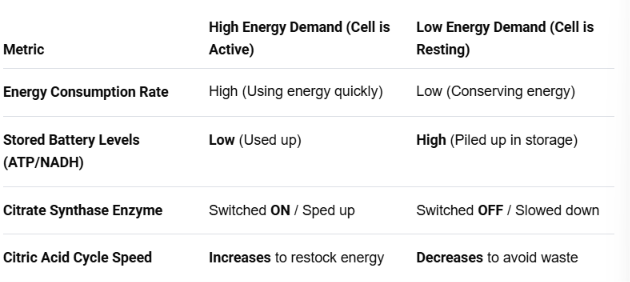
occurs at 1st step enzyme (citrate synthase)
if energy demands high (cell working hard)
lvls of NADH, ATP, & pathway intermediates low
bc cell is using it up faster than it can make them
cycle activity increased
citrate synthase, switches into high gear to speed up the cycle and crank out more energy.
if energy demands low (cell at rest)
lvls of NADH, ATP, & pathway intermediates high
substances start piling up in storage, indicates cellular energy demands are low
decreased activity of the citrate synthase & citric acid cycle
ATP and NADH molecules bump into the enzyme citrate synthase and clog it up (a process called negative feedback inhibition).
these adjustments maintain homeostasis
citrate synthase
Catalyzes a Key Reaction: It joins a molecule of acetyl-CoA with oxaloacetate to create citrate and coenzyme A.
Controls the Pace: It acts as the rate-limiting, pace-making switch that determines how fast the cell processes energy.
Citric acid
hydrogen ion + citrate
ATP synthase
membrane enzyme that uses the potential energy in a proton (H^+) gradient to produce ATP / uses an electrochemical gradient of hydrogen ions
uses the energy of a proton gradient to add a phosphate to ADP (ADP + P = ATP)
enzyme complex that admits protons through a membrane, triggering the production of ATP
location: inner mitochondrial membrane (cristae)
Electron Transport Chain (ETC)
set of proteins which collectively extract the energy from reduced coenzymes (NADH, FADH2) to form ATP
occur in mitochondria, witthin inner membrane (cristae)
series of redox reactions
require oxygen
function: transfer of electrons from NADH & FADH2, energy used to make ATP
oxidation of NADH at enzyme complex 1
establishment of a chemiosmotic gradient in the intermembrane space
structures:
H^+ pump / ion gradient
proteins that transport H^+ from matrix to outer membrane compartment
against/up their concentration gradient (active transport, low to high)
more H^+ in outer compartment than in matric
as electrons are “falling” & passed through the ETC, kinetic energy harnessed by H^+ pumps
by ATP synthase to form ADP & Pi into ATP through oxidative phosphorylation
move H^+ from matrix to outer compartment maintaining H^+ gradient
electron carriers
transport electrons between H^+ pumps
oxygen is the final electron acceptor
electrons combine with H^+ and oxygen to form water
Product: H2O (byproduct) & net ~30 ATP (38 total max, 26 from etc)