Bio 266 Problems For Quiz #1 on Sep 20
 View linked note
 Call Kai
 Learn
Learn Practice Test
 Spaced Repetition
 Match
Match Flashcards
 Knowt Play
1/43

Name | Mastery | Learn | Test | Matching | Spaced | Call with Kai | Chat |
|---|
No analytics yet
Send a link to your students to track their progress
44 Terms
Mendel’s Experiment is about Autosomal gene Inheritance while Figure 2-18 is about Sex-linked inheritance.
In Figure 2-18, how does the 3:1 ratio in the bottom-left-hand grid differ from the 3:1 ratio obtained by Mendel?
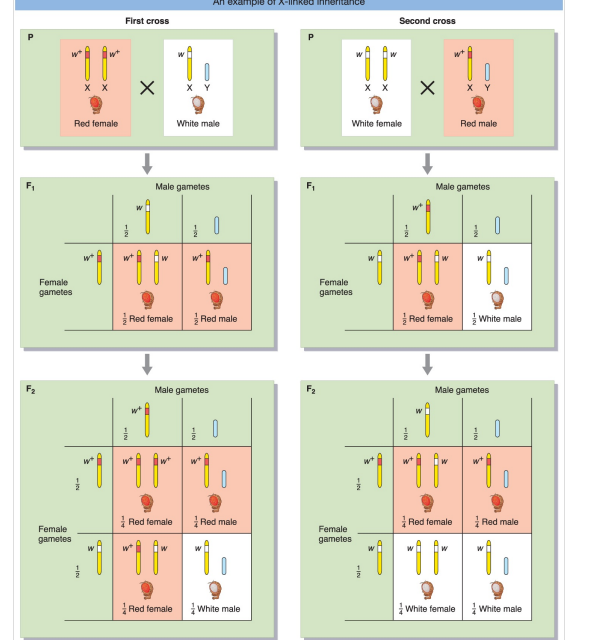
All females will have red eyes. ½of males will have red eyes and ½ of males will have white eyes
In Figure 2-18, what progeny would you predict from a cross of a red F2 male from the first cross and a red F2 female from the second cross?
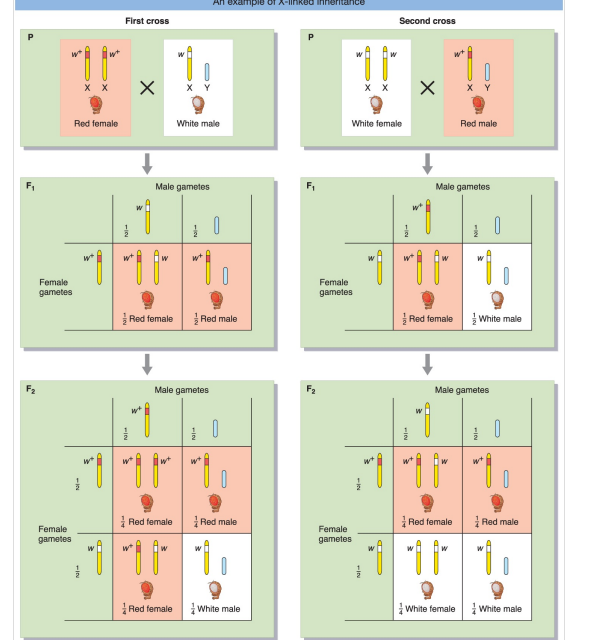
Creation of 2 identical daughter cells.
Name the key function of mitosis.
Cell reproduction and creation of gametes
Name Two key function of Meiosis
Meiosis has crossing over of chromosomes, but mitosis does not. (Non-identical sister chromatids)
In what ways does the second division of meiosis differ from mitosis?
There are a lot of different chromosomes (a lot of variety and possibility) and they are inherited randomly. (there are 2^23 possibilities)
If children obtain half their genes from one parent and half from the other parent, why aren’t siblings identical?
92 Chromatids
Human cells normally have 46 chromosomes. How many nuclear DNA molecules (Chromatids) are present during Metaphase of mitosis?
92 chromatids
Human cells normally have 46 chromosomes. How many nuclear DNA molecules (Chromatids ) are present during Metaphase I of meiosis ?
92 Chromatids
Human cells normally have 46 chromosomes. How many nuclear DNA molecules (Chromatids ) are present After telophase of mitosis?
46 chromatids
Human cells normally have 46 chromosomes. How many nuclear DNA molecules (Chromatids ) are present After telophase I of meiosis?
23 chromatids
Human cells normally have 46 chromosomes. How many nuclear DNA molecules (Chromatids ) are present After telophase II of meiosis?
Chromosome pairing
Four of the following events are part of both meiosis and mitosis, but only one is meiotic. Which one?
(1) Chromatid formation
(2) spindle formation
(3) chromosome condensation
(4) chromosome movement to poles
(5) chromosome pairing
Equal segregation of allele
What is Mendel’s First law ?
The law of independent assortment
What is Mendel’s Second law
Law of Dominance
What is Mendel’s third law
Test Cross. If it is A/A, then all of the phenotype will be A. If it was A/a, half of the phenotype would express A and the other half a.
If you had a fruit fly (Drosophila melanogaster) that was of phenotype A, what cross would you make to determine if the fly’s genotype was A/A or A/a?
There is a 3:1 Ratio this means both parents are heterozygous. ¼ of Offspring will be Homozygous Dominant. ½ will be Heterozygous. ¼ will be homozygous Recessive
Two black guinea pigs were mated and over several years produced 29 black and 9 white offspring. Explain these results, giving the genotypes of parents and progeny.
1/8
The ability to taste is an autosomal dominant phenotype, and the inability to taste it is recessive. If a taster woman with a nontaster father meets a taster man who in a previous relationship had a nontaster daughter, what is the probability that their first child will be a NonTaster girl.
3/8
The ability to taste is an autosomal dominant phenotype, and the inability to taste it is recessive. If a taster woman with a nontaster father meets a taster man who in a previous relationship had a nontaster daughter, what is the probability that their first child will be a Taster girl?
3/8
The ability to taste is an autosomal dominant phenotype, and the inability to taste it is recessive. If a taster woman with a nontaster father meets a taster man who in a previous relationship had a nontaster daughter, what is the probability that their first child will be a Taster Boy?
9/16
The ability to taste is an autosomal dominant phenotype, and the inability to taste it is recessive. If a taster woman with a nontaster father meets a taster man who in a previous relationship had a nontaster daughter. What is the probability that their first two children will be tasters of either sex?
¼
John and Martha are contemplating having children, but John’s brother has galactosemia (an autosomal recessive disease) and Martha’s great-grandmother also had galactosemia. Martha has a sister who has three children, none of whom have galactosemia. What is the probability that John and Martha’s first child will have galactosemia?
Recessive Pedigree
What is pedigree #1 ?
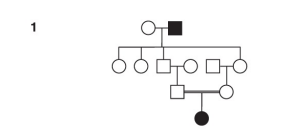
Dominant Pedigree
What is pedigree #2 ?
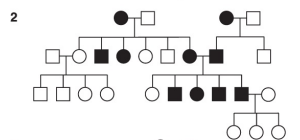
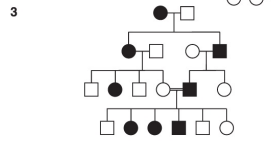
Dominant Pedigree
What is pedigree #3 ?
Recessive Pedigree
What is pedigree #4 ?
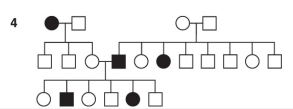
Recessive Pedigree
If Two unaffected individual have an affected Progeny
Dominant pedigree
If Two affected individuals have an unaffected Progeny
0%
An X-linked dominant allele causes hypophosphatemia in humans. A man with hypophosphatemia marries a normal woman. If they have children, what proportion of their sons will have hypophosphatemia?
1/8
Duchenne muscular dystrophy is sex linked and usually affects only males. Victims of the disease become progressively weaker, starting early in life.
What is the probability that a woman whose brother has Duchenne’s disease will have an affected child?
¼
Duchenne muscular dystrophy is sex linked and usually affects only males. Victims of the disease become progressively weaker, starting early in life.
If your mother’s brother (your uncle) had Duchenne’s disease, what is the probability that you have received the allele?
Girls have 100%. Boys have 0%
Duchenne muscular dystrophy is sex linked and usually affects only males. Victims of the disease become progressively weaker, starting early in life.
If your father’s brother had the disease, what is the probability that you have received the allele?
8
In a diploid organism with 2n = 6, How many different combinations of centromere could be produced in a gametes ?
A Variant of a gene
What is an allele?
By looking at a pedigree diagram
How can we know if an allele is dominant or recessive?
a RECESSIVE allele
If parents do not have trait but children have trait, the trait is caused by —
The child is a male and their mother’s brother has red-green colorblindness.
Red-Green colour blindness is caused by an X-linked recessive allele. A child would be a risk for red-green colour blindness if:
9:3:3:1
A cross with two genes that are both heterozygous in each parent will have a Phenotypic ratio of —
4
How many different genotype of gamete could this organism produce?
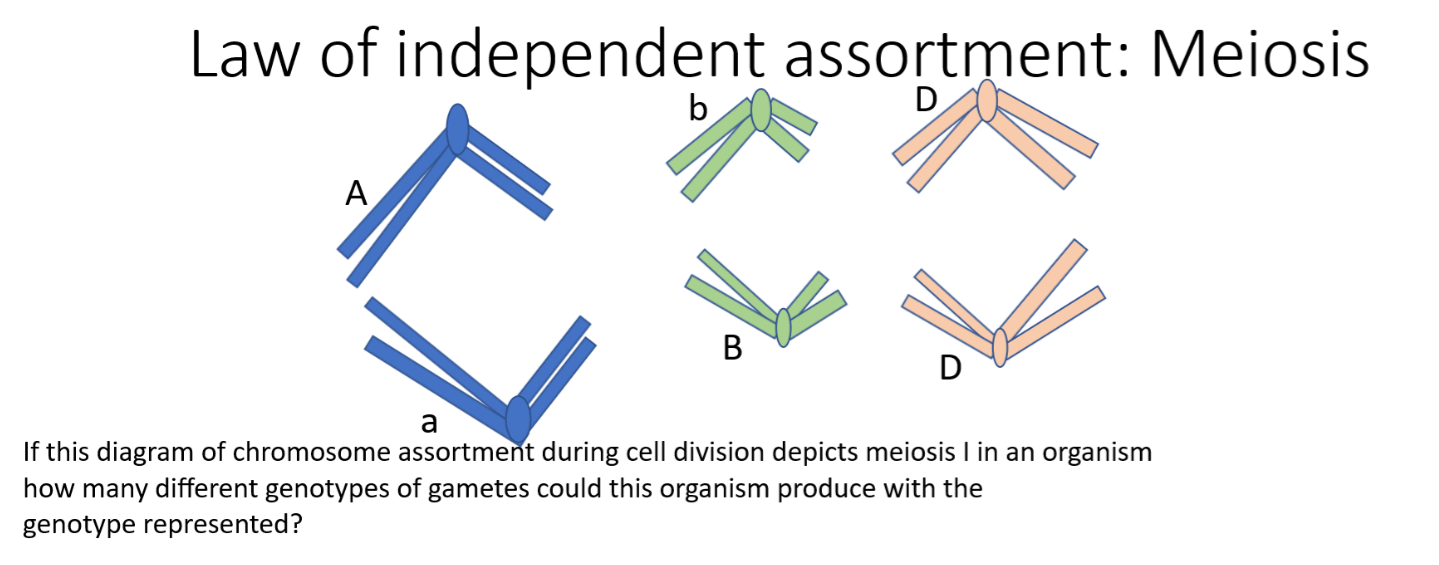
47
How many offsprings there should be to have at least a 95% change of having at least 1 AABB offspring in the cross AaBb x AaBB cross?
1/9
If maternal and paternal Grandparents are heterozygous and the parents both show the dominant phenotype what is the probability that the first baby will have the recessive phenotype?
¾
Predict the fraction of offspring in the cross Aa x Aa that will have the dominant Phenotype?
The probability of two or more independent events occurring together can be calculated by multiplying the two individual probabilities of the events.
What is the Product Rule ?
The probability that any of several mutually exclusive events will occur is equal to the sum of the events’ individual probabilities.
What is the Sum Rule?