Bio 266 Problems For Quiz #1 on Sep 20
1. Problems assigned Sept 4, for discussion the week of Sept. 11, f or a quiz during tutorial Sept 20.
Chapter 2: 15, 16, 30, 31, 34, 39, 41, 42, 44, 45, 47, 55, 56, 63, 72, 73, 75 ( 12th edition) PDF, p. 320
Q.15 ( Tutorial )
In Figure 2-18, how does the 3:1 ratio in the bottom-left-hand grid differ from the 3:1
ratios obtained by Mendel?
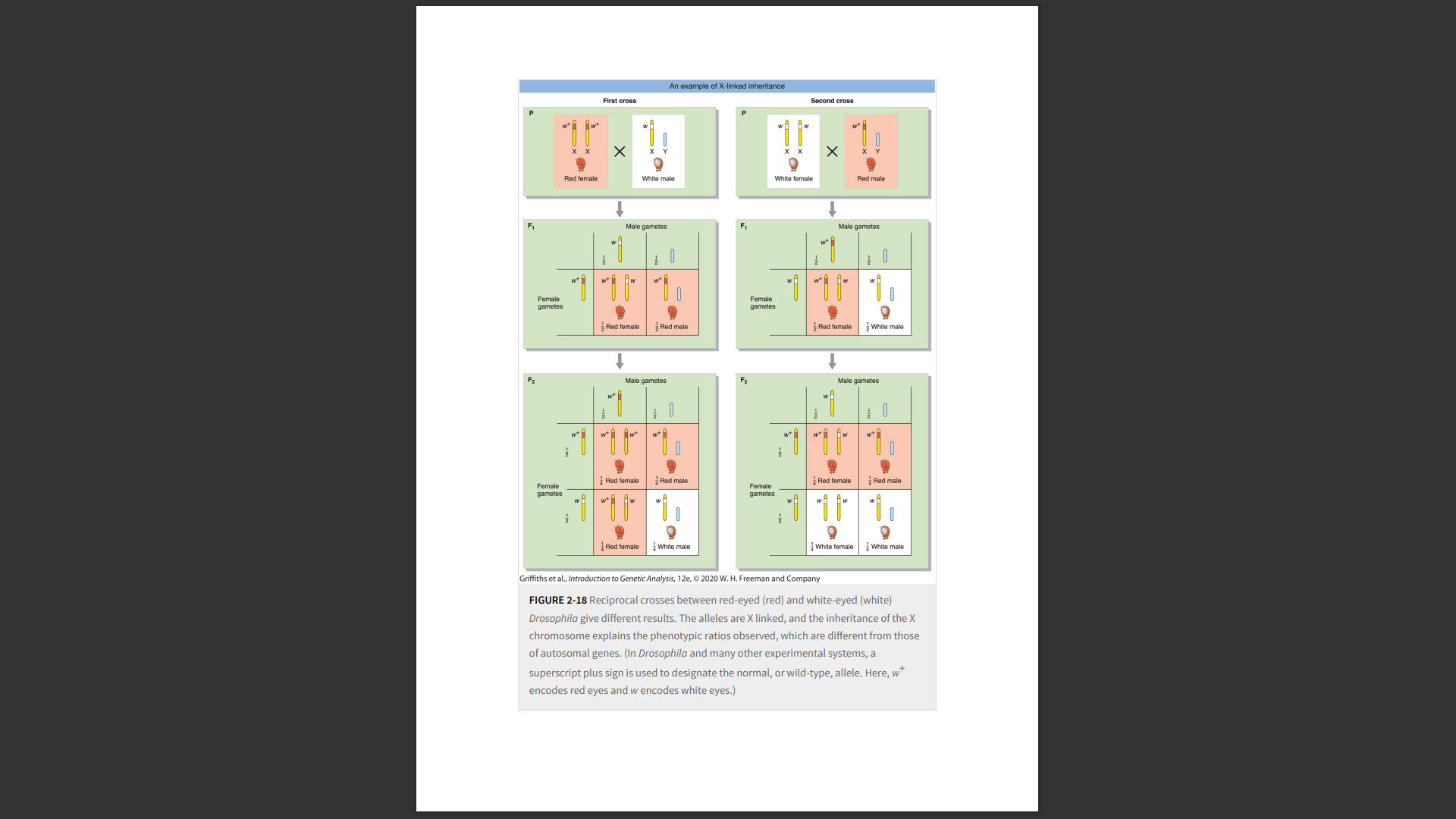 → Mendel’s Experiment is about Autosomal gene Inheritance while Figure 2-18 is about Sex-linked inheritance
Q16. In Figure 2-18, what progeny would you predict from a cross of a red F2 male from the
first cross and a red F2 female from the second cross?
→
Genotype: XW+Y x XW+XW | XW+ | XW |
|---|---|---|
XW+ | XW+XW+ (Red eye Female) | XW+XW (Red Eye Female) |
Y | XW+Y ( Red eye male ) | XWY ( White eye male |
Q30.Name the key function of mitosis.?
→ Cell duplication= Creation of 2 identical daughter cells . And Growth ( Conservation of genetic information)
Q31. Name two key functions of meiosis ??
Cell reproduction and creation of gametes. ( Reduction of chromosomes)
Q34. In what ways does the second division of meiosis differ from mitosis???
Meiosis has crossing over of chromosomes but mitosis does not. ( Non identical sister chromatids)
Q39. If children obtain half their genes from one parent and half from the other parent, why aren’t siblings identical?
→ There are a lot of different chromosomes (a lot of variety and possibility) and they are inherited randomly. (there are 223 possibilities)
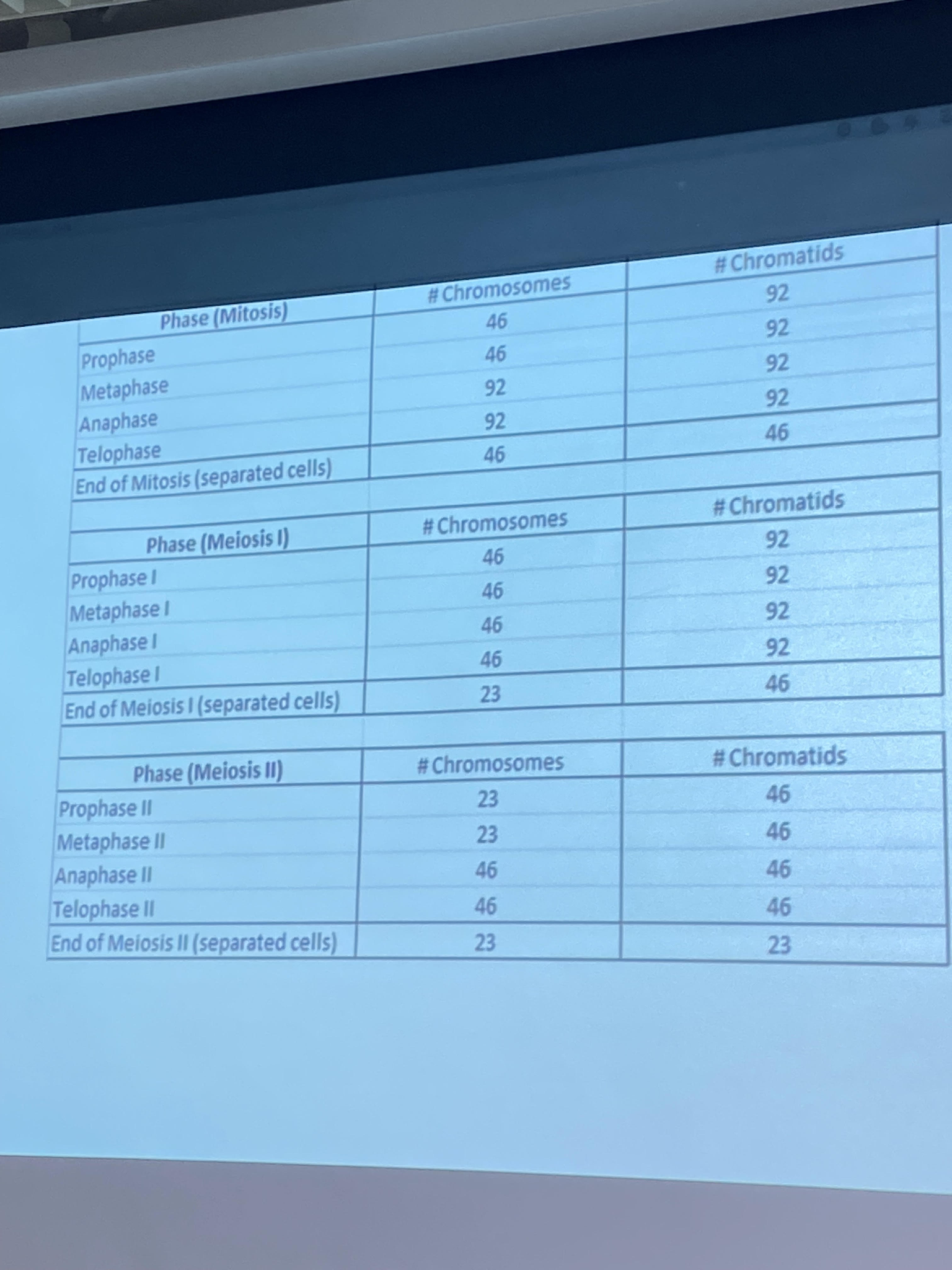
Q41. Human cells normally have 46 chromosomes. For each of the following stages, state
the number of nuclear DNA molecules ( Chromatids ) present in a human cell:

a. Metaphase of mitosis → 92 Chromatids
b. Metaphase I of meiosis → 92 Chromatids
c. After telophase of mitosis → 92 Chromatids
d. After telophase I of meiosis → 46 Chromatids
e. After telophase II of meiosis → 23 Chromatids
Q42. Four of the following events are part of both meiosis and mitosis, but only one is
meiotic. Which one? (1) Chromatid formation, (2) spindle formation, (3) chromosome
condensation, (4) chromosome movement to poles, (5) chromosome pairing ???
→ Synapsis / Crossing over / Chromosome pairing
Q44. What is Mendel’s first law?
→ Equal Segregation of allele ( OR Law of segregation )
Q45. If you had a fruit fly (Drosophila melanogaster) that was of phenotype A, what cross would you make to determine if the fly’s genotype was A/A or A/a?
→ Test Cross ( Cross with Homozygous Recessive ). If half of the offspring have the phenotype a, this means that that the parent phenotype is heterozygous A/a. If all of the offspring have phenotype A, this means that the parent phenotype is Homozygous A/A.
47. Two black guinea pigs were mated and over several years produced 29 black and 9 white offspring. Explain these results, giving the genotypes of parents and progeny.
→ There is a 3:1 Ratio this means both parents are heterozygous
B- Black b-White
Parent Genotype: Bb x Bb | B | b |
|---|---|---|
B | BB ( Black ) | Bb (Black) |
b | Bb (Black) | Bb ( White) |
55. a. The ability to taste the chemical phenylthiocarbamide is an autosomal dominant phenotype, and the inability to taste it is recessive. If a taster woman with a nontaster father meets a taster man who in a previous relationship had a nontaster daughter, what is the probability that their first child will be

Parent Genotype: Tt x Tt | T | t |
|---|---|---|
T | TT( Taster) | Tt (Taster) |
t | Tt (Taster) | tt (NON-Taster) |
! Prob of Taster child = ¾ and Prob of NON-Taster child = ¼
1. A nontaster girl : → Prob of NON-Taster (¼) x prob of having girl (½) = ¼ x ½ = ⅛
2. A taster girl : → Prop of Taster ( ¾ ) x prob of having girl (½) = ¾ x ½ = ⅜
3. A taster boy : → Prob of Taster (¾) x prob of having Boy (½) = ¾ x ½ = ⅜
- What is the probability that their first two children will be tasters of either sex?
→ Prob of 1st Taster (¾ ) x Prob of second taster (¾) = 9/16
Q.56 John and Martha are contemplating having children, but John’s brother has galactosemia (an autosomal recessive disease) and Martha’s great-grandmother also had galactosemia. Martha has a sister who has three children, none of whom have galactosemia. What is the probability that John and Martha’s first child will have galactosemia?
Key : G- Healthy / g-disease
If John and Martha are both carrier:
Genotype: Gg x Gg | G | g |
|---|---|---|
G | GG ( Healthy ) | Gg ( Healthy ) |
g | Gg ( Healthy ) | Gg (galactosemia) |
→ Prob of first child having galactosemia is ¼
Q.63
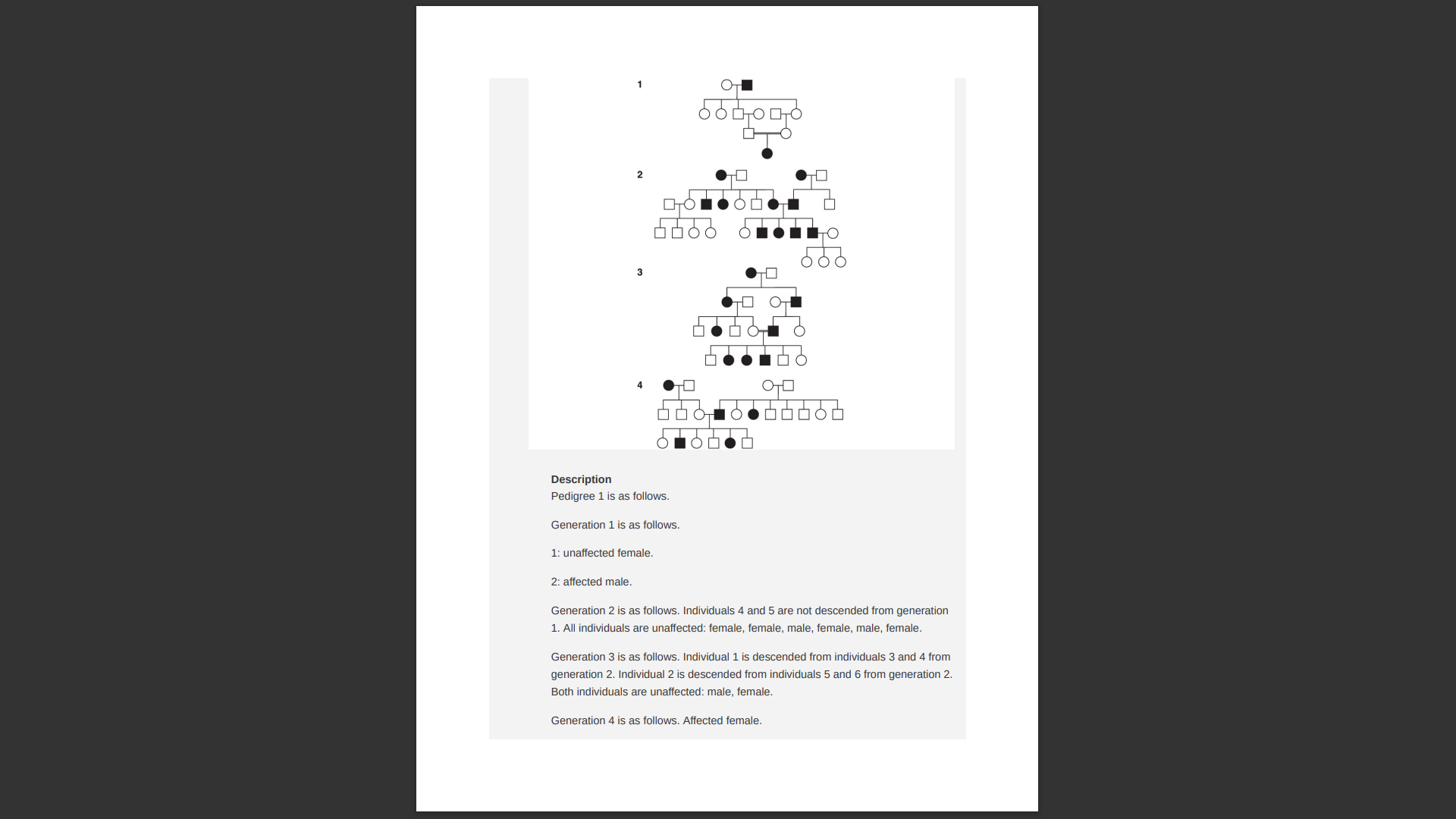
Pedigree 1) Recessive
Pedigree 2) Dominant
Pedigree 3) Dominant
Pedigree 4) Recessive
If you don’t know whether heterozygous or homozygous us the symbol A/-
! If Two unaffected individual have an affected Progeny = Recessive Pedigree
(aa - Infected)
! If Two affected individuals have an unaffected Progeny = Dominant Pedigree
(aa - Healthy) or if half of induviduals affected = shows Dominant pedigree
Q72. An X-linked dominant allele causes hypophosphatemia in humans. A man with hypophosphatemia marries a normal woman. If they have children, what proportion of their sons will have hypophosphatemia?
Key : XD = hypophosphatemia / X = Normal
Dad : XDY
Mom : XX
Genotype :XDY x XX | X | X |
|---|---|---|
XD | XDX | XDX |
Y | XY | XY |
→ All of the Sons will be normal since they will inherit the Y chromosome from their father and the Normal X chromosome from the mother. 0% of sons will have the disease. There is no need to do the pedigree.
73. Duchenne muscular dystrophy is sex linked and usually affects only males. Victims of the disease become progressively weaker, starting early in life.

a. What is the probability that a woman whose brother has Duchenne’s disease will have an affected child?
Parent Genotype: XdX x XY | Xd | X |
|---|---|---|
X | XdX ( Healthy ) | XX (Healthy) |
Y | XdY (Sick ) | XY (Healthy) |
Prob that grand-mother passed allele to the mother: ½
Prob that Child will be affected ¼
→Total Prob = ½ x ¼ = ⅛
Or
Prob that grand-mother passed Xd allele to the mother: ½
Prob that mother will passed Xd allele to child : ½
Prob of boy : ½
Total Prob : ½ x ½ x ½ = ⅛
b. If your mother’s brother (your uncle) had Duchenne’s disease, what is the probability that you have received the allele?
Prob of grand-mother passed allele to the mother: ½
Prob of mother will passed Xd allele to child : ½
→Total Prob : ½ x ½ = ¼
c. If your father’s brother had the disease, what is the probability that you have received the allele?
Girls : 100% chance of receiving allele, because will inherit the Xd from father
Boys : 0% chance of receiving allele, because will inherit the Y from father
Q75. The accompanying pedigree concerns a rare inherited dental abnormality, amelogenesis imperfecta.
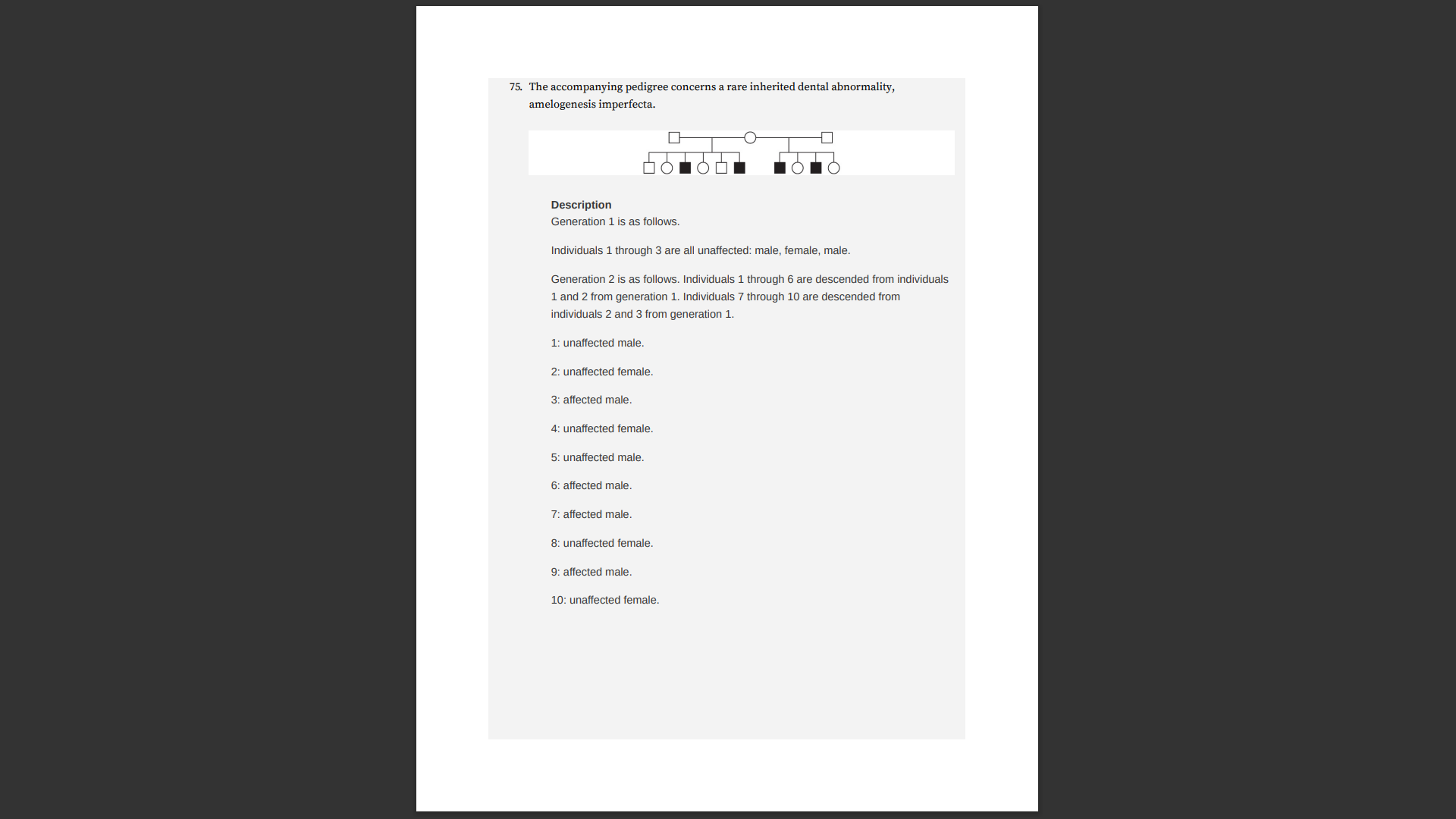
a. What mode of inheritance best accounts for the transmission of this trait?
Recessive
b. Write the genotypes of all family members according to your hypothesis.
EXTRA FROM TUTORIAL :
Q. If A/- x A/-, what is the probability that the first baby will have the recessive phenotype?
Grand-ParentsGenotype: A/a x A/a | A | a |
|---|---|---|
A | Aa | Aa |
a | Aa | aa |
Prob of Genotype of Parents Mom : ⅔ (not including aa) and dad : ⅔ ( not including aa ).
Prob of mom and dad having recessive phenotype child : P(mom) x P(Dad) x P(recessive) = ⅔ x ⅔ x ½ = 1/9
Q. 2 black pigs were mated over several years and produced 29 black and 9 white offspring. explain the result giving genotype of parents and progeny.
→ There is a 3:1 Ratio this means both parents are heterozygous
B- Black b-White
Parent Genotype: Bb x Bb | B | b |
|---|---|---|
B | BB ( Black ) | Bb (Black) |
b | Bb (Black) | Bb ( White) |
Genotype: | ||
|---|---|---|