SIA—MODULE 1
 Studied by 0 people
 Call with Kai
 Learn
Learn Practice Test
 Spaced Repetition
 Match
Match Flashcards
 Knowt Play
1/93

There's no tags or description
Looks like no tags are added yet.
Name | Mastery | Learn | Test | Matching | Spaced | Call with Kai |
|---|
No study sessions yet.
94 Terms
System Integration (SI)
is the process of combining various subsystems, components, or applications into a single, functional system. It involves integrating software, hardware, networks, and data to facilitate communication, data exchange, and interoperability between diverse systems.
System Integration (SI)
is the process of combining all virtual and physical components into a single cohesive infrastructure to ensure that all of an organization’s parts function as a whole.
System Integration (SI)
is also known as software integration and information technology integration.
software integration and information technology integration.
SI is also known as __ and __
virtual and physical components
SI is the process of combining all __ and _ into a single cohesive infrastructure to ensure that all of an organization’s parts function as a whole
combining, single, functional system
SI is the process of __ various subsystems, components, or applications into a __. It involves integrating software, hardware, networks, and data to facilitate communication, data exchange, and interoperability between diverse systems.
System Architecture
refers to the design and structure of a system at a high level. It describes the arrangement and organization of the system’s components, their relationships, and how they interact to attain the system’s goals.
System Architecture
provides a blueprint for effectively constructing and integrating systems.
System Architecture
also known as the architectural model of a system that is responsible for defining the system’s behavior in addition to its structure.
in unison to increase productivity and improve the quality
Businesses implement system integration primarily to ensure that all systems operate __ to and _ of day-to-day operations.
streamline
The purpose of system integration is to __ and facilitate communication not only between an organization’s internal systems but also with its external partners.
System integration
expedites the flow of information and reduces operational expenses.
system integration
The purpose of __ is to streamline and facilitate communication not only between an organization’s internal systems but also with its external partners.
Integration of Legacy System Technology
Enterprise Application Integration (EAI)
Data Integration
Enterprise-to-Enterprise Integration (B2B)
Electronic Document Exchange (EDI)
System Integration Types?
Integration of Legacy System Technology
enables the modernization of legacy systems by facilitating a seamless communication channel with more recent technological solutions and information systems.
Enterprise Application Integration (EAI)
integrates diverse subsystems into a unified business environment and facilitates the exchange of data between applications in real-time.
Data Integration
enables the collection of data from various services aggregate and transform it, and make it accessible from a central location to facilitate interactive reporting.
Enterprise-to-enterprise Integration (B2B)
is the automation of inter-organizational business communications and processes that enables businesses to trade and work more efficiently with their business partners, suppliers, and customers.
Electronic Document Exchange (EDI)
is the exchange of standardized business documents between companies and also be defined as the standard electronic format that businesses use to supplant paper-based documents such as invoices and purchase orders
standard electronic format
Electronic Document Exchange (EDI) is the exchange of standardized business documents between companies and also be defined as the _
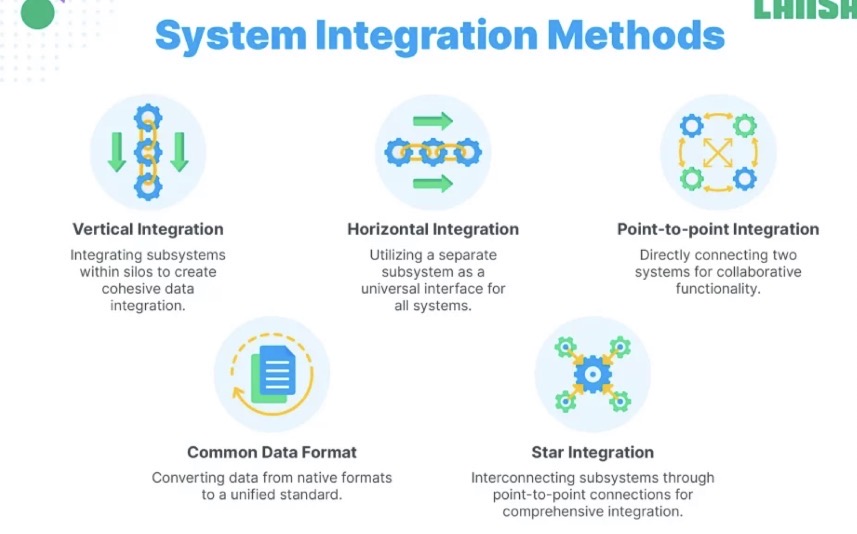
Integration between specific nodes
(Point-to-point Integration)
Concept: A typical connection between two system components.
Integration between specific nodes
(Point-to-point Integration)
Usage: Employed to manage a single business function; typically does not involve complex business logic.
Integration between specific nodes
(Point-to-point Integration)
Challenge: As systems are added, the number of connections grows exponentially, quickly becoming unmanageable.
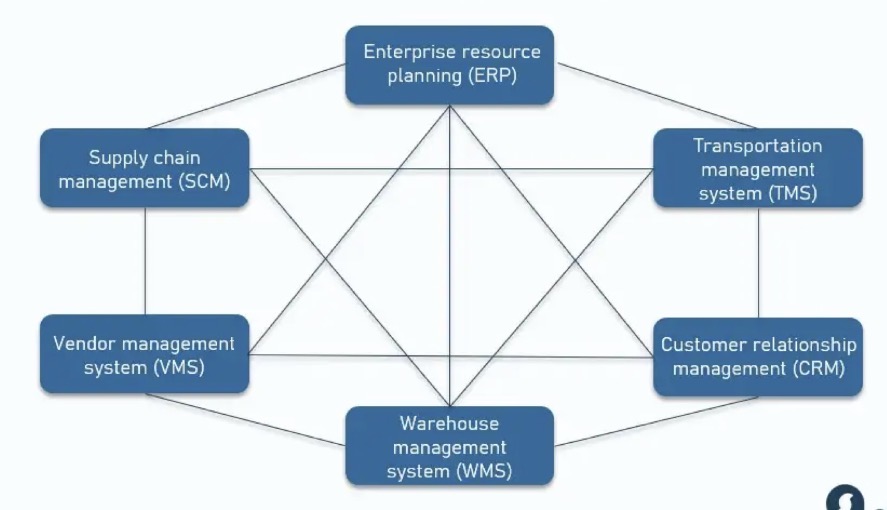
Star Amalgamation
Structure: Connects every subsystem to every other subsystem using individual Point-to-Point links.
Challenge: As the number of integrated systems increases, so does the number of integrations, resulting in a more complex administration of these integrations.
Star Amalgamation
Note: Only feasible for a very small, limited number of subsystems
Star Amalgamation
Concept: Also known as the "Spaghetti Method."
Star Amalgamation
Integrated Hub-and-Spoke Structure
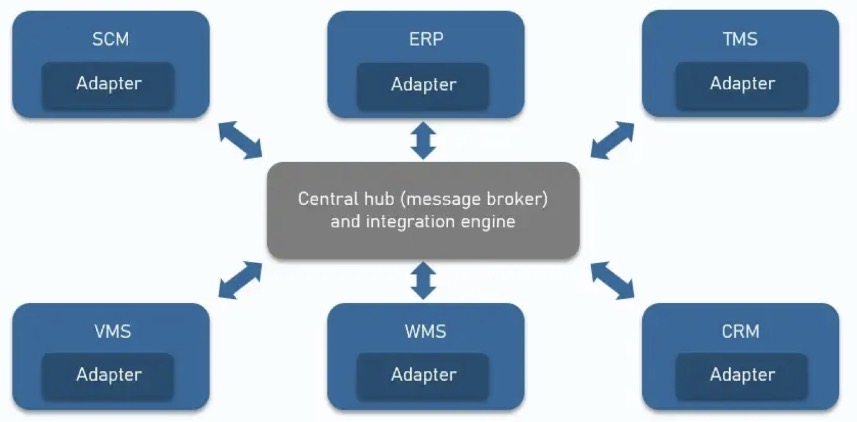
Concept: A centralized hub (broker/mediator) manages all communication between systems (spokes).
Benefit: Decouples data senders and receivers, providing a centralized location for routing, control, and data transformation.
Outcome: Simplifies maintenance and enhances security compared to Star Amalgamation.
Integrated Hub-and-Spoke Structure
Vertical Integration
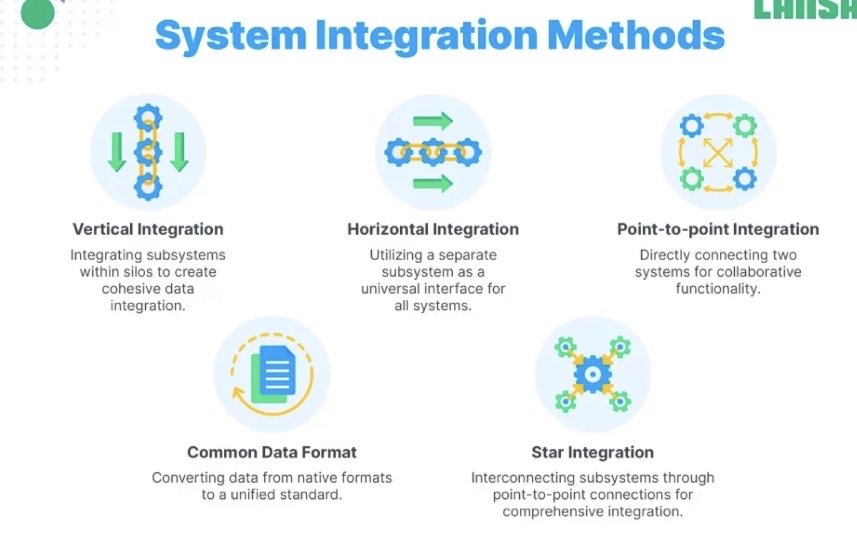
Concept: Subsystems are linked by constructing functional "silos" that run from the fundamental function up to the user interface.
Structure: Integration occurs primarily within a single functional area.
Challenge: New functionality requires building a new silo, making it increasingly difficult to manage and upgrade over time.
Horizontal Integration
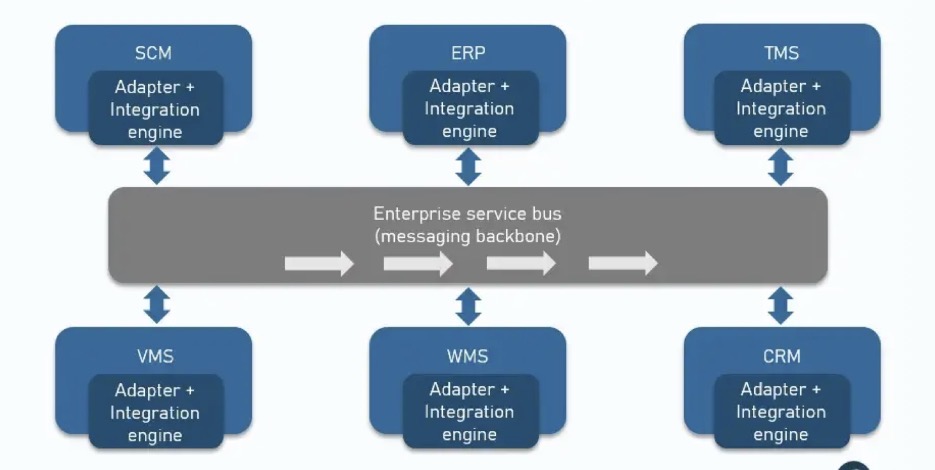
Concept: Facilitates communication between subsystems across different functional areas.
Structure: Achieved through the use of a single, specialized subsystem—often an Enterprise Service Bus (ESB)—that acts as a common interface layer for all applications.
Challenge: The number of connections grows exponentially as the number of subsystems increases.
Horizontal Integration (ESB Integration Model)
Common Data Format Integration
Concept: Developing a universal data format or "data language" used by all subsystems for exchange and analysis.
Benefit: Eliminates the need for every system to contain multiple custom adapters for exchanging data with every other system.
Challenge: Requires extensive initial custom coding to develop and manage the data language/format.
system integrator
it specializes in bridging disparate internal and external applications,
systems, cloud-based software solutions, and data storage.
system integrator
this streamlines real-time data and increases efficiency.
system integrator
its primary objective is to combine multiple subsystems into a singular integrated solution and ensure that they operate in tandem.
DAADSIM
Determine Requirements
Analyze Feasibility
Architect Design
Develop the Management Plan
System Integration Design
Implementation
Maintenance
Stages involved in SI Stage
Determine Requirements
Define expectations and integrated systems' full usage.
Analyze Feasibility
Determine if the requirements are operationally feasible.
Architect Design
Develop a strategy to integrate all components into a unified system.
Develop the Management Plan
Schedule, alternatives, and risk calculation.
System Integration Design
Detailed design phase (most time-consuming).
Implementation
Coding, configuration, bug resolution, and error-free operation.
Maintenance
Routine diagnostics, proper operation, and scheduled system health checks.
DIRE
Data Consolidation And Streamlining
Improve Data Accessibility
Reduced Data Storage Redundancy
Elimination of Repetitive Data Entry
Primary Advantages of SI
IESIVHC
Integration between specific nodes (Point-to-Point Integration)
Enterprise Application Integration (EAI)
Star Amalgamation
Integrated Hub-and-Spoke Structure
Vertical Integration
Horizontal Integration
Common Data Format Integration
System Integration Methods
Data Consolidation and Streamlining
Facilitates the retrieval and processing of data across all subsystems.
Improved Data Accessibility
Eliminates the need to manually synchronize data across the various subsystems.
Reduced Data Storage Redundancy
Reduces the costs associated with maintaining superfluous data storage.
Elimination of Repetitive Data Entry
Improves accuracy and increases productivity.
DiToCoHi
Difficulties with Legacy and Monolithic Systems
Tools selection complexity
Complexity and Time-Consumption
High Expense
What challenges does SI present?
SPESE
Seamless Data Flow
Process Automation
Enable Digital Transformation
Scalability and Flexibility
Enable Ecosystem Integration
Importance in Modern Organizations
Seamless Data Flow
Provides a unified, accurate, and real-time view of data for better decision-making (e.g., financial institution integrating CRM and BI).
Process Automation
Orchestrates the flow of data across systems to automate processes, reduce errors, and free up resources (e.g., e- commerce order-to-shipment process).
Enable Digital Transformation
Provides the foundation for adopting new digital technologies (e.g., Industry 4.0, IoT integration).
Scalability and Flexibility
Enables organizations to adapt their IT infrastructure to business needs by designing systems with modularity and loose coupling.
Enable Ecosystem Integration
Facilitates connection and data exchange with external systems and partner ecosystems, enabling collaboration and value creation (e.g., a retail company integrates its online store with third-party payment gateways and logistics providers).
LSDSS
Loose Coupling
Service-Oriented Architecture (SOA)
Data Integration and Transformation
Scalability and Performance
Security and Governance
Key Principles and Concepts of SIA
Loose Coupling
refers to designing systems with minimal interdependencies between subsystems or components.
This enables the adaptability and independent evolution of integrated systems, making it simpler to modify, replace, or add new components without affecting the entire system.
Loose Coupling
Example: A company's CRM system is integrated in a loosely coupled manner using well-defined APIs, allowing the company to switch or upgrade marketing automation tools without disrupting the CRM system.
Service-Oriented Architecture (SOA)
is an architectural methodology that prioritizes the utilization of reusable services to facilitate system integration
Service-Oriented Architecture (SOA)
Services are autonomous and loosely coupled, with well-defined interfaces for leveraging their capabilities.
Service-Oriented Architecture (SOA)
promotes reusability, interoperability, and modularity, making it simpler to integrate and compose systems from diverse services.
Service-Oriented Architecture (SOA)
Example: An organization implements a SOA architecture where different business functions (such as sales, inventory, and billing) are implemented as separate services that can be accessed and composed to build various applications.
Data Integration and Transformation
A unified view can be achieved through the process of data integration, which involves merging, mapping, and consolidating data from a variety of sources.
Data Integration and Transformation
The process of transforming and mapping data from one format to another, maintaining compatibility and consistency across all connected systems, is referred to as data transformation.
Data Integration and Transformation
Example: Integrating an EHR system with a data analytics platform requires consolidating patient data into a standardized format.
Scalability and Performance
Integration of systems and architecture should be built to be able to handle growing amounts of work while maintaining optimum levels of performance.
Scalability and Performance
Example: A cloud-based application uses horizontal scaling, adding more instances to distribute the workload, and employing load balancers and distributed caching to maintain optimal performance.
Scalability
refers to the capacity to manage increasing data volumes, user traffic, and transaction loads.
Performance
focuses on the ability to fulfill reaction time and throughput requirements.
Security and Governance
are two of the most important factors. It is imperative that appropriate authentication, authorization, data protection, and access control procedures be put into place to guarantee the availability, confidentiality, and integrity of data.
Security and Governance
Example: An organization implements a secure API gateway as part of its integration architecture, which enforces security policies and protects against unauthorized access or data breaches.
PHP SEE MBM
Point-to-Point Integration
Hub-and-Spoke Integration
Publish/Subscribe Integration
Service-Oriented Architecture
Enterprise Service Bus
Event-Driven Architecture
Microservices Architecture
Batch Processing
Message-Oriented Middleware
Overview of SI Patterns and Architectural Styles
Point-to-Point Integration
A straightforward strategy where separate systems are linked one- to-one in a single fashion.
Typically lacks complexity; each system is responsible for its own communication.
Point-to-Point Integration
Example: Integrating an e-commerce website with multiple payment gateways, where each gateway is managed separately.
Hub-and-Spoke Integration
A central system (the "hub") operates as a broker or mediator between several other systems (the "spokes").
Provides a centralized location for routing, control, and data transformation.
Hub-and-Spoke Integration
Example: Using an ESB to integrate a CRM, ERP, and HR system by managing message routes and transformations.
Publish/Subscribe (Pub/Sub) Integration
Enables systems to communicate asynchronously by publishing messages to specific topics or channels.
Other systems interested in the topic can subscribe, providing decoupled communication and enhancing scalability.
Publish/Subscribe (Pub/Sub) Integration
Example: A stock market data provider publishes real-time stock data to a topic, and multiple client applications subscribe to receive the relevant quotes.
Service-Oriented Architecture (SOA)
An architectural style emphasizing the production of reusable services that other applications can consume.
Service-Oriented Architecture (SOA)
Example: Implementing an architecture where functions like inventory and billing are separate services that can be accessed and composed to build applications.
Services
are self-contained modules that offer clearly delineated interfaces and self-specified functionality.
Enterprise Service Bus (ESB)
A type of middleware backbone offering a centralized message broker to make system integration easier.
Fulfills the role of a mediator, supporting smooth message transformation and routing.
Enterprise Service Bus (ESB)
Example: Using an ESB to integrate multiple enterprise applications, such as CRM, ERP, and HR systems, by defining message routes, transformations, and protocols.
Event-Driven Architecture (EDA)
Example: A system where a new order generates an event, and inventory, billing, and shipping systems instantly and asynchronously react to that event.
Event-Driven Architecture (EDA)
Management and processing of events are significant; components respond to events in real-time.
Supports complex communication in real-time, asynchronous, processing, and the decoupling of individual components.
Microservices Architecture
An application is broken up into a number of smaller services that are only weakly linked with one another.
Each microservice is independently created, deployed, and scaled, communicating via APIs.
Microservices Architecture
Example: An e-commerce site breaks down its monolithic application into separate services for user authentication, product catalog, shopping cart, and payment processing.
Batch Processing
The process of collecting data or transactions over a period of time in order to process them all at once on a predetermined schedule.
Used when real-time processing is not required; involves a series of processes like ETL.
Batch Processing
Example: Running the end-of-day financial reconciliation process at midnight to process all transactions completed since the previous report.
Message-Oriented Middleware (MOM)
An architecture for communication that allows for the asynchronous transmission of messages between different systems.
Decouples the systems of the sender and recipient, ensuring reliable message delivery even if systems are offline.
Message-Oriented Middleware (MOM)
Example: Implementing a message queue to integrate a payment processing system with an order fulfillment system; the payment system sends messages and the fulfillment system retrieves and processes them later.