Atrial Flutter (AFL)
 Call Kai
 Learn
Learn Practice Test
 Spaced Repetition
 Match
Match Flashcards
 Knowt Play
1/10

There's no tags or description
Looks like no tags are added yet.
Name | Mastery | Learn | Test | Matching | Spaced | Call with Kai | Chat |
|---|
No analytics yet
Send a link to your students to track their progress
11 Terms
Typical flutter
saw-tooth pattern P-waves in leads II, III, aVF (inverted w/ CC and positive w/ C rotation)
AV ratio ranges from 2:1 - 4:1 with atrial rates commonly 150-250 ms
The circuit includes the CTI and tricuspid valve
Atypical flutter
Saw-tooth pattern P-waves, but different morphology than typical flutter
A:V ratio ranges from 2:1-4:1 with the atrial rate varying depending on circuit and substrate properties
Often occurs as a result of substrate from atrial myopathies and prior surgeries or ablation procedures
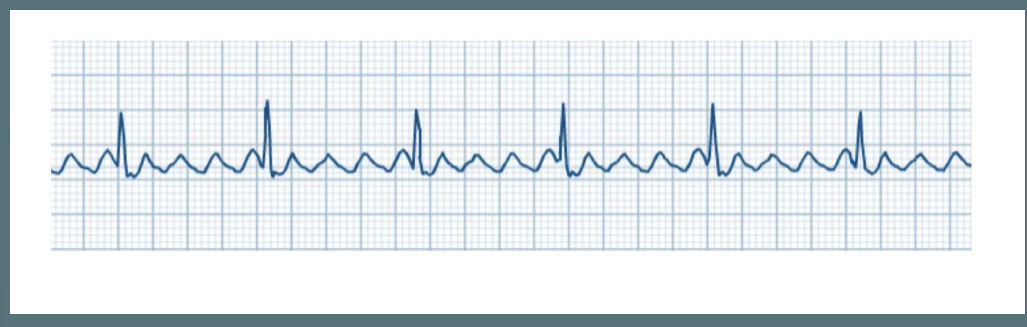
Atrial flutter (rate, p-wave, pr interval, qrs, rhythm)
Rate: fast 250-350 BPM for atrial, but ventricular rate is often slower
P-wave: saw-toothed morphology
PR interval: not measurable
QRS: Narrow (<120ms)
Rhythm: regular atrial and ventricular rates can vary
Prerequisites for reentry
Two pathways- separated by an anatomical structure
Different conduction/refractory velocities
Unidirectional block in one pathway
Types of atypical atrial flutter
Peri-mitral annulus → uses mitral annulus and left atrial isthmus and occurs post-Afib
Roof-dependent → uses PV ablation lines (commonly between RSPV and LSPV ablation lines, occurs post Afib ablation
Scar dependent → uses surgical scars and occurs post left atrial atriotomy
Entrainment mapping
Burst atrial pacing during tachycardia
location: HRA or prox CS
Confirms CTI dependence
acceleration of tachycardia to PCL
continuation of TCL upon cessation of pacing
measuring PPI
if PPI-TCL is <30ms, entrainment within reentrant circuit confirmed
Activation sequence mapping
Continuously compare atrial electrograms against a reference signal to the progression of the activation sequence around a defined macro-reentrant circuit
For typical flutter:
initial atrial wave deflection is observed on CS ostium EGM
timed with initial downstroke of flutter p wave in inferior ECG leads
followed by HIS atrial EGM
then RA free wall EGM
Concealed entrainment
Fusion of the paced stimulus with the tachycardia activation wavefront, typically near the circuit
Confirmed via acceleration of tachycardia during pacing without change in activation pattern
Manifest entrainment
Paced stimulation causes a change in the tachycardia activation wavefront because the stimulus is outside of the circuit
Crista terminalis
During typical AFlutter, the CT serves as an electrical barrier, channeling the wavefront to propagate the flutter circuit
placement location for multi-electrode catheters to evaluate signal propagation, timing, and differential pacing to determine CCW vs CW, typical vs atypical AFL, and bi-directional block post AFL ablation
Trans-isthmus interval
the time it takes from the onset of CSd simulation to the ablation to the ablation catheter
baseline is 79 ms, and the goal is to achieve an increase in the trans-isthmus interval by 50% or greater
TII post-ablation should be > 160 ms to indicate a successful line of conduction block across the CTI because the paced stimulation has to travel the long way around to the lateral side of the ablation line