NHA CCMA Part 1
 Call Kai
 Learn
Learn Practice Test
 Spaced Repetition
 Match
Match Flashcards
 Knowt Play
1/154

There's no tags or description
Looks like no tags are added yet.
Name | Mastery | Learn | Test | Matching | Spaced | Call with Kai | Chat |
|---|
No analytics yet
Send a link to your students to track their progress
155 Terms
Advance beneficiary notice (ABN)
A form provided to the patient when the provider believes Medicare will probably not pay for services received.
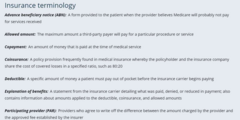
Allowed amount
The maximum amount a third-party payer will pay for a particular procedure or service.
Copayment
An amount of money that is paid at the time of medical service.
Coinsurance
A policy provision frequently found in medical insurance whereby the policyholder and the insurance company share the cost of covered losses in a specified ratio, such as 80:20.
Deductible
A specific amount of money a patient must pay out of pocket before the insurance carrier begins paying.
Explanation of benefits
A statement from the insurance carrier detailing what was paid, denied, or reduced in payment; also contains information about amounts applied to the deductible, coinsurance, and allowed amounts.
Participating provider (PAR)
Providers who agree to write off the difference between the amount charged by the provider and the approved fee established by the insurer.
Medicare
A federal health insurance program generally covering patients age 65 and older by Part A (hospitalization) or Part B (routine medical office visits) benefits.
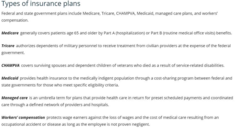
Tricare
A program that authorizes dependents of military personnel to receive treatment from civilian providers at the expense of the federal government.
CHAMPVA
A program that covers surviving spouses and dependent children of veterans who died as a result of service-related disabilities.
Medicaid
A program that provides health insurance to the medically indigent population through a cost-sharing program between federal and state governments for those who meet specific eligibility criteria.
Managed care
An umbrella term for plans that provide health care in return for preset scheduled payments and coordinated care through a defined network of providers and hospitals.
Workers' compensation
A program that protects wage earners against the loss of wages and the cost of medical care resulting from an occupational accident or disease as long as the employee is not proven negligent.
CMS-1500 Form
The health insurance claim form most health care payers use for claims submitted by a provider or supplier.

Section 1: Carrier Block
Contains the address of the insurance carrier and is located at the top of the CMS-1500 form.
Section 2: Patient/Insured Section
Contains information about the patient or insured (if other than the patient); includes boxes 1 through 13 on the CMS-1500 form.
Section 3: Physician/Supplier Section
Contains information about the physician or supplier; includes boxes 14 to 33 on the CMS-1500 form.
What is the supine position?
The patient lies flat on their back, facing up.
What is the supine position used for?
Examination and treatment of the anterior (or front) surface of the body from head to toe.
What is the dorsal recumbent position?
the patient is flat on their back, knees bent, and feet flat on exam table.
What is the dorsal recumbent position used for?
In this position, the physician can examine the head, neck, chest, and abdomen. This position is also used to examine the pelvis and rectum of patients who cannot assume a lithotomy position. Medical procedures are also performed in this position, such as urinary catheterization.
What is the prone position?
the patient lies on their abdomen, facing down. Arms may be placed above the head or along the sides of the body, and the head is turned to the side
What is the prone position used for?
This position is used for examining the dorsal (or back) surface of the body, especially the spine, back, and legs.
What is the lithotomy position?
the patient lies on their back with their knees bent and buttocks close to the bottom edge of the exam table. The heel of each foot goes in a stirrup attached to the end of the table. A drape sheet should cover from the chest to over the knees, and a pillow should be placed under the head.
What is the lithotomy position used for?
This position is used for pelvic and rectal examinations.
What is Sims position?
the patient lies on their left side with top leg bent sharply and lower leg bent slightly.
What is the Sims position used for?
This position is used for rectal exams and procedures (sigmoidoscopy, colonoscopy, and administering an enema).
What is Fowler's position?
the patient is supported by the back of the examination table raised to either 45 degrees or 90 degrees.
What is Fowler's position used for?
This position is comfortable for patients who have trouble breathing or back pain and allows examination of the front of the body.
Schedule I controlled substances
Includes substances that have a high potential for abuse and no approved medical use in the United States, such as heroin and LSD.
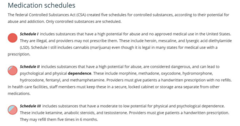
Schedule II controlled substances
Includes substances that have a high potential for abuse and can lead to psychological and physical dependence, such as morphine and oxycodone.
How must healthcare providers handle Schedule 2 substances?
Providers must give patients a handwritten prescription with no refills. In health care facilities, staff members must keep these in a secure, locked cabinet or storage area separate from other medications.
What are Schedule III controlled substances?
Substances that have a moderate to low potential for physical and psychological dependence.
Name a substance classified as a Schedule III controlled substance.
Ketamine
Name another substance classified as a Schedule III controlled substance.
Testosterone
What type of steroids are included in Schedule III controlled substances?
Anabolic steroids
Schedule IV (4) controlled substances
Includes substances that have a low potential for abuse and dependence, such as diazepam and alprazolam.
How often can Schedule 4 controlled substances be refilled?
5 times in 6 months and staff members may authorize refills over the phone
Schedule V controlled substances
Includes substances that contain limited quantities of some narcotics, usually for antidiarrheal, antitussive, and analgesic purposes.
Fat-soluble vitamins
Vitamins A, D, E, K that are absorbed and stored in fat.
Water-soluble vitamins
Vitamins B1, B2, B3, B6, folate, B12, pantothenic acid, biotin, C that dissolve in water.
Where is the location of the intradermal injection?
skin of the upper chest, forearms, and upper back
Where is the location of the intramuscular (IM) injection?
deltoid, vastus, laterialis, ventrogluteal muscle
Where is the location of the subcutaneous injection?
under the skin of the abdomen, anterior thighs, upper outer arm, upper back (under the shoulder)
What is the first stage of Erikson's psychosocial development?
Trust vs mistrust
When is the first stage of Erikson's theory of psychosocial development?
Infancy, 0-18 months
What is the primary focus of the first stage of Erikson's theory?
Developing a sense of trust in caregivers and the world.
How do infants learn to trust according to Erikson's theory?
When their needs are consistently met by responsive, sensitive caregivers.
What does the first stage of Erikson's theory lay the foundation for?
A child's sense of safety and security in the world.
Give an example of how a baby develops trust in the first stage of Erikson's theory.
A baby cries and is promptly comforted by their caregiver.
What is the second stage of Erikson's psychosocial development?
Autonomy vs shame and doubt
When is the second stage of Erikson's theory of psychosocial development?
Toddlerhood, 18 months-3 years
What is the primary focus of the second stage of Erikson's theory?
developing independence and self-control.
How do toddlers develop autonomy according to Erikson's theory?
Through encouragement and support while exploring independence
What does the second stage of Erikson's theory lead to if successful?
A sense of autonomy and confidence
Give an example of autonomy in Erikson's second stage.
A toddler tries to put on their own shoes
What is the third stage of Erikson's psychosocial development?
Initiative vs guilt
When is the third stage of Erikson's theory of psychosocial development?
Preschool, 3-5 years
What is the primary focus of the third stage of Erikson's theory?
Taking initiative and planning activities
What happens when children succeed in the third stage?
They develop a sense of initiative
What happens when children fail in the third stage?
They may feel guilt
Give an example of initiative in Erikson's third stage.
A child helps set the table
What is the fourth stage of Erikson's psychosocial development?
Industry vs inferiority
When is the fourth stage of Erikson's theory of psychosocial development?
School Age, 5-12 years
What is the primary focus of the fourth stage of Erikson's theory?
Developing skills and competence
What happens when children succeed in the fourth stage?
They feel competent and confident
What happens when children fail in the fourth stage?
They may feel inferior
Give an example of industry in Erikson's fourth stage.
A child learns to read and feels proud
What is the fifth stage of Erikson's psychosocial development?
Identity vs role confusion
What is the fifth stage of Erikson's theory of psychosocial development?
Adolescence, 12-18 years
What is the primary focus of the fifth stage of Erikson's theory?
Forming identity and sense of self
What happens when adolescents succeed in the fifth stage?
They develop a strong identity
What happens when adolescents fail in the fifth stage?
They experience role confusion
Give an example of identity development in Erikson's fifth stage.
A teen explores different styles and interests
What is the sixth stage of Erikson's psychosocial development?
Intimacy vs isolation
When is the sixth stage of Erikson's theory of psychosocial development?
Young Adulthood, 18-40 years
What happens when individuals succeed in the sixth stage?
They form intimate relationships
What happens when individuals fail in the sixth stage?
They may feel isolated
Give an example of intimacy in Erikson's sixth stage.
Developing a committed romantic relationship
What is the seventh stage of Erikson's psychosocial development?
Generativity vs stagnation
When is the seventh stage of Erikson's theory of psychosocial development?
Middle Adulthood, 40-65 years
What is the primary focus of the seventh stage of Erikson's theory?
Contributing to society and future generations
What happens when individuals succeed in the seventh stage?
They feel productive and purposeful
What happens when individuals fail in the seventh stage?
They may feel stagnant
Give an example of generativity in Erikson's seventh stage.
Mentoring or helping others
What is the eighth stage of Erikson's psychosocial development?
Ego integrity vs despair
When is the eighth stage of Erikson's Theory of Psychosocial Development?
Late Adulthood, 65+ years
What is the primary focus of the eighth stage of Erikson's theory?
Reflecting on life
What happens when individuals succeed in the eighth stage?
They feel satisfied and fulfilled
What happens when individuals fail in the eighth stage?
They feel regret and despair
Give an example of ego integrity in Erikson's eighth stage.
An older adult shares life stories with meaning
The grief cycle
Denial, anger, bargaining, depression, acceptance
What are the fat-soluble vitamins?
A, D, E, K
What are the water soluble vitamins?
all B vitamins, folate, pantothenic acid, biotin, C
What is the denial stage of grief?
A defense mechanism that buffers the immediate shock
What is the anger stage of grief?
A reaction to the intense emotion of the situation
What is the bargaining stage of grief?
The need to gain control of feelings of helplessness
What is the depression stage of grief?
A period of sadness and regret
What is the acceptance stage of grief?
A sense of calm
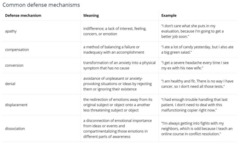
Defense mechanism
A psychological strategy used to cope with reality and maintain self-image