Interferential therapy (IFT)
 Call Kai
 Learn
Learn Practice Test
 Spaced Repetition
 Match
Match Flashcards
 Knowt Play
1/11

There's no tags or description
Looks like no tags are added yet.
Name | Mastery | Learn | Test | Matching | Spaced | Call with Kai | Chat |
|---|
No analytics yet
Send a link to your students to track their progress
12 Terms
What is IF current?
IF Current
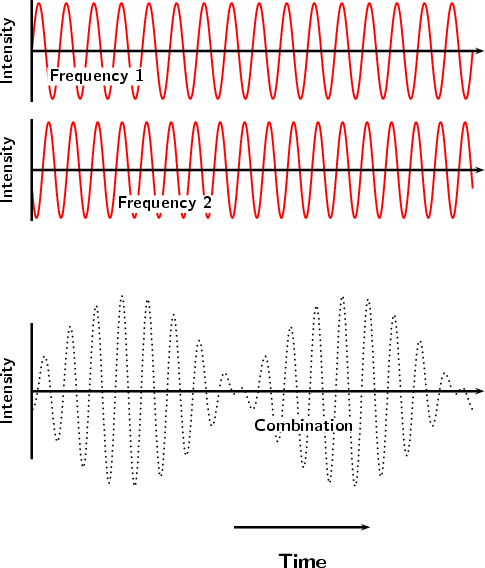
IF (Interferential) current = interference of 2 medium-frequency currents → produces a low-frequency current.
Usually uses a base current of 4000 Hz.
Why medium frequency?
More comfortable than low-frequency current.
Interference in tissues is theorised to allow greater depth penetration.
How IF is generated
Generating IF
AMF (Amplitude Modulated Frequency) = the effective component of IF.
AMF = difference between the 2 frequencies.
Example:
4000 Hz − 4100 Hz = 100 Hz AMF.
How/when to modulate IF machines
Modulating IF
Most IF machines can sweep/alter the AMF over time → frequency sweep.
Different sweep patterns:
6:6 → slow increase + decrease over 6 sec
1:1 → 1 sec at one dose, then 1 sec at another
6:6 → 6 sec at one dose, then 6 sec at another
Clinical value/effectiveness of frequency sweeps is questionable.
How many electrodes and where?
IF — Electrodes
2 or 4 electrodes can be used.
With 4 electrodes, position them so the 2 currents interfere.
Suction electrodes don’t add to the treatment → they only facilitate application.
IFT — Electrode Placement
Place electrodes to stimulate:
Nerve root → if treating pain
Motor point
4 channels can be used to achieve greater depth/joint penetration.
IF — Evidence & Clinical Use
Moderate-quality evidence supports IFT for:
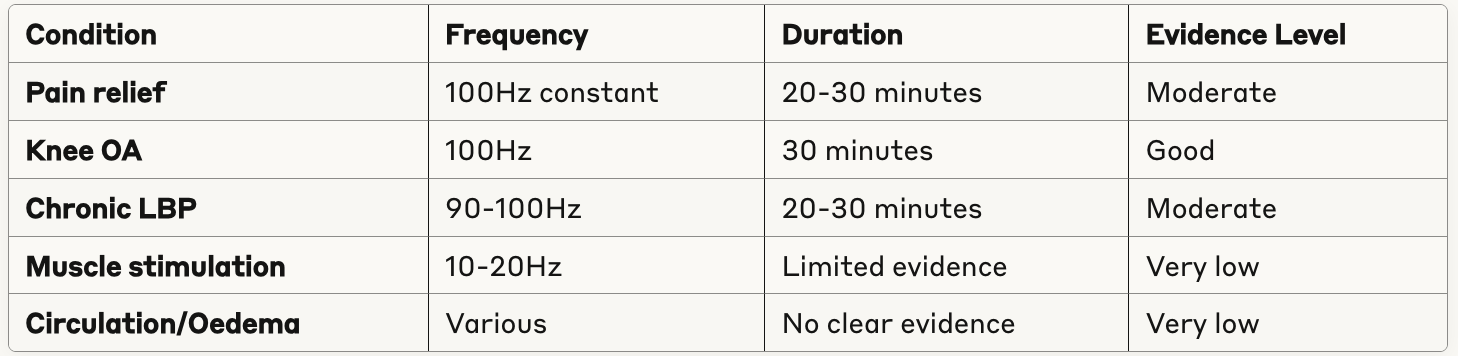
Knee OA → significant short-term pain reduction (Chen et al., 2022).
Chronic non-specific low back pain → 1.57-point pain reduction vs placebo (Rampazo et al., 2023).
IFT appears to work through conventional nerve stimulation, similar to TENS.
Most effective as an adjunct, not standalone treatment.
No evidence for unique “interferential” effects.
Limited evidence for:
Muscle strengthening
Increased circulation
Wound healing
Cost-effectiveness vs TENS is questionable (NICE, 2022).
Best used as part of multimodal therapy.
IFT & Modern Pain Science
Pain mechanisms:
Gate control theory → main explanation.
Activates A-beta fibres → inhibits nociception at the spinal level.
May influence descending pain modulation.
Biopsychosocial model:
Patient expectations influence outcomes.
Therapeutic relationship can enhance treatment effects.
Consider central sensitisation in chronic pain.
Evidence-based approach:
No research specifically examines IFT pain-relief mechanisms.
Current understanding is extrapolated from TENS research.
Set realistic expectations about outcomes.
IFT — Evidence-Based Parameters
Carrier frequency: 4000 Hz
AMF for pain: 100 Hz constant → most evidence
Duration: 20–30 min
Frequency: 3–5×/week for 2–4 weeks
Intensity: Strong but comfortable, just below pain threshold
Key finding: Exact parameters may be less important than previously thought.
Focus on patient comfort + treatment adherence.
2 vs 4 electrodes: similar effectiveness.
IF treatment dosages
IFT — When to Use
Consider IFT for:
Chronic musculoskeletal pain
As an adjunct to exercise/manual therapy
Patient preference after education
When TENS unavailable/not tolerated
Do NOT use IFT:
As the primary treatment for complex pain
Expecting unique “interferential” effects
Conditions with poor evidence: fibromyalgia, wound healing, incontinence
Patient selection:
Realistic expectations → modest benefits
Commitment to multimodal treatment
No contraindications
IFT — Tissue Healing
Limited evidence for tissue-healing effects:
No strong evidence for enhanced bone healing
Wound healing benefits not established
Circulation improvements not consistently demonstrated
Modern approach:
Focus on optimal loading + movement
Address nutrition, sleep + stress
IFT may help patients participate in active treatment
Clinical application:
Use IFT to reduce pain barriers to rehabilitation
Combine with evidence-based interventions
Monitor functional outcomes, not just pain.
IFT — Hazards & Detrimental Effects
Burns
Increased pain
Nausea + vomiting
Dizziness
Headaches / migraine
Neurological effects
IFT — Recent Safety Concerns
Reported adverse effects:
Unusual neurological effects lasting 4–5 hrs post-treatment
Possible interaction with opioids (tramadol case report)
Balance disturbances in elderly patients
Extra precautions:
Elderly with cognitive/balance deficits
Patients taking opioid medication
Patients with pre-existing neurological conditions
Safety:
IFT included in NHS adverse-event surveillance
Importance of standardised reporting.
Precautions and contraindications
Precautions:
Perform sharp/blunt skin test.
Check skin integrity → allergies, eczema, skin lesions.
DO NOT place electrodes over the anterior neck.
Set all parameters before switching on/connecting electrodes to the patient.
Contraindications
Absolute contraindications:
Pregnancy → around foetus / 1st trimester
Active implants → e.g. pacemakers
Epilepsy → do not apply around the neck
Actively bleeding tissue
Local contraindications:
Malignancy
Eyes
Testes
Active epiphysis
Use caution with:
Local circulatory insufficiency
Devitalised tissue