Linear Algebra Test 4 Review
0.0(0)
Studied by 2 people Call Kai
 Learn
Learn Practice Test
 Spaced Repetition
 Match
Match Flashcards
 Knowt Play
Card Sorting
1/36

Earn XP
Description and Tags
Sections 4.7, 4.8, 5.1, 5.2, 6.1, 6.2, 6.3, 10.4.
Last updated 3:53 AM on 11/23/22
Name | Mastery | Learn | Test | Matching | Spaced | Call with Kai | Chat |
|---|
No analytics yet
Send a link to your students to track their progress
37 Terms
1
New cards
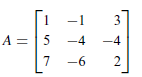
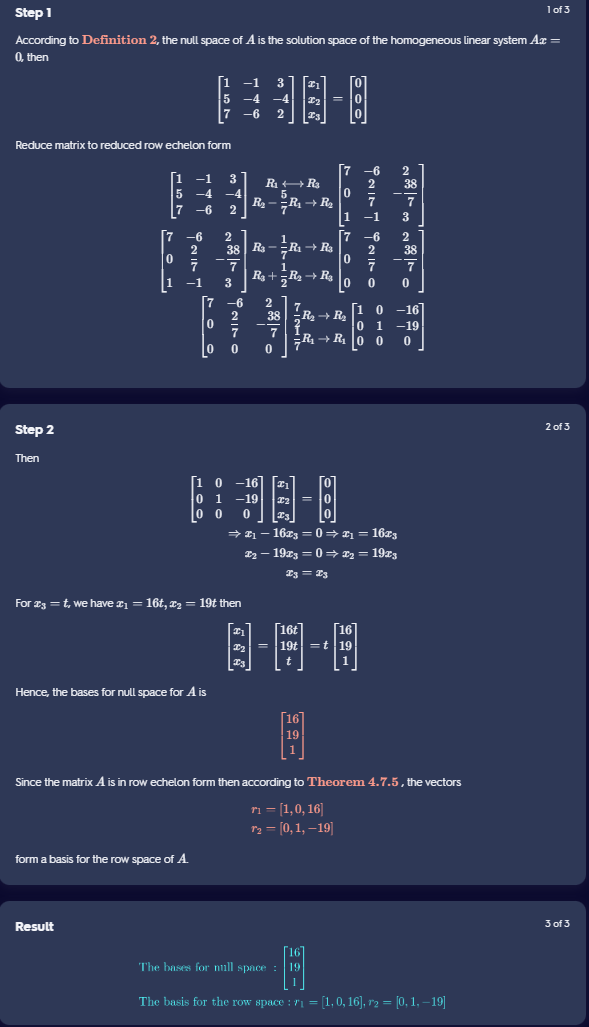
Find bases for the null space and row space
of A.
of A.
2
New cards
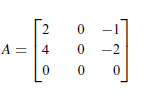
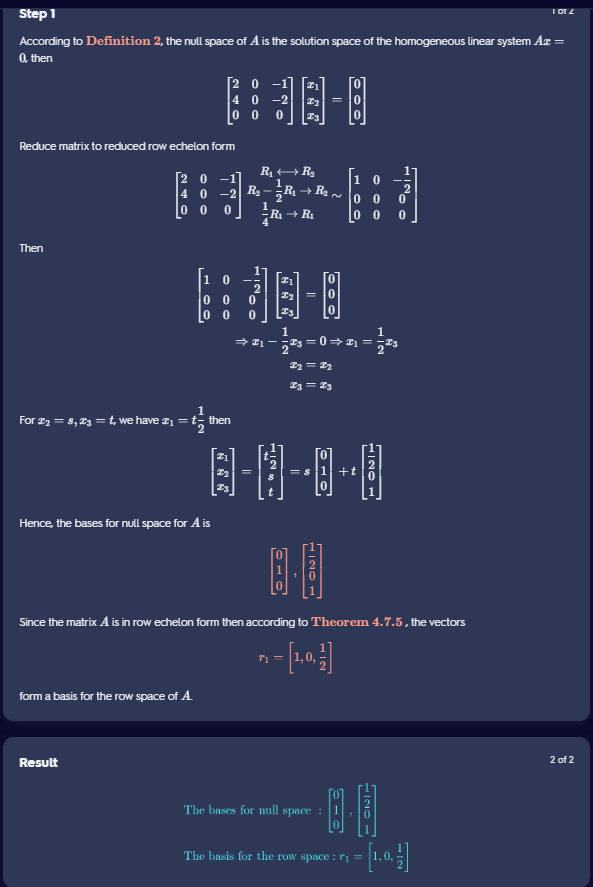
Find bases for the null space and row space
of A.
of A.
3
New cards

A matrix in row echelon form is given. By inspection, find a basis for the row space and for the column space of that matrix.
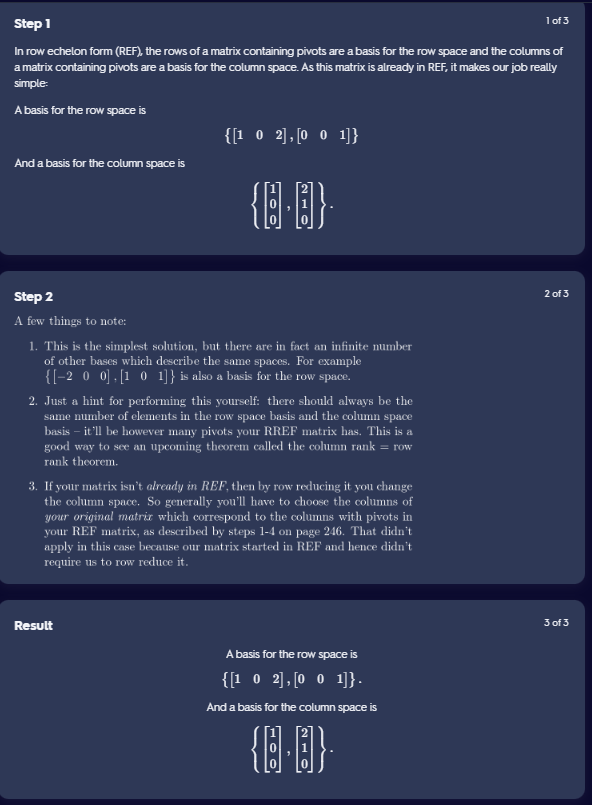
4
New cards
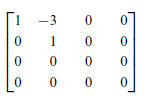
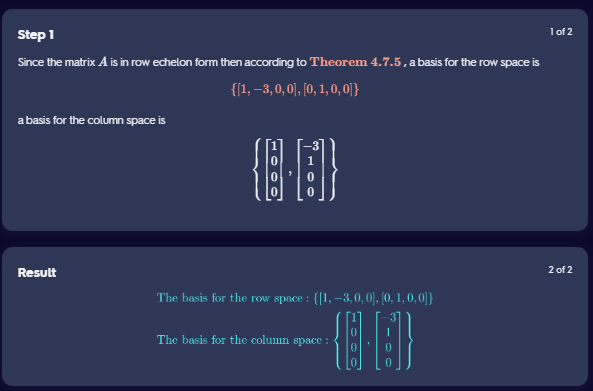
A matrix in row echelon form is given. By inspection, find a basis for the row space and for the column space of that matrix.
5
New cards

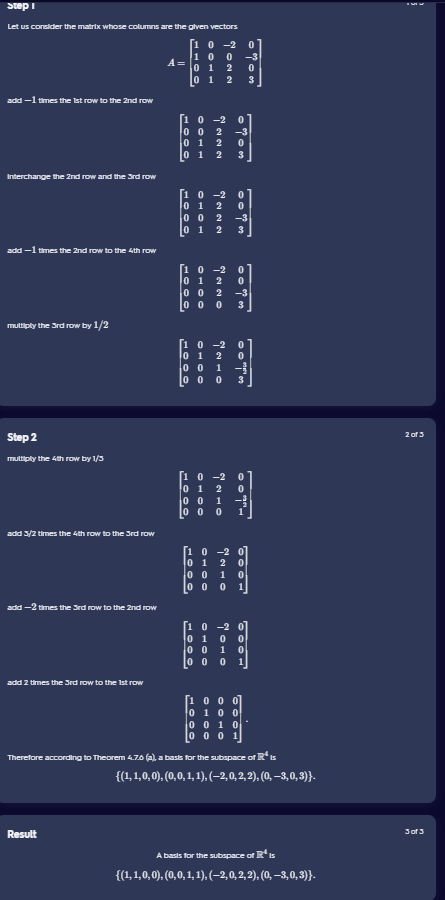
Find a basis for the subspace of R4 that is
spanned by the given vectors.
spanned by the given vectors.
6
New cards
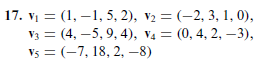
Find a subset of the given vectors that forms a basis for the space spanned by those vectors, and then express each vector that is not in the basis as a linear combination of the basis vectors.

7
New cards
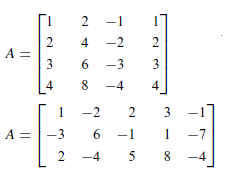
Find the rank and nullity of the matrix A by
reducing it to row echelon form.
reducing it to row echelon form.
rank(A) = 1, nullity(A) = 3
8
New cards
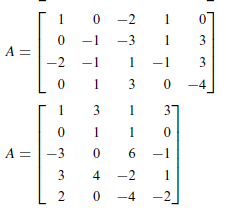
Find the rank and nullity of the matrix A by
reducing it to row echelon form.
reducing it to row echelon form.
rank(A) = 2, nullity(A) = 3
9
New cards
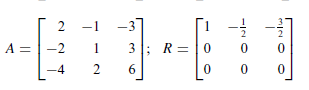
The matrix R is the reduced row echelon form of the matrix A.
(a) By inspection of the matrix R, find the rank and nullity
of A.
(b) Confirm that the rank and nullity satisfy Formula (4).
(c) Find the number of leading variables and the number
of parameters in the general solution of Ax = 0 without solving the system.
(a) By inspection of the matrix R, find the rank and nullity
of A.
(b) Confirm that the rank and nullity satisfy Formula (4).
(c) Find the number of leading variables and the number
of parameters in the general solution of Ax = 0 without solving the system.
a) rank(A) = 1 (this is the number of leading variables in the general solution of Ax = 0), nullity(A) = 2 (this is the number of parameters in the general solution of Ax = 0)
b) rank(A) + nullity(A) = 3
c) rank(A) = 1, nullity(A) = 2
b) rank(A) + nullity(A) = 3
c) rank(A) = 1, nullity(A) = 2
10
New cards

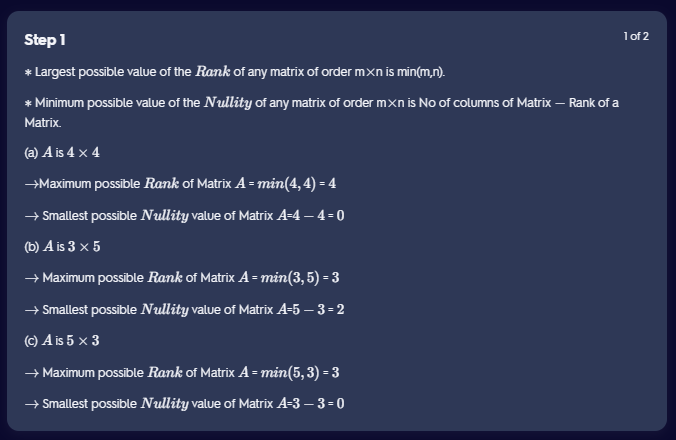
In each part, find the largest possible value for the rank of A and the smallest possible value for the nullity of A.
11
New cards
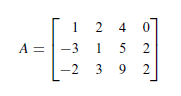
a) Find an equation relating nullity(A) and nullity(A^T).
b) Find an equation relating nullity(A) and nullity(A^T) for a general m × n matrix.
b) Find an equation relating nullity(A) and nullity(A^T) for a general m × n matrix.
a)nullity(A) = nullity(A^T) + 1
or
nullity(A) + nullity(A^T) = 3
b) nullity(A) + nullity(A^T) = m + n − 2rank(A).
or
nullity(A) + nullity(A^T) = 3
b) nullity(A) + nullity(A^T) = m + n − 2rank(A).
12
New cards
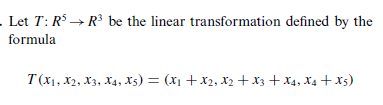
(a) Find the rank of the standard matrix for T.
(b) Find the nullity of the standard matrix for T.
(b) Find the nullity of the standard matrix for T.
a) 13
b) 2
b) 2
13
New cards
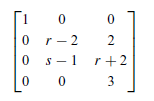
Are there values of r and s for which this matrix has rank 1? Has rank 2? If so, find those values.
r = 2, s = 1
14
New cards
(a) If A is a 3 × 5 matrix, then the number of leading 1’s in
the reduced row echelon form of A is at most _____. Why?
(b) If A is a 3 × 5 matrix, then the number of parameters in
the general solution of Ax = 0 is at most ______. Why?
(c) If A is a 5 × 3 matrix, then the number of leading 1’s in
the reduced row echelon form of A is at most ______. Why?
(d) If A is a 5 × 3 matrix, then the number of parameters in
the general solution of Ax = 0 is at most ________. Why?
the reduced row echelon form of A is at most _____. Why?
(b) If A is a 3 × 5 matrix, then the number of parameters in
the general solution of Ax = 0 is at most ______. Why?
(c) If A is a 5 × 3 matrix, then the number of leading 1’s in
the reduced row echelon form of A is at most ______. Why?
(d) If A is a 5 × 3 matrix, then the number of parameters in
the general solution of Ax = 0 is at most ________. Why?
a) If A is a 3×5 matrix, then the number of leading 1's in the reduced row echelon form of A is at most will be less than the minimum value of 3,5. The smallest value here is 3.
b) A is a 3 X 5 matrix, then the number of parameters in the general solution of Ax=0 is at most will be equal to the maximum value of 3,5. The highest value here is 5.
c)f A is a 5×3 matrix , then the number of leading 1's in the reduced row echelon form of A is at most will be less than the minimum value of 3,5. The smallest value here is 3.
d) A is a 5×3 matrix, then the number of parameters in the general solution of Ax=0 is at most will be equal to the maximum value of 3,5. The highest value here is 3.
b) A is a 3 X 5 matrix, then the number of parameters in the general solution of Ax=0 is at most will be equal to the maximum value of 3,5. The highest value here is 5.
c)f A is a 5×3 matrix , then the number of leading 1's in the reduced row echelon form of A is at most will be less than the minimum value of 3,5. The smallest value here is 3.
d) A is a 5×3 matrix, then the number of parameters in the general solution of Ax=0 is at most will be equal to the maximum value of 3,5. The highest value here is 3.
15
New cards
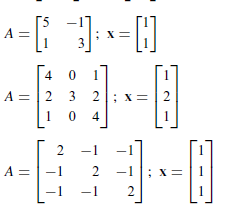
Confirm by multiplication that x is an eigenvector of A, and find the corresponding eigenvalue.
1. The vector x is indeed an eigenvector of A corresponding to the eigenvalue 4.
2. The resulting vector is indeed the eigenvector and it corresponds to the eigenvalue 5.
3. x is indeed an eigenvector of A and the corresponding eigenvalue is 0.
2. The resulting vector is indeed the eigenvector and it corresponds to the eigenvalue 5.
3. x is indeed an eigenvector of A and the corresponding eigenvalue is 0.
16
New cards

Find the characteristic equation, the eigenvalues, and bases for the eigenspaces of the matrix.
lambda^2 - 4lambda - 5 = 0, Eigenvalues are -1 and 5, Basis are [-2 -4][-2 -4] and [4 -4][-2 2].
17
New cards
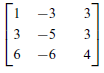
Find the characteristic equation, the eigenvalues, and bases for the eigenspaces of the matrix.
Characteristic Equation: lambda^3 - 12lamba^2-16=0
Eigenvalues: -2, -2, 4.
Eigenvalue: -2, Eigenvector: [1][1][0], [-1][0][1].
Eigenvalue: 4, Eigenvector: [1/2][1/2][1].
Eigenvalues: -2, -2, 4.
Eigenvalue: -2, Eigenvector: [1][1][0], [-1][0][1].
Eigenvalue: 4, Eigenvector: [1/2][1/2][1].
18
New cards
Find the eigenvalues and a basis for each eigenspace of the linear operator defined by the stated formula. Suggestion: Work with the standard matrix for the operator.]
T(x,y) = (x+4y, 2x + 3y)
T(x,y) = (x+4y, 2x + 3y)
Characteristic Equation: lambda^2 - 4lambda - 5 = 0
Eigenvalues: -1, 5.
Eigenvalue: 5, Eigenvector: [1][1].
Eigenvalue: -1, Eigenvector: [-2][1].
Eigenvalues: -1, 5.
Eigenvalue: 5, Eigenvector: [1][1].
Eigenvalue: -1, Eigenvector: [-2][1].
19
New cards
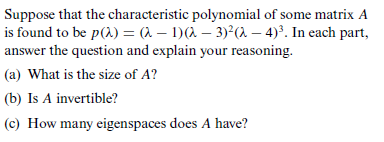
(a) Size of A is 6 X 6.
(b) A is invertible.
(c) A has 3 eigenspaces.
(b) A is invertible.
(c) A has 3 eigenspaces.
20
New cards
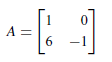
Find a matrix P that diagonalizes A, and check your work by computing P^−1AP .
[2 0 0][0 3 0][0 0 3]
21
New cards
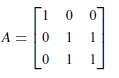
Find a matrix P that diagonalizes A, and check your work by computing P^−1AP .
[0 0 0][0 1 0][0 0 2]
22
New cards
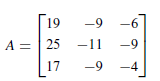
Find the geometric and algebraic multiplicity of each eigenvalue of the matrix A, and determine whether A is diagonalizable. If A is diagonalizable, then find a matrix P that diagonalizes A, and find P^−1AP.
The eigenvalues of the matrix A is 1 with algebraic multiplicity 2 and eigenvalue 1 with algebraic multiplicity 1.
Since lanba = 1 has one corresponding eigenvector, its geometric multiplicity is 1, but its algebraic multiplicity is 2, so this matrix is not diagonalizable.
**Denote that the matrix A is diagonalizable if and only if the algebraic and geometric multiplicities of each eigenvalues are equal.
Since lanba = 1 has one corresponding eigenvector, its geometric multiplicity is 1, but its algebraic multiplicity is 2, so this matrix is not diagonalizable.
**Denote that the matrix A is diagonalizable if and only if the algebraic and geometric multiplicities of each eigenvalues are equal.
23
New cards
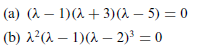
Find the size of the matrix and the possible dimensions of its eigenspaces.
a) A is a 3 X 3 matrix w/ a dimension of 1.
b) dim(A0) = 1, 2; dim(A1) = 1; dim(A2) = 1, 2, 3;
**The roots of this equation are eigenvalues of the matrix A.
b) dim(A0) = 1, 2; dim(A1) = 1; dim(A2) = 1, 2, 3;
**The roots of this equation are eigenvalues of the matrix A.
24
New cards
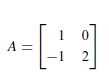
Use the method of Example 6 to compute the matrix A^10.

25
New cards
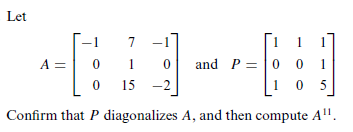
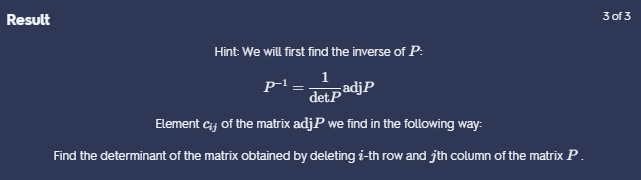
Confirm that P diagonalizes A, and then compute A^11.
26
New cards
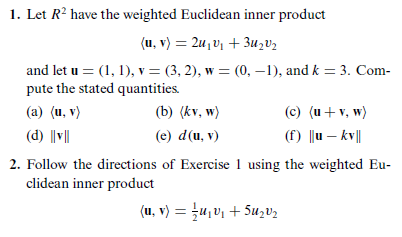
1.
a) 12
b) -18
c) -9
d. sqrt(30)
e) sqrt(11)
f) sqrt(203) when k = 3.
2. d(u,v) = sqrt(157)
a) 12
b) -18
c) -9
d. sqrt(30)
e) sqrt(11)
f) sqrt(203) when k = 3.
2. d(u,v) = sqrt(157)
27
New cards

Find the standard inner product on P2 of the given polynomial.
-29
28
New cards

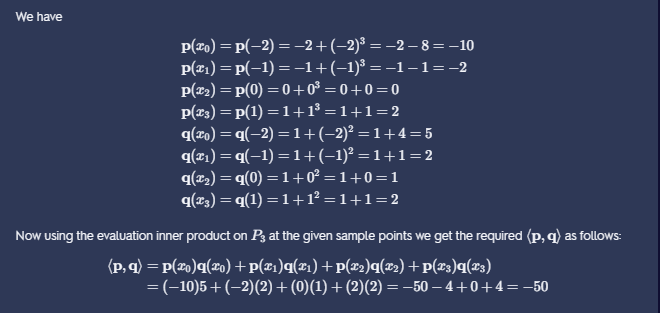
A sequence of sample points is given. Use the evaluation inner product on P3 at those sample points to find <p, q> for the polynomials (image).
x0 = −2, x1 = −1, x2 = 0, x3 = 1
x0 = −2, x1 = −1, x2 = 0, x3 = 1
-50
29
New cards
Determine whether the vectors are orthogonal with respect to the Euclidean inner product.
a) u = (−1, 3, 2), v = (4, 2,−1)
(b) u = (−4, 6,−10, 1), v = (2, 1,−2, 9)
a) u = (−1, 3, 2), v = (4, 2,−1)
(b) u = (−4, 6,−10, 1), v = (2, 1,−2, 9)
a) Since <u,v> = 0, therefore u and v are orthogonal with respect to the Euclidean inner product.
b) Since ⟨u,v⟩ = 27 is NOT EQUAL TO 0 therefore u and v are not orthogonal with respect to the Euclidean inner product.
b) Since ⟨u,v⟩ = 27 is NOT EQUAL TO 0 therefore u and v are not orthogonal with respect to the Euclidean inner product.
30
New cards
If the vectors u = (1, 2) and v = (2,−4) are orthogonal
with respect to the weighted Euclidean inner product
<u, v> = w1u1v1 + w2u2v2, what must be true of the weights w1 and w2?
with respect to the weighted Euclidean inner product
<u, v> = w1u1v1 + w2u2v2, what must be true of the weights w1 and w2?
w1 − 4w2 = 0 with w1 and w2, both positive.
31
New cards
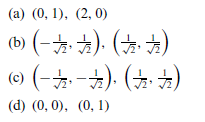
In each part, determine whether the set of vectors is orthogonal and whether it is orthonormal with respect to the Euclidean inner product on R2.
a) S is orthogonal but not orthonormal.
b) S is an orthogonal set and an orthonormal set.
c) S is not orthogonal and not orthonormal.
d) S is orthogonal but not orthonormal.
b) S is an orthogonal set and an orthonormal set.
c) S is not orthogonal and not orthonormal.
d) S is orthogonal but not orthonormal.
32
New cards
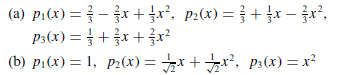
In each part, determine whether the set of vectors is orthogonal with respect to the standard inner product on P2.
a) p1, p2, p3 are orthonormal with respect to the inner product.
b) p1, p2, p3are not orthonormal with respect to the inner product.
b) p1, p2, p3are not orthonormal with respect to the inner product.
33
New cards
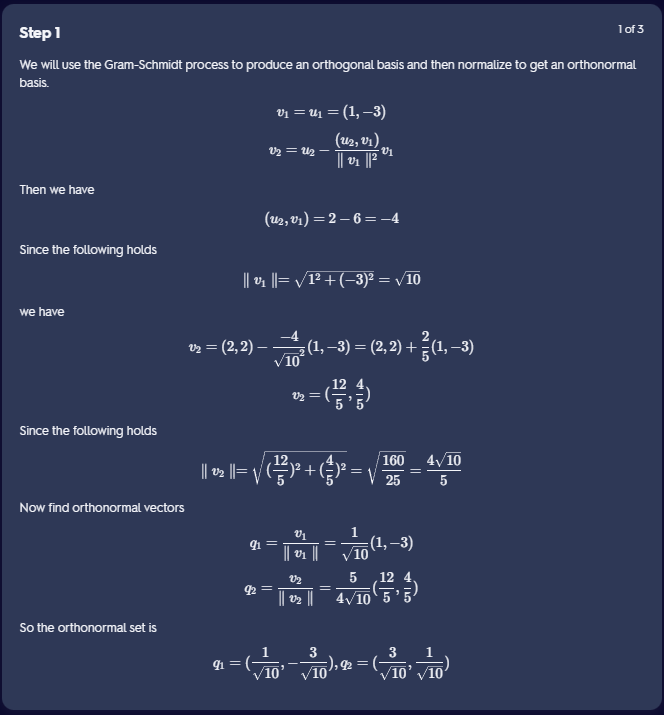
Let R2 have the Euclidean inner product and use the Gram–Schmidt process to transform the basis {u1, u2} into an orthonormal basis. Draw both sets of basis vectors in the xy-plane.
u1 = (1, -3), u2 = (2, 2)
u1 = (1, -3), u2 = (2, 2)
34
New cards
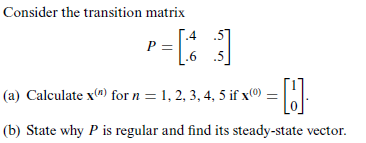
b) x = (5/11, 6/11)

35
New cards

Find the steady-state vector of the following regular transition matrix:
x = (26/45, 19/45)
36
New cards
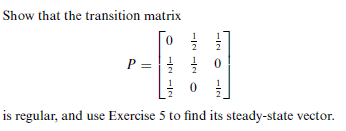
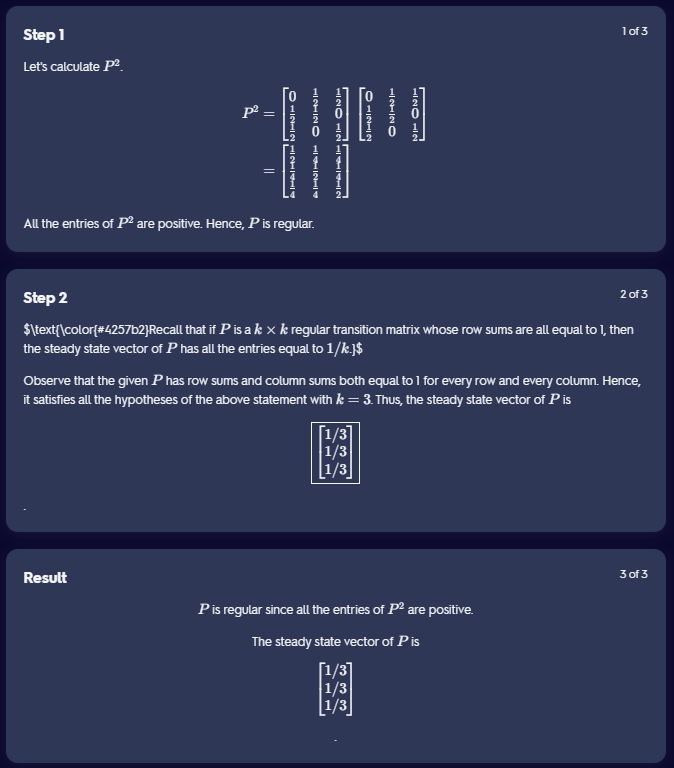
Show that this matrix is regular.
37
New cards
John is either happy or sad. If he is happy one day, then he is happy the next day four times out of five. If he is sad one day, then he is sad the next day one time out of three. Over the long term, what are the chances that John is happy on any given day?
Transition Matrix is P = [4/5 2/3][1/5 1/3].
Since we want to find the probability of J being happy or sad over a long period of time, we need to calculate the steady state vector of P.
x = [10/13][3/13]
After a long period of time, the probabilities that J is happy on a day is 10/13 and that he is sad is 3/13.
Since we want to find the probability of J being happy or sad over a long period of time, we need to calculate the steady state vector of P.
x = [10/13][3/13]
After a long period of time, the probabilities that J is happy on a day is 10/13 and that he is sad is 3/13.