Chapter 2: Protein Composition and Structure
 Call Kai
 Learn
Learn Practice Test
 Spaced Repetition
 Match
Match Flashcards
 Knowt Play
1/43

Earn XP
Description and Tags
Exam 1
Name | Mastery | Learn | Test | Matching | Spaced | Call with Kai | Chat |
|---|
No analytics yet
Send a link to your students to track their progress
44 Terms
Amino acid
An organic compound containing an amino group, a carboxyl group, and a unique functional group that are each bonded to a common carbon atom
Alpha carbon (-carbon)
The central carbon of an amino acid, linked to an amino group, a carboxylic acid group, a hydrogen atom, and a side chain.
Side chain/R group
The distinctive variable group bonded to the α-carbon atom of an amino acid
Chiral
The property of asymmetry in which a structure and its mirror image are not superimposable
Dipolar ion/zwitterion
an ion carrying both a positive and a negative charge
Peptide bond/amide bond
covalent linkage formed between the alpha-carboxyl group of one amino acid and the alpha-amino group of another
residue
each amino acid unit in a polypeptide
main chain/backbone
regularly repeating part of a polypeptide including the amino group, alpha-carbon and carbonyl groups
protein
a biological macromolecule built of chains of amino acids
Oligopeptide/peptide
polypeptide chains made of small numbers of amino acids
Dalton
A unit of mass equal to one atomic mass unit, or very nearly equal to that of a hydrogen atom
amino acids w/ionizable side chains
aspartic acid/aspartate
glutamic acid/glutamate
lysine
arginine
histidine
cysteine
tyrosine
disulfide bond
covalent bond formed by the oxidation of 2 sulfhydryl groups
primary structure
amino acid sequence of a protein
Torsion angle/dihedral angle
measure of the rotation about a bond
Ramachandran plot
demonstrates possible psi and phi values due to steric collisions between atoms
phi
angle of rotation around the N-C alpha bond
psi
angle of rotation around the C alpha - C bond
secondary structure
the spatial arrangement of amino acid residues that are near one another in the linear sequence
due to regular pattern of h-bonding of backbone N-H and O=C
alpha-helix
a tightly coiled backbone forms the inner part of the rod and the side chains extended outward in a helical array
h-bond pattern is i + 4
1.5 A rise, 3.6 residues per turn (every 3-4 AA)
beta-pleated sheet (beta-sheet)
composed of 2+ polypeptide chains called beta-strands lying next to one another through hydrogen bonds
3.5 A between adjacent residues
side chains in opposite direction
can be parallel or anti-parallel
beta strand
A polypeptide chain that is almost fully extended rather than being tightly coiled as in the α helix
parallel h-bonding
slightly distorted/angled h-bond, 1 amino acid from strand A h-bonds to 2 amino acids on strand B
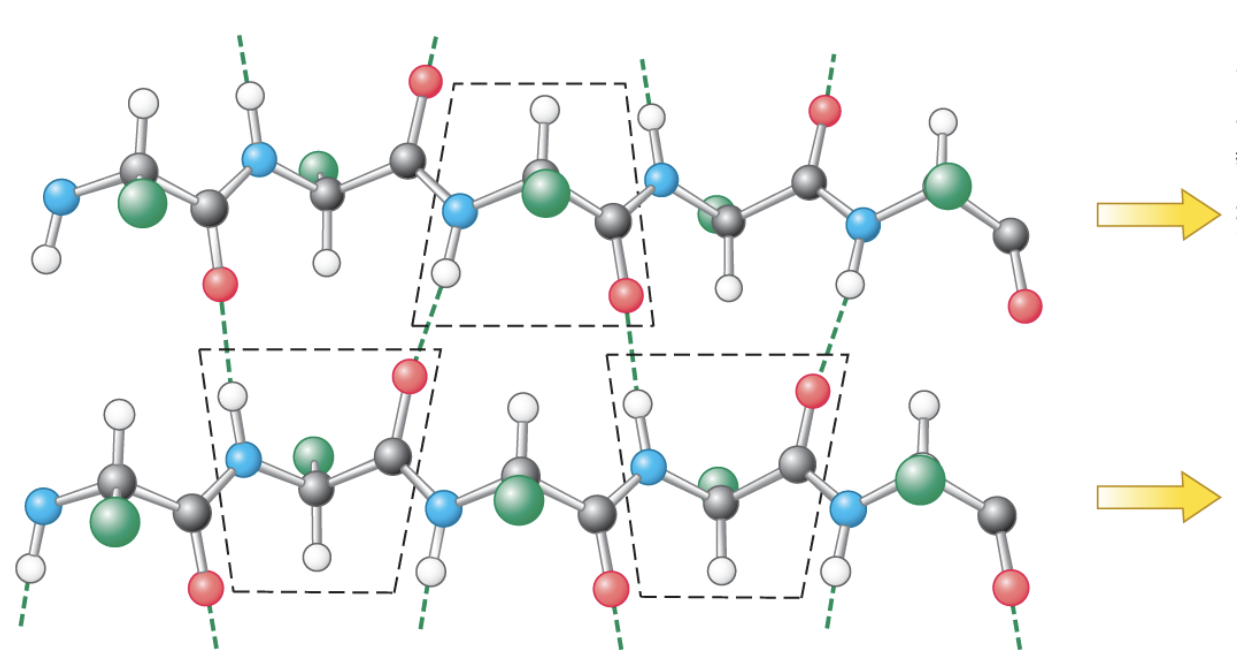
antiparallel h-bonding
virtually straight h-bonds between strands, 1 amino acid on strand A h-bonds 1 amino acid on strand B
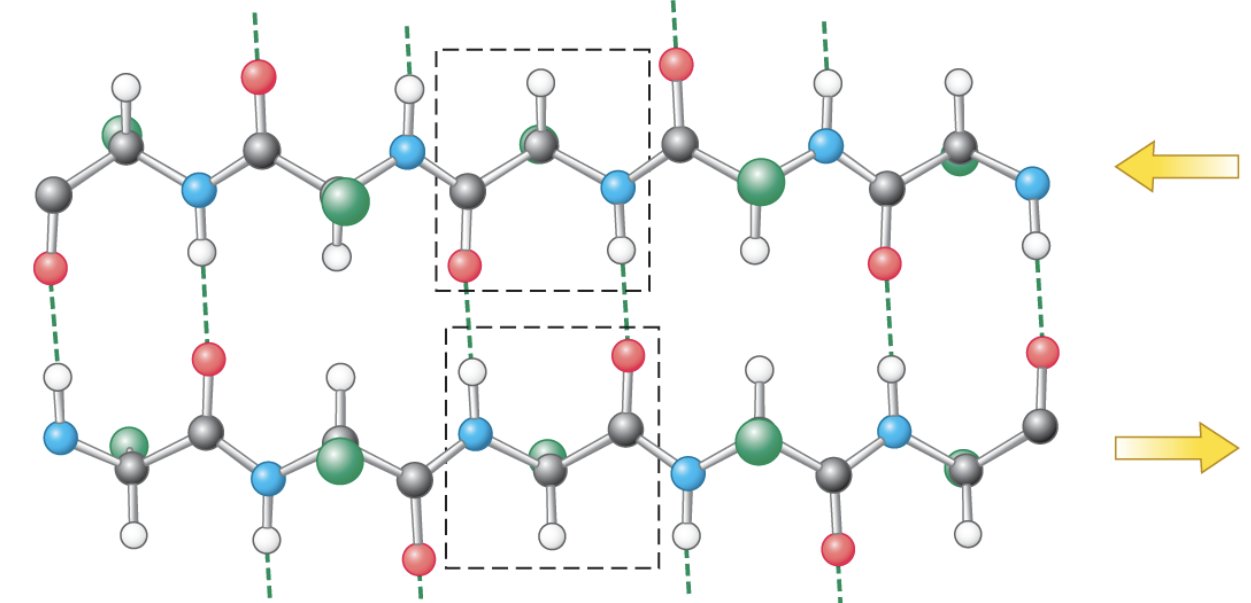
Reverse turn/beta turn/hairpin turn
a short segment of residues where the polypeptide chain reverses direction

loop
a segment of residues where the polypeptide chain reverses direction, usually longer and more elaborate than a reverse turn
tertiary structure
the overall course of the polypeptide chain (3D folding)
globular protein
a protein that forms a tightly packed structure, usually water soluble and devoid of overall symmetry
protein folding is driven by hydrophobic effect
myoglobin
interior consists of non-polar residues
outside consists of both NP and P residues
amphipathic
have both hydrophobic/polar side + hydrophilic/non-polar side
Motif/supersecondary structure
certain combinations of secondary structure present in many proteins which frequently exhibit similar functions
patterns of secondary structure in tertiary structure
ex: helix-turn-helix
domain
an independently folded unit in the tertiary structure of a polypeptide chain, often connected to other similar regions by a flexible polypeptide segment

fibrous protein
a protein that adopts a long, extended structure with repeated sequences
structural/support role
insoluble
use special type of helices that facilitate formation of long fibers that serve a structural role
alpha-keratin
single alpha-keratin polypeptide strand is an alpha-helix
2 right-handed alpha-helices intertwined to form a left handed coiled-coil
contains a heptad repeat b/c 3.5 residues per turn (instead of 3.6)
collagen
rod-shaped
single polypeptide contains left-handed helical structure
3 helical polypeptide chains wrap around each other to form right-handed superhelix
lacks hydrogen bonding
proline and hydroproline help stabilize structure
quaternary structure
proteins containing more than one polypeptide chain
subunit
individual polypeptide chain within a protein that contains multiple chains
denatured protein
a protein that has lost its natural three-dimensional shape and biological function due to external stress, but keeps its primary sequence of amino acids intact
native protein
a protein in its original active and folded form
cooperative transition
post-translational modification
covalent chemical changes made to a protein after it has been translated from mRNA
Valine and isoleucine tend to be present in β strands
Branching at the β-carbon atom tends to destabilize α helices because of steric clashes
Cooperative transition
In protein folding, an “all-or-none” process where conditions that lead to the disruption of any part of a protein structure are likely to unravel the entire protein completely