Physics BC - Kinematics
 Call Kai
 Learn
Learn Practice Test
 Spaced Repetition
 Match
Match Flashcards
 Knowt Play
1/17

There's no tags or description
Looks like no tags are added yet.
Name | Mastery | Learn | Test | Matching | Spaced | Call with Kai | Chat |
|---|
No analytics yet
Send a link to your students to track their progress
18 Terms
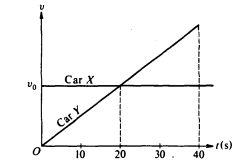
At time t = 0, car X traveling with speed v0 passes car Y. which is just starting to move. Both cars then travel on two parallel lanes of the same straight road. The graphs of speed v versus time t for both cars are shown above.
2. Which of the following is true at time t = 20 seconds? (A) Car Y is behind car X. (B) Car Y is passing car X. (C) Car Y is in front of car X. ( D) Both cars have the same acceleration. (E) Car X is accelerating faster than car Y.
Answer: A.
The cars were at the same spot at t = 0; we might as well call this the origin. The distance traveled by each during the next 20 seconds is the integral of v with respect to t; it is the area under the curve. Car X has traveled twice as far as Car Y in this time, because the rectangle has twice the area of the triangle.
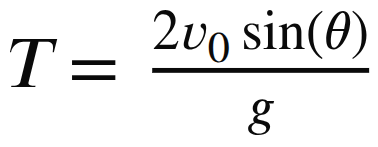
Time of flight equation
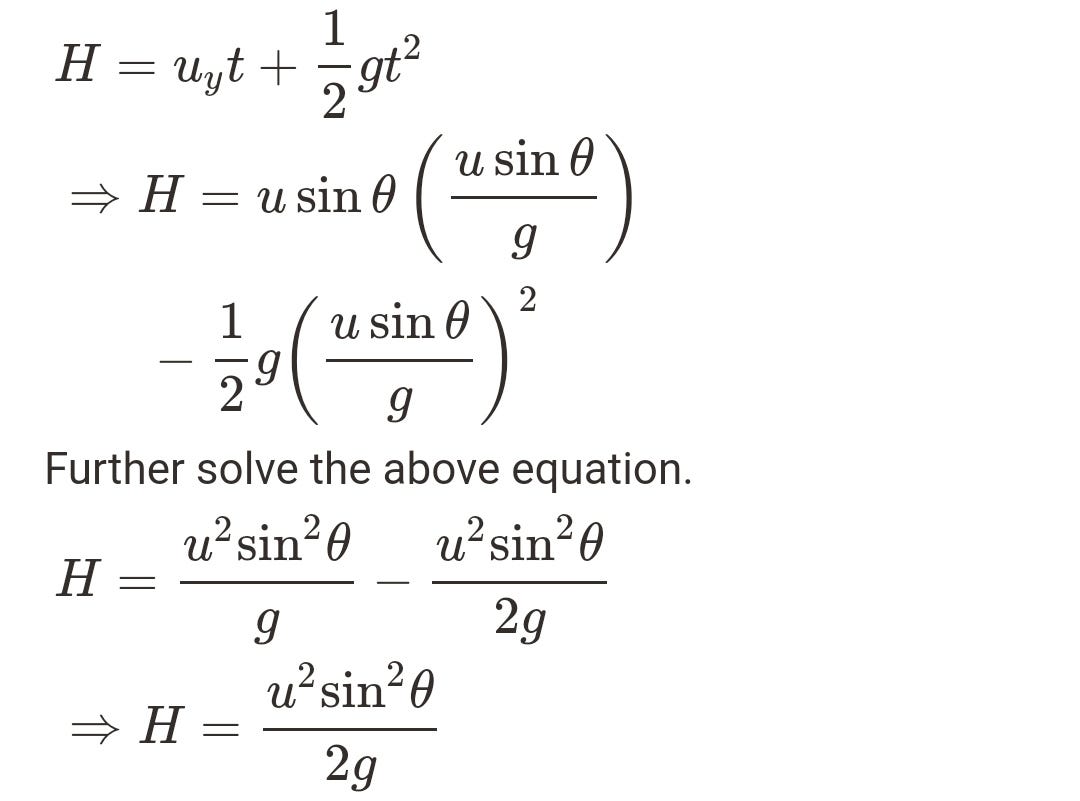
maximum height equation
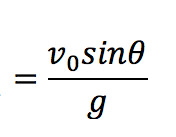
time of maximum height equation
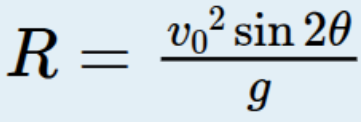
maximum horizontal range equation
An object released from rest at time t = 0 slides down a frictionless incline a distance of 1 meter during the first second. The distance traveled by the object during the time interval from t = 1 second to t = 2 seconds is
(A) 1 m (B) 2 m (C) 3 m (D) 4m (E) 5 m
Since under uniform acceleration x is proportional to t^2 , if the object travels 1m in 1 second, it C should travel 4 m in 2 seconds. Which means from the time 1 to 2 seconds, the object traveled the additional 3 m.
Solve for acceleration first using displacement equation from t = 0 - 1, then solve for total displacement from t = 0-2, and finally subtract 4 - 1. The answer is 3m (C).
A body moving in the positive x direction passes the origin at time t = 0. Between t = 0 and t = 1 second, the body has a constant speed of 24 meters per second. At t = 1 second, the body is given a constant acceleration of 6 meters per second squared in the negative x direction. The position x of the body at t = 11 seconds is
(A) +99 m (B) +36 m (C) -36 m (D) -75 m (E) -99 m
Solve for x1, multiplying v0t gives you (24 m/s)(1 s) = 24 m. Since acceleration begins @ t = 1s, the duration of the 2nd phase is 11-1 = 10s. Plugging into the equation, you get 24 + 24(10) + ½ (-6)(10), giving x = -36m (C).
Two people are in a boat that is capable of a maximum speed of 5 kilometers per hour in still water, and wish to cross a river 1 kilometer wide to a point directly across from their starting point. If the speed of the water in the river is 5 kilometers per hour, how much time is required for the crossing?
(A) 0.05 hr (B) 0.1 hr (C) 1 hr (D) 10 hr (E) The point directly across from the starting point cannot be reached under these conditions.
In order to travel directly across a river, the boat’s velocity must have a component that cnacels the river’s current. In order to do this, the boat must point directly upstream. This leaves no way for the boat to have any component of its velocity across the river and hence, cannot make the trip.
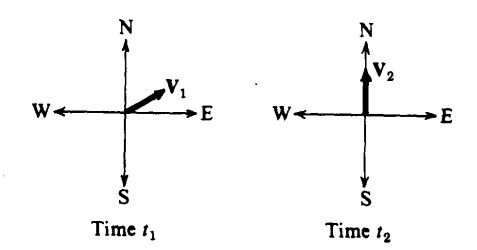
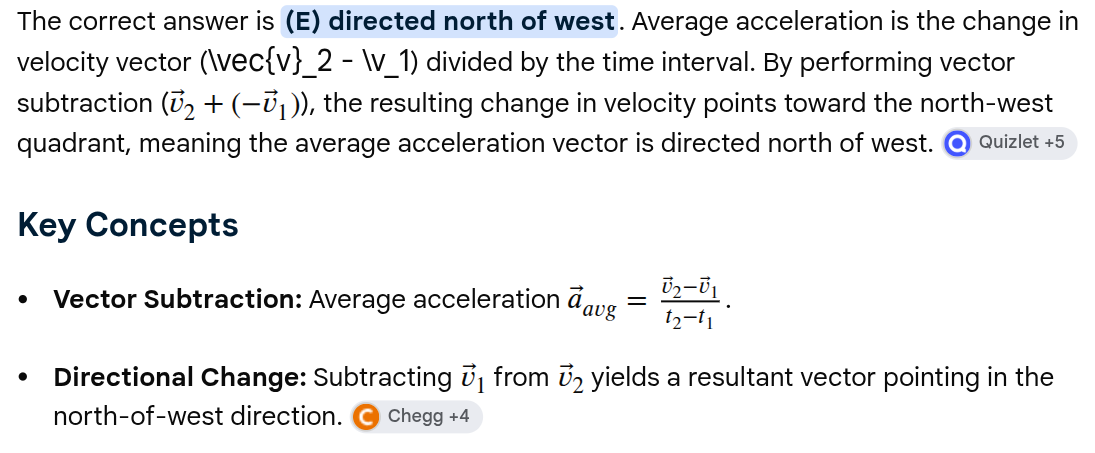
Vectors V1 and V2 shown above have equal magnitudes. The vectors represent the velocities of an object at times t1, and t2, respectively. The average acceleration of the object between time t1 and t2 was
(A) zero (B) directed north (C) directed west (D) directed north of east (E) directed north of west
E.
A projectile is fired from the surface of the Earth with a speed of 200 meters per second at an angle of 30° above the horizontal. If the ground is level, what is the maximum height reached by the projectile?
(A) 5 m (B) 10 m (C) 500 m (D) 1,000 m (E) 2,000 m
C.
See formula for maximum height.
A particle moves along the x-axis with a nonconstant acceleration described by a = 12t, where a is in meters per second squared and t is in seconds. If the particle starts from rest so that its speed v and position x are zero when t = 0, where is it located when t = 2 seconds?
(A) x = 12 m (B) x = 16m (C) x = 24 m (D) x = 32 m (E) x = 48 m
B.
v(t) is the integral of a(t) and x(t) is the integral of v(t). Integrating the given function twice and plugging in the initial conditions gives x = 2t³
An object moving in a straight line has a velocity v in meters per second that varies with time t in seconds according to the following function. v = 4 + 0.5 t².
The instantaneous acceleration of the object at t = 2 seconds is
(A) 2 m/s² (B) 4 m/s² (C) 5 m/s² (D) 6 m/s² (E) 8 m/s²
A
a = dv/dt = t
An object moving in a straight line has a velocity v in meters per second that varies with time t in seconds according to the following function. v = 4 + 0.5 t².
The displacement of the object between t = 0 and t = 6 seconds is
(A) 22 m (B) 28 m (C) 40 m (D) 42 m (E) 60 m
E
x is the integral of v, which gives x = 4t + t³/6
A rock is dropped from the top of a 45-meter tower, and at the same time a ball is thrown from the top of the tower in a horizontal direction. Air resistance is negligible. The ball and the rock hit the level ground a distance of 30 meters apart. The horizontal velocity of the ball thrown was most nearly
(A) 5 m/s (B) 10 m/s (C) 14.1 m/s (D) 20 m/s (E) 28.3 m/s
B
y = ½ at², remember, for horizontal projectiles v0y = 0. Since the cliff is 45 m high, the rocks B take 3 seconds to strike the ground. In this time, the rock thrown horizontally travelled 30 m. v = x/t
In the absence of air friction, an object dropped near the surface of the Earth experiences a constant acceleration of about 9.8 m/s2. This means that the
(A) speed of the object increases 9.8 m/s during each second
(B) speed of the object as it falls is 9.8 m/s
(C) object falls 9.8 meters during each second
(D) object falls 9.8 meters during the first second only
(E) derivative of the distance with respect to time for the object equals 9.8 m/s2
A
9.8 m/s² can also be stated as 9.8 meters per second, per second
A 500-kilogram sports car accelerates uniformly from rest, reaching a speed of 30 meters per second in 6 seconds. During the 6 seconds, the car has traveled a distance of
(A) 15 m (B) 30 m (C) 60 m (D) 90 m (E) 180 m
D
using v = v0 + at, we get a = 5 m/s².
using x-x0 = v0t + ½ at², plugging in values, we get 90 m.

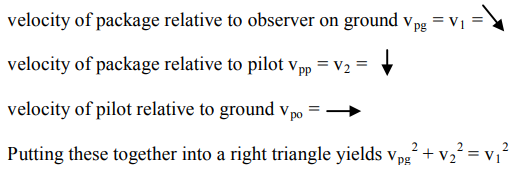
At a particular instant, a stationary observer on the ground sees a package falling with speed v1 at an angle to the vertical. To a pilot flying horizontally at constant speed relative to the ground, the package appears to be falling vertically with a speed v2 at that instant. What is the speed of the pilot relative to the ground?
D
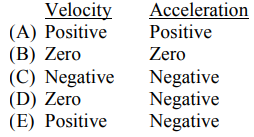
An object is shot vertically upward into the air with a positive initial velocity. Which of the following correctly describes the velocity and acceleration of the object at its maximum elevation?
D
While the object momentarily stops at its peak, it never stops accelerating downward.